
Cloud Adoption : Major Challenges

How to transition to a cloud-based analytics environment

Since the start of the pandemic, digital transformation has accelerated as more businesses see the need to adopt advanced technologies and do so quickly. Providing ways to propel businesses forward, adapt to new ways of working and cut-costs, digital transformation has many benefits. Cloud adoption, while a necessary element of that transformation, is not without its challenges. Before migration takes place, companies need to know what the main challenges are. Here, we explain.

Security in the cloud

What is cloud security? | Kaspersky

Cloud services, in themselves, are exceptionally secure. All cloud providers have to comply with stringent regulations and this requires them to put robust security measures in place, including the use of strict protocols and advanced security tools. However, companies still have concerns about multi-tenancy and data location.

Multi-tenancy can be a compliance issue for some organisations which hold sensitive data. The problem can be overcome by storing the data in a single-tenancy private cloud where they have dedicated use of the underlying hardware.

Data location is an issue for organisations which store data protected by regulations such as GDPR. Using a cloud provider that migrates data or backups between countries, puts the data at risk of being kept in a nation that doesn’t comply with those regulations. For example, EU citizen data is protected by GDPR, however, if it is stored on servers in the US, the government there has legal access to it for national security purposes. If it is accessed, the organisation will be in breach of compliance. The easy solution here is to opt for a cloud provider which locates all its datacentres in a single country, as Anteelo does in the UK.

Cost management

What Does a Successful Cost Management Program Look Like? | Clarizen

One of the biggest advantages of the cloud is the ability to reduce capital expenditure on hardware and in-house datacentres. The other financial advantage is that cloud resources are chargeable on a pay per use basis, enabling companies to scale up and down quickly so that costs can be minimised.

The financial risks here depend on how well a company manages its use of the cloud. Poorly managed, it is easy for the use of these on-demand resources to spiral and this can be costly. Companies need to implement use policies, monitor cloud usage and carefully analyse where the money is being spent.

Lack of IT expertise

Is the hybrid cloud's biggest challenge a lack of expertise? | CIO

Migration to the cloud not only presents a new type of infrastructure to an organisation; it also puts a host of new technologies at their disposal. While the benefits of using these are the prime reason for cloud adoption, one of the challenges faced by most companies is developing the expertise to make use of them.

Organisations adopting the cloud need a clear understanding of what they want to use it for and make sure they have the necessary expertise to help them meet their objectives. This could require the training of current staff or the recruitment of new ones.

Thankfully, many providers offer managed services and 24/7 technical support. There is also a wide range of tools which automate many of the tasks which not so long ago required expert manual input.

Multi-clouds and hybrid clouds
Pros of a Multi-Cloud Strategy – Xorlogics

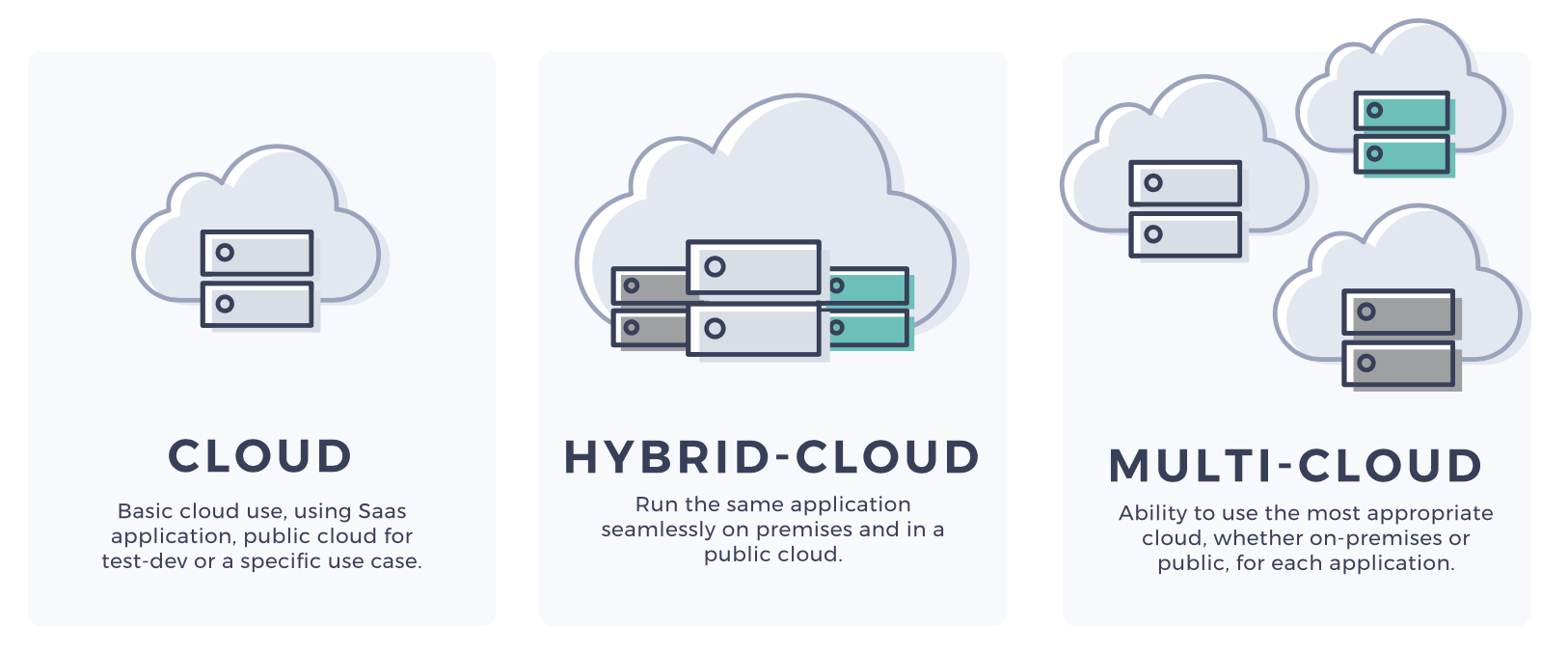
Over 80% of companies now use more than one cloud provider, some as many as five, to carry out different workloads. The reasons for this are numerous, but it boils down to choosing the most appropriate vendor for the specific workload being undertaken. At the same time, there is an increasing number of businesses developing hybrid-clouds, a mixture of public and private clouds together with dedicated servers.

While multi-cloud and hybrid cloud can be beneficial for financial, operational and compliance purposes, they add to the complexity of an organisation’s overall infrastructure. Here, there will be a greater need for governance, monitoring, expertise and security.

Migration

Step-by-Step Cloud Migration Checklist | by Manisha Mishra | DataDrivenInvestor

While the points above discuss the challenges of cloud adoption, the migration itself can also cause problems. A cloud environment can be markedly different from the one on which an application is hosted in-house. Issues with operating system compatibility and system configuration may mean an application might not work, or work as expected, in a cloud environment. Resolving these issues can have an impact on the speed of migration, project deadlines and budgets.

Thankfully, there are a wide and growing range of applications, many of them open-source, that have been developed for cloud environments, are quickly deployable and work straight out of the box.

The key to a smooth and speedy migration, however, is to find a vendor with the expertise and technical support to help you manage the migration process.

Conclusion

The pandemic has accelerated the pace of digital transformation across the globe with unprecedented numbers of companies migrating to and expanding workloads in the cloud. While for many organisations, this is a necessary part of the ‘new normal’, they should not underestimate the challenges that cloud adoption presents. The best way to prevent issues is to work closely with a cloud provider that will get to know your company and put tailored solutions in place for you.


Why Are So Many Small Businesses Adopting Cloud in 2020?

Six reasons why COVID-19 will accelerate the rush to cloud - Intelligent CIO Middle East

The impact of the pandemic has led to a dramatic rise in the number of small businesses adopting cloud technology. With nine out of ten companies now making use of cloud IT and 60 per cent of workloads being run in the cloud, it has become the go-to option for forward-thinking firms. By providing them with the same technologies used by larger rivals, but without the need for capital investment, the cloud delivers an affordable way to innovate, automate and become more agile. Here are just some of the ways small businesses are benefitting from cloud adoption.

Awesome power at low-cost

4 Tips For Low Cost Video Production - Bold Content Video Production

In the age of digital transformation, companies need hi-tech solutions to help them compete. While technologies such as data analytics, AI, machine learning, IoT and automation are widely used, a lack of financial resources has left many smaller businesses out of the loop. However, by migrating to the cloud, companies can have access to the necessary infrastructure without having to invest heavily in setting up an on-site datacentre. All the hardware is provided by the service provider and paid for on a pay-as-you-go basis.

Furthermore, the cloud offers the ideal set-up for fast and easy expansion, enabling companies to scale up or down their IT resources on-demand, helping them to increase capacity in line with growth and cope with spikes in demand in a convenient way. Expansion that would take considerable expenditure and days of work to set up in-house, can be had cost-effectively at the click of a button.

New normal adaptation

Adapting to a new world

The pandemic has led many companies to reassess the way they operate, especially with regard to their working practices. Across the globe, swathes of employees are finding themselves able to ditch the commute and work more flexibly from home as executives seek to downsize offices.

Cloud technology is a key enabler of remote working, giving employees the ability to access the company’s IT resources anywhere with an internet connection. Firms can also make use of software as a service (SaaS) packages, providing them with a multitude of business applications, such as Microsoft 365, with which to carry out their work.

These technologies enable employers to offer flexible hours, recruit staff from further afield and reduce office occupancy. What’s more, they can also monitor staff productivity and task progress, as well as tracking inventory and shipping.

Better collaboration

5 Keys to Better Collaboration in Healthcare | PreCheck

Over the course of the lockdown, the leading software companies have gone all out to improve the collaborative cloud-based applications that teams rely on. Existing apps have been enhanced and new ones created to provide far better video chat, messaging and document sharing platforms. Features such as group editing, instant syncing and project management, together with improved security, enable remote working teams to be assembled and collaborate on a wide range of initiatives.

Transformative technology in your hands  

Top 10 Digital Transformation Trends For 2020

The cloud is the ideal place to benefit from today’s must-have technologies, like artificial intelligence, data analytics and the Internet of Things. Indeed, many of these are cloud-native, with applications that can be deployed at the click of a button in a cloud environment. What’s more, a lot of these cloud-based apps are open-source, meaning that they are free to use.

This means small businesses can take advantage of the cloud immediately, accelerating their ability to benefit from data-driven insights. As a result, they can reduce costs, improve operations and discover new opportunities much quicker than before.

Solid security

Rock-Solid Security - Krimzen

While security is a concern for every business, small firms have an additional issue when it comes to providing the in-house security expertise and resources to keep their systems protected. Migration to the cloud removes many of these headaches as the service provider will undertake a great deal of this work on their customers’ behalf.

Cloud providers have to comply with stringent regulations to ensure their infrastructure is robustly secure. By migrating to the cloud, small businesses will be automatically protected by a wide range of sophisticated security tools, such as next-gen firewalls, intrusion prevention apps and malware scanners – all of which are managed and maintained by security experts.

Swift recovery

Top 10 Best Data Recovery Software That Worth Your Time (2021)

Data loss can have a devastating impact on a business: taking its services offline, preventing it from trading and damaging its reputation. Swift recovery is essential to minimise the impact.

Cloud-based backups are the ideal solution for disaster recovery: they store data at a geographically separate location to your cloud server; they are encrypted for security and checked for integrity, and they can be scheduled to occur at the frequency a company demands.

Perhaps most crucially, they enable companies to restore data, and even entire servers, quickly and easily, ensuring that disruption is kept to an absolute minimum. And with 24/7 technical support, the issue of internal expertise is easily overcome.

Conclusion

The pandemic has accelerated the pace of digital transformation, with growing numbers of small firms adopting cloud technology in order to adapt to the new business environment. Its cost-effectiveness and easy scalability, together with its wide range of open-source, easily deployable applications, make it highly attractive to companies that want to take advantage of the technologies and insights it offers.

error: Content is protected !!