Zero-Knowledge Proof & its Role in the Blockchain World

What are Zero Knowledge Proofs?. Zero-Knowledge Proofs (ZKPs) allow data… | by Shaan Ray | Towards Data Science

Over the past few years, we have become accustomed to the way large banks and other firms access and employ our personal information to deliver us an enhanced experience. We have over time given them a ‘green signal’ to the mechanisms that use our sensitive details to help us sustain in a certain way. But then entered the Blockchain technology and it totally changed everything.

The Blockchain technology brought various characteristics like transparency, immutability, decentralization, and distributed ledger into existence. It enabled users to act anonymously and perform transactions with high-end security.

[Before we look further, we strongly recommend taking the time to understand the basics of Blockchain.]

Blockchain, in simple terms, gave users control to their privacy and future back.

But, has Blockchain really succeeded in doing so?

In one word, the answer is NO.

Many blockchain networks use public databases. So, anyone having an internet connection can view the list of the network’s transaction history. They can see all the details associated with the transaction and your wallet details, but the name of the user will still be unknown to them. Instead, they will come across as a public key – the unique code representing the user on the blockchain network.

This way, the public key created via the cryptography technique safeguard your privacy to some extent. But, it is still possible for one to expose you via other techniques.

This put your anonymous cover blown; debunking the myth of Blockchain’s anonymity and privacy, and make you realize that –

The user’s sensitive information stored on a Blockchain network is only confidential, not anonymous.

Likewise, there are various blockchain networks governed by consensus algorithms to deliver high-end privacy and stability, but decentralization is considered as a second priority in such cases. In many such cases, the two parties do not trust each other. [To read about these consensus models in detail, check out this blockchain consensus algorithm guide.]

This, as a whole, gives a clear indication that Blockchain is not that anonymous and decentralized as many of its enthusiasts believe it to be. And even gives birth to various questions, such as –

Do Blockchain networks really need to be anonymous? How can Blockchain offer more anonymity and better privacy protection to their users?

In the present Blockchain networks, the transactions are recorded in the public ledger and are transparent in nature. Because of this, various reputed brands and markets like Wall Street are hesitating to adopt this technology as the confidentiality of client and transaction is a must for them. This, as a whole, is questioning if at all Blockchain web 3.0 will be able to impact businesses.

Coming to the second question, there are various concepts and methods like Coin mixing, Ringct, and Coin Join that are making transactions anonymous in Blockchain, but the one that is highly appreciated is Zero-Knowledge Proof.

The one will cover in detail in this article.

So, let’s begin with a simple definition of zero-knowledge proof.

What is Zero Knowledge Proof?
Introduction to Zero Knowledge Proof: The protocol of next generation Blockchain | by Ashish | Medium

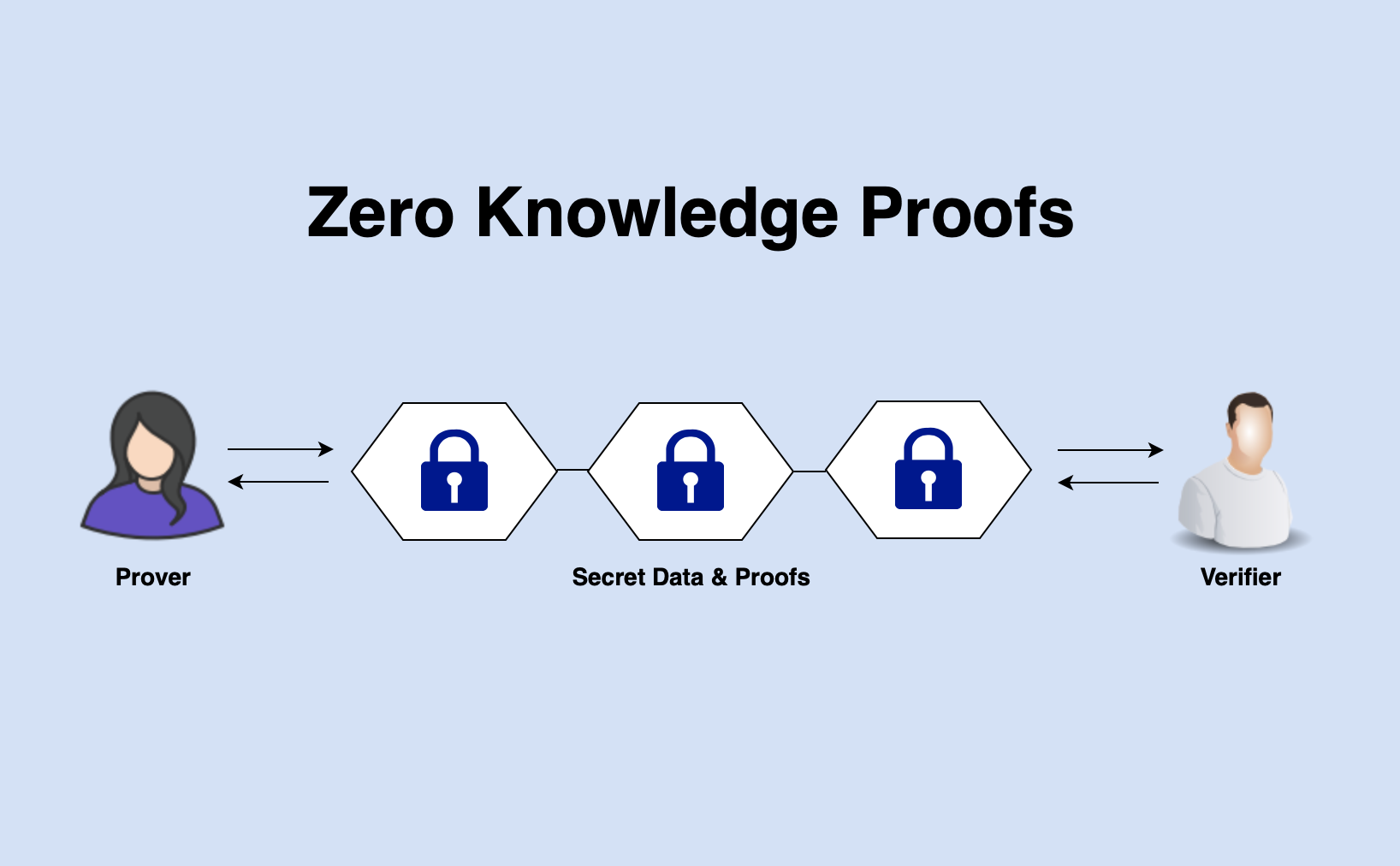
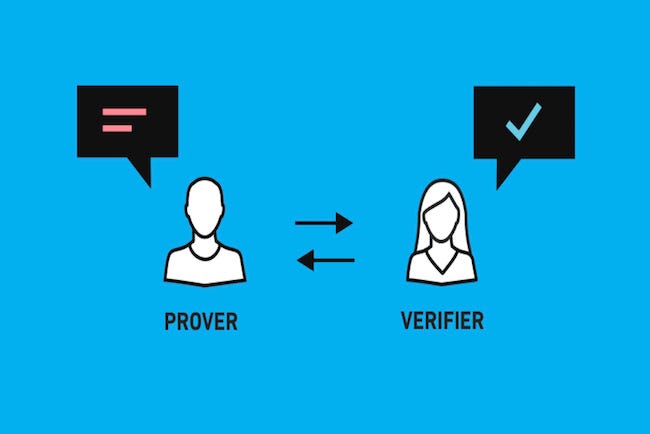
Zero-knowledge Proof is an encryption scheme proposed by MIT researchers Silvio Micali, Shafi Goldwasser, and Charles Rackoff in the 1980s. In this method, one party (Prover) can prove that a specific statement is true to the other party (Verifier) without disclosing any additional information.

With definition being cleared, let’s take an example to understand how zero knowledge proof works.

Example: Kids and Candy Bars

Suppose, two children – Bob and Alice, have received some candy bars from a party. Bob wants to know if Alice has got the same number of candy bars or not. But, at the same time, none of them is ready to reveal the exact number.

So, what they do is that Bob brings four lockable boxes in a room, assuming that the number of candy bars received will be 10, 20, 30, and 40. He labels each box with a value corresponding to the number of candy bars.

Then, Bob keeps the key to the box that defines the number of candy bars he received in his pocket (let’s say he got 30 candy bars) and throws away the keys of all other boxes. And he leaves the room.

Now, Alice enters the room with 4 small pieces of paper and writes ‘+’ on one of them while ‘-’ on every other. Here, ‘+’ denotes the number of candy bars she got, while ‘-’ represents every other value.

She slips the paper piece with ‘+’ sign in one box (let’s say in the one representing 20 candy bars) and ‘-’ in the rest of the boxes. And she leaves.

Now, Bob enters the room again and opens the box whose key is in his pocket. Then, he checks if the box has a piece of paper with ‘+’ sign or ‘-’ sign. If it’s a ‘+’ sign, he realizes that Alice has an equal number of candy bars. While, in the other case, she doesn’t.

As we know that Alice has 20 candy bars and Bob has 30 candy bars, it is clear that Bob will find a ‘-’ sign in the lockable box whose key he has. This will make him clear that they both do not have the same number of candy bars.

At the same moment, Alice will re-enter the room and find a ‘-’ sign in Bob’s hand and she will also come to know that they have a different number of candy bars.

Note: By this method, Bob will learn that they do not have an equal number of candy bars. But, he will still have no clue if Alice has more or less candy bars than him, and vice versa.

Thus, the zero-knowledge proof maintains the privacy of users’ sensitive information, while making a transaction (in this case, the transaction is finding if they have the same number of candy bars or not).

Although this example would have helped you in understanding what exactly is Zero Knowledge Proofs (ZKPs), let’s refresh the concept with an image-

Now, as the concept of zero-knowledge proofs (ZKPs) is explained, it is the best time to look into what makes everyone prefer it over other available options.

Benefits of Zero Knowledge Proofs (ZKPs)

97,491 Employee Benefits Illustrations & Clip Art

  1. Simple – One of the prime advantages of zero-knowledge proof is that it does not involve any complex encryption method.
  2. Secure – It does not require anyone to reveal any sort of information.

While these are the pros of Zero-knowledge proof, the concept has some disadvantages as well. A few of which are:-

  1. Lengthy – In the zero-knowledge method, there around 2k computations, with each requiring a certain amount of time to process. This is the foremost con of going with zero-knowledge proof.
  2. Imperfect – The messages delivered to verifier/prover might be destroyed or modified.
  3. Limited – The zero-knowledge protocol demands the secret to be a numerical value. In other cases, a translation is required.

With this covered, let’s dig deeper into the technicalities before we evaluate when and how Zero-knowledge protocols can be introduced into the Blockchain ecosystem.

Starting with what are the core characteristics of a zero-knowledge proof.

Properties of Zero-Knowledge Proofs

Zero Knowledge Protocols without magic

1. Completeness

If the statement is true and both users follow the rules religiously, then the verifier would be convinced without any external help.

2. Soundness

If the statement is false, the verifier won’t be convinced in any scenario (even if the prover says that the statement is true for some small probability).

3. Zero-Knowledge

In both cases, verifier won’t be able to know any information beyond that the statement is true or false.

While the principles of Zero Knowledge Proof are covered, let’s talk about the different types of ZKPs a business enthusiast can invest in.

Types of Zero Knowledge Proofs

1. Interactive Zero-Knowledge Proof

Are you a robot? Prove it.. Captchas are a form-validation… | by Vangelis Trikoupis | DataDrivenInvestor

In an interactive zero-knowledge proof, a prover performs a series of actions under the mechanism of mathematical probability to convince the verifier of a particular fact.

2. Non-Interactive Zero-Knowledge Proof (NIZKP)

The Zero Knowledge Proof Explained – Tokens24

As depicted from the name, Non-interactive zero-knowledge proof does not require an interactive process. Meaning, the prover can generate all the challenges at once and the verifier(s) can later respond. This restricts the possibility of collusion. However, it requires additional machines and software to find out the sequence of experiments.

Note: It is possible to make a transition from non-interactive to interactive ZKP.

Where to Implement Zero-Knowledge Proof in Blockchain System?

1. Messaging

Cybersecurity 101: How to choose and use an encrypted messaging app | TechCrunch

In messaging, end-to-end encryption is imperative so that no one can read your private message besides the one you are communicating with. To ensure security, messaging platforms ask users to verify their identity to the server and vice-versa.

But, with the advent of ZKP, they will be able to build end-to-end trust in the messaging world without leaking any extra information. This is one of the prime applications of zero-knowledge proof in the blockchain world.

2. Authentication

Authentication vs Authorization: What's the Difference? | LoginRadius

Zero-knowledge proof can also facilitate transmitting sensitive information like authentication information with better security. It can build a secure channel for the users to employ their information without revealing it. And this way, avoid data leakage in the worst scenarios.

3. Storage Protection

Why Cloud Storage Protection Is a Top Opportunity for MSPs

Another possible use case of zero-knowledge proofs (ZKPs) is in the field of storage utility.

Zero-knowledge proof comes with a protocol that not only safeguards the storage unit, but also the information within it. Needless to say, the access channels are also protected to give a seamless and secure experience.

4. Sending Private Blockchain Transactions

Send/ Receive Bitcoin and Crypto: How to Transfer | Gemini

When talking about sending private blockchain transactions, it is utterly important to keep it out of the reach of the third parties. Now, while the traditional methods are somewhat protective, they have some loopholes.

This is yet another area where ZKP comes into play. The concept, when integrated wisely, helps in making it nearly impossible to hack or intercept the private blockchain transactions.

5. Complex Documentation

Since zero-knowledge proof has the potential to encrypt data in chunks, it enables one to control certain blocks to provide access to a particular user, while restricting access for others. This way, the concept protects the complex documentation from those not authorized to see them.

6. File System Control

Another place where you can see an effective zero-knowledge proof implementation is the file system.

The concept adds different layers of security to the files, users, and even logins that makes it quite difficult for one to hack or manipulate the stored data.

7. Security for Sensitive Information

Securing Your Sensitive Information in Salesforce: Data Protection and Security for Cloud | Imprivata

Last but not least, Zero-knowledge proof also refines the way blockchain technology is revamping transactions.

ZKP adds a high-end security level to every block containing sensitive banking information like your credit card details and history, such that banks need to manipulate only required blocks when a user requests for information. Other blocks remain untouched and thus, protected.

So, these were some of the use cases of zero-knowledge proof in the blockchain environment. To make your brand presence in the market by building one of these, hire a blockchain app development company.

And in case you are confused about its real-world implementation, check for the following existing projects operating with the convergence of two.

Real-Life Examples of Convergence of Zero Knowledge Proofs and Blockchain

1. ZCash

Zcash - Wikipedia

ZCash is an open-source and permissionless blockchain platform that offers the functionality to keep transactions ‘transparent’ and ‘shielded’ as per the requirement.

In the former case, the transactions are governed by a t-addr, just like bitcoin transactions. While in the latter case, a zero-knowledge proof called zk-SNARKs is used and the transactions are controlled by a z-addr.

2. ING

The ING Group

ING is a Netherlands based bank that has introduced its own zero-knowledge blockchain. However, they have modified their zero-knowledge system to make it a zero-knowledge knowledge range proof to lower down the need for computational power.

This way, they have prepared their zero-knowledge system to elevate the impact of blockchain in fintech.

3. ZCoin

What is Zcoin? 2019 Beginner's Guide on XZC Cryptocurrency

The company uses Zerocoin protocol, which is based on zero-knowledge proof, to enhance security and anonymity in the transaction process. However, what makes it distinct from other projects working on this concept is that it offers scalability too.

Though various international actors have started showing an interest in implementing the concept of zero-knowledge proof into the blockchain, the adoption pace is too slow. And the prime reason behind is the following set of challenges associated with the addition of ZKP into the blockchain environment.

Challenges You Might Face While Integrating ZKP into Your Blockchain Project

1. Absence of Standards

Since blockchain technology itself is at its early adoption stage, there are no standards, system and homogeneous languages that enables app developers and business prospects to interact with the concept of ZKP and harness its potential in an efficient way.

2. Scalability

Another challenge that restricts the adoption of zero-knowledge proof in the blockchain environment is scalability, provided such algorithms require high computing capacity to operate on a high level.

Wrapping Up

Now that the concept of Zero Knowledge Proof and its scope in the Blockchain domain (along with real-life examples) is clear to you, we expect to find you investing in the broader application of the concept while stepping into the decentralized world. But, in case you still have any queries, connect with our Blockchain consultants.

Cross-Functional Teams Building Better Digital Product

How to Lead Effective Cross-Functional Teams

Did you ever feel like your organization is working in silos? Designers want to deliver meaningful experiences, the Marketing team is keen on entering a new vertical while sales are focussed on bringing in more and more leads, but all of this happens in isolation. Even though the roles of each of these departments are varying in nature, their priorities and end goals must be clear and consistent. Otherwise, it’s a sheer wastage of the business’s resources spent across different directions. Cross-functional teams foster cohesion within the company, reduce wastage of valuable resources and enable you to maximize your efforts in order to accomplish goals faster.

More often than not, the underlying reason why companies struggle with building better digital products is how they prioritize milestones and the linear approach, where work is passed from one team to another without fully channeling the skill and expertise of each discipline.

Building a digital product requires a team effort. Each discipline has a role to play and sometimes, these roles are overlapping. A great idea can come from any person and any team. Organizations looking to grow with agility and speed need to build cross-functional teams and bring them to the center stage. When the skill of each discipline is valued, their perspective is heard and every discipline is represented at the table, it results in quality solutions.

So, What is a Cross-functional Team, anyway?

5 Proven Strategies towards Improving Cross-Team Collaboration

A Cross-functional team brings people together from different functional expertise. By mutually exploring the prospects of a project and through shared expertise the team accomplishes a common goal.

There are so many crucial roles in digital product design and development– Designers, Product Managers, Business Analysts, Engineers, Quality Analysts, Marketing Specialists, and the list goes on.

The approach behind a cross-functional team is to gather a good mix of people from various disciplines to work on a project together. It is about brainstorming ideas, uncovering different and unique perspectives, and channeling an umbrella of expertise towards achieving one common goal – how to build a unique digital solution.

The idea behind cross-functional teams stems from agile methodology. Every discipline deserves a seat at the table regardless that their department’s primary phase is underway.

What’s the need for a Cross-functional Team?

5 Ways to Break Down Organizational Silos

When teams collaborate together in every phase and stage of creating a digital product, the result is impactful. In a cross-functional team, each person understands the role of other team members and views the product not only from the perspective of his/ her field but as an entire product and as a team effort.

Having a Cross-functional team is extremely crucial because every person brings so much value to the table. When a diverse set of people come together, a problem is approached in all possible ways and we are able to uncover unique perspectives.

For instance, when an Engineer has a seat at the table right when the project kicks off, identifying the best technology to build a product becomes easy. While others in the team may not be technically adept, an Engineer brings a different level of technical understanding to the front, especially when they have worked with cutting-edge technologies in the past.

As a full-cycle app development company, we believe in agile development with cross-functional teams. By building cross-functional teams, we were not only able to reduce the cycle time in new product development, but our teams also demonstrated flexibility in adapting to changing market needs and were able to develop innovative solutions at a faster pace.

While the number of Designers involved in a project will be more in the Design phase and the number of Engineers will rapidly increase in the Development phase, having representatives from each discipline throughout the app development process regardless of the phase adds a lot of value to the product.

The approach behind a cross-functional team resonates quite well with the practices of DevOps.

DevOps can be seen as a cultural perspective on how teams should be engaged in working the right way.

In today’s fast-paced world, with more advanced projects coming up, the need to move faster and be agile is ever-growing. DevOps addresses this concern – it makes development, operations, and other groups within an organization come together, collaborate closely on shared goals, and deliver software faster and more reliably.

Just like DevOps emphasizes close collaboration between software development and operations, having a cross-functional team for the entire product-development process improves collaboration across disciplines like  Strategy, Design, Development, Testing and results in quality outcomes.

Benefits of Cross-functional Teams in Digital Product Development

The advantages of a cross-functional team in digital product development are manifold.

When all disciplines collaborate closely and everyone is invested in maximizing their contributions towards the project, it results in the best product possible.

1.  Knowledge Sharing

Advanced Mobility: Supporting Knowledge Sharing | The Upside Learning Blog

The key idea behind accomplishing goals through interdisciplinary work is the exceptional variety of talent figuring out how to create something that is meaningful and brings value to end-users.

Confronting new perspectives, learning from others, and looking at things holistically impact the quality of solution and results in a robust product.

2.  Alignment on Goals

Strategic Alignment Of Virtual Team Goals

In a cross-functional team, people look beyond their roles and responsibilities and are focused on accomplishing the common goal. There is total alignment on set milestones and people collaborate together to achieve them in the best way possible.

3.  Less Handovers 

Handover in projects – some pitfalls and good practices - IPMA International Project Management Association

When you collaborate across disciplines and everyone is present throughout the product development lifecycle, it minimizes handovers and speeds up the processes.

4.  Teamwork

How to have effective teamwork: Lessons from the Beatles | RingCentral

Working together facilitates teamwork. It brings people closer and improves communication. It is easy to talk through the issues and brainstorm great ideas. Collaborating closely builds respect and trust in teammates.

5.  Identifying  issues 

How to Identify the Real Problem - Nano Tools for Leaders

When a project is handled by a cross-functional team, everyone is up to date with the project’s progress. When people work at the same time and don’t focus solely on their disciplines, it is easy to identify bugs and flag issues that may trouble the user.

6.  Iteration

As mentioned above, cross-functional teams are up to date with all the issues within a project, which implies, making changes to the design or the code becomes easy. Testing and iteration can be done at the same time and it saves a lot of time, effort, and money.

7.  Positive customer experience 

Importance of positive customer experience for your business

While there are many different roles in an organization, each of these functions exists to serve the customer. By encouraging effective communication across teams, it becomes easy to provide a meaningful tailored customer experience.

8.  Increased Innovation 

Ten Types of Innovation: Strings You Can Pull | Cre8tive Capital

When a group of people from different functional expertise comes together to solve a common problem, it is relatively easy to generate creative and overall solutions.

Companies that use cross-functional teams include marketing perceptions, sales conversations, product usage data, and other relevant sources of information into keen consideration when making product decisions which result in smarter decision making. The power of cross-functional teams is to drive better decision-making through business-wide learning.

Challenges faced by Cross-functional Teams 

Effective cross-functional team collaboration is the key to tackle an organization’s biggest problems. However, there are certain problems with cross-functional teams and sometimes they can be difficult to manage.

  • Conflicting Goals

How to resolve project sponsors' conflicting goals - TechRepublic

Each discipline comes with a set of roles and responsibilities. Oftentimes, when functional experts from different teams come together, they tend to give less priority to the project and are more focused on their own goals.

In such cases, it is essential for leaders to identify strategic goals to make sure there is clarity of purpose and the whole team is alined, on the goals of the team or the company.

  • Too much or too little Communication

Too Much and Too Small Communication: Remarks and Tips

With a cross-functional team, it is crucial to decide the right measure of communication. Too many unnecessary meetings lead to loss of time and can harm productivity while little communication regarding the project status and dulication can negatively impact a project.

  • Choosing Ideas

How to pick a winner in life and venture cap? - The San Diego Union-Tribune

In a cross-functional team, you may give up on good ideas when others don’t like them.

While sometimes, it becomes easy to let go of complicated ideas and work more efficiently. This is where Discovery Workshop and operating in an agile manner comes into the picture. Scrum Methodology helps cross-functional teams encounter the biggest challenges and achieve great outcomes.

  • Leadership

Ask These 2 Simple Questions to Grow as a Leader | Inc.com

In a self-organizing team with no clear leader, there is a possibility that the team may get lost and feel there is no clarity of purpose. It is essential to have a leader that can provide sufficient oversight so that small problems do not snowball into a bigger crisis and the team is able to collaborate efficiently.

Conclusion 

Cross-functional teams often struggle because the organization lacks a structured approach. Teams are affected by insufficient oversight, conflicting goals, lack of accountability, and the organization’s failure to measure the impact of cross-functional collaboration.

Corporate structures are reorganizing themselves into cross-functional teams since the advantages are many. It may take time to adopt the cross-functional team approach to building products but it has nearly three times the success rates and is worth the rewards.

Digital Twin Technology in aircraft MRO

digital twin technology


Commercial air travel is safer than ever, according to a recent study published in Transportation Science. Data compiled by MIT professor Arnold Barnett shows that in 2017 only eight of more than 4 billion boarding air passengers around the world died in air accidents.  The risk of death for boarding passengers fell by more than half from 2008 to 2017 compared to the prior decade.

Aerospace companies nonetheless remain under tremendous pressure to continually improve flight safety because any fatality is a human tragedy, say nothing of the damage accidents can do damage to business, brand, and shareholder value. Ensuring aircraft are safe begins with design and engineering and extends through the manufacturing, maintenance, and repair processes.

But airplanes aren’t like a fleet of taxis consistently housed in a common garage and maintained by a group of workers familiar with the vehicles and who have ready access to repair and performance records. Planes can be located almost anywhere, yet they still need daily maintenance. That’s just the beginning of the challenges. As Steve Roemerman writes in Aerospace Manufacturing and Design:

Maintenance needs of one plane can differ drastically from another identical model. No two planes are exposed to the same conditions or usage and therefore do not need the same support on the same schedule.

An aircraft’s location, for example, directly influences the time between maintenance. Other factors – such as incomplete maintenance logs, unexpected issues, fleet usage, age, and weather – also make it difficult to create accurate maintenance schedules. In many cases, unexpected issues are only evident after starting repairs, causing major delays or strain on expensive personnel.

Bottlenecks in production and repair can be caused if aerospace manufacturers or airline maintenance and repair organizations (MROs) are unable to coordinate the availability of parts for a specific plane with the availability of the right specialists and mechanics. The inevitable result of prolonged maintenance delays is elongated manufacturing lead times or in-service aircraft availability reductions.

In addition to safety and aircraft availability, proper maintenance is important to flight schedules. Passengers are familiar with the frustration of waiting onboard as a repair team tries to fix an unexpected equipment problem that is delaying takeoff. Such delays have a negative impact on an airline’s reputation, particularly in a world where disgruntled passengers can vent their dissatisfaction on social media in real time from the tarmac.

Digital Twin on aircraft

To improve aircraft safety and to increase the efficiency of manufacturing, maintenance, and repair, aircraft manufacturers and MROs are harnessing tools such as artificial intelligence (AI), digital twins, and predictive analytics. Though the aerospace industry has been using analytics and digital twins for at least two decades, the proliferation of data from connected devices combined with AI-powered analytics and high-performance computing (HPC) has allowed engine and aircraft manufacturers, along with MROs, to achieve even greater cost and time efficiencies while continuing to raise the bar on passenger safety and satisfaction.

Digital twins are virtual models of products, processes, systems, services, and devices. These digital replicas produce data for building prescriptive models that can pinpoint problems and solve them in the virtual state. Connecting and tying this maintenance data in with the initial manufacturing design phase and the volumes of data collected during operation  allows aerospace manufacturers to optimize design and production processes, saving time and money and leading to better and safer aircraft.

The benefits of digital twin extend beyond the manufacturing process. Aerospace manufacturers are continually seeking ways to anticipate and address longevity requirements. These also encompass maintenance efforts. Building resilience into an aircraft benefits everyone. “When an aircraft engine manufacturer uses digital twin technology, the resulting data is used to predict exactly when to bring the aircraft in for inspection, “They can ingest engine usage for every flight, including the physics of the engine blades to see and measure how the engine is operating … virtually.”

While MROs have been slow to implement data-driven solutions, the projected increase in the world airline fleet along with the need to support both aging aircraft equipment and newer aircraft and systems – is forcing these companies to adopt smart technologies to take full advantage of growing volumes of sensor data, as well as data trapped in silos.

AI and predictive analytics can be deployed by MROs to leverage data created by connected aircraft engines and devices, allowing them to accurately forecast when parts can be expected to fail. Using prescriptive analytics, potential outcomes to a parts failure can be analyzed to determine the best solution.

“Robust analytics can drive streamlined material staging, more efficient labor planning, and more effective equipment check programs,” according to a white paper on how MROs can use data to drive actionable analytics. “When data and analytics streamline engine and component service, carriers can reduce AOG (aircraft on ground) times, minimizing the revenue impact of flight delays, and therefore maximizing uptime for crucial revenue-producing assets.”

By embracing AI, digital twins, and advanced, actionable analytics, players in the aerospace industry can position themselves to take full advantage of their data, technologies, workforces, and processes. This will enable an airline’s MRO to be more resilient.

Human-Centered AI


Unlocking human potential in the AI-enabled workplace

For all the hype and excitement surrounding artificial intelligence right now, the AI movement is still in its infancy. The public perceptions of its capabilities are painted as much by science fiction as by real innovation. This youth is a good thing, because it means we can still affect the course of AI’s impact. If we pursue AI purely with the goal of automating our lives, we risk pushing people aside. We would end up marginalizing human contributions, instead of optimizing them. Instead, we should pursue AI with the goal of augmenting our lives — as a means of benefiting humanity rather than devaluing it. Think of this path as human-centered AI, which seeks to free up people for more creative and innovative work. The technology is the same, but the goals of the systems we build are different. There’s a fine line between automation and augmentation. So, how can you ensure you’re pursuing human-centered AI? Start with how AI is built.


AI development models: The factory vs. the garage

When I was a kid, my dad’s hobby was woodworking, specifically building furniture, and he did it in our garage. What I remember was how he used the most of his space. My mom insisted that she be able to park her car in the garage, and that his tools should have homes when he wasn’t in the middle of a project. When he was in the middle of something, the garage could look a little chaotic, but it was never cluttered. Everything had a purpose and a home. The garage was designed to fit the needs and constraints of his environment.

Unfortunately, when creating AI we too often think of factories rather than garages. In any factory the goal is efficiency at scale. To achieve efficiency, design is separated from production, and then production is tuned for peak performance. This performance tuning makes many humans in factories simply extensions of tools. To judge whether a factory is set up well, the key metric of production is velocity.

A factory approach doesn’t make sense for something as abstract and virtual as AI development. Compared to a physical factory, software production is cheap to change over and doesn’t require capital investment to be ripped out and replaced. And turning developers into high velocity code assembly lines wastes a huge opportunity to cultivate highly trained, creative, innovative people.

An alternative is to approach AI development similar to the way my dad approached woodworking in his garage. A developer is not an executor of code but a creator. Tools exist to affect the creator’s vision, and the vision adapts based on the productive experience. Design and production work in tandem. The goal isn’t peak performance; it is innovation. The key metric is achievement.

You can recognize this “garage model” when you see people creatively building toward a project or goal. we invest time upfront making sure we all understand and can articulate the goal of project — the thing we are going to build. AI is more than code and technologies; it is an approach to problem solving. It’s a good approach that we think more people should use, but it’s still just a means to an end. The goal is what matters. When my dad started projects in his garage, he didn’t incrementally explore his way to a finished piece of furniture. He had a piece of furniture in mind and an initial plan of how he was going to make it.

Artificial Intelligence And Surveillance – Where Do We Draw the Line | Robot background, Computer robot, Artificial intelligence

The Applied AI Center of Excellence

When it comes to AI, a garage isn’t only a physical place. In the Applied AI CoE we run garages with teams of people sitting all over the world. A small AI garage will have a leader and a team of three to eight people. Larger garages will see that pattern fractal or reorganize outward to handle greater complexity. A key thing I have had to remember as an AI garage leader is that my role is not to direct work or control the ideas. This would create a factory and stymie innovation. Instead, my role is to set the initial vision or goal of a project and then prune ideas to maintain focus — in other words, my biggest contribution is to keep the garage clean. For me and other garage leaders, this can be difficult — especially if the leader was the one who originated the idea, but even when that was not the case, it can be hard to let go. Success belongs to the team; failure belongs to the leader. It’s natural to want to control away failure, but then the garage model would be lost.

This distinction between the factory and the garage is critical — performance vs. innovation. In a garage model, the people developing AI are centered in the process, and this creates a foundation for a system that reinforces human-centered AI. By increasing the number of people who have a personal stake in how AI is developed, we create an AI that has a stake in the people who use it.

What can a garage do for human-centered AI?

We have used AI garages to do such things as create apps that help people fight decision fatigue, recognize when someone is paying attention or is distracted, use the weaker constraints of the virtual world to reconnect people to the physical world, and create AI Starter libraries to share what we’ve learned.

These examples show that we believe effective AI capabilities don’t push people to the side. Instead, they place humans at the center, augmenting what people can do and how well they can do it. We achieve these things because our AI development model, the “garage model,” is similarly human-centered.

AI’s Possibilities in Healthcare: A Journey into the Future

Artificial intelligence in health care

Artificial intelligence (AI), machine learning and deep learning have become entrenched in the professional world. AI-style capabilities are being embraced and developed globally (over 26 countries/regions have or are working on a national AI strategy) for many different purposes — from ethics, policies and education to security, technology and industry, the scope is broad and multi-faceted. If, like many others, you are unclear as to what this new terminology means, below is a diagram depicting the hierarchy of AI, machine learning and deep learning for you to consider. In healthcare, the opportunities are vast and significant. Just from a financial point of view, AI has the potential to bring material cost savings to the industry.

But where should you start, and where do the opportunities lie?

AI And Human Accountability In Healthcare

Where to start with AI

First, look at where money is invested — in other words, which start-ups are attracting investors and what is their focus. Rock Health (the first venture fund dedicated to digital health) shows that the top four areas for venture capital investment between 2011 and 2017 were research and development, population health management, clinical workflow and health benefits administration. More than $2.7 billion was invested over 6 years, across 206 start-ups.

Another venture capital and digital health community, Startup Health, which also keeps track of global investments, found that funding is doubling every year for companies which use machine learning technology to enhance health solutions. The companies that focused on diagnostics or screening, clinical decision support and drug discovery tools received the largest share of funding for machine learning in 2018 — i.e., $940 million.

Delving into AI’s opportunities

Perhaps the biggest opportunity lies in assisted robotic surgery, with a potential cost saving of US$40 billion per year. AI-enabled robots can assist surgical procedures by analyzing data from pre-op medical records and past operations to guide a surgeon’s instrument during surgery and to highlight new surgical procedures. The potential benefit to the healthcare organization and the patient from this approach is noteworthy: a 21 per cent reduction in length of hospital stay because robotic-assisted surgery ensures a minimally invasive procedure, thus reducing the patient’s need to stay in the hospital longer.

Surgical complications were found to be dramatically reduced, according to one study into AI-assisted robotic procedures involving 379 orthopedic patients. Robotic surgery has been used for eye surgery and heart surgery. For example, heart surgeons have used a miniature robot, called the Heart Lander, to carry out mapping and treatment over the surface of the heart.

Another valuable use of AI is in virtual nursing assistants. One example is Molly, an AI-enabled virtual nurse that has been designed to help patients manage their chronic illnesses or deal with post-surgery requirements. According to a Harvard Business Review article, assistants like Molly could save the healthcare industry as much as US $20 billion annually.

Diagnosis is another exciting development for AI, with some promising findings on the use of an AI algorithm to detect skin cancers. A Stanford University report found that deep convolutional networks (CNNs) performed as well as dermatologists in classifying skin lesions. Other exciting breakthroughs in AI-assisted diagnosis include a deep-learning program that listens to emergency calls, analyses what is said, tone of voice and background noises to determine whether the patient is having cardiac arrest. Astonishingly, a study from the University of Copenhagen found the AI assistant was right 93% of the time, compared with 73% of the time for human dispatchers.

A fourth potential use for AI lies in digital image analysis, which could help to improve future radiology tools. In one example, a team of researchers from MIT developed an algorithm to rapidly register brain scans and other 3-D images. The result reduces the time to register scans with accuracy comparable to that of state-of-the-art systems.

With so much potential to be gained from AI, healthcare organizations will need to enhance their skills in AI and related capabilities. Decision-makers need to inform themselves about the potential and what is required to achieve those objectives, and then ensure that their teams are properly trained. Culture change in understanding how AI can be used to solve current and future problems is paramount to the future of next-generation healthcare and life sciences organizations.

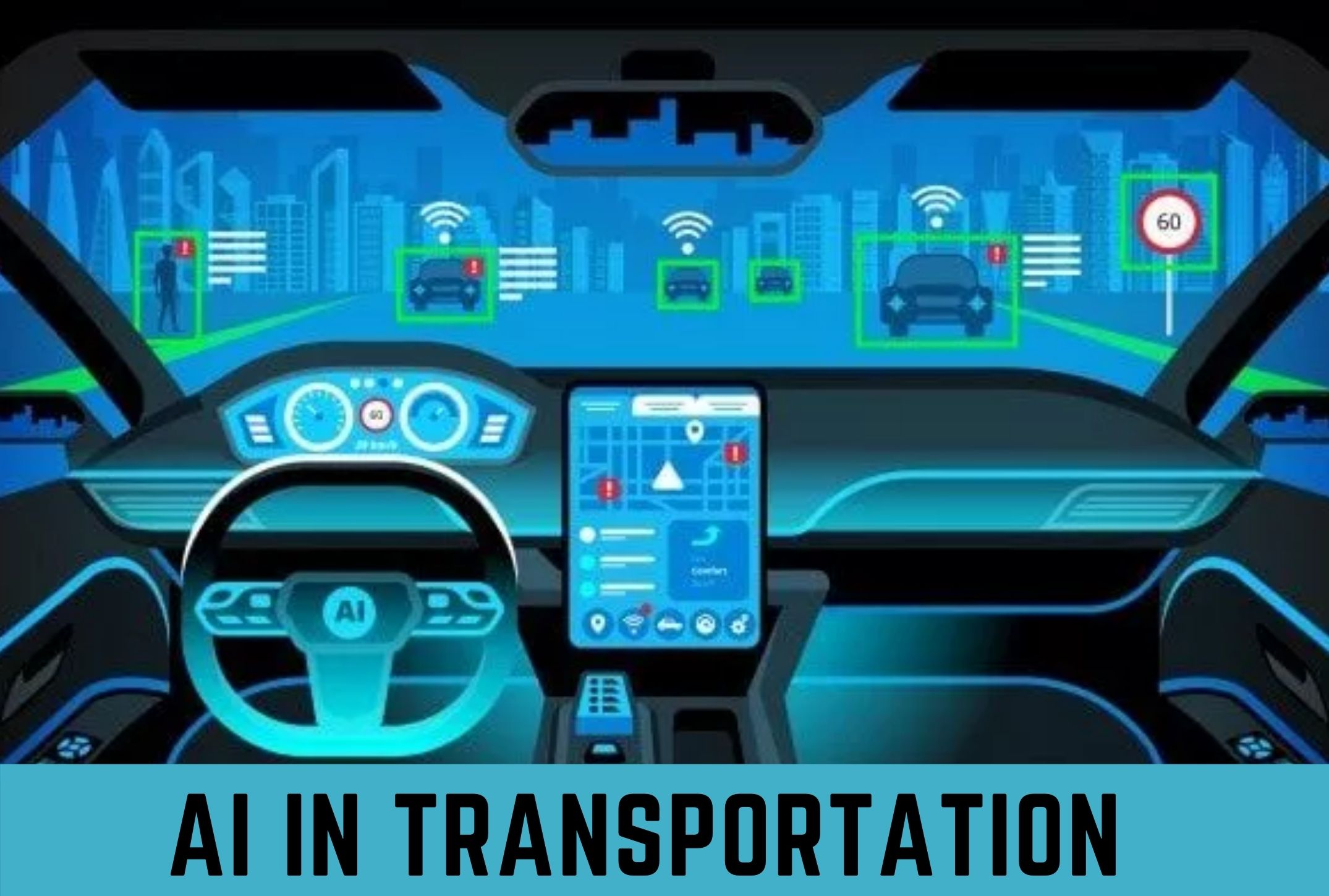
AI in Transportation

AI in Transportation – Current and Future Business-Use Applications | Emerj

Why AI?

You may have heard the terms analytics, advanced analytics, machine learning and AI. Let’s clarify:

  • Analytics is the ability to record and playback information. You can record the travels of each vehicle and report the mileage of the fleet.
  • Analytics becomes advanced analytics when you write algorithms to search for hidden patterns. You can cluster vehicles by similar mileage patterns.
  • Machine learning is when the algorithm gets better with experience. The algorithm learns, from examples, to predict the mileage of each vehicle.
  • AI is when a machine performs a task that human beings find interesting, useful and difficult to do. Your system is artificially intelligent if, for example, machine-learning algorithms predict vehicle mileage and adjust routes to accomplish the same goals but reduce the total mileage of the fleet.

If you’re in travel and transportation, here’s how to make sense of the terms analytics, advanced analytics, machine learning and AI.

AI is often built from machine-learning algorithms, which owe their effectiveness to training data. The more high-quality data available for training, the smarter the machine will be. The amount of data available for training intelligent machines has exploded. By 2020 every human being on the planet will create about 1.7 megabytes of new information every second. According to IDC, information in enterprise data centers will grow 14-fold between 2012 and 2020.

And we are far from putting all this data to good use. Research by the McKinsey Global Institute suggests that, as of 2016, those with location-based data typically capture only 50 to 60 percent of its value.  Here’s what it looks like when you use AI to put travel and transportation data to better use.

Lack of Action in Congress on Autonomous Technology Could Hinder States, Lawmaker Warns | Transport Topics

Here’s what it looks like when you apply industrialized AI in travel and transportation.

Take care of the fleet

Get as much use of the fleet as possible. With long-haul trucking, air, sea and rail-based shipping, and localized delivery services, AI can help companies squeeze inefficiencies out of these logistics-heavy industries throughout the entire supply chain. AI can help monitor and predict fleet and infrastructure failures. AI can learn to predict vehicle failures and detect fraudulent use of fleet assets. With predictive maintenance, we anticipate failure and spend time only on assets that need service. With fraud detection, we ensure that vehicles are used only for intended purposes.

AI combined with fleet telematics can decrease fleet maintenance costs by up to 20 percent. The right AI solution could also decrease fuel costs (due to better fraud detection) by 5 to 10 percent. You spend less on maintenance and fraud, and extend the life and productivity of the fleet.

Take care of disruption

There will be bad days. The key is to recover quickly. AI provides the insights you need to predict and manage service disruption. AI can monitor streams of enterprise data and learn to forecast passenger demand, operations performance and route performance. The McKinsey Global Institute found that using AI to predict service disruption has the potential to increase fleet productivity (by reducing congestion) by up to 20 percent. If you can predict problems, you can handle them early and minimize disruption.

Take care of business

Good operations planning makes for effective fleets. AI can augment operations decisions by narrowing choices to only those options that will optimize pricing, load planning, schedule planning, crew planning and route planning. AI combined with fleet telematics has the potential to decrease overtime expenses by 30 percent and decrease total fleet mileage by 10 percent. You cut fleet costs by eliminating wasteful practices from consideration.

Take care of the passenger

The passenger experience includes cargo — cargo may not have a passenger experience directly but the people shipping the cargo do. Disruptions happen, but the best passenger experiences come from companies that respond quickly. AI can learn to automate both logistics and disruption recovery. It can provide real-time supply and demand matching, pricing and routing. According to the McKinsey Global Institute, AI’s improvement of the supply chain can increase operating margins by 5 to 35 percent. AI’s dynamic pricing can potentially increase profit margins by 17 percent. Whether it’s rebooking tickets or making sure products reach customers, AI can help you deliver a richer, more satisfying travel experience.

Applied AI is a differentiator

If we see AI as just technology, it makes sense to adopt it according to standard systems engineering practices: Build an enterprise data infrastructure; ingest, clean, and integrate all available data; implement basic analytics; build advanced analytics and AI solutions. This approach takes a while to get to ROI.

But AI can mean competitive advantage. When AI is seen as a differentiator, the attitude toward AI changes: Run if you can, walk if you must, crawl if you have to. Find an area of the business that you can make as smart as possible as quickly as possible. Identify the data stories (like predictive maintenance or real-time routing) that you think might make a real difference. Test your ideas using utilities and small experiments. Learn and adjust as you go.

It helps immensely to have a strong Analytics IQ — a sense for how to put smart machine technology to good public use. We’vefit built a short assessment designed to show where you are and practical steps for improving. If you’re interested in applying AI in travel and transportation and are looking for a place to start, take the Analytics IQ assessment.

The MLOps principles for AI Development

Automation & AI – Network Software & Technologies

Many companies are eager to use artificial intelligence (AI) in production, but struggle to achieve real value from the technology.

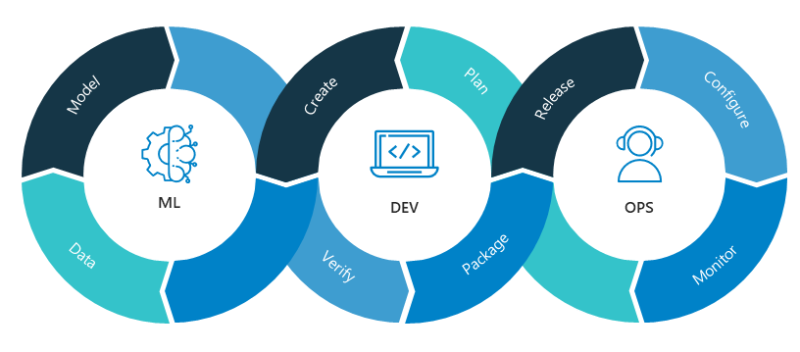
What’s the key to success? Creating new services that learn from data and can scale across the enterprise involves three domains: software development, machine learning (ML) and, of course, data. These three domains must be balanced and integrated together into a seamless development process.

Most companies have focused on building machine learning muscle – hiring data scientists to create and apply algorithms capable of extracting insights from data. This makes sense, but it’s a rather limited approach. Think of it this way: They’ve built up the spectacular biceps but haven’t paid as much attention to the underlying connective tissues that support the muscle.

Why the disconnect?

Focusing mostly on ML algorithms won’t drive strong AI solutions. It might be good for getting one-off insights, but it isn’t enough to create a foundation for AI apps that consistently generate ongoing insights leading to new ideas for products and services.

AI services have to be integrated into a production environment without risking deterioration in performance. Unfortunately, performance can decline without proper data management, as ML models will degrade quickly unless they’re repeatedly trained with new data (either time-based or event-triggered).

Professionalizing the AI development process

The best approach to getting real and continuous value from AI applications is to professionalize AI development. This approach conforms to machine learning operations (MLOps), a method that integrates the three domains behind AI apps in such a way that solutions can be quickly, easily and intelligently moved from prototype to production.

What is MLOps? | NVIDIA Blog

AI professionalization elevates the role of data scientists and strengthens their development methods. Like all scientists, these professionals bring with them a keen appreciation for experimentation. But often, their dependence on static data for creating machine learning algorithms –which they developed on local laptops using preferred tools and libraries – impedes production AI solutions from continuously producing value. Data communication and library dependency problems will take their toll.

Data scientists can continue to use the tools and methods they prefer, their output accommodated by loosely coupled DevOps and DataOps interfaces. Their ML algorithm development work becomes the centerpiece of a highly professional factory system, so to speak.

Smooth pilot-to-production workflow

Pilot AI solutions become stable production apps in short order. We use DevOps technology and techniques such as continuous integration and continuous delivery (CICD) and have standard templates for automatically deploying model pipelines into production. By using model pipelines, training and evaluation can happen automatically if needed – when new data arrives, for instance – without human involvement.

Our versioning and tracking ensure that everything can be reused, reproduced and compared if necessary. Our advanced monitoring provides end-to-end transparency into production AI use cases (including data and model pipelines, data quality and model quality and model usage).

Using our innovative MLOps approach, we were able to bring the pilot-to-production timeline for one U.S. company’s AI app down from six months to less than one week. For a UK company, the window for delivering a stable AI production app shrank from five weeks to one day.

The transparency of AI solutions, and confidence in their agility and stability, is critical. After all, the value lies in the ability to use AI to discover new business models and market opportunities, deliver industry-disrupting products and creatively respond to customer needs.

Significance of Data ethics in healthcare

Is medicine ready for artificial intelligence? | ETH Zurich

Over the past few years, Facebook has been in several media storms concerning the way user data is processed. The problem is not that Facebook has stored and aggregated huge amounts of data. The problem is how the company has used and, especially, shared the data in its ecosystem — sometimes without formal consent or by long and difficult-to-understand user agreements.

Having secure access to large amounts of data is crucial if we are to leverage the opportunities of new technologies like artificial intelligence and machine learning. This is particularly true in healthcare, where the ability to leverage real-world data from multiple sources — claims, electronic health records and other patient-specific information — can revolutionize decision-making processes across the healthcare ecosystem.

Healthcare organizations are eager to tap into patient healthcare data to get actionable insights that can help track compliance, determine outcomes with greater certainty and personalize patient care. Life sciences companies can use anonymized patient data to improve drug development — real-world evidence is advancing opportunities to improve outcomes and expand on research into new therapies. But with this ability comes an even greater need to ensure that patients’ data is safeguarded.

Trust — a crucial commodity

The data economy of the future is based on one crucial premise: trust. I, as a citizen or consumer, need to trust that you will handle my data safely and protect my privacy. I need to trust that you will not gather more data than I have authorized. And finally, I have to trust that you will use the data only for the agreed-upon purposes. If you consciously or even inadvertently break our mutual understanding, you will lose my loyalty and perhaps even the most valuable commodity — access to all my personal data.

Unfortunately, the Facebook case is not unique. Breaches of the European Union’s General Data Protection Regulation (GDPR) leading to huge fines are reported almost daily. What’s more, the continual breaches and noncompliance are affecting the credibility of and trust in software vendors. It’s not surprising that citizens don’t trust companies and public institutions to handle their personal data properly.

The challenge is to embrace new technology while at the same time acting as a digitally responsible society. Evangelizing new technology and preaching only the positive elements are not the way forward. As a society we must make sure that privacy, security, and ethical and moral elements go hand in hand with technology adoption. This social maturity curve might now follow Moore’s law about the extremely rapid growth of computing power, which means that — regardless of whether society has adapted — digital advancement will prevail.  But we can’t simply have conversations that preach the value of new technology without addressing how it will impact us as a community or as citizens.

Trust is a crucial commodity, and ensuring that trust means demonstrating an ethical approach to the collection, storage and handling of data. If users don’t trust that their data will be processed in keeping with current privacy legislation, the opportunities to leverage large amounts of data to advance important goals — such as real-world data to improve healthcare outcomes or to advance research in drug development — will not be realized. Consumers will quickly turn their backs on vendors and solutions they do not trust — and for good reason!

Rigorous approach to privacy

Health Data Privacy: Updating HIPAA to match today's technology challenges - Science in the NewsEthics and trust have become new prerequisites for technology providers trying to create a competitive advantage in the digital industry, and only the most ethical companies will succeed. Governments, vendors and others in the data industry must take a rigorous approach to security and privacy to ensure that trust. And healthcare and other organizations looking to work with software vendors and service providers must consider their choices carefully. Key considerations when acquiring digital solutions include:


  • How should I evaluate future vendors when it comes to security and data ethics?
  • How can I use existing data in new contexts, and what will a roadmap toward new data-based solutions look like? How will my legacy applications fit into this new strategy?
  • How will data ethics and security be reflected in my digital products, and how should access to data be managed?
  • How can I ensure I am engaging with a vendor that understands not only its products but can also handle managed security services or other cyber security and privacy requirements before any breach occurs?

Using technology to create an advantage is no longer about collecting and storing data; it’s about how to handle the data and understand the impact that data solutions will have on our society. In healthcare — where consumers expect their data to be used to help them in their journey to good health and wellness — that’s especially true. Healthcare organizations need to demonstrate that they have consumers’ safety, security and well-being at the heart of everything they do.

IT – The remote worker’s toolkit

IT the remote worker's toolkit

Enterprise clients have looked to automate IT support for several years. With millions of employees across the globe now working from home, support needs have increased dramatically, with many unprepared enterprises suffering from long service desk wait times and unhappy employees. Many companies may have already been on a gradual pace to exploit digital solutions and enhance service desk operations, but automating IT support is now a greater priority. Companies can’t afford downtime or the lost productivity caused by inefficient support systems, especially when remote workers need more support now than ever before. Digital technologies offer companies innovative and cost-effective ways to manage increased support loads in the immediate term, and free up valuable time and resources over the long-term. The latter benefit is critical, as enterprises increasingly look to their support systems to resolve more sophisticated and complex issues. Instead of derailing them, new automated support systems can empower workers by freeing them up to focus more on high-value work.

Businesses can start their journey toward digital support by using chatbots to manage common support tasks such as resetting passwords, answering ‘how to’ questions, and processing new laptop requests. Once basic support functions are under digital management, companies can then transition to layering in technologies like machine learning, artificial intelligence and analytics among others.

An IT support automation ecosystem built on these capabilities can enable even greater positive outcomes – like intelligently (and invisibly) discovering and resolving issues before they have an opportunity to disrupt employees. In one recent example, DXC deployed digital support agents to help manage a spike of questions coming in from remote workers. The digital agents seamlessly handled a 20% spike in volume, eliminated wait times, and drove positive employee experiences.

Innovative IT support

Innovative IT supports

IT support automation helps companies become more proactive in serving their employees better with more innovative support experiences. Here are three examples:

Remote access

In a remote workforce, employees will undoubtedly face issues with new tools they need to use or with connections to the corporate network. An automated system that notifies employees via email or text about detected problems and personalized instructions on how to fix is a new way to care for the remote worker. If an employee still has trouble, an on-demand virtual chat or voice assistant can easily walk them through the fix or, better yet, execute it for them.

Proactive response

The ability to proactively monitor and resolve the employee’s endpoint — to ensure security compliance, set up effective collaboration, and maintain high performance levels for key applications and networking – has emerged as a significant driver of success when managing the remote workplace.

 For example, with more reliance on home internet as the path into private work networks, there’s greater opportunity for bad actors to attack. A proactive support system can continuously monitor for threat events and automatically ensure all employee endpoints are security compliant.

Leveraging proactive analytics capabilities, IT support can set up monitoring parameters to match their enterprise needs, identify when events are triggered, and take action to resolve. This digital support system could then execute automated fixes or send friendly messages to the employee with instructions on how to fix an issue. These things can go a long way toward eliminating support disruptions and leave the employee with a sense of being cared for – the best kind of support.

More value beyond IT

Companies are also having employees leverage automated assistance outside of IT support functions. These capabilities could be leveraged in HR, for example, to help employees correctly and promptly fill out time sheets or remind them to select a beneficiary for corporate benefits after a major life event like getting married or having a baby.

Remote support can also help organizations automate business tasks. This could include checking on sales performance, getting recent market research reports sent to any device or booking meetings through a voice-controlled device at home.

More engaged employees With the power to provide amazing experiences, automated IT support can drive new levels of employee productivity and engagement, which are outcomes any enterprise should embrace.

Hey! Get Ready for a Virtual Desktop World

The new age of the remote employee is upon us. Close to half the workforce in the U.S. never worked from home before the worldwide healthcare crisis, Statista reports. Today, 44% work from home five days a week. Companies had to scramble to adapt their services and systems so that business could continue. Now, they are making significant long-term changes for a workplace that will never be the same. Under today’s circumstances virtual desktops will become more widespread – in some cases, even becoming the rule rather than the exception – as companies rethink their overall strategy for employee experience.

Finding new ways to manage in a virtual desktop world -- FCW

Cloud migration also has a role in driving the growth of the desktop virtualization market, which was valued at $6.7 billion in 2020 and is expected to nearly double by 2026, according to Mordor Intelligence.

There are many other factors in favor of moving to virtual desktops. One is that companies  are broadening use of virtual desktops across their workforce to give employees more flexibility. Another is that they are making themselves attractive to a wider pool of remote talent with hard-to-find expertise who don’t want to move to take a job. Desktop virtualization is also a vital asset for providing business continuity.

Virtual desktops save costs, which has become a higher priority for many companies that need to offset the revenue declines they have experienced.

With a virtual desktop model, there’s less complexity for IT operations, especially when businesses partner with service providers to implement and operate fully managed end-to-end virtual desktop infrastructure and applications.

Addressing security concerns

Microsoft Previews MSIX App Attach for Windows Virtual Desktop -- Redmondmag.com

IT security and policy compliance has always challenged desktop virtualization deployments and is probably one of the biggest reasons some companies have been hesitant to adopt it widely. With the ability to take advantage of the native Azure security features in Windows Virtual Desktop (WVD), including multi-factor authentication, company leaders can be more confident about tightening security and compliance.

Assuring the right cyber-security foundation was in place for desktop virtualization was a major goal for one of our customers in the U.K. public sector, so that it could maintain compliance with its IT security standards and policies. We were able to address that issue for its 2,000-plus users with our Virtual Desktop and Application Services solution based on Azure-native WVD, which leverages our comprehensive virtual desktop infrastructure (VDI) and managed desktop virtualization and application service offerings including managed security services.

Our customer’s timeline and constraints called for us to move fast, and we deployed a turnkey solution that included design and implementation – as well as ongoing support – in just 6 weeks. Now the project is expanding to increase the number of business applications and the organization has the flexibility to quickly and easily expand the solution for more users.

Recently we became one of the first Microsoft partners to receive the WVD Microsoft Advanced Specialization certification, which recognizes our expertise in deploying, optimizing, and securing VDI on Azure with WVD. This attests to our understanding and experience in helping businesses create the right VDI design and model – public cloud or hybrid deployments – for WVD. We’re proud of this recognition and validation of DXC as a trusted provider to deliver a comprehensive solution for WVD environments.

error: Content is protected !!