Predictions for the Cloud service in 2019

Predictions for the cloud in 2020 - Information Age

2018 saw important technological advances in cloud computing that made businesses take a fresh look at how it could help them achieve their goals. In 2019, we are likely to see a further shift towards the collection and use of data, including that gathered from business processes and external data sets.

To enable businesses to make the most of this, we’ll see organisations move from standard infrastructure as a service (IaaS) solutions to cloud services with more advanced features, such as AI, machine learning, blockchain and analytics. Hand in hand with this, we are also going to see more organisations adopt hybrid and multi-cloud environments which provide them with a more effective infrastructure and a better set of tools to achieve their aims. As a result, here at Anteelo, we believe the cloud trends mentioned below will become increasingly widespread as more businesses continue to develop their use of cloud technology.

A shift to hybrid and multi-cloud infrastructures
Why You Need To Shift To A Hybrid Cloud Infrastructure?

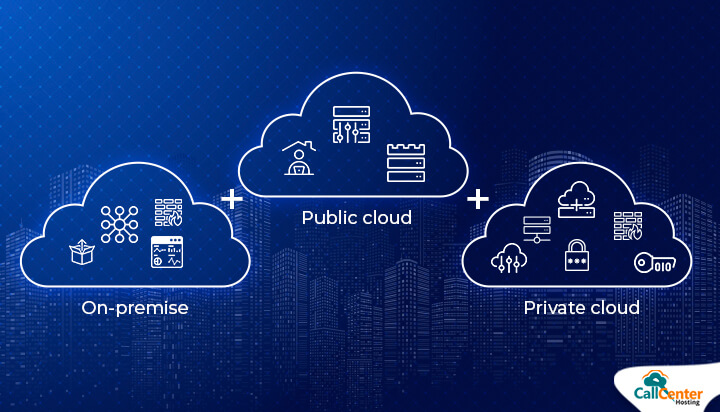
While many businesses have adopted cloud technology in some form or other, performance concerns and compliance requirement mean the majority of companies still run mission-critical applications and handle sensitive data in-house. In order to continue their move towards a cloud environment, companies will look at using a wider range of cloud options.

Public cloud will still be used as a cost-effective way to handle many processes, however, rather than rely on a single provider, many organisations will opt for a multi-cloud approach using a variety of hosting solutions for different purposes. At the same time, some workloads are more suited to private cloud networks and this means we’ll see an increase in the use of hybrid cloud infrastructures being developed.

While this mix of in-house, private cloud and public cloud architecture is obviously more complex, their integration will give enterprises the opportunity to build the most effective infrastructure it needs to drive the business forward.

A move towards open cloud technology

Reasons to Move to the Cloud. – ON – Belleville

The shift to hybrid, multi-cloud environments naturally leads to the adoption of open cloud technologies. Doing so helps companies avoid vendor lock-in and gives them greater freedom to choose the right solution providers. Indeed, using open cloud technology improves the interoperability of platforms, apps and data which is ideal for businesses looking to create diversely hosted infrastructures.

Increased adoption of containers

Turbocharge Your Cloud Transformation With Containers And Serverless Technology

Another consequence of companies moving towards a multi-cloud strategy is that they will want to deploy their apps across their multiple cloud platforms. This will lead to the increasing adoption of containers which will enable migration between various IT environments to take place easily and quickly. Key to this will be the use of the open source tool, Kubernetes, which enables the deployment and management of container-based applications.

An emphasis on security

Blog: Remote Work Places an Emphasis on Endpoint Security Solutions

Any move to a hybrid cloud setup means enterprises will need a more sophisticated approach to security. Using the services of multiple cloud providers means they will need to consistently manage all the threats to their applications and data across all vendors. An important aspect of this will be the need to get developers to integrate security features into their apps during development in order to ensure better app visibility, protection and control.

Skilling up

Why we will need up-skilling courses in 2019 to get successful careers - Education Today News

Adopting a hybrid, multi-cloud approach means IT teams will need to develop new skills and practices in the way they operate. While relying on managed services may still be appropriate in some situations, there will be an increased need for staff with skills in using cross-platform tools, automation and data integration.  The training up or recruitment of specialists, such as cloud architects, service brokers and automation engineers may be a necessity.

Rapid growth in edge computing

Growth of Edge Computing in Asia | Vertiv Insights

The huge rise in the numbers of connected devices and the emergence of 5G networks means that 2019 will see edge computing grow rapidly. Its use will enable companies to significantly benefit from the analysis of all the valuable data being harvested from sensors and other IoT devices in operation. Whether to gain customer insights, improve operation efficiency or for real-time condition monitoring, the use of interoperable technologies enables edge locations to remain synced with the company’s system to ensure it has a consistent overview of the wider network.

Conclusion

As you can see, the big development in 2019 is the move towards a hybrid, multi-cloud strategy where enterprises create bespoke IT solutions that combine public and private cloud service with in-house IT. Hand in hand with this will be a move to open source cloud technology, the increased adoption of containers, a stronger emphasis on security, the skilling up of IT teams and a rapid growth in the use of edge computing.


Cloud-automated IT eliminates shorcomings of Traditional IT model

Cloud Computing Risks, Challenges & Problems Businesses Are Facing

For small and medium-sized companies, the traditional IT model of an on-premises network built and operated with an in-house IT staff is often fraught with problems.  IT teams are stretched to capacity simply keeping the lights on and there are always going to be issues with systems performance, network reliability, end user productivity, data recovery, security and the help desk.  Staffing is another constant challenge. And if companies decide to outsource some IT functions, they end up with multiple service providers, which creates additional headaches.

The problem is highlighted in the 2018 State of the CIO survey conducted by CIO Magazine, in which CIOs said their role is becoming more digital and innovation focused, but they don’t have time to address those pressing needs because they are bogged down with functional duties.

The common business challenges reported in the survey are often symptoms of needs that are misaligned with technologies and service providers, plus the lack of budget to address the problems.  Those challenges typically revolve around:

  • security and disaster recovery
  • lost productivity due to downtime and end users waiting for support
  • shadow IT and users not following security training
  • escalating or unpredictable costs
  • outdated infrastructure
  • shortage of talent
  • multiple tech providers and systems working at cross-purposes

Smaller businesses that may have turned to traditional managed service providers quickly discover these services lack seamlessness and result in reactive support challenges. According to the Ponemon Institute’s State of Endpoint Security Risk Report, 80% of these reactive issues can be eliminated through standardization and automation.

Moving to a cloud-based IT infrastructure

Why Your Business Should Be Adopting Cloud-Based IT Services - Consolidated Technologies, Inc.

Cloud-automated IT services can address these challenges and free up IT teams so they can align their strategies with the business.  Cloud-automated IT does all this by providing seamless, proactive support, enterprise-level security and compliance, redundant systems, highly available virtual desktops, continuous upgrades, predictable costs and improved end user productivity. The cloud-based IT infrastructure is managed by a team of experienced, knowledgeable, highly trained professionals who apply industry best practices.

Aligning the technologies in the IT infrastructure and having experts managing them delivers several key benefits:

  • Cost predictability: Not only are ongoing costs for an IT infrastructure that supports the business predictable and easy to budget for, surprise costs for disasters like outages, ransomware and security breaches are essentially eliminated.

Cyberlink - Reduce Variable Costs with Predictable Pricing Icon [9.27.17]-01 - CyberlinkASP

  • Reduced Friction and Risk: By standardizing on best-in-class, constantly updated technologies, friction is reduced between equipment, vendors, integration points, and service providers. This results in stronger security, performance, and ease of use.

Reduce Operational Risk with Effective Workflow Management

  • User Satisfaction and Productivity: If you’ve ever muddled through a few days of work on a loaner laptop you understand how important the user experience is to employee satisfaction and productivity. VDI and proactive management deliver a better computing experience and increased productivity. Instances can be refreshed just like you would with a cell phone.

60+ Customer Satisfaction Survey Questions You Can Borrow

With cloud-automated IT, the entire IT infrastructure moves to the cloud in a well-planned, efficient manner. The service provider helps create a personalized upgrade plan based on the specific needs of the organization, does a health check on existing applications, makes sure everything is configured properly and updates applications to the latest releases.

And cloud-automated IT goes far beyond simply lifting and shifting existing systems to the cloud. It is a holistic approach that aligns cutting-edge technologies and fully managed services to provide smaller companies enterprise-grade IT that can make a significant impact on the security and effectiveness of the business.

How Can Migrating to the Cloud Help Customers?

Debunking the multi-cloud myths - Information Age

There are many benefits of migrating to the cloud: financial savings, increased agility, tighter security and uninterrupted service, just to name a few. But one often overlooked benefit is the improvements it brings to the customer experience and the positive effects this has on user trust and satisfaction, brand engagement and a company’s online reputation.

Improving the user experience is increasingly important for an enterprise’s success. According to Bloomfire, over 80% of businesses see the user experience as something which helps differentiate between competitors and, by the end of the decade, it is projected to overtake price and product choices as the main reason why consumers choose one brand over another.

Online, where consumers expect immediate, unlimited and uninterrupted access to information, products or services, businesses that still use non-cloud systems may miss out on the opportunities that the cloud has to offer. Migrating to the cloud provides the tools and services businesses need to participate in today’s competitive, on-demand marketplace, enabling them to enhance the customer experience and reap the rewards of doing so. Here are the ways migrating to the cloud can improve your customers’ experience.

Give customers 24/7 access to your products and services

Still Not Providing with 24/7 Customer Service? Here Are 9 Reasons Why You Should Start Right Away! | CommBox

The days where customers were prepared to wait for usual business hours to get in touch with a company are over. Today, they expect online operations to be available 24/7, whether that is to buy products, contact customer support or access online services. They also expect that these things can be done from anywhere, using any type of connected device.

By migrating to the cloud, it means that businesses have a much greater flexibility to put these things in place. For example, as employees can connect with work-based applications anywhere they have a connection, it means they can deal with customer service enquiries even when they are out of the office, helping expand operations and keeping costs to a minimum. Indeed, by using AI chat boxes, many of the inquiries a company has out of hours can be automated with only a minimal need for any human interaction.

This 24/7 availability can be provided for many services, such as product sales, ticket ordering, delivery tracking and much more.

Provide a one-stop shop

Qt 6.0 to provide one-stop-shop for software design and development

Ever had the experience of waiting for ages in a phone queue and then, when you finally get through, to be told you need to call a different number? There is nothing more frustrating for a customer than finding out they cannot access all a company’s services from a single point of entry, whether this is on the telephone or online.

Thankfully, the tools and systems available to companies which migrate to the cloud enable them to provide the integrated services that their customers demand, without them needing to leave the website.

The applications available in the cloud provide customers with easy to use interfaces from which they can manage all their services from a single place, whether on a website or smartphone app. Just think of all the things that online banking customers can now carry out on a bank’s website or apps. And if they have a problem, they can have access to support using the same interface no matter where they are, what time of day or what device they are using.

Offer personalised experiences

The Importance of Digital Personalization in B2B Marketing

Despite all the concerns around data privacy, most customers prefer it when companies provide them with personalised shopping experiences. It’s great for consumers seeing products and services that are tailored to their needs and desires and putting these things directly in front of customers certainly helps improve sales. It’s a win-win situation for both consumer and company and something we are seeing a lot more of when we visit websites.

The reason companies can provide personalised shopping experiences is because of the vast amount of data that is made available. Websites can track browsing and shopping history; they provide wish lists to see what people like; if customers don’t inform them directly, their algorithms can quickly ascertain a consumer’s age, gender, family background, geographic location and similar data; and all these things can be compared with the data of those in a similar demographic. The result is that users of these websites see an increasingly accurate guess at the things they are looking to buy and this increases their chance of buying them – especially when the company uses this data to incentivise a purchase through offers and discounts.

To provide personalised shopping experiences, however, all that data needs to be collected, processed and analysed. And there is a lot of data to collect. Cloud computing offers the best way to do this, providing unlimited storage and processing capacity, charged for on a pay as you use basis while allowing the use of widely available big data and AI applications to undertake the data crunching.

Improve the trustworthiness of your brand

6 Ways to Establish a Trustworthy Brand | ZoomInfo Blog

The cloud provides several ways to improve the reputation of your brand. With high availability cloud hosting, the bad press associated with application downtime can be a thing of the past; the security features available from service providers means that there is a reduced risk of IT systems becoming victims of cyber attacks, infections or ransomware; and the choice of cloud-based tools on offer provides a range of ways to ensure that customers’ needs are dealt with quickly. Together, these things ensure that customers see your online provision as something that is both reliable and trustworthy.

Conclusion

Migrating to the cloud can greatly improve the user experience, helping to attract new customers and retain existing ones. With many tools available, the cloud can help businesses give their customers the online experiences they demand, providing 24/7 access to integrated services and personalised shopping from a reliable and trustworthy business. With these in place, businesses will have a clear advantage over their competitors.

error: Content is protected !!