AI in Transportation

AI in Transportation – Current and Future Business-Use Applications | Emerj

Why AI?

You may have heard the terms analytics, advanced analytics, machine learning and AI. Let’s clarify:

  • Analytics is the ability to record and playback information. You can record the travels of each vehicle and report the mileage of the fleet.
  • Analytics becomes advanced analytics when you write algorithms to search for hidden patterns. You can cluster vehicles by similar mileage patterns.
  • Machine learning is when the algorithm gets better with experience. The algorithm learns, from examples, to predict the mileage of each vehicle.
  • AI is when a machine performs a task that human beings find interesting, useful and difficult to do. Your system is artificially intelligent if, for example, machine-learning algorithms predict vehicle mileage and adjust routes to accomplish the same goals but reduce the total mileage of the fleet.

If you’re in travel and transportation, here’s how to make sense of the terms analytics, advanced analytics, machine learning and AI.

AI is often built from machine-learning algorithms, which owe their effectiveness to training data. The more high-quality data available for training, the smarter the machine will be. The amount of data available for training intelligent machines has exploded. By 2020 every human being on the planet will create about 1.7 megabytes of new information every second. According to IDC, information in enterprise data centers will grow 14-fold between 2012 and 2020.

And we are far from putting all this data to good use. Research by the McKinsey Global Institute suggests that, as of 2016, those with location-based data typically capture only 50 to 60 percent of its value.  Here’s what it looks like when you use AI to put travel and transportation data to better use.

Lack of Action in Congress on Autonomous Technology Could Hinder States, Lawmaker Warns | Transport Topics

Here’s what it looks like when you apply industrialized AI in travel and transportation.

Take care of the fleet

Get as much use of the fleet as possible. With long-haul trucking, air, sea and rail-based shipping, and localized delivery services, AI can help companies squeeze inefficiencies out of these logistics-heavy industries throughout the entire supply chain. AI can help monitor and predict fleet and infrastructure failures. AI can learn to predict vehicle failures and detect fraudulent use of fleet assets. With predictive maintenance, we anticipate failure and spend time only on assets that need service. With fraud detection, we ensure that vehicles are used only for intended purposes.

AI combined with fleet telematics can decrease fleet maintenance costs by up to 20 percent. The right AI solution could also decrease fuel costs (due to better fraud detection) by 5 to 10 percent. You spend less on maintenance and fraud, and extend the life and productivity of the fleet.

Take care of disruption

There will be bad days. The key is to recover quickly. AI provides the insights you need to predict and manage service disruption. AI can monitor streams of enterprise data and learn to forecast passenger demand, operations performance and route performance. The McKinsey Global Institute found that using AI to predict service disruption has the potential to increase fleet productivity (by reducing congestion) by up to 20 percent. If you can predict problems, you can handle them early and minimize disruption.

Take care of business

Good operations planning makes for effective fleets. AI can augment operations decisions by narrowing choices to only those options that will optimize pricing, load planning, schedule planning, crew planning and route planning. AI combined with fleet telematics has the potential to decrease overtime expenses by 30 percent and decrease total fleet mileage by 10 percent. You cut fleet costs by eliminating wasteful practices from consideration.

Take care of the passenger

The passenger experience includes cargo — cargo may not have a passenger experience directly but the people shipping the cargo do. Disruptions happen, but the best passenger experiences come from companies that respond quickly. AI can learn to automate both logistics and disruption recovery. It can provide real-time supply and demand matching, pricing and routing. According to the McKinsey Global Institute, AI’s improvement of the supply chain can increase operating margins by 5 to 35 percent. AI’s dynamic pricing can potentially increase profit margins by 17 percent. Whether it’s rebooking tickets or making sure products reach customers, AI can help you deliver a richer, more satisfying travel experience.

Applied AI is a differentiator

If we see AI as just technology, it makes sense to adopt it according to standard systems engineering practices: Build an enterprise data infrastructure; ingest, clean, and integrate all available data; implement basic analytics; build advanced analytics and AI solutions. This approach takes a while to get to ROI.

But AI can mean competitive advantage. When AI is seen as a differentiator, the attitude toward AI changes: Run if you can, walk if you must, crawl if you have to. Find an area of the business that you can make as smart as possible as quickly as possible. Identify the data stories (like predictive maintenance or real-time routing) that you think might make a real difference. Test your ideas using utilities and small experiments. Learn and adjust as you go.

It helps immensely to have a strong Analytics IQ — a sense for how to put smart machine technology to good public use. We’vefit built a short assessment designed to show where you are and practical steps for improving. If you’re interested in applying AI in travel and transportation and are looking for a place to start, take the Analytics IQ assessment.

The MLOps principles for AI Development

Automation & AI – Network Software & Technologies

Many companies are eager to use artificial intelligence (AI) in production, but struggle to achieve real value from the technology.

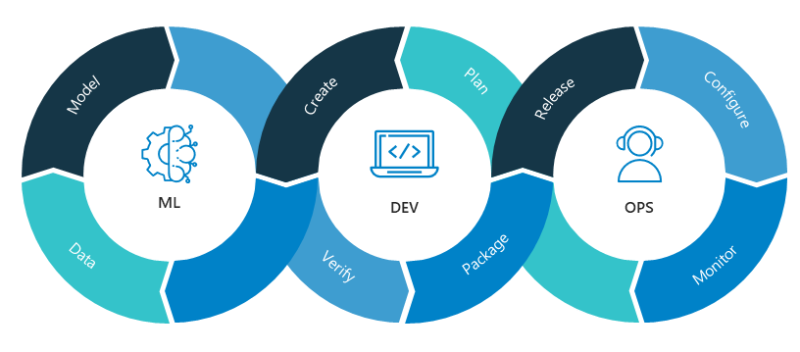
What’s the key to success? Creating new services that learn from data and can scale across the enterprise involves three domains: software development, machine learning (ML) and, of course, data. These three domains must be balanced and integrated together into a seamless development process.

Most companies have focused on building machine learning muscle – hiring data scientists to create and apply algorithms capable of extracting insights from data. This makes sense, but it’s a rather limited approach. Think of it this way: They’ve built up the spectacular biceps but haven’t paid as much attention to the underlying connective tissues that support the muscle.

Why the disconnect?

Focusing mostly on ML algorithms won’t drive strong AI solutions. It might be good for getting one-off insights, but it isn’t enough to create a foundation for AI apps that consistently generate ongoing insights leading to new ideas for products and services.

AI services have to be integrated into a production environment without risking deterioration in performance. Unfortunately, performance can decline without proper data management, as ML models will degrade quickly unless they’re repeatedly trained with new data (either time-based or event-triggered).

Professionalizing the AI development process

The best approach to getting real and continuous value from AI applications is to professionalize AI development. This approach conforms to machine learning operations (MLOps), a method that integrates the three domains behind AI apps in such a way that solutions can be quickly, easily and intelligently moved from prototype to production.

What is MLOps? | NVIDIA Blog

AI professionalization elevates the role of data scientists and strengthens their development methods. Like all scientists, these professionals bring with them a keen appreciation for experimentation. But often, their dependence on static data for creating machine learning algorithms –which they developed on local laptops using preferred tools and libraries – impedes production AI solutions from continuously producing value. Data communication and library dependency problems will take their toll.

Data scientists can continue to use the tools and methods they prefer, their output accommodated by loosely coupled DevOps and DataOps interfaces. Their ML algorithm development work becomes the centerpiece of a highly professional factory system, so to speak.

Smooth pilot-to-production workflow

Pilot AI solutions become stable production apps in short order. We use DevOps technology and techniques such as continuous integration and continuous delivery (CICD) and have standard templates for automatically deploying model pipelines into production. By using model pipelines, training and evaluation can happen automatically if needed – when new data arrives, for instance – without human involvement.

Our versioning and tracking ensure that everything can be reused, reproduced and compared if necessary. Our advanced monitoring provides end-to-end transparency into production AI use cases (including data and model pipelines, data quality and model quality and model usage).

Using our innovative MLOps approach, we were able to bring the pilot-to-production timeline for one U.S. company’s AI app down from six months to less than one week. For a UK company, the window for delivering a stable AI production app shrank from five weeks to one day.

The transparency of AI solutions, and confidence in their agility and stability, is critical. After all, the value lies in the ability to use AI to discover new business models and market opportunities, deliver industry-disrupting products and creatively respond to customer needs.

Significance of Data ethics in healthcare

Is medicine ready for artificial intelligence? | ETH Zurich

Over the past few years, Facebook has been in several media storms concerning the way user data is processed. The problem is not that Facebook has stored and aggregated huge amounts of data. The problem is how the company has used and, especially, shared the data in its ecosystem — sometimes without formal consent or by long and difficult-to-understand user agreements.

Having secure access to large amounts of data is crucial if we are to leverage the opportunities of new technologies like artificial intelligence and machine learning. This is particularly true in healthcare, where the ability to leverage real-world data from multiple sources — claims, electronic health records and other patient-specific information — can revolutionize decision-making processes across the healthcare ecosystem.

Healthcare organizations are eager to tap into patient healthcare data to get actionable insights that can help track compliance, determine outcomes with greater certainty and personalize patient care. Life sciences companies can use anonymized patient data to improve drug development — real-world evidence is advancing opportunities to improve outcomes and expand on research into new therapies. But with this ability comes an even greater need to ensure that patients’ data is safeguarded.

Trust — a crucial commodity

The data economy of the future is based on one crucial premise: trust. I, as a citizen or consumer, need to trust that you will handle my data safely and protect my privacy. I need to trust that you will not gather more data than I have authorized. And finally, I have to trust that you will use the data only for the agreed-upon purposes. If you consciously or even inadvertently break our mutual understanding, you will lose my loyalty and perhaps even the most valuable commodity — access to all my personal data.

Unfortunately, the Facebook case is not unique. Breaches of the European Union’s General Data Protection Regulation (GDPR) leading to huge fines are reported almost daily. What’s more, the continual breaches and noncompliance are affecting the credibility of and trust in software vendors. It’s not surprising that citizens don’t trust companies and public institutions to handle their personal data properly.

The challenge is to embrace new technology while at the same time acting as a digitally responsible society. Evangelizing new technology and preaching only the positive elements are not the way forward. As a society we must make sure that privacy, security, and ethical and moral elements go hand in hand with technology adoption. This social maturity curve might now follow Moore’s law about the extremely rapid growth of computing power, which means that — regardless of whether society has adapted — digital advancement will prevail.  But we can’t simply have conversations that preach the value of new technology without addressing how it will impact us as a community or as citizens.

Trust is a crucial commodity, and ensuring that trust means demonstrating an ethical approach to the collection, storage and handling of data. If users don’t trust that their data will be processed in keeping with current privacy legislation, the opportunities to leverage large amounts of data to advance important goals — such as real-world data to improve healthcare outcomes or to advance research in drug development — will not be realized. Consumers will quickly turn their backs on vendors and solutions they do not trust — and for good reason!

Rigorous approach to privacy

Health Data Privacy: Updating HIPAA to match today's technology challenges - Science in the NewsEthics and trust have become new prerequisites for technology providers trying to create a competitive advantage in the digital industry, and only the most ethical companies will succeed. Governments, vendors and others in the data industry must take a rigorous approach to security and privacy to ensure that trust. And healthcare and other organizations looking to work with software vendors and service providers must consider their choices carefully. Key considerations when acquiring digital solutions include:

  • How should I evaluate future vendors when it comes to security and data ethics?
  • How can I use existing data in new contexts, and what will a roadmap toward new data-based solutions look like? How will my legacy applications fit into this new strategy?
  • How will data ethics and security be reflected in my digital products, and how should access to data be managed?
  • How can I ensure I am engaging with a vendor that understands not only its products but can also handle managed security services or other cyber security and privacy requirements before any breach occurs?

Using technology to create an advantage is no longer about collecting and storing data; it’s about how to handle the data and understand the impact that data solutions will have on our society. In healthcare — where consumers expect their data to be used to help them in their journey to good health and wellness — that’s especially true. Healthcare organizations need to demonstrate that they have consumers’ safety, security and well-being at the heart of everything they do.

IT – The remote worker’s toolkit

IT the remote worker's toolkit

Enterprise clients have looked to automate IT support for several years. With millions of employees across the globe now working from home, support needs have increased dramatically, with many unprepared enterprises suffering from long service desk wait times and unhappy employees. Many companies may have already been on a gradual pace to exploit digital solutions and enhance service desk operations, but automating IT support is now a greater priority. Companies can’t afford downtime or the lost productivity caused by inefficient support systems, especially when remote workers need more support now than ever before. Digital technologies offer companies innovative and cost-effective ways to manage increased support loads in the immediate term, and free up valuable time and resources over the long-term. The latter benefit is critical, as enterprises increasingly look to their support systems to resolve more sophisticated and complex issues. Instead of derailing them, new automated support systems can empower workers by freeing them up to focus more on high-value work.

Businesses can start their journey toward digital support by using chatbots to manage common support tasks such as resetting passwords, answering ‘how to’ questions, and processing new laptop requests. Once basic support functions are under digital management, companies can then transition to layering in technologies like machine learning, artificial intelligence and analytics among others.

An IT support automation ecosystem built on these capabilities can enable even greater positive outcomes – like intelligently (and invisibly) discovering and resolving issues before they have an opportunity to disrupt employees. In one recent example, DXC deployed digital support agents to help manage a spike of questions coming in from remote workers. The digital agents seamlessly handled a 20% spike in volume, eliminated wait times, and drove positive employee experiences.

Innovative IT support

Innovative IT supports

IT support automation helps companies become more proactive in serving their employees better with more innovative support experiences. Here are three examples:

Remote access

In a remote workforce, employees will undoubtedly face issues with new tools they need to use or with connections to the corporate network. An automated system that notifies employees via email or text about detected problems and personalized instructions on how to fix is a new way to care for the remote worker. If an employee still has trouble, an on-demand virtual chat or voice assistant can easily walk them through the fix or, better yet, execute it for them.

Proactive response

The ability to proactively monitor and resolve the employee’s endpoint — to ensure security compliance, set up effective collaboration, and maintain high performance levels for key applications and networking – has emerged as a significant driver of success when managing the remote workplace.

 For example, with more reliance on home internet as the path into private work networks, there’s greater opportunity for bad actors to attack. A proactive support system can continuously monitor for threat events and automatically ensure all employee endpoints are security compliant.

Leveraging proactive analytics capabilities, IT support can set up monitoring parameters to match their enterprise needs, identify when events are triggered, and take action to resolve. This digital support system could then execute automated fixes or send friendly messages to the employee with instructions on how to fix an issue. These things can go a long way toward eliminating support disruptions and leave the employee with a sense of being cared for – the best kind of support.

More value beyond IT

Companies are also having employees leverage automated assistance outside of IT support functions. These capabilities could be leveraged in HR, for example, to help employees correctly and promptly fill out time sheets or remind them to select a beneficiary for corporate benefits after a major life event like getting married or having a baby.

Remote support can also help organizations automate business tasks. This could include checking on sales performance, getting recent market research reports sent to any device or booking meetings through a voice-controlled device at home.

More engaged employees With the power to provide amazing experiences, automated IT support can drive new levels of employee productivity and engagement, which are outcomes any enterprise should embrace.

Hey! Get Ready for a Virtual Desktop World

The new age of the remote employee is upon us. Close to half the workforce in the U.S. never worked from home before the worldwide healthcare crisis, Statista reports. Today, 44% work from home five days a week. Companies had to scramble to adapt their services and systems so that business could continue. Now, they are making significant long-term changes for a workplace that will never be the same. Under today’s circumstances virtual desktops will become more widespread – in some cases, even becoming the rule rather than the exception – as companies rethink their overall strategy for employee experience.

Finding new ways to manage in a virtual desktop world -- FCW

Cloud migration also has a role in driving the growth of the desktop virtualization market, which was valued at $6.7 billion in 2020 and is expected to nearly double by 2026, according to Mordor Intelligence.

There are many other factors in favor of moving to virtual desktops. One is that companies  are broadening use of virtual desktops across their workforce to give employees more flexibility. Another is that they are making themselves attractive to a wider pool of remote talent with hard-to-find expertise who don’t want to move to take a job. Desktop virtualization is also a vital asset for providing business continuity.

Virtual desktops save costs, which has become a higher priority for many companies that need to offset the revenue declines they have experienced.

With a virtual desktop model, there’s less complexity for IT operations, especially when businesses partner with service providers to implement and operate fully managed end-to-end virtual desktop infrastructure and applications.

Addressing security concerns

Microsoft Previews MSIX App Attach for Windows Virtual Desktop -- Redmondmag.com

IT security and policy compliance has always challenged desktop virtualization deployments and is probably one of the biggest reasons some companies have been hesitant to adopt it widely. With the ability to take advantage of the native Azure security features in Windows Virtual Desktop (WVD), including multi-factor authentication, company leaders can be more confident about tightening security and compliance.

Assuring the right cyber-security foundation was in place for desktop virtualization was a major goal for one of our customers in the U.K. public sector, so that it could maintain compliance with its IT security standards and policies. We were able to address that issue for its 2,000-plus users with our Virtual Desktop and Application Services solution based on Azure-native WVD, which leverages our comprehensive virtual desktop infrastructure (VDI) and managed desktop virtualization and application service offerings including managed security services.

Our customer’s timeline and constraints called for us to move fast, and we deployed a turnkey solution that included design and implementation – as well as ongoing support – in just 6 weeks. Now the project is expanding to increase the number of business applications and the organization has the flexibility to quickly and easily expand the solution for more users.

Recently we became one of the first Microsoft partners to receive the WVD Microsoft Advanced Specialization certification, which recognizes our expertise in deploying, optimizing, and securing VDI on Azure with WVD. This attests to our understanding and experience in helping businesses create the right VDI design and model – public cloud or hybrid deployments – for WVD. We’re proud of this recognition and validation of DXC as a trusted provider to deliver a comprehensive solution for WVD environments.

Data Centric Architecture

Data Centric architecture

The value proposition of global systems integrators (GSIs) has changed remarkably in the last 10 years. By 2010, it was the waning days of the so-called “your mess for less” (YMFL) business model. GSIs would essentially purchase and run a company’s IT shop and deliver value through right-shoring (moving labor to low cost places), leveraging supply chain economies of scale and, to a lesser degree, automation.

This model had been delivering value to the industry since the ‘90s but was nearing its asymptotic conclusion. To continue achieving the cost savings and value improvements that customers were demanding, GSIs had to add to their repertoire. They had to define, understand, engage and deliver in the digital transformation business. Today, I am focusing on the value GSIs offer by concentrating on their client’s data, rather than being fixated on the boxes or cloud where data resides.

In the YMFL business, the GSIs could zero in on the cheapest, performance compliant disk or cloud to house sets of applications, logs, analytics and backup data. The data sets were created and used by and for their corresponding purpose. Often, they were tenuously managed by sophisticated middleware and applications for other purposes, like decision support or analytics.

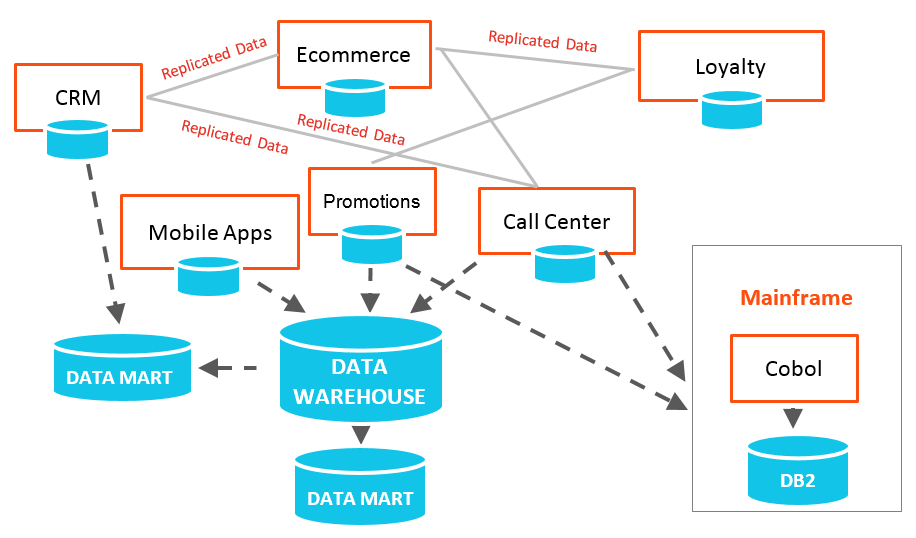
Getting a centralized view of the customer was difficult, if not impossible. First, it was due to the stove piping of the relevant data in an application-centric architecture. In tandem, data islands were created for analytics repositories.

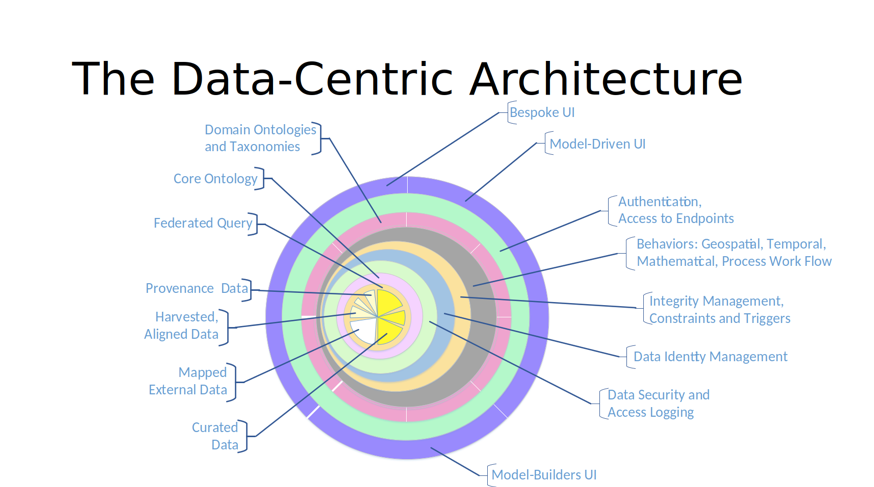
Now enters the “Data Centric Architecture.” Transformation to a data-centric view is a new opportunity for GSIs to remain relevant and add value to customer’s infrastructures. It is a layer deeper than moving to cloud or migrating to the latest, faster, smaller boxes.

A great way to help jump start this transformation is by rolling out Data as a Service offerings. Rather than taking the more traditional Storage as a Service or Backup as a Service approach, Data as a Service anticipates and provides the underlying architecture to support a data-centric strategy.

It is first and foremost a repository for collected and aggregated data that is independent of application sources. From this repository, you can draw correlations, statistics, visualizations and advanced analytical insights that are impossible when dealing with islands of data managed independently.

It is more than the repository of the algorithmically derived data lake. A Data as a Service approach provides cost effective accessibility, performance, security and resilience – aimed at addressing the largest source of both complexity and cost in the landscape.

Data as a Service helps achieve these goals by minimizing, simplifying and reducing the data and its movement within and outside of the enterprise and cloud environments. This is achieved around four primary use cases, which range from enterprise storage to backup and long-term retention:


Each of the cases illustrates the underlying capabilities necessary to cost effectively support the move to a data-centric architecture. Combined with a “never migrate or refresh again” evergreen approach, GSIs can focus on maximizing value in the stack of offerings. This approach is revolutionary.  In past, there was merely a focus on the refresh of aging boxes, or the specifications of a particular cloud service, or the infrastructure supporting a particular application. Today, GSIs can focus on the treasured asset in their customer’s IT — their data

How Do I Get My App Into The Google Play Store?

Google Play Store Gets New Interface: Did You Notice the Subtle Changes to Google Play UI?

No one can doubt the popularity and dominance of the Google Play Store in the domain of mobile applications and software.

The domain gets all the more solidified by the Play Store statistics that there are approximately 2.8 million apps on Play Store and that almost 3739 apps get released on it daily.

Numbers like these solidify how Play Store is an excellent option to upload your application on.

Now, if you are wondering “How to submit an app to Google Play Store” then end your quest here. We have covered end-to-end all about the process to upload an app to Google Play Store.

To put it out there, there are certain things that need to be done before the actual process of app submission begins. This is what we are going to attend to before answering the question of “How to get an app on the play store”, we will look at the pre-steps to publishing an application.

Without any further ado, let’s dive in.

Prerequisite of Submitting App To Play Store

Since this is your first time submitting your application to a gigantic platform, there are certain prerequisites that you must take care of in order to successfully upload an app to Google Play Store. So, without any further ado, let’s get started.

1. Test Your Application

Unit Tests & Data Coverage for Machine Learning Models - Data Analytics

It is needless to mention how crucial testing your application is. No matter how many incredible features you have packed into your app, if it does not perform upto the expectations of the user, it will be ditched like a hot potato. In which case, it is imperative for you to painstakingly test your app as many times as possible and be 100 percent certain that it is going to perform remarkably, before you look ahead to upload apps on Play store.

You can always use emulators for this purpose, however, using an  Android-powered device will make the testing process more effective. It will give the experience of using your app on a real device, as would users, and enable you to analyze any bugs or discrepancies.

2. Concise App Size

The App Design Process: A Guide to Designing Mobile Apps

In terms of applications, the size of the app matters a lot. Users do not feel inclined to download an app that takes too much space in their device storage. Moreover, Google only permits the app size to up to 50MB.

Although, if your app exceeds this limit, then you can use Android APK’s Expansion file, to successfully upload the app to Play Store. This will break your app into parts and each can be up to 2GB, giving an additional 4GB space to your app. This added data is saved in Google Cloud and is retrieved whenever the app is installed.

3. Get App Licensed

Web Development Mobile App Development Mobile Phone Web Design, PNG, 658x636px, Web Development, Advertising, Android, Application

Though this is an optional choice, it wouldn’t hurt you to get your app licensed before you upload your app to Google Play Store. Licensing your application will prove most beneficial for you if it is paid in nature. By adding the End User License Agreement, you will gain full control over your application which may help in the future, should any discrepancies arise.

  • Create your APK file with Bundle ID and Version Number
  • You need to prepare an APK file in which you can assign a version number to your application which will help you in the future when you need to upload a new update for your app. This number is mentioned in the code and would increase as the updates for the application are introduced.
  • Bundle ID, also called App ID, is used to make an application unique, making it a crucial part of the prerequisites for submitting your application. This is applicable for all the applications for Android 5.0 and above.

4. Sign App With Security Certificate 

Android Security: Certificate Transparency | by Matthew Dolan | Medium

Here, you need to create a private key using Release Keystore. This is a security certificate signed as an APK which you will need every time you publish an app to the Play Store. This is also known as JSK file including credentials such as Keystore password.

5. Prepare App Store Listing

How to publish your app on Google Play and the App Store? | GoodBarber

App listing is a powerful element that helps your application in gaining downloads. Not every one devotes their time on app listing but if you do this before android app submission, you will definitely see some mind-blowing results.

In the app listing, you provide some information to users about what type of application it is and what are its features. One of the best practices of app listing is using high-quality screenshots. Play Store requirements allow developers to use a maximum of 8 images and a minimum of 2.

Here are the best practices and what you should include in your app listing-

    • Title
    • Short Description
    • Full Description
    • Screenshots of your app (JPEG or 24-bit PNG)(Min-320px,Max-3840px)
    • Hi-resolution icon (512 x 512)((with alpha) 32-bit PNG)
    • Feature Graphic (1024 w x 500 h)(JPG or 24-bit PNG (no alpha))
    • Type of application
    • Category of your app
    • Rating of the content
    • Email of Developer or Company
    • Url for Privacy Policy

6. Go Through Guidelines

Crew App — LH CREATIVE

When it comes to App Store vs Play Store guidelines, it is safe to say that Google’s guidelines are more flexible, which works in favor of developers.

However, you have to be careful when you add an app to the Play Store and you would have to make sure you follow all the guidelines given by Google, lest your app will be kicked out of the platform. Now, this is something you would want to avoid at all costs, right?

Step-by-Step Process to Upload App To Google Play Store

Now that the obvious is out of the way, let’s move on to the steps regarding how to upload an app on Play Store. Make sure you follow each in the exact chronological order to avoid any mistakes in the process.

1. Google Play Developer Console

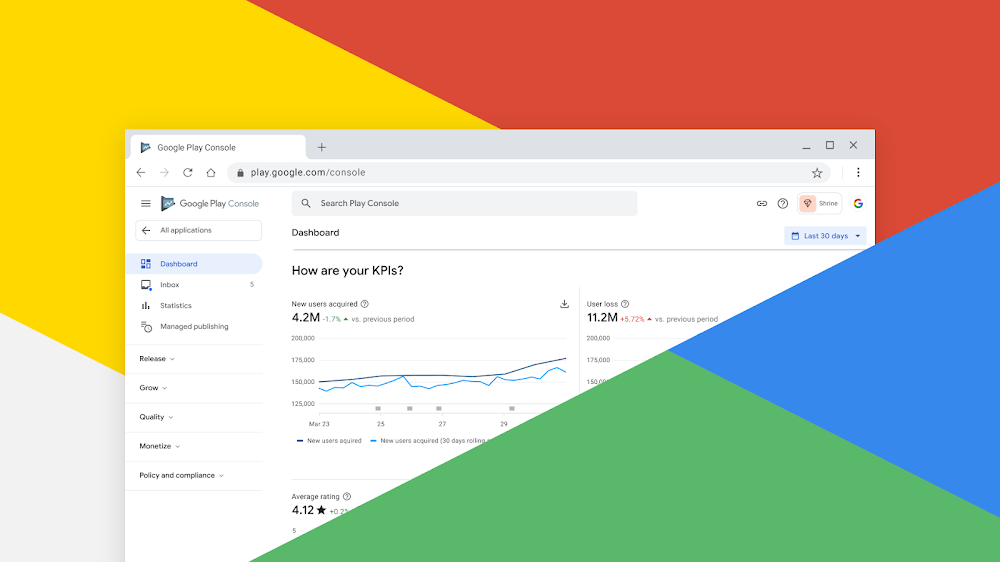
Google Play Console | Google Play Console

In order to upload a mobile app to Google Play Store, a developer dashboard is imperative. Developer console is kind of a backend controlling center, from where developers submit an app to Play Store. There is a one-time fee of $25 by which a developer can open an account, loaded with functions and control features. After paying this one-time fee, you can upload apps to Google Play Store for free.

You need to fill out all the credentials asked while creating the account, such as your name, country and more. Once you submit your account it will take upto 48 hours to get approved.

2. Link Developer Account with Google Wallet Merchant Account

Create a Google Merchant account – AppMachine Help Center

If the app getting uploaded to Play Store supports in-app purchases, then you will need a merchant account. To create one you can sign in to your Google Console account and click on ‘Reports’ followed by ‘Financial Reports’ option. After this, you may select ‘Set up a merchant account now’ option and simply fill out your details.

The merchant account will automatically get linked to your Google Console account and will allow you to manage and examine app sales.

3. Create Application

How To Submit An App To The Google Play Store | Clearbridge Mobile

This is yet another step towards how to publish an app to the play store.

Once you are logged into your developer or publisher account, here are a few steps you need to take:

  • In the menu, go to the ‘All applications’ tab
  • You will see an option ‘Create Application’ – select it
  • From the drop-down menu, choose the application’s default language
  • Enter your application’s title (it can be changed later)
  • Now, click on “Create”

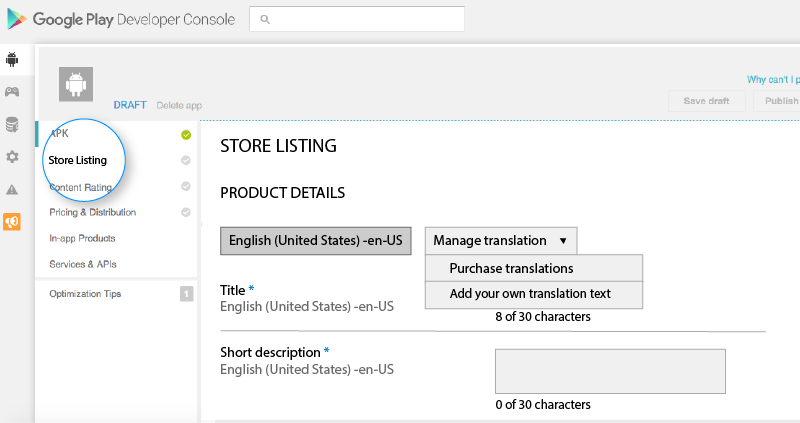
4. App Store Listing

Store Listing Panel

It is at this point, your preparations will come handy.

In this step around how to upload an app to the play store, you are required to fill out all the information and details you have already prepared with caution before. The table below shows what information you need to fill in the app listing-

Make sure to use appropriate keywords in your app description to increase the chances of your app showing up in searches. Along with this, make sure to use all the data we have talked about in the prerequisite section for app listing.

5. Upload App Bundles or APK To Google Play

How to publish Android appBundle to Google Play Store | by Andres Sandoval | Medium

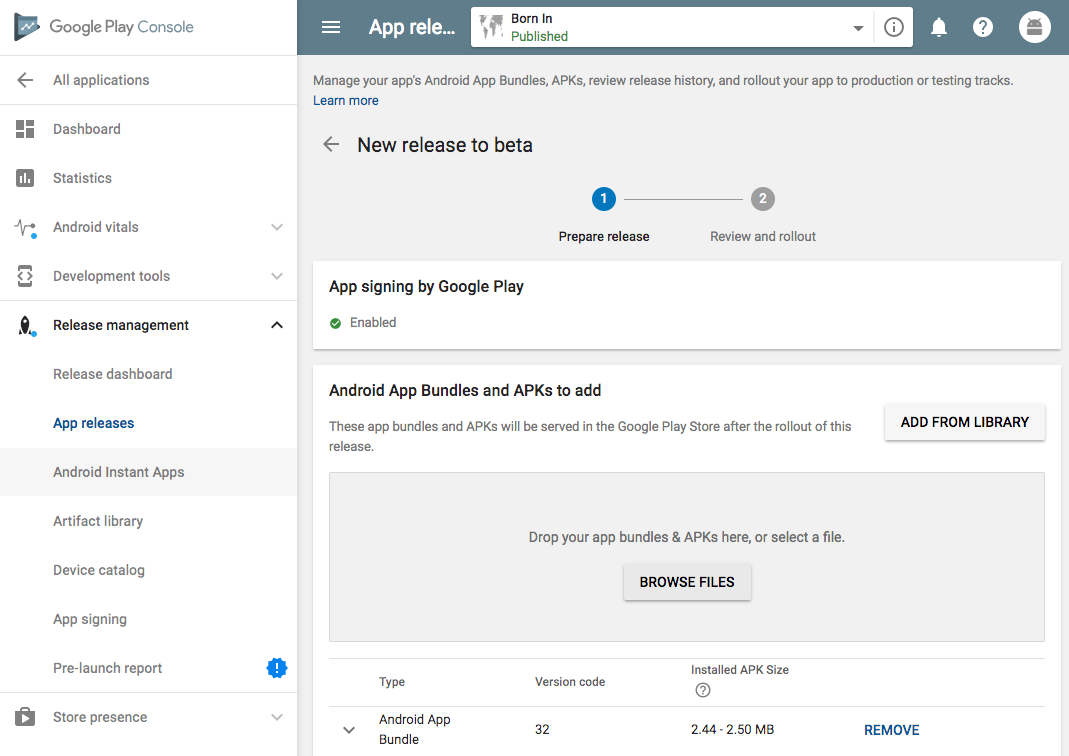
Now, you are required to use the files such as App bundle or APK and signed app release and upload them into your application. This is how you do it: Navigate to the ‘Release Management’ and then ‘App Release’ tab in the menu. After this, you will be asked to choose any one type of release from four options- internal test, close test, production release, and an open test.

Once, you have made a decision regarding which type of release you want, you may select ‘Create Release’.

At this point, you will be redirected to the New release to the production page. Here, you are again required to make another decision- to opt for Google Play app signing on the app or not. If you choose the latter, then simply click on the ‘OPT-OUT’ option.

Now, select ‘Browse files’ and then look into how to upload apk to google play store while naming and describing your release through on-screen instructions. You can also click on ‘Review’ to confirm the information. When everything is taken care of, press ‘Save’.

6. Time For Content Rating

How We Rate and Review | Common Sense Media

The next step regarding how to publish apps on the Play Store is to rate your app. This is crucial for it is listed as ‘Unrated’, it might get removed altogether from the store, so it is imperative to rate the application.

For Content Rating, you must again navigate to the menu on the left side of the screen and then select the same. By clicking on ‘Continue’ you can move forward and then type your email address in the respective field and then ‘Confirm’ it.

Now, you may fill the questionnaire for your app rating. Follow this by selecting the ‘Save Questionnaire’ and then choose the ‘Calculate Rating’ option to see your app rating on the Play Store. The last thing to finalize your app’s content rating is to click on ‘Apply’.

7. Fix App Pricing and Distribution

Complete Guide: How to submit app to App Store and Google Play

Now, you have to be clear about what countries your app is going to be available in. The point to note here is that Google doesn’t support publishing an app for all regions. The app will be published in selected countries instead of world-wide.

Moreover, assigning a price to your app is crucial. If you want your app to be free, make sure that this decision is permanent, as Google does not allow you to convert free apps into paid ones. Although, the price of the app can be altered.

To do all this, go to the Pricing and Distribution tab in the menu, and then make a choice whether your app is going to be Free or Paid. You may now select the countries you want your app to be released. Additionally, if your application is suited for children under the age of 13, you may select the option of ‘Yes’ for Primary Child-Detected. If otherwise is the case, simply select ‘No’. Similarly, select the options for allowing ads into your application.

8. Finally, Publish the Application

How To Upload An App To Google Play Store?

Once you are confirmed about everything being correct, take the last step of this guide on how to upload an app on Play Store, i.e, add the application to the platform. You need to go back to the ‘App Releases’ tab and then select ‘Manage Production’ followed by ‘Edit Release’. After this, click on ‘Review’ and then choose ‘Start rollout to production’ option. To bring this process to an end select the ‘Confirm’ option and Voila! You have successfully uploaded the app to the Google Play Store for free.

All there is left to do now is to just wait for your application to get approved. It generally took about two hours for your application to get reviewed. But with Google Play’s updated privacy policy, it will now take hours and even days for the same, encouraging mobile app development companies to create even more flawless applications that get selected instantly. So, hold your excitement in the place and just wait.

How To Get Your App Featured On Play Store?

How to get your app featured on the Google Play Store - Business of Apps

Your job to make sure the app gains popularity and thousands of downloads doesn’t end here. After successful execution of the steps regarding how to upload an app to Google Play Store, it is now time to get it featured on Play Store.

There are certain practices such as user interaction and visual design services, working on the latest technologies, localization, etc. that helps your app to get featured. Getting featured on Google Play can benefit your app to an extent that it increases the attention of users on your app by multi-folds.

What To Do After Play Store App Submission?

With the question of “How to publish an app on Play Store” answered, you might think “What is there to do next?”. Well, we have got you covered with this as well. Here are some practices you can do to ensure your application enjoys global exposure.

1. Promote App On Social Media

How to Promote an App on Social Media? | Promote Android App

Social Media is a great medium to skyrocket the popularity of your application. The fact that 42% of the world’s population uses social media is enough to justify the statement. There are some platforms such as Facebook, Instagram, Linkedin, Pinterest, and a lot more that are constantly in use. So, promoting your app on these platforms promises more traffic and eventually more downloads.

2. Initiate Press-Release

PRESS RELEASE! — Foundation to Fight H-ABC

Press-release is another way through which you can promote your brand. With this, your brand will come into limelight and many publications will cover your app release which will eventually allow your app to reach a wider user base and develop an authentic connection.

A press release that covers the words, attributes and insights of the mobile app developers and application itself has proved to be an incredible app marketing strategy. It is a great example to show users that what they expect is good.

3. Focus On App Maintenance And Update

Mobile App Maintenance and Support Plans Sydney | DigiGround

You cannot just publish your application of the app store and let it be. You need to efficiently maintain your application and introduce frequent updates, attending to the issues and bugs faced by users. Maintaining something is a constant task rather than a one-time thing. So, make sure you keep your app updated with the latest tech-stack and fix whatever needs fixing.

4. Practice ASO

ASO: App Store Optimization ? SEO Guide for Google Play & App Store

App Store Optimization is a celebrated practice among all the top Android app development companies. Famously known as ASO, it primarily focuses on the activities which target aspects that can generate more attention and visibility of your application of the app store. These practices are focused on increasing the conversion rate of impressions into downloads on the application.


Become An Immaculate Designer

But, if you’re a designer who is a fan of the term ‘hot fixes’ and you roll your eyes at the mention of ‘iterations’, this blog is for you!

I know it’s frustrating when people just don’t get the art in your design. I know the tantrums, the bouts of criticism that clients throw at you all because the submit button was red, not green.

Bloody quibbler!

But you know what, forget it.

*sigh*

Don’t ever lose the feeling that you were put on this earth by the God of Design themselves. Users and designers don’t understand what it takes to build masterpieces.

So, let’s shine some light inside the mind of a despicable designer and try to look at life from their perspective-

Screw the users and their problems

You should start practicing the mantra — a good designer always designs things for themselves. Period.

Users Moosers.

It shouldn’t even come into the picture. You should automatically assume the personas, it’s no big deal. You spent years studying this in school.

Just pretend that you understood their problems. Resist frequent changes.

What people don’t understand is that you have already put your blood and sweat into the project. They will always ask for more. Because perfection is a state of mind. It will always be relative. They will try to throw into the vicious circle of ‘Design. Take Feedback. Repeat’.

Fall back. And charge with arrogance.

Repeat it after me- User knows nothing. They just don’t get it. They never will.

Copy your favorite designer’s work. Blindly.

Whether you are a pro or a beginner, someone will be always better than you. The world is full of them. I never understood this, what’s the big deal about copying work? Find your godfather designer and copy his/her ideas. It’s the right way to learn. How do you think great designers are made? They follow their idols.

If you are a newbie designer, you need to have an industry perspective. And for that, you need a person who has already been in the industry for long. So stalk his/her portfolio and binge copy his/her designs.

You need to do renovation before you start doing innovation, right?

Haters gonna hate!

Alignment is just a passing fad

Always remember- Design means decoration. What looks good, sells well. A good designer always draws what catches his attention. Alignment brings monotony into designs and the job of a good designer is to always bring in contrast.

So, throw elements randomly on the page. It would help the users spend quantity time (don’t worry about quality) on your pages thus making your application a success.

Consistency is the hobgoblin of little minds

As a designer, you should only believe in one kind of consistency — being Consistently Inconsistent. That would always keep the users on their toes. If the Call to Action button has been rendered green on one screen, make it red on the other. Give users a chance to learn new things on every screen. The more variety they encounter, the more they would swear by the freshness of your design ideas.

Keep your emotions at bay

Design fanatics will try to make you think about users. What do users want? Why they want what they want? Do you know things like user’s journey, user’s persona, user’s birthday, user’s pet’s name?

Go to hell, you want to yell! I know!

If you start thinking about all this, when will you design? Half of the time, even users don’t know what they want. They are fickle-minded. You are the one with expertise and experience. You went to college, studied sixteen hours every day, submitted research papers. Not them!

Era of AI in Cybersecurity

Artificial Intelligence to revolutionize cybersecurity

Palo Alto Networks study highlights preference for AI management of cyber  security – Risk Xtra

Cyber attacks are increasing rapidly these days and the trend for zero-day attacks is also not so unknown. To cope up with these evolving cyber threats, it is the need of the hour to be prepared with more advanced counter mechanisms. This is where AI in cybersecurity comes into play.

These days there are tools and security devices that use AI to make the attack detection and prevention process easy and automated. AI in cybersecurity helps to bring out the concepts of behavioral analysis, automation, and many more that help to create a new space in the field.

Role of AI in cybersecurity

AI has opened new horizons and opportunities to detect and mitigate cyberattacks. Every day multiple cyberthreats are born and increase the attack surfaces of the firm. AI in cybersecurity helps to delve deeper into the key areas to find the threats and adjust itself in a suitable way to mitigate them.

AI can identify and prevent cyberattacks

AI has lots of reference modules and predetermined attack engines that helps the user to detect the inbound cyber attacks easily. Some attackers use predefined scenarios, methodologies, and techniques to attack websites and applications. By using AI-based detection techniques, it will be easy for the user to identify the attacks. Once the ongoing attacks are identified, you can add some of the pre-requisites in the AI engine that will help you to mitigate the same.

The automation of cyberattacks

The Real Challenges of Artificial Intelligence: Automating Cyber Attacks |  Wilson Center

AI in cyberspace is rapidly growing and is both boon and bane for the industries. Whereas on one hand, the application of AI in cybersecurity helps to automate the process for mitigation of cyber threats, it also helps malicious actors to create automated cyberattacks. These attacks are pre-programmed based on the analysis of threat vectors of the organization and attack the same in various ways.

The latest research shows that the threat landscape is increasing these days due to the presence of the open-source AI-enabled hacking tools and software. Within the report, the cybersecurity firm documented three active threats in the wild which have been detected within the past 12 months. Analysis of these attacks — and a little imagination — has led small attackers like script kiddies and newbies to create scenarios using AI which could be more dangerous and threatening.

Impact of AI in cybersecurity space

The presence of AI in the cybersecurity space has opened new horizons for attackers and defenders. The landscape of cyberspace is changing its demographics due to the presence of AI, which proves to be uncertain and unbiased. Sooner or later it is going to be the key differentiator between both the veils.

The AI has helped the cybersecurity researchers and continues to do the same in all the way possible.

The presence of the AI has impacted the cyberspace on the following grounds:

  • Identification of the threat
  • Mitigation of the threat
  • Vulnerability assessment of the organization
  • Constant monitoring of the organization’s threat posture
  • Helps in reporting and accounting of cyber threat of the firm


Approaches of Developing a Digital Strategy

B2B Digital Marketing Strategy, Tactics & Examples

Products built by aerospace and defense companies are highly engineered and sophisticated, which means they’re often complex. That’s not a bad thing. But they’re also complex in ways that are undesirable. Products and their constituent parts are tracked in dozens of systems –from design to manufacturing to maintenance — which can result in an average of 26 different reference numbers for each part.

The drive to digital transformation is helping A&D companies recognize that situations like this, which arise from a lack of governance and the absence of an enterprise-wide data strategy, have created substantial costs and risks that have to be addressed to realize the full benefits of digital transformation.

That’s especially true for companies that want to establish a “digital thread” for products and parts throughout their systems. The ability to follow any part throughout the A&D value chain (design, manufacture, service) by following a single digital ID will help A&D companies recognize tremendous cost savings. A digital thread also provides a glass pane for status, reduces rework and errors, improves security, and helps manage compliance and regulatory issues with greater efficiency.

That sounds great. But the key question for many companies remains: How do you get started with an endeavor like that? Many organizations fail to prioritize defining a data strategy on the grounds that it’s either a case of “boiling the ocean” or else an “infinity project” that will deliver little value.

A few key points can help your company move toward a data strategy that allows you to pursue the rest of your digital transformation agenda.


1. Make an affirmative decision to manage your data.

All companies make decisions about how they engage with, operate on and leverage their data — whether at an enterprise or project level. Even if a company has no formal data management policy, that in itself is a decision, albeit one that leads to the situation many companies find themselves in today. On the other hand, companies that form a holistic point of view in adopting an enterprise-grade data strategy are well positioned to optimize their technology investments and lower their costs.

2. Establish executive sponsorship and governance.

Sustaining a successful data strategy requires alignment with corporate objectives and enforced adherence. As corporate objectives evolve, so should the data strategy — keeping up not only with how the business is operating, but also with how supporting technologies and related innovations are maturing. This means including representatives from all the domains that are involved. It also means assigning someone with the authority to resolve conflicts between groups. This is a key element to helping federate data across silos and moving to a data hub approach, thus eliminating the need to maintain 26 different part numbers for a single item.

Sustaining a data strategy also means making a specific investment in personnel. Companies that embrace the constructs of a data strategy often define dedicated roles to own these strategies and policies. This ranges from augmenting executive and IT staff with roles such as chief data officer and chief data strategist, respectively, to expanding the responsibilities of traditional enterprise data architects.

digital strategies

3. Get started by instituting good data management practices in smaller programs.

Success demonstrate the value that data management can deliver at a small scale and what it could potentially deliver at the enterprise level.  Applying an Agile methodology, which continually demonstrates short bursts of success, will help gain momentum (like a snowball rolling down a hill) and organizational acceptance.


As with any business or technical process, a data strategy has its own lifecycle of continual evolution, maturity, change and scale. But the benefits it makes possible—for example, the ability to construct a digital thread for products and parts—will far outweigh the investment that’s required.

For a thorough view of the process that’s involved in setting digital strategy, read the whitepaper Defining a data strategy by my colleagues, Aleksey Gurevich and Srijani Dey. It offers a concise view of the components of a winning data strategy as well as the steps needed to implement, maintain and evolve it.

error: Content is protected !!