Product Development: Cruciality of decisions & risk log

If you are a product manager you would have experienced at least one of the below scenarios.Scenario 1: During a meeting with partners (we refer to our clients as partners), a conflict surfaces while recalling the reasons for a particular decision in the past. You have one version of the story while the partner remembers an altogether different version or, worse, doesn’t remember anything about the decision.Scenario 2 : A new team member joins the team. During a discussion, he/she asks “why are we doing it this way” and you go blank. You need time to recollect your thoughts to give the right answer.

Scenario 3: Before starting the project, you identify risks that might arise during the development phase. Your partners ignore it and give you a go-ahead. Months later, when you start facing technical issues and convey it to them, your partners don’t remember the conversation you had at the beginning of the project.

Scenario 4: During knowledge transition sessions, you share everything that you know about the product’s development history. But you fail to remember when and why this decision came into existence. It’s difficult to recollect exact conversations that led you to take this decision. It’s all in the email threads but even those emails are hard to find.

Do you feel deja-vu reading the above scenarios?

I do. I have lost count of the times I’ve faced these scenarios. I am sure you would have faced them too sometime in your career. It’s not that I haven’t tried anything to overcome these challenges. I have tried different things apart from discussing over calls with our clients/partners-

  • Mentioning all the important decisions in emails
  • Mentioning all risks in the initial proposal
  • Mentioning new risks in the emails as they come
  • Sending MoMs with a defined structure- discussions, decisions, action items
  • For any kind of technical decision, attaching an analysis document in the respective JIRA ticket and adding a comment with the final takeaway.

But, the truth is, as the product grows and the team expands, searching emails for MoMs and referring to JIRA tickets doesn’t make the cut.

Especially if you are working on a big project that goes on for years. After a time, recovering JIRA tickets and long email threads feels like digging the Earth for a dead body. I myself have faced this while recalling why we decided using Inspectlet over Fullstory? Or, why did we decide to push the MVP deadline?

So, what’s the solution?

When I started looking for a solution to this problem, I discovered that I am not alone. A lot of PMs face this problem. Thankfully, there’s a solution to tackle this problem. A product manager can maintain registers/logs for a product that can help him/her remember important product decisions. These two logs are-

  1. Decision log
  2. Risk log

Decision log

A decision log is a centralized list of all critical decisions taken throughout the product’s life cycle. It can be a business decision impacting the delivery, a technical decision, a process decision or a people decision.

This helps in effective communication in the present and then in future for recall times in conflicting situations.
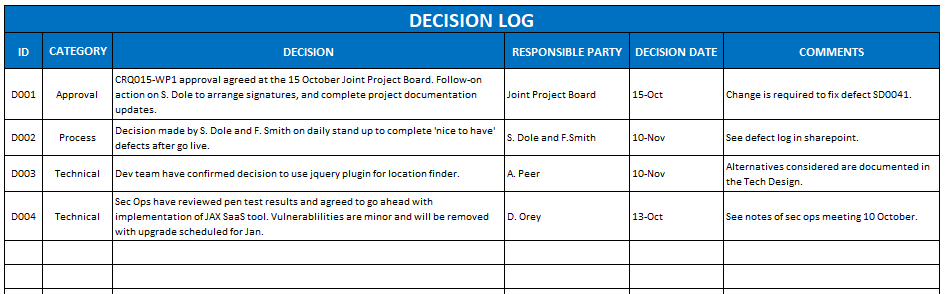
Decision Log Template | FREE Download

What goes inside a decision log?

  • What is the decision about?
  • When was the decision made? (Date)
  • Why this decision? Pros and cons, if any.
  • Who are the contributors? Who is the approver?
  • Outcome of the decision?
  • When the decision was proposed?

Risk Log

It would be a centralized list of all potential risks and issues identified throughout the product life cycle. This includes all the information of the identified risk – nature of risk, level of risk, mitigation etc.

Many times, we maintain the product risk log for internal purposes only. But, keeping it open with all stakeholders really helps.

How do I create and use a Risk Log?

What goes inside a risk log?

  • What is the actual risk?
  • What is the impact of the risk?
  • When was this risk identified?
  • What is the impact level?
  • What is the probability level? (PB Level)
  • Priority level (PR level) = Impact level * Probability level  (PB Level)
  • Who is the owner?
  • Are there any mitigation notes?
  • What are the recent updates?

When to list a risk?

All the risks should be identified and communicated to the stakeholders using the Risk Log itself right at the beginning.

After that, risk identification should be a recurring activity. You can make it a part of your sprint rituals – sprint planning, retrospective or even in your daily scrum meetings.

Risks can be identified by anyone – Stakeholders, Leads, PMs, Designer, QAs or Developers.

Just as in decision log, a risk’s priority could change in future or a risk could become an issue (i.e. already occurred). You can read about Risks vs Issues. Hence, at a given time the risk register should show the updated risk information.

Also, once the risk becomes an issue it can go to the Issue Log which is the same as Risk Log and usually kept in parallel.

In short, maintaining Decision and Risk logs in your product might be an additional task for you in the starting. But, once it becomes a part of your process, it really proves beneficial in the long run. You can use it to-

  • Keep everyone on the same page.
  • Save time in debating/recalling the reasons for a particular decision.
  • Avoid “We told you so” situations that become the root cause of conflicts..

7 virtual onboarding practices in the new normal

One of my ex-colleagues left her job to move to a new organization in Feb 2020. She worked in her new workplace for one month before the world shut down. Just like everyone, her entire organization shifted to remote. A few weeks into the lockdown, I called her to catch up. We talked about random things and she told me that she badly missed Anteelo– the people, the culture, and the feeling of oneness.It wasn’t that her current organization didn’t have a good culture. No. In fact, she was happy in her new role. Her peers were friendly, the work was challenging, and her leader was supportive. She just missed the camaraderie in her new workplace.
My friend is one of those rare people who kickstarts conversations, takes initiatives, and makes friends easily. But in the new organization, she felt limited by the barriers created by remote work. Before lockdown, she hardly got much time to bond with her colleagues and now in the lockdown, whenever she tried a new initiative, it crashed after leaving her circle of influence (which by the way was limited to her team). All of this despritied her.

And she isn’t alone.

The feeling of ‘I don’t have any friends at work’‘I still feel like a stranger in a foreign land’‘I don’t think anyone likes me here’, is quite common. And though, it’s normal to feel these emotions in the initial few months when people are settling in, but beyond that, they are a RED FLAG.

A dissatisfied new hire is like a person standing at the edge of a mountain. We can’t let them slip.

One of the solutions to tackle this problem is to spend more time onboarding them — defining the relationship with the new hire sets the right foundation.

A good onboarding practice ensures that the new hire is aligned with the vision of the organization and has enough resources and support to wade through the nitty gritty of how things work in the organization. A good onboarding is like a first impression. If you get it right at the honeymoon phase, you’re likely to be together for a long time.

But all this was easy when a new hire joined in a physical workplace. The part where they met their peers, received a warm welcome at their desk, participated in onboarding rituals, all of this added a personal touch to their onboarding experience. If they had any concerns, they could easily reach out to people, or ask for help. Their problems were addressed in real-time, and were given importance (and precedence) over other regular day-tasks.

Those were old days. Sigh!

In the new world order, the physical distance has posed a new challenge to integrate the new hires into the organization’s soul. So how does one ensure that the new hires receive the same (or even better) virtual onboarding experience and feel welcomed.

I can share a few changes we made to Anteelo’ onboarding process. It’s not bullet-proof. But I like the fact that we acted fast and made changes well in time.

Interact with the new hires before they join


Hiring Process Steps for 2021 | SmartRecruiters

In the new normal, we started a new practice– after new hires accepted the offer to join the organization, we spent some time connecting with them informally. We shared our excitement about welcoming them in the team. We also gave them an overview of the project they’ll be working on and shared a little bit about the existing team members so that they knew whom they’ll be working with.

If you wish to imbibe this practice, you can add some extra elements like talking to them about their expectations, their feelings about joining your organization and so on. The idea is to make them comfortable and let them know you’re expecting them to join your tribe soon.

Involve the existing team members in the onboarding process

7 Mistakes to Avoid While Hiring Dedicated Development Team

In the old normal, team members were the first ones that got acquainted with the new joinee. The team was responsible for making sure they went together on lunch and coffee breaks and made the person comfortable.

In the virtual setup, none of this is possible. But that doesn’t mean that we shouldn’t make efforts to make the new hire feel welcomed. At Anteelo, we tackled this problem by taking turns on video calls and talking to the new team members on their first day. Every time a new Quant joined our team, we asked him/her about their day, and if they needed any help.

These are little things, and you might feel that you’re interrupting/disturbing the new person. But it’s the only way to ensure that he/she feels comfortable in the new setup.

Give them a virtual tour of your office

Accessibility in Agile Team Practices | Deque

We all are itching to go back to our cozy nook in the office, to feel the warmth of workplace vibes, to smile, greet, bump into each other. Imagine the enormity of this itch in new hires– how does my new workplace look, where would I sit when I join the office, would there be a coffee machine, a foosball table, a breakout area?

I bet there are other questions too that they go through in their mind while making the decision to switch. One of the solutions that we discovered is giving a virtual tour of the office through videos/photos. It not only settles their curiosity and piques their interest, but also helps build familiarity with the organization.

Retrospect on your onboarding kit

Is It Time to Fix Your Onboarding Process? | HRExecutive.com

Earlier our onboarding kit consisted of a laptop, a bag and a notebook. We thought of it as a whole because our other practices complemented the physical kit. We spent hours talking to the new hire– introducing them to everyone, aligning them to their peers, and being with them through every step of the onboarding.

This year, we asked ourselves– what else can we add in the virtual onboarding kit so that it brings a smile on their face? We wanted to keep the gesture small but impactful. So we designed a greeting card that welcomes the new team member and added a small potted plant in the virtual onboarding kit.

The card has a message to welcome them to our team. The potted plant is a gesture of how we wish to see them grow with us, just like the plant. It’s a small change, and we’re happy everyone likes it (so far).

Set up a central repository of resources

Recruitment Process - The Ultimate Guide to Hiring Top Talent | Jobsoid

The shift to the remote setup was abrupt. But, it made us realize the mistakes we were making earlier. We realized that it’s unfair to expect new people to remember everything. Going through all the information related to the organization in one go is exhausting.

So we made the shift to a digital setup by making a central repository of every information. Everything is now available on Zepplin — be it leave guidelines, WFH manual or core values of our organization. We let our new team members be the owner of how, when and through what medium they want to access information.

Engage with them regularly

What is Customer Engagement? A Complete Guide

A regular practice to engage with new team members is to give them a stack of PDFs, videos, and presentations about the organization. It’s easy to consider that the new team member will find what they need from this Pandora box of information.

We made a shift in our mindset. We started engaging with our new team members regularly through weekly, monthly 1:1s and began asking them how it was going. By making them participate in pop quizzes and activities around our practices and vision, we eased out their familiarity with the organization.

Couple them with a work-buddy

The Dos and Donts of Onboarding New Employees in a Call Center

A buddy at work is like a friend who can steer you through a freshman party and help you make new friends. At Anteelo, we always had the buddy system. In the remote setup, being a buddy to a new hire turned out to be an even bigger responsibility.

So we tweaked the guidelines a bit and motivated the work-buddy to be more open, approachable, and proactive in their conversations with the new Quant.

Apart from these virtual onboarding practices, you can even leverage social media to your advantage. By welcoming people on your social media platforms, introducing them in your network, you send them a message that you’re welcoming them wholeheartedly.

Good onboarding practices help you retain the talent for a much longer period. So, make sure a new hire’s first few months are positive and productive.

Secret to Patient Encounter: Never Skip Small Talk!

Small talk is delightful. It’s an easygoing, inconsequential conversation where you’re not running to reach an answer. It flows like wind, from one talker to the next. Small talk appears trivial, but it’s a way for strangers to know each other and for friends to bond over little details.In office, people indulge in small talk during watercooler run-ins, in elevators, and in big meetings where they don’t know each other. Small talk is used to break the ice with casual questions like ‘how are you?’, ‘How’s the weather in your city?’, ‘How was your day?’.In human conversations, small talk serves many purposes. It’s like a bonding ritual. If the two people are meeting for the first time, it acts as a conversation starter. But if they already know each other, it serves as a conversation kickstarter before diving into the real conversation. Small talk is the foundation of good conversations and great relationships.

In a chatbot, small talk enhances the user experience by bringing a feeling of connection. By adding answers to inputs like ‘How are you?’ and ‘Are you really a robot?” in the chatbot’s architecture, we make it less robotic and more humane. We give our chatbot a human character that builds an invaluable connection with the user.

How can small talk help in a healthcare chatbot?

COVID 19: Driving Chatbot's Growth In HealthCare Industry

A good healthcare chatbot is the one that answers users’ questions with accuracy, timeliness and empathy.

But a great healthcare chatbot is the one that understands the moods of users, urgency of the situation and answers accordingly.

For instance, when you’re panicking about waking up to bloodshot eyes, the chatbot calms you down with some first-aid steps. If you’re in a rush to book an appointment, the chatbot sends you proactive information on which doctor is nearest to your location. If you’re feeling low, the chatbot brightens up your mood with some light-hearted conversation. Just as a good friend would do.

The highlight of the above conversation is the personal touch in the conversation. It doesn’t feel like we’re reading a conversation with a chatbot. That’s the magic of small talk. Phrases like ‘that’s dreadful’, ‘wish you a speedy recovery’, add a human element and creates a connection of care between the bot and the end-user.

Small talk in a healthcare chatbot also helps create trust. It eases them through important and time-sensitive tasks— like emergency calls to ambulances — with empathy. Contrary to this, robotic responses in yes or no and apathetic comprehension of chatbots frustrates users and they go elsewhere in search for answers.

But how can chatbots mimic human-like conversations and engage users in delightful conversation? By leveraging the power of AI and NLP.

How to implement small talk?

Small Talk Dataset for Chatbot - Free Dataset List - The Chatbot Business Framework

There are certain guidelines that one can follow to tailor such conversations.

  • Decide the voice and tone of your chatbot. Every response should reflect the personality of your chatbot.
  • Initially, you’ll have to hardcode some of the small talk in your chatbot. So, brainstorm ways in which users can ask questions. Do some research and make some educated guesses to decide on the most relevant questions that your targeted audience may ask. Cover the edge cases as well– from casual questions to genuine queries that users might ask.
  • Write answers to each question as per your understanding.
  • Keep the small talk brief and clear. Don’t go too far from the crux of the conversation.
  • There can be multiple levels of small talk. Each parent question can have a child query. The child query can only be asked when the parent question has been asked by the user and the chatbot has responded to it.
  • Small talk should always be accompanied by a call to action or a solution. Example- You: “Do you really exist?” Chatbot: “Yes I exist as a computer program. An intelligent human created me, so you can trust me. How can I help you?”
  • Train your chatbot to learn from the conversations of small talk.
  • Small talk is language-specific. So give users an option to talk to the chatbot in their native language.

Small talk makes the interactions with chatbot intuitive. By adding a small talk feature, we can increase the number of conversations and engagement levels of the user with the chatbot. So, if you have a healthcare chatbot, consider incorporating small talk. It doesn’t even require you to do a complete overhaul of your chatbot development.

Next Big Threat? – Polymorphic Attacks

During the first half of 2020, cybersecurity analysts and security experts have discovered that most of the phishing attacks conducted through the use of spoofed login pages. Polymorphic phishing attacks are on the rise in recent times as hackers are coming up with new ways to create spoofed login pages that are almost unidentifiable. This is one of the most frequently used methods implemented by cybercriminals for stealing the credentials of employees and users.Researchers have disclosed that more than 50,000 spoofed login pages replicating 200 popular international brands have been circulating since 2019.

This sudden increase in the number of polymorphic phishing attacks is because spoofed login pages are extremely difficult to identify but are comparatively easier to generate by hackers. Automated phishing kits that are illegally sold over the dark web, are deployed by cybercriminals to instigate these malicious phishing campaigns and to trick employees on a wider scale. This is why phishing awareness and training has become absolutely imperative in organizations in the 21st Century. As a CISO or CIO of your company, taking adequate precautions to prevent polymorphic phishing attacks is the need of the hour.

All you need to know about Polymorphism 

In a polymorphic phishing attack, attackers usually make minor alterations in the sender ID of a valid source or spoof an email address. They use social engineering attack techniques to make sure that the spoofed email ID replicates the authentic ID. The hackers then send these malicious emails to the employees in reputed organizations. More often than not, the email lands into the inbox of employees due to the lack of proper email authentication protocol in the company.

This malicious email comes with a link or attachment that redirects the employee to a spoofed login page. The login page asks for the employees’ corporate credentials and passwords. Ill-informed and unaware employees can easily fall for such polymorphic phishing attacks and give up their company login credentials on the spoofed page.

This information is used by hackers to extract valuable data of the company, gain access to company assets and financial information, find out personal details of employees working in the company, and conduct other fraudulent activities.

42% of all phishing attempts in 2020 were as a result of Polymorphism, as per a global survey conducted by security researchers.

According to security officials around the world, while these login pages are fraudulent in nature, they look extremely similar to original webpages. This is why cyber attackers use Polymorphism techniques to phish employees via spoofed login pages and succeed at it.

A cybercriminal can make minuscule changes in the email address so as to replicate a popular brand as closely as possible to skip detection. Since the changes made are very minor, such emails easily evade email security checkers, and email security tools may fail to detect them.

The most probable reasons for the increase in the number of spoofed login pages may be due to the following two reasons:

  • CISOs, CIOs, and SOC analysts of the reputed brand whose landing page has been spoofed seek ways for taking the fake pages down. This makes the hackers create more new pages so that it can continue to spoof employees.
  • Certain brands or companies may be an easy target for cybercriminals due to the lack of a well-rounded workplace security policy in their organization. This is the reason why attackers get away with polymorphic phishing attacks.

How to Detect Spoofed Login Pages?

While it may be difficult to detect spoofed login pages and prevent being phished, there are certain ways by which one can attempt to understand whether a login page is from an authentic source or not. Before being redirected to a login page it is always advisable to check whether the email is from a valid IP address as well.

This can be done by paying attention to the domain name and subdomains, as attackers might make minor changes in the same to trick employees. It also advisable to check whether the email has a relevant subject, is grammatically correct, and doesn’t provide lucrative offers or instigate a sense of urgency. After making sure of these pointers and clicking on the URL in the attachment when the login page opens up, employees must make sure:

  • While hovering over the URL it is redirecting them to the desired page
  • The login page is well-designed and all the hyperlinks on the page are fully functional and redirect them to the desired pages
  • The URL of the webpage is secured over HTTPS
  • The page doesn’t ask them to disclose their corporate credentials or bank account details and password since such information should never be submitted on external platforms

Polymorphic Phishing Attack Prevention and Solution

As a CISO in your company, implementing a robust cybersecurity policy in your organization is imperative. To achieve this, security analysts may take help from the IT department and implement security solutions and tools in their respective organizations. A phishing attack awareness and training program can help employees to gain better insights on social engineering attack vectors. Proper awareness among employees can reduce the chances of polymorphic phishing attacks.

cyber attack awareness and training program starts working by simulating sophisticated impersonations of real-life cyber attacks on a company’s employees. A number of simulations are perpetrated to increase security awareness.

After this, the training procedure is initiated, by imparting knowledge on the various types of attack vectors. This is done through awareness content giving detailed insight on them, visual presentations on attack identification, as well as video lectures and advisories on the same. Regular cumulative assessments are then taken to ensure improvements and initiate a better response against attacks.

Detailed analysis of simulation reports is provided to track results and monitor progress made via assessments and knowledge imparting sessions taken by employees.

In order to prevent employees from falling prey to phishing attacks, it is imperative for CISO and security officials to implement AI-driven cybersecurity solutions. By upgrading your workplace cybersecurity policy and implementing leading-edge cybersecurity solutions in your company, it is possible to ensure protection against polymorphic phishing attacks.

Wonders of CSS3

Wonders of CSS3

How your site feels and looks to its visitors is a huge determinant of the user experience (UX) offered on it. Site developers and designers leave no stones unturned to make their website’s style and design line up with its utility and functionality to give it a comprehensive look and make it practical. The most crucial decision amongst this is the successful utilization of CSS and its features.

Since its previous version, CSS3 has taken a giant leap and emerged as one of the most brilliant technological advances in the web design industry.  With CSS3, internet browsers locally produce plenty of styling effects that were once just feasible through inventive HTML hacks and editing software like Photoshop. What’s extraordinary about CSS3 is that it’s exceptionally amazing at lessening the requirement of pictures and code that you previously had to put on your site as a significant aspect of your structure. This implies decreased server requests and loading time for your website. This article talks about some of the most striking CSS3 features, which will help you to augment the feel and aesthetics of your project effortlessly

Features of CSS3

1. Advanced Animations

Facing Advanced Animations

We can utilize both Transition and Animation when it is required to change a component starting with one state moving/transitioning onto the next. The thing that matters is that animation can be comprised of numerous states, giving command over its animation. These animations are now available and compatible with all browsers.  There are two different ways to make CSS animations. The first is simple; it is done through animating the progressions of CSS properties with the transition assertion. With transitions, you can make float or mouse down effects, or you can trigger the animation by changing the style of a component with JavaScript.

The second route for characterizing animations is more complex- it includes the portrayal of specific moments of the animation along with the code. This enables you to have recurring animations that don’t rely upon user activities or JavaScript to get activated.

2. Multiple Backgrounds & Gradient

Advanced effects with CSS background blend modes - LogRocket Blog

With multiple backgrounds, creators can accomplish extremely intriguing impacts. They can stack various pictures as backgrounds of a component. Each picture (or layer) can be moved and animated effortlessly. CSS3 features also include the provision of having gradients in the background. Gradients enable website specialists to make smooth advances between hues without turning to pictures. CSS gradients likewise look extraordinary on retina displays, since they are created the moment the page loads. They can be straight or outspread and can be set to repeat.

3. Multiple Column layout

Multi-column layout with bootstrap - Stack Overflow

This CSS3 feature incorporates properties to enable web designers to display their content in multiple sections with alternatives like column-width, column-gap, and column-count. Column-based formats were previously hard to pull off in CSS. It normally included utilizing JavaScript or server-side processing that parts the content into various components. This is superfluously convoluted and wastes valuable development time. Luckily, presently there is a route around this by utilizing the CSS columns rule.

4. Opacity

CSS | Opacity / Transparency - GeeksforGeeks

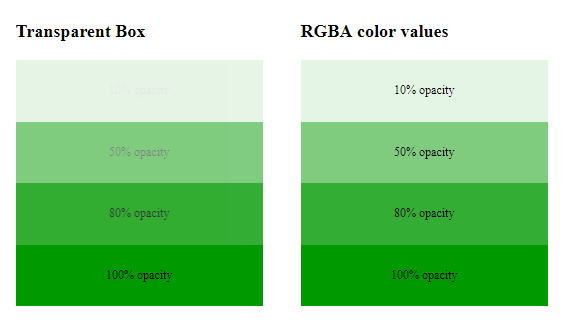
This property can make components more transparent. You could approach setting the opacity of a picture in a picture manager or photo editing software, and afterward, save it as a .png or .gif document with opacity enabled. Or on the other hand, you could simply get this done with a single line of code in CSS. It’s up to you. The opacity ranges from 0 (totally transparent) to 1 (totally opaque).

5. Rounded Corner:

Sketch Quick Tip — Different Rounded Corners for a rectangle | by Kumar Saurav ? | Screens | Medium

Greatly utilized by the social media giant Twitter, this CSS3 feature is already very renowned on the web. Rounded corner components can tidy up a site, however, making a rounded corner requires a web designer to compose a great deal of code. Modifying the stature, width, and location of these components is an endless task in light of the fact that any adjustment in content can break them.  CSS 3 tends to simplify this issue by presenting the rounded corner property, which gives you the equivalent rounded corner impact, and you don’t need to compose all the code. Truly, rounded corners simply look more appealing and easy to use than square boxes. The best part currently is, you can apply this effect to HTML components with CSS3. That is the reason why you’ll discover rounded corners all over the web.

 6. Selectors

CSS Selectors 101

Selectors enable the web designer to choose on increasingly precise degrees of the website page. They are basic pseudo-classes that perform halfway-matches to assist in coordinating with crediting and trait esteems. New selectors focus on a pseudo-class to style the components focused on the URL. Selectors likewise incorporate a checked pseudo-class to style checked components, for example, checkboxes and radio buttons.

CONCLUSION

Cascading Style Sheets Level 3 (CSS3) is a version of the CSS standard utilized in the styling and designing of Web pages. CSS3 features fuse the CSS2 standard with certain progressions and upgrades. CSS3 is a fantastic asset for Web creators. From the time CSS3 has been presented, there has been a superior control over the exhibition of content on a site. Regardless of where we choose to utilize our programming capacities, it will be seen that web advances are really basic and important to take advantage of on each stage. Give CSS3 a try and utilize it in case you’re making a site. Mess around with it. You’ll find it very intriguing to work with its cutting edge features while also sparing yourself a great deal of time that you would have otherwise spent to make precisely the same thing in a photo editing software.

With a new feature of CSS3’s modularized specification, it has further eased out the process for browser developers as it permits them to support incremental modules without doing any heavy modifications or refactoring of the browsers’ codebases. This concept of modularization makes it much simpler and faster to implement individual CSS3 modules.

The Next Big Cybersecurity Wave? – IoT in India

The Current Impact of IoT in India

How IoT Can Fast Track the 'Make in India' Initiative

The introduction of IoT in India has brought the next level industrial revolution in the country. Besides in the new “Digital India” program launched by Prime Minister Narendra Modi, IoT plays a prominent part in the contribution. With a vision to create $15 billion of the IoT industry by 2020, the government has drafted a strategic roadmap to bring India on the global IoT map.

But before we discuss the impact of IoT in India, it is important to understand what this term exactly means. More often we get to hear new jargon like AI(Artificial Intelligence)ML (Machine Learning)Big DataCloud computingBlockchain,etc. with the evolution of technology. Similar to these technical buzzwords is the term IoT also known as Internet of Things.

Internet of Things or IoT is basically the extension of internet connectivity into physical devices and day to day objects. In vague terms, IoT empowers “smart” devices for sending and receiving information. The IoT devices are mainly smart watches, smart health wear gadgets, smart home appliances, voice assistant devices, etc. These IoT devices are embedded with electronics, internet connectivity, and other kinds of hardware. The devices communicate and interact through the internet and are easily remotely monitored or controlled.

Getting back to the subject, as per ET CIO, “the IoT market in India will make at least $15 billion by 2020”. It accounts for nearly 5% of the total global market. Also, the usage of IoT devices in India has shown a significant increase from approximately 200 million units in 2016 to 2.7 billion units by this year.

The IoT devices generate data that fuels innovation not only in solutions that are targeted at end-users but also in manufacturing processes and creating new business models. Whereas, according to the NASSCOM report, IoT adoption in India is expected to keep the country in lead. In fact, the IoT industry is already imminent to rejig the Indian manufacturing industrial landscape.

What are the IoT Trends in India for the Year 2020?

IoT in India - The Next Big Wave | NASSCOM

With the potential to enhance the connectivity of everything everywhere, the Internet of Things (IoT) has brought a massive change in the manner of doing things. Currently, India has a landscape of 120 IoT firms! These firms hold required technical skills, driving the IoT revolution and making India one of the key countries poised to implement large scale IoT projects.

Ever since the technology of IoT in India has been introduced, the nation has already started working on the latest upcoming trends. Here are the top IoT trends in India for the year 2020:

  • Smart Factories

The journey to create the fourth industrial revolution also known as Industry 4.0 is the project for developing smart factories that are agile and autonomous in nature. These digitally-enabled smart factories will be optimizing resources for manufacturing to provide high-quality output.

  • Smart Homes, Smarter Grids

The IoT adoption in India is massively going to be effective in the utility management processes for electricity, water, gas, and sewerage. Further, the trend of smart homes with smart grids will improve the applicability of infrastructure and will help in the efficient management of resources.

  • Data-Driven Healthcare Sector

One of the best IoT trends in India for 2020 is bringing advancement in the healthcare sector. With the help of the latest IoT trends, the service providers and hospitals in India can easily get access to real-time data. This would further help in mitigating the risk of diseases and in remotely monitoring patients.

  • Artificial Intelligence (AI) with IoT

This trend will continue to grow higher in 2020 and the nation will witness a lot of positive development in this platform. The AI techniques will be used in analyzing the huge bulk of information collected through IoT devices. The amalgamation of AI, Big Data and IoT will surely pave a way of the next generation experience for end-users.

Apart from these top four IoT trends in India for 2020, the Indian industries are also experiencing growth of segments like connected building and homes, smart lifestyles, etc. which are quite recent concepts.

IoT Technology in India – Data Security Council of India (DSCI) Blog

Will IoT Adoption in India Lead to the Growth of Cyber Risks Too?


No matter how far the evolution of technology takes place, a hacker’s mindset will always remain the same. The loop of attempting cyber attack goes on with identifying weaknesses in the network or a system, exploiting vulnerabilities and repeat! Whereas now, since the advanced connected devices are being introduced, a new addition to the cyber attack surface has further expanded.

These IoT technology-based smart devices like home security sensors, wireless applications, smart grids, etc., offer more options to access points than ever before. These sensors and smart devices present great opportunities for hackers to find vulnerability or loopholes.

Although the developing landscape of IoT has made it easier and faster to carry out day to day activities, it is important to make sure that no cyber risk is prevailing in the back door. And when we talk about cyber risks associated with the IoT, security and privacy could be considered as one of the most critical issues.

With the emergence of 5G technology, the IoT devices will become more empowered to collect, store and share data across other platforms. Due to lack of right security and privacy measures, the generated data can be left open for identity theft or misuse of personal information. Also, insufficient security risk assessment tools and irregular IoT security testing of devices is another major challenge to deal with.

As for organizations that have adopted the latest IoT trends, it is essential for them to identify and understand the vulnerabilities existing in the connected devices and systems. These vulnerabilities may turn into severe cyber threat postures for the entire IT infra of the organization if not patched from time to time.

The year 2020 is undoubtedly going to have leaps in innovation along with unpredictable data breaches and cyber attacks. As our responsibility towards cybersecurity it is important to ensure that our devices are hard to access and do not fall victim to cyber threat actors. For this, organizations must implement security awareness training for their employees and help them in navigating IoT operations in order to secure the network and data of the company.

Implementation of IoT devices can be all fun and games unless you realize how vulnerable the latest technology can leave the cybersecurity of your organization. Remember, prevention is better than cure, do not wait for a devastating cyber attack to take place. Now is the right time to step up for proper cybersecurity measures and make IoT work fruitful for you with the right IoT security testing.


Developing App the Native way, Hybrid or Highway?

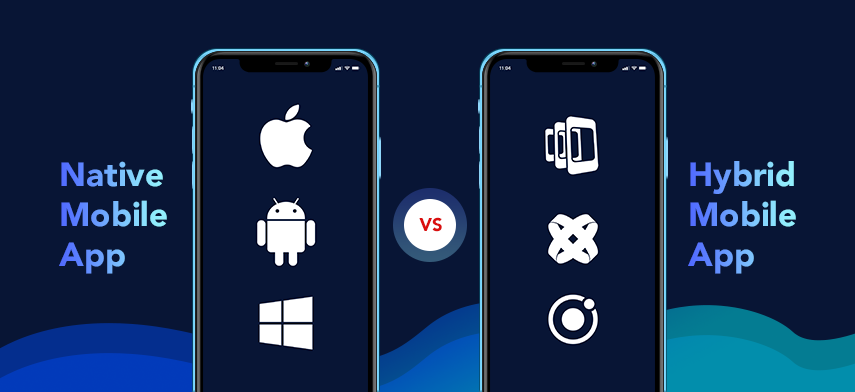
Smartphones have become an invaluable part of human existence, and their impact on society is only going to increase as the industry undergoes rapid and groundbreaking innovation. In this era of mobile app dominance, various cutting edge technologies have been introduced to keep pace with the demands of consumers and make the development process more efficient. Mobile app developers have the option to create either Native or Hybrid mobile apps, based on their preference. Each of these technologies has its pros and cons, and it is up to the developer to decide which way to go with the app development. Platforms like Squareboat are excellent mobile and web development services providers, which provide both Native and Hybrid app development services.

Native vs Hybrid App Development

There are a few key differences between Native and Hybrid app development:

Underlying Technology

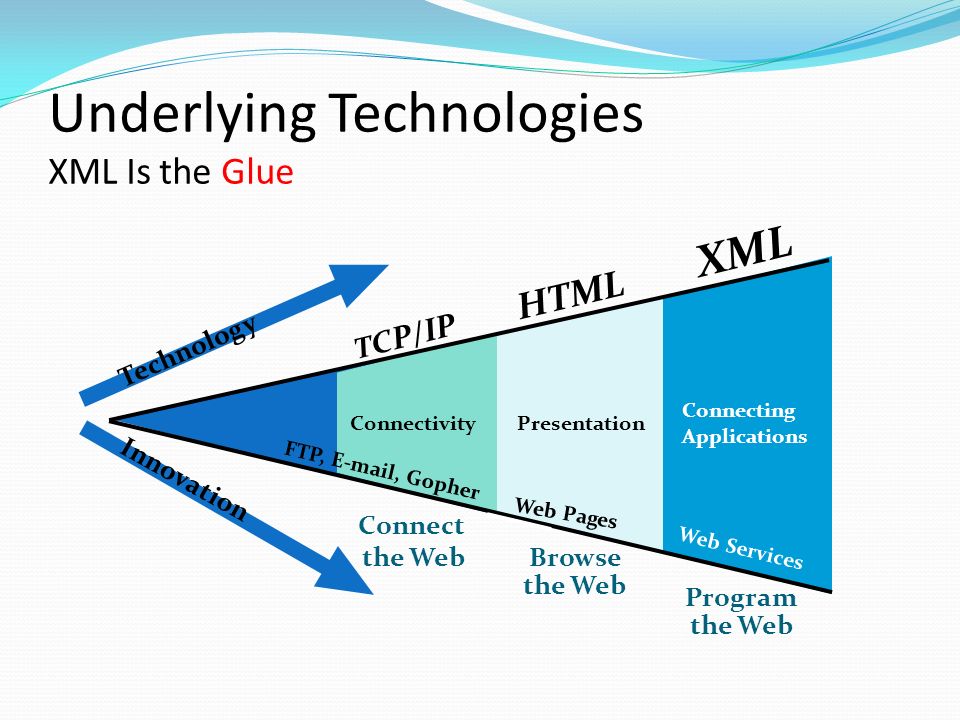
Underlying Technologies XML Is the Glue Program the Web XML Browse the Web HTML T C P/IP Connect the Web Technology Innovation ConnectivityPresentation. - ppt download

There is a vast difference in the way Native and Hybrid apps work behind the scenes. Native apps are specifically created for a particular target platform, using a specific programming language along with the dedicated SDK and toolkit. As an, e.g., for native Android app development, Java is used to develop the app using the SDK and toolkit provided by Google. Native apps have full access to the native APIs and all the device’s sensors like gyroscope, accelerometer, camera, GPS, and more.

Hybrid apps are a mixture of both Native and Web apps. It is essentially a web app enclosed in a native app container called Web View. Hybrid apps are created by using web technologies like HTML, CSS, and JavaScript, among other tools. As they are enclosed in a native shell, they can be downloaded and added to the home screen, just like native apps. Hybrid apps have moderate access to devices’ features.

Platforms Supported

All about using Applozic on your preferred platforms - Applozic Blog

Native apps, as the name suggests, are native to the target platform for which the app is created. Hence they can only run on a single platform. So a Native Android app can only run on the Android devices, and a native iOS app can only run on iOS devices.

Hybrid apps can run on multiple platforms like Android, iOS, and Windows mobile, as they are built using platform-independent web technologies. Hybrid apps are enclosed inside a native shell which can connect with devices’ sensors, just like a native app.

Performance and Stability

Performance Testing - Testing for Speed, Stability, and Scalability - TestLodge Blog

Native apps set the benchmark in terms of performance as they are built specifically for the target platform. They have shorter response times and lag less often. Hence Native apps provide a better overall user experience than hybrid apps. Native apps also have an added stability factor as they are usually backed by giant corporations like Google and Apple, which means that the platform is supported for a long time in the future with regular bug fixes and updates. Native apps also have well-defined guidelines for the developers to follow in terms of how the app should look and feel. Thus making the job of app developers much easier and also increases the security, as developers can refer to the security guidelines laid down by Apple of Google.

Hybrid apps are relatively slower than native apps as they add a layer between the source code and the mobile target platform. They usually have longer launch times and more crashes when compared to native apps. The user interface also might feel sluggish if the app involves vast amounts of data manipulations. Advanced animations and effects could be slower as the app runs inside the webview container. Web technologies are advancing at a rapid pace, and hence, hybrid apps, which depend on web technologies, are also inching closer and closer to the native apps in terms of performance. The stability and security of hybrid apps depend on the best practices followed by the app developers as there is a lack of clear guidelines, and also on the type of framework being used to create the hybrid app. E.g., a framework like Ionic adds multiple layers on top of HTML and JavaScript, and breaking changes in any of these layers can cause severe bugs in the app.

Development Time and Cost

Rapid Custom eLearning Development - The Cost & Time Element

Native apps are comparatively harder to create as they require the developer to learn full-featured programming languages like Java or Swift in addition to other tools. Native apps are built on sophisticated IDEs (Integrated Development Environment) with advanced features for compilation and debugging. Therefore, the app developer has to learn multiple technologies that are much more complex when compared to the hybrid apps, which in turn increases development time and cost, as it becomes equally costly to hire a native app developer.

Hybrid apps are built using web technologies, which are relatively easier to learn, which means that Hybrid apps have shorter development time. It is also relatively cheaper to hire a hybrid app developer.

Native vs Hybrid App Development: Head to Head Comparison

Let’s summarize the differences between Native and Hybrid apps in a tabular form:

Native Apps Hybrid Apps
Performance Very fast Slower compared to Native apps
Platforms supported Only the target platform is supported Supports multiple platforms like Android, iOS, Windows mobile, etc.
User experience Provides better user experience due to low response times and fewer bugs User experience might suffer if the app is dealing with huge traffic or complex calculations or animations
Stability More stable as they are backed by big corporations like Google and Apple. Relatively less stable as they need the support of third party platforms, and thus increases the chances of breaking changes and bugs in the code
Development time Required more time to develop the app for each platform Required less time to develop the app as a single code base can be used to create an app for multiple platforms
Development cost More expensive to hire a developer and maintain the app for multiple platforms Less expensive to hire a developer and maintain the app

Conclusion

Even though Native apps are faster and more stable than Hybrid apps, for most of the scenarios choosing a Hybrid app is a better decision. If the app is dealing with not a very high amount of web traffic and complex animations, then there will not be a noticeable difference in the performance of a Hybrid and a Native app. Also, it is much faster to start development on a Hybrid app and produce the final product, as compared to a Native app. If you need to deploy the app on multiple platforms and cost is a limiting factor, then  Hybrid apps are a great option to go with.

Native apps are best suited if the app is going to serve a lot of people on the web, or if the app will have complex animations and effects. In those cases, a Native app will provide the best user experience as there will be less lag and possible bugs compared to a Hybrid app. So, if you need the best performance, and time and cost are not a limiting factor, then going with Naive is a better option.

Full Stack Frameworks: Pros of 2020

Full Stack Frameworks: Pros of 2020

In today’s modern world, everything is instant to our hands with sophisticated technologies. As the adaptability of online space proliferates, web development technologies also get mature leading to developing more complex feature-rich web apps. The advancements in technology have also raised the bar of customers in terms of an elemental online presence. Each company looks forward to working with a service provider who is well-versed with the latest web development trends and is proficient in the work that they do.

Web development frameworks support the development of web apps, websites and web resources, web services as well as web APIs. Simply put, they are nothing but libraries that help you build your web app efficiently and effortlessly.

With the market flooding with new web development frameworks every day, it can be very challenging to choose which one would be the best fit for your project. The whole process can be made very easy if the developers are well-versed with the below-mentioned web development technologies and frameworks:

Top 10 Web Development Frameworks

1. Spring- Java Framework

Spring Framework Helps you to Develop robust Java applications very easily and very rapidly. | by Arpit Dixit | IndiaNIC | Medium

Spring is one of the most renowned frameworks enterprise-grade app development using Java. The primary intent of having this framework is to ease the process of making J2EE apps. It is a back-end development framework based on Java, which enables developers to create simple, fast, flexible Java Applications. Used by many big names like Wix and Ticket Master, Spring has a rigid architecture that provides the developers with a frame for their future projects.

2. Vue.JS

Introduction to Vue.js + BigCommerce | by Nancy Montiel | BigCommerce Developer Blog | Medium

One of the most adaptive frameworks, Vue, is an advanced framework used to build outstanding user-interfaces. With a central library emphasizing on the view layer, integrating it with other libraries and preexisting projects is a piece of cake. The integration of Vue in your projects is very similar to that of Jquery, and there is no necessity whatsoever of a build step. Created by Evan You, it is a framework that focuses on component composition and declarative rendering. Moreover, Vue is an excellent choice if you want to develop a powerful SPA (Single Page Application) as it is loaded with lots of supporting libraries and modern tools.

3. Yii Framework

Logo Yii Framework | Zend

Yii is a powerful, practical, and flexible web development framework based on PHP. Yii is an acronym for Yes it is! Which stands quite an appropriate answer to the question, “Is it so amazing?”. It is a universal web-app development framework that can develop any web application. It is an excellent option for high-traffic apps and websites like E-commerce websites, portals, Content Management Systems, or any complicated web app because of its exceptional security features. Since it models the data as objects, there is no need to go on writing monotonous SQL queries and statements. It also provides many cache mechanisms like cFileCache, cDummyCache, cMemCache, thereby allowing an effortless cache app component integration. Yii is loaded with great features and comes with clear-documentation.

4. Symphony Framework

Why We Use Symfony. What the framework is and why we think… | by Maygen Jacques | Code Enigma | Medium

Symphony is a feature-rich, reusable, highly flexible full-stack web development framework. It provides the developers with a complete free-hand with working on a RAD environment by giving a vivid choice of 30 components. It is based on the Model View Controller (MVC) System, which allows session management, decoupled components, and error logging and is easily maintainable. It can be effortlessly clubbed with many renowned client-side frameworks like AngularJS along with other third-party apps. It is a collection of Web App Frameworks and PHP components and boasts the two most stellar benefits, Bundles, and Components.

5. AngularJS

AngularJS: "Controller as" or "$scope"?

Based on the comprehensive programming language- JavaScript, AngularJS is a multifaceted open-source front-end framework. With the growing fame of SPAs (Single Page Applications) Development, the popularity of AngularJS is also speeding up. Developed and maintained by Google, AngularJS helps you create dynamic web pages utilizing JavaScript and HTML. Additionally, Patterns are created in AngularJS with the help of the Declarative Paradigm to make the core easy to read and very light-weight. The need for additional getter and setter functions is eradicated by the presence of POJO, which allows object manipulation using` standard JavaScript Functionalities.

6. Rails Framework

Rails Logo - LogoDix

Ruby on Rails is a very proficient web development program developed by David Heinemeier Hansson in the year 2003. Considered as very developer-friendly, Rails is an opensource, object-oriented, general-purpose back-end development framework. Rails follow the DRY (Don’t Repeat Yourself) and CoC (Convention over Configuration) approach, which facilitates the building of light-weight apps and boosts flexibility. It also ensures flawless interaction with third-party apps by allowing each object to possess unique attributes. The applications are maintained to be bug-free as the developers are provided with a detailed error-log. It also supports the development of SEO friendly URLs.

7. Laravel

12 Reasons why Laravel Is the Best PHP Framework

One of the most fantastic PHP web frameworks, Laravel, has an exquisite and expressive structure that backs out ordinary errands, for example, authentication, sessions, storing, and steering. The main aim of the Laravel Framework is to make the process of development easy and fun. Laravel emerges as the top choice of many developers as it offers excellent performance, scalability, and features. Its unique architecture enables the developers to build customized infrastructure for their apps. It also has an integrated cloud storage system like Amazon S3 and Rack Space, along with local storage.

8. Tensor Flow

Learn TensorFlow Fundamentals in 20 Minutes | by Chidume Nnamdi ???? | Bits and Pieces

It is a unique, open-source library for mathematical computation utilizing the data-flow graphs. Tensor Flow is exclusively used for Artificial Intelligence apps that involve a massive community with itself. Although it has a broad range of uses, it is preferred to be used in the domains of Deep Learning. With the boom in the AI and ML technologies, TensorFlow has also seen a rise in the number of users as it is the framework of the future. Artificial intelligence is perceived to takeover every field and every niche, which is a positive indication for the use of TensorFlow.

9. CakePHP

CakePHP - Build fast, grow solid | PHP Framework | Home

CakePHP is a revolutionary PHP framework that simplifies the developers’ job by eliminating the need for developing an app from scratch. Its various scaffolding features, along with the swift code generation, dramatically cut down the development cost. The ability to reuse the code in CakePHP makes the web development process very rapid. Not just that, but most of the essential elements for building an application are in-built in CakePHP, which saves a lot of developers’ precious time. The availability of vivid documentation and pragmatic guides along with colossal community support is a cherry on the top.

10. MeteorJS

Beckon Delve

MeteorJS is, hands-down, the best choice if you are looking for speedy web development as it is a full-stack web development framework, which solves both your front-end and back-end needs. It is a JavaScript framework that has an in-built collection on libraries and packages that are linked and bound together. It is an isomorphic framework that can be utilized to create a cross-platform code. It is based on MEAN stack and comprises of many components like Cordova, Communication Line Tool, CLI, Browser, and Server.

Summary

With the exponential amplification of the tech world, new web development tools and frameworks are rising every day. The competition is the market is fierce, and you need to select nothing but the best for your project. The above list can help you choose the best web development framework that fits well with the requirements of your business and help you grow manifolds.

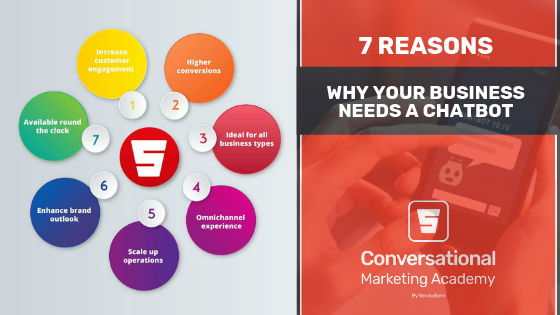
Chatbots <3 (your) Business: 7 Reasons Why?

Chatbots <3 (your) Business: 7 Reasons Why?

It is a known fact that human is a social animal. A human needs to interact with his fellow humans to express himself. Interaction gives a human a sense of comfort and understanding. This fact is well utilized by Chatbots, which has been a revolution in the market in a short time.  The Chatbot technology has taken a giant leap and has emerged as a ground-breaking trend. All the businesses are eager to keep up with the updating trends and utilize the Chatbot technology to interact with their customer base and influence the market. Within the brief time-period, Chatbots have taken over the market. They are seen to be rocking the sectors of Customer Support, Customer behavior Analysis, Customer Service & Management, DevOps Management, Branding, and other Qualitative tasks.

What is a Chatbot?

What is Chatbot | 4-Step Guide for Beginners

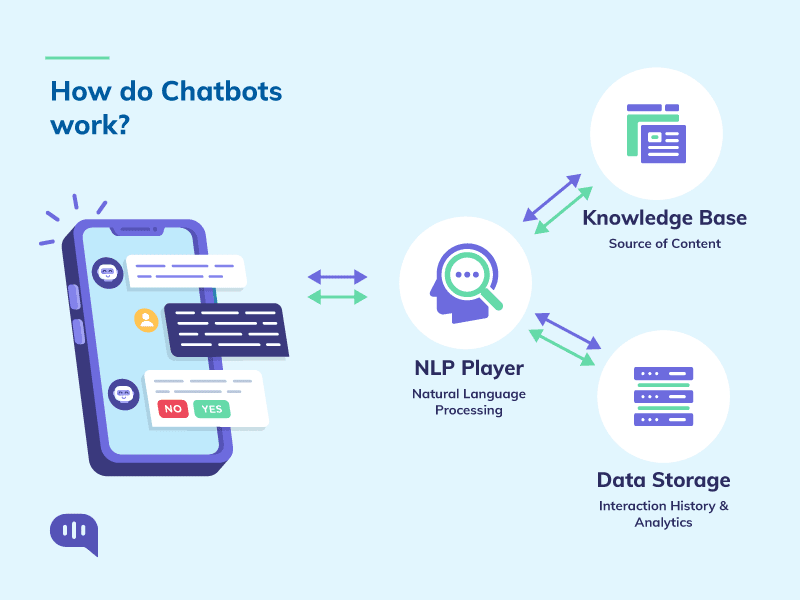
In the most simple layman language, A Chatbot is an automated computer program that talks back to you. It interacts with the users as a human would and attends the customers round the clock without needing any break or having any geographical limitations. The conversation can be either text-based or voice-based, depending upon the requirement of the business.  It is a virtual assistant that aids businesses to get closer to their customers and broaden customer engagement. With the introduction of ultra-modern technologies like speech recognition, machine learning, artificial intelligence, and NLP (Natural Language Processing), Chatbots have advanced so much that they can simulate a human conversation very closely.

Broadly, Chatbots can be divided  into two categories:

1.Command Based Chatbots:

How do chatbots work? An overview of the architecture of a chatbot

These Chatbots are based on the “if-else” algorithm. These Chatbots do not learn from the conversations they have; instead, they can only answer a limited number of predefined questions. It has a set of pre-written questions with specific answers. In these situations, users do not usually type or converse with the bot; instead, they select one of the many options provided to them.  They have a fixed database so they can not answer the questions which are not listed in their database and can not function outside their code.

2. Artificial Intelligence Based Chatbots:

How Artificial Intelligence Chatbots are Revolutionizing Healthcare?

These Chatbots learn from the conversations they have with users and better themselves over time. They are contextual Chatbots and utilize high-end technologies like Artificial Intelligence and Machine Learning and appear quite sci-fi at the initial glance. They can understand natural questions and reply with the most appropriate answers. They remember the details about their customers and improvise their communication with them accordingly.

Now, if you are asking yourself, “Do I really need a Chatbot for my business?”, the question itself is problematic. The market is ever-growing, and the competition is getting stronger every day. The inability of a business to keep up with such a trend, which is woo-ing the market with its exceptional capabilities, could be a fall-behind for and your business. NOW is the ideal time to introduce your business with this cutting-edge technology and watch your sales and business fly high.  Your business/company might be in a need of Chatbot Development if you relate to any of the below-mentioned points:

  1. If you own an E-Commerce Business:

As per a recent study, it has been established that E-Commerce is one sector that is expected to make the most benefit out of the Chatbot Technology. The Chatbots can turn the monotonous shopping process into an exciting one by encouraging more user engagement. A Chatbot can keep an account of customer history, preferences, location, address, and navigation and, based on that, personalize the whole shopping experience for the customer. The Chatbots can recommend customers new products according to their preferences and also provide them with personalized vouchers and coupon codes, which can boost up customer engagement, resulting in an extremely positive impact on the sales.  For example, if you have are a Pizza delivery App, a Chatbot can remember the previous orders made by the customer, additional topping requests along with their address and contact details so that they need not fill in the information again while placing an order. This makes the ordering process seamless and attracts more customers. This also increases the loyalty of the customer towards the brand and ensure that the customer revisits your app/website.

  1. If you have customers/queries coming in round-the-clock:

Chatbots are not bound by and physical or geographical limitations. They can work day in and out without getting tired or needing a break.  So if you are a business that deals with customers from different time zones, or if you like to keep your services open each and every day, every time, Chatbots can be a blessing for you.  This takes off the burden of this redundant job from the shoulders of a human employee and allows his energy to be utilized for something more crucial.

  1. If you need to give repetitive/similar information:

Most of the businesses need to answer an almost identical set of questions all the time. Customers usually inquire regarding the timings, address, or prices. A significant portion of human effort can be saved by automating this process with the help of Chatbots.

  1. If scaling your business is requisite:

Unlike humans who can handle just 3-4 customers (at max) at a time, there is no such limit for the Chatbots.  Chatbots can be assigned as the initial point of contact for the customers. In this manner, they can help to filter or segregate the customers according to their issues and then raise the issue to a human representative if required. This way, the tedious and redundant part of recurrent question-answering is handled by these new-age virtual assistants. They increase your productivity and efficiency, thereby improving your ranking and reputation in the market.

  1. If you are low on time and budget:

No matter how fancy and sci-fi these Chatbots sound, the cost of building one won’t be leaving any holes in your pocket. The cost of developing a Chatbot is often similar to or sometimes even less than developing an application. Additionally, Chatbots aren’t just economical but are worth the price you pay for them as they bring in a commendable amount of business along with them. They are like a one-time investment that can take your business to a new height.

One Chatbot is equal to an army of employees. It saves the time of your team, which might otherwise go into redundant tasks or hiring a team to do the Chatbot’s jobs.

  1. If you are targeting social media:

The integration of Chatbots with various social media websites and apps and their capability to engage the audience on the same has swept off the market. In this age of social media and smart devices, people prefer having apps that are multi-functional. Therefore, it is crucial for businesses not to leave any potential area to grab the customer base. Facebook, Instagram, Whatsapp, etc. have become the greatest markets, and Chatbots can help you acquire them by interacting with your customers on the same.

  1. If you need to analyze customer behavior:

The Chatbots can be made to ask for feedback from the customers regarding their experience on your website/app or about product or service. This feedback can be a great help while making the marketing strategy and targeting a more precise clientele. The data acquired by the Chatbots can be used to provide a personalized experience to the customers, which can significantly impact the engagement on your platform.


Conclusion

A Chatbot is the need of the hour for every business, whether big or small. No matter which industry you belong to, Chatbots can definitely scale up your business and put you on the front foot, a step ahead of your contemporaries. The customer is always looking for a smoother experience, and with a Chatbot, you can ensure that your customer gets exactly what they want.

Most Valuable Person? Nope, find out the reality!

MVP in the field of Software Development stands for Minimum Viable Product. It is a concept developed by Eric Ries as a part of the Lean Start Up method. According to his definition:

 “The Minimum Viable Product is that version of the new product which allows a team to collect the maximum amount of validated learning about the customer with the least efforts.”

It is based on the idea of Incremental Software Development that renders a product more efficient which is complete on its own with each iteration. A Minimum Viable Product is developed as a core unit of an experimentation strategy. It consists of a basic set of solutions for testing the viability of a business idea and how the customers react to it.

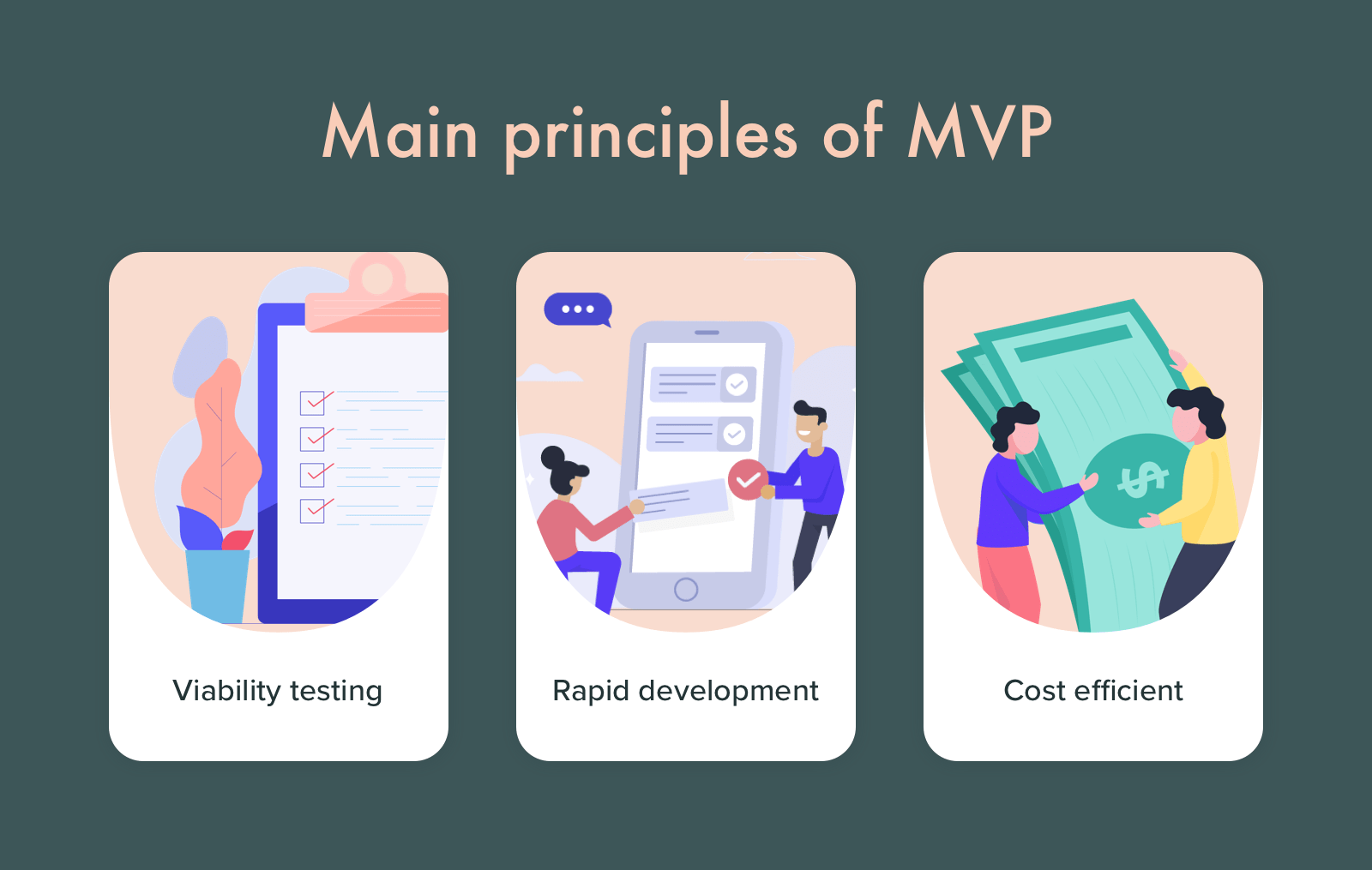
The main purpose of building an MVP :

How to build an MVP: Steps, Examples, and Benefits

  • Deliver a working product that provides immediate value with minimum resources be it money, time or infrastructure.
  • Create a baseline for future development and clarify the next steps to be taken in the project.
  • Earliest possible product release.
  • Minimum implementation costs.
  • Test the viability of the product before investing large capital and manpower into it.
  • Identify potential features and failures.
  • Identify and understand its user base and its preferences.

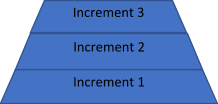
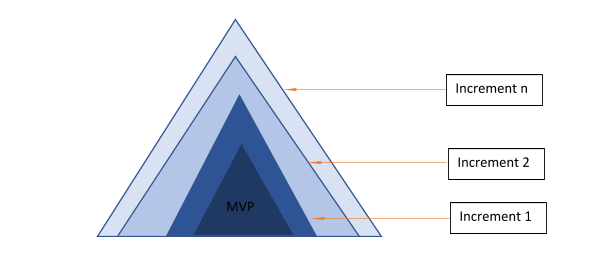
After receiving feedback, more features can be added. Every new release of the MVP should ensure a better solution for the customers and should be completed rather than a ‘work in progress’ solution.  This can be understood better through an illustration by John Mayo in his article ‘Two Ways to Build a Pyramid’.

In a traditional approach, building the pyramid can be started from the base, and a new level can be added on top with each increment. Although this is an incremental process, until the last iteration it is only a ‘work in progress’, as in the image below.

The other approach is to start with a small pyramid. With each iteration, components can be added to increase its size or extend its functionality. Thus, after each increment, you will have a complete pyramid which can be further extended. 

The rule here is to add new features gradually with each release of the MVP being a better and faster solution for the agenda under consideration.

Types of MVP

There are two categories of MVPs. Low Fidelity MVPs help you to get an insight into your customer’s problems and the kind of solution that will be most effective for the customer. High Fidelity MVPs are used to find out how much the customers will be willing to pay for the solution. Furthermore, it helps you to optimize your marketing strategy and communication channels along with the best potential growth strategies.

In today’s market where a wide range of services and products are in demand, minimum viable products differ accordingly. The different types of MVPs which can be categorized under Low-Fidelity and High-Fidelity MVPs are as follows:

Low Fidelity MVPs High Fidelity MVPs
An Honest Customer Interview Digital Prototypes like wireframes and mock-ups
Blogs and their Comments 3D Models for manufacturing products.
Subject Matter Forums The Wizard of Oz
Website or an Application Landing Page The Concierge MVP
Split Testing to measure user reaction to changes The Piecemeal MVP
Videos Crowdfunding helps generate funding for the product creations as well as testing its future demand in the market.
UX Prototypes. Single Featured MVP in order to focus on the most essential solutions that will be provided by the product.
Ad Campaigns for market surveys Email MVP
User SignUp for an Upcoming Product
Audience building via tests, interviews and questionnaires.
Micro-Surveys

Out of the above MVPs, most of which are self-explanatory, let us elaborate on the following few.

  • Concierge MVP: Here building a product is not necessary. Here you provide the services manually and analyze your customer interaction. This helps to understand if the customers will use your product or they need an entirely different product.
  • Wizard of Oz MVP: Here a fully functional product prototype is presented before the user while you are at work behind the scenes providing all that is necessary. Through this type of MVC, you are able to interact directly with your customers and review their preferences.
  • Piecemeal MVP: Here existing tools and solutions are used to create your product. This involves a minimum or no investment. A piecemeal MVP consists of existing components from multiple third-party sources that are put together to create the product or service.
  • Email MVP: Here you begin by sending emails with the business proposition to your existing customers. If the feedback is positive, the business idea is worth pursuing, however, if the feedback is bleak, either the proposal is missing something or it does not solve any problem.

Pitfalls


The main pitfall of an MVP is its lack of understanding. More often teams tend to believe it is the smallest amount of functionality that needs to be presented to the consumers in order to understand its viability. It might also be confused with minimum market earning. MVP is more focused on learning from customer feedback. It is very important to identify the set of features that needs to be included for an MVP. Including too many features will overload the MVP, incur cost and time and may fail to succeed. However, filtering features may cut out its key functions. The basic set of solution repeatedly mentioned here, refers to developing a deployable product with the key features which allows customers to access the solution and complete their entire journey towards their goal. Hence, it is essential that before releasing an MVP teams correlate the terms ‘minimum’ and ‘viable’ correctly. Finally, always keep in mind the metrics – Daily active users, maintenance rate and the average time spent with the product in order to quantify the success of your MVP.

Conclusion 

Developing an MVP is a strategy to avoid developing products that are liable to be rejected by consumers. It is basically built to test a specific set of assumptions and prove that the product will provide an effective solution. MVPs are effective only when you take into account market feedback. This will help you to understand which features are to be developed and which to be discarded. While developing an MVP always keep in mind the most accurate but least features of the product but not the complete product.

error: Content is protected !!