Business Benefits and Services of Blockchain

Will 2020 Be The Year Cryptocurrency And Blockchain Becomes Operational?

The real-world applications of blockchain are expanding by the minute. But the resources and skill sets needed for developing blockchain applications and hosting them are neither cost effective nor popularly available. Is blockchain as a service for business the answer of how to make blockchain technology accessible to an audience?

In this article, we are going to look into the BaaS solution for business works, the benefits of blockchain as a service, and how to choose the best BaaS providers operative in the market today.

Table of Content

  1. What is Blockchain as a Service?
  2. How Does Blockchain as a Service Business Model Works?
  3. How Blockchain as a Service is Shaping Businesses?
  4. The Region Wise Adoption of Blockchain as a Service?
  5. The Top Blockchain as a Service Providers
  6. A Look Into Self-hosting Blockchain Applications

What is Blockchain as a Service?

What Is Blockchain as a Service and How Does It Benefit Enterprise?

For offering the benefits of blockchain based services to a wider audience, the technology has started being offered in the cloud as a service business model. On the operational front, it is more or less similar to the SaaS, PaaS, and IaaS models which enables using cloud-based apps and storage.

It allows businesses of all types and sizes to access blockchain based technologies without investing in the in-house development. The BaaS model enables companies to access the blockchain provider’s service wherein they can develop blockchain applications at minimal cost. This benefit is what has made it a key part of the blockchain technology trends.

The only limitation of the BaaS solution for business is that it asks for a certain level of centralization since the transactions have to be funneled through the host’s blockchain services. And because the answer to how blockchain is used in business lies at the center of decentralization, companies tend to be wary of its adoption.

Key takeaways:

  • Blockchain-as-a-Service is third party cloud infrastructure and management that businesses use for developing and managing blockchain applications.
  • It operates as a web host which runs an app’s backend.
  • BaaS acts as a catalyst which leads to widespread adoption of blockchain technology.

How Does Blockchain as a Service Business Model Works?

What is Blockchain as a Service (BaaS) in the Tech Industry? - GeeksforGeeks

Blockchain as a service business model describes the process through which third parties install, host, and maintain a blockchain network on the behalf of organizations. The service provider offers setting up of blockchain infrastructure and technology in return for fees.

In many ways, the role of blockchain as a service for business is similar to that of a web hosting provider. It enables customers to make use of the cloud based solutions for developing and hosting blockchain applications and smart contracts in the ecosystem managed by the provider.

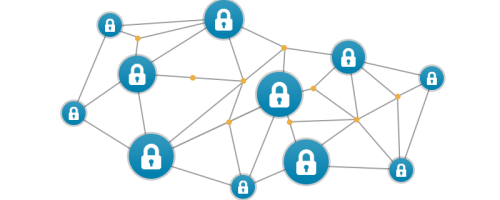
Here is a visual showcasing the working of Hyperledger Cello Blockchain-as-a-Service, which is a BaaS-like blockchain module utility system and toolkit under the Hyperledger project.

The BaaS integration in traditional business provides support around allocation of resources, bandwidth management, data security features, and hosting requirements. The biggest impact of BaaS on business is that the enterprises can concentrate on their main business without thinking of the complexities around blockchain operation.

How Blockchain as a Service is Shaping Businesses

7 Ways to Embrace Blockchain for Business Transformation

Businesses and consumers are willing to adapt blockchain technology. But the operational overhead cost related to development, configuration, operation, and maintenance of infrastructure along with the technical issues act as a barrier. The advantages of blockchain for SMEs, no matter how massive, are very resource intensive and energy consuming – thus preventing the technology’s mass adoption.

Renting a blockchain infrastructure in BaaS allows businesses to acquire the skillset needed for operating the blockchain infrastructure. Additionally, the investment needed for entering the technology segment is also lowered, since the service agreement can be easily scaled up or even terminated within short notice.

It offers a way for businesses to stay at the edge of technology without any unnecessary risks.

BaaS for startups

The opportunities of BaaS for businesses, especially small businesses, is deemed ideal for organizations which outsource the technological aspects, and are not very hands-down involved with the blockchain’s working mechanism. It enables these firms to get the understanding of the technology without having to develop their proprietary blockchain.

The integration of BaaS solutions is being used by a number of industries for things like identity management, supply chain management, and payments. Blockchain development services are emerging as the ideal solution for a number of SME challenges like elimination of middlemen, lack of transparency, etc.

Use cases of Blockchain as a Service for business

  • Document tracking – Blockchain technology offers a distributed, immutable document tracking system. By keeping the documents on blockchain, all the participants are given equal access to the information. Additionally, blockchain technology is immutable, thus ensuring that the documents are secured.
  • Data storage – With the data stored in the decentralised blockchain, the amount of data loss risk is reduced by manifold. The regulated industries like healthcare, real estate, etc benefit a lot from this immutable, secure facility of data storage on blockchain.
  • Contract execution – Under the smart contracts service of blockchain, a platform is provided for the contract execution which promises high transparency levels. Its distributed nature implies that all the parties should be equally informed.

The benefits of Blockchain as a Service lies in the unraveling of the several use cases that are yet to be emerged. It offers enterprises an opportunity to work on those use cases without making any large term commitments. All they would have to do is partner with a blockchain service company and then fully embrace Blockchain’s capabilities.

Now that we have looked into how is blockchain as a service valuable for SMEs and enterprises, let us look into its regional adoption.

The Region Wise Adoption of Blockchain as a Service?

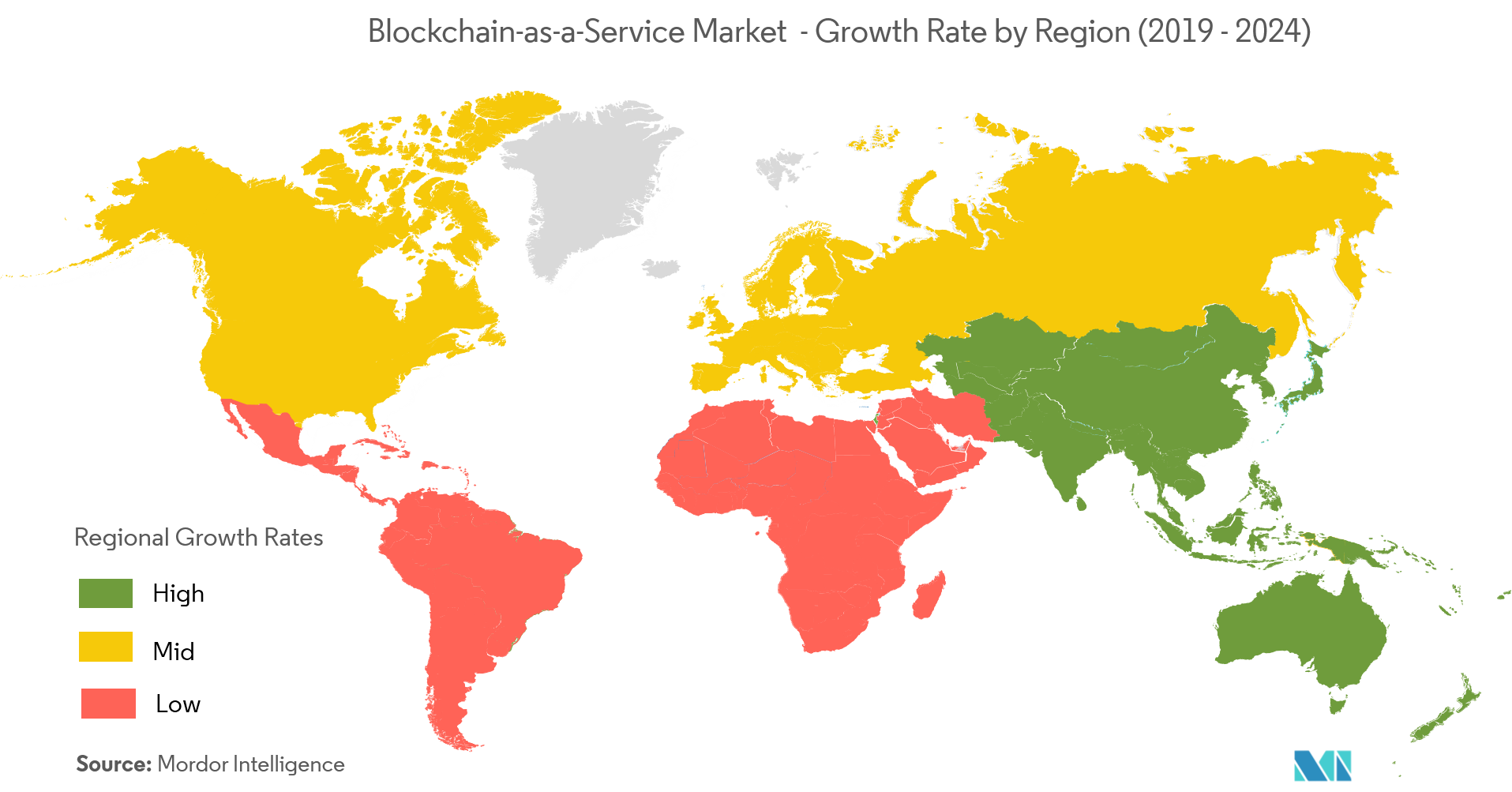
Blockchain-as-a-Service Market | 2020-2027 | Industry Report | Covid Insights

The impact of BaaS on business has led to a huge demand for the service – a sign of which can be seen in the fact how the BaaS market growth is poised to be USD 24.94 Bn by 2027.

The worldwide market of BaaS is big around the US, Mexico and Canada. One prime reason behind this is the presence of SMEs and large businesses operating in the US location along with a willingness to combine the technology with the public utilities services.

Europe has also been seen as the leading BaaS market. One of the major drivers of blockchain and BaaS adoption has been the government support from different countries.

The Asia Pacific (APAC) region is the third-most biggest market for the BaaS integration. Driven by the BaaS integration in traditional businesses and growing investment in Japan, China, and South Korea, the technology is poised to grow in the region.

To take the adoption of blockchain as a service for business further, a number of tech companies have emerged as BaaS providers. Here are a few of them:

The Top Blockchain as a Service Providers

Top Blockchain as a Service Providers

A Look Into the Alternative – Self-hosted Blockchain

Up until this point, we have looked in the BaaS ecosystem and how Blockchain as a Service is influencing the small business, in addition to the list of top providers. While it all suggests that it is a good option to go with this approach, businesses can in fact lose out on the essence of decentralization – the foundation of blockchain fundamentals.

So what is the alternative? The answer is Self-Hosted Blockchain.

When we talk about the Self-Hosted Blockchain app cost, the ownership amount tends to be a lot higher because of the startup costs, retirement costs, and operational costs. Moreover, the amount of developing and deploying a smart contract under this model can amount to up to hundred thousand dollars or more.

In contrast, a blockchain app hosted on cloud as a BaaS offering can be around $0.29 per allocated CPU hour. This means, businesses would only have to pay as they go and only for the service units used.

The costs of the BaaS model vary on factors such as number of concurrent transactions, transaction rate, and the payload size on transactions, etc.

Alignment of Lean Principles During Software Development

Online Essay Help | amazonia.fiocruz.br

The first time I heard of lean manufacturing was in the context of Toyota in my business operation class. Everyone, like me, who read into lean principle, was completely fascinated by the concept of reducing waste and increasing productivity through an intentional design.

Over time, the lean manufacturing method worked and the lean principles of product development flow was adopted by a number of industries, even outside manufacturing, which included software development.

Lean development principle is an agile approach which was developed on lean manufacturing principles. The same, that is being used by Toyota as a lean development methodology for managing and optimizing the process of vehicle production for minimizing waste and increasing customer value.

I know what you must be thinking. If the lean principles originated around vehicle manufacturing, how does software development fit in?

The connection between lean agile methodology and software development was first introduced in 2003 in a book named “Lean Software Development: An Agile Toolkit” by Tom and Mary Poppendieck.

In the book, Poppendiecks interpreted how the lean principles could be applied into the software development process. Both software development and manufacturing processes follow repeatable structures and rely on high quality standards. They also depend heavily on teamwork to get things done.

The question, however, is how it can be done. In this article, we are going to look into how we align our software development process with lean software principles.

Table Of Content

  1. What are the Strengths and Weakness of Lean Agile Software Development?
  2. The 7 Principles Of Lean Software Development
  3. Tools Used in Software Development Process
  4. Aligning The 7 Lean Principles Into Our Software Development Projects:
  5. Phase Wise Application of the 2 Principles
  6. Overcoming The Challenges of Using Lean Principles
  7. Conclusion

If you still are not sure about what are the lean principles in the software development process, then let me help you out with the meaning.  Lean software development is a collection of principles that is used for software development to reduce the programming effort. Lean principles got their start in manufacturing, as a way to optimize the production line to minimize waste and maximize value to the customer.

  • Repeatable processes
  • Team collaboration
  • Uniform standards

What are the Strengths and Weakness of Lean Agile Software Development?

What are your Strengths and Weakness? How to Deal with them?

The strengths of lean product development principles include:

  • A streamlined approach allowing functionalities to be delivered in a limited time
  • Elimination of unnecessary activities which can lower the cost
  • Empowerment of the development team, helping them make decisions that can boost their morale.
  • The flexibility of the project to frequently adapt the project and customize it according to the customer’s requirement.

The weaknesses of lean software development methodology include:

  • It depends greatly on the involved team, making it less scalable compared to other frameworks
  • It relies on stringent documentation. Failure on this part can lead to heavy development mistakes.
  • Planning is necessary before the project is started. Before kicking off the project, you should be aware of the project vision, roadmap, release plan, and iteration plan.
  • Professional teams are required to maintain workflow coordination and make quick decisions while working.

The 7 Principles Of Lean Software Development

There are seven key principles of the lean software development approach working with the aim of fastening delivery and bringing high value to the end-users:

  • Eliminate Waste
  • Create Knowledge
  • Build Quality In
  • Fast Delivery
  • Empower Your Team
  • Delay in Making Decisions
  • Optimize the whole

To fulfill these objectives cum principles, we make use of tools such as:

Tools Used in Software Development Process

5s System – It is designed to improve efficiency and productivity through a systematic approach and following its five S’s that stands for Sort, Set, Shine, Standardize, and Sustain.

Inventory management – We follow the practice where we lower the number of operations that are in progress in one go through the application of theory or constraints or queuing theory.

Kaizen – This lean development tool helps in promoting improvement in quality, technology, processes, productivity, and safety. It is most helpful in developing a safe and tech culture.

Kaizen - Wikipedia

Kanban – It is a pull project management system, where we limit tasks that are getting completed simultaneously. This helps us in preventing the overload of the development process.

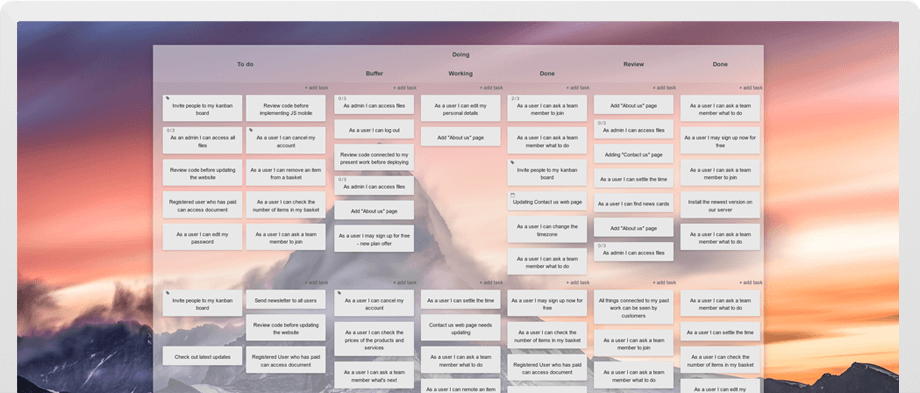
Kanban Tool - Kanban Boards for Business | Kanban Software

Value stream mapping – It is a visualization method, where we visualize the development cycle – from client request to deployment. This helps us in demonstrating and helping optimize the time spent on holding and on actual processing.

Let us now look at how we align the seven principles of lean manufacturing with our software development cycle in our role as a leading lean software development company.

Aligning The 7 Lean Principles Into Our Software Development Projects:

Lean Software Development Guide - Lean Principles, Waste and Process

1.  Eliminate Waste

7 Wastes of lean – How to eliminate all non-value-added activities? | Spica International

The foremost principle of lean product development that we adopt is elimination of everything which does not bring any value to the end-users. We start by identifying value of the product we have to build.

It makes it easy to identify the waste like unnecessary code, unclear goals, additional features, and extra processes, etc.

Wastes is one of the biggest digital transformation challenges. In our experience, can be found in a number of domains:

  • Waste of work-in-progress i.e. the partial work. This can be lowered by putting limitations in work-in-progress, through the mode of Kanban.
  • Waste of overproduction waste. These emerge when the feedback cycles get too lengthy and a series of extra features are demanded.
  • Processes waste. These are eliminated by our software development company through pair programming approaches and better collaborations.
  • Handsoff waste. We solve the issue by not keeping our team functioning as silos. We work as a close knit cross-functioning team which helps in enhancing efficiency.
  • Software defects. Waste tends to seep in when the quality is not made a part of the software development firm process with different balance and checks.

2.  Create Knowledge

The Expert's Guide To Create A Self-Service Knowledge Base

Software development process, in itself, is one that is heavily knowledge generating one. Anteelo from the beginning has been an extremely knowledge focused company. This is one of the main reasons how we have been able to incorporate blockchain and AI technology in the projects before any other software application development company in the industry.

We align the principle with our development process by implementing some key methods like: code reviews, performing training, code comments, project documentation, pair programming, and sharing sessions, etc.

3.  Build Quality In

Build Quality In: The Key to Continuous Delivery in Kanban - Blog | Planview

Our software development team ensures that the focus is always on delivering high-quality products. We always keep enhancing our development process to eliminate the project from the first step to the end product.

There are various lean agile software development approaches that we apply to better the product quality:

  • Pair programming – to lower the miscommunication waste and maximum output.
  • Testing criteria – offering the engineers a system ensuring that it meets the requirement.
  • Incremental development – bettering the quality through timely, consistent feedback.
  • Lesser wait states – to protect the quality and streamline efficiency while lowering the gap in knowledge.
  • Automation – using assets like AI and machine learning to lower and eventually eliminate the errors in development processes.

4.  Fast Delivery

Isometric Super Businessman Flying Fast to Delivery Parcel to Customer by ojogabonitoo

The agile development basics focuses heavily on the fast delivery of software processes. Lean agile principles, being a part of the approach also put focus on fast delivery. It simply means that the project team would have to deliver the modules according to the milestone plans.

Achieving fast app development time becomes easier when there is a stable workflow that helps teams in understanding the value of the process and thus facilitate fast results.

5.  Empower Your Team

How To Empower Your Team: It's All About Leaning In, Not Stepping Away

This one lean principle is what we follow regardless of the team and project. Our team that focuses on software development for startups understands that when you work together you have to respect each other. And when things go south or not according to plan, the focus should be kept on checking for gaps in the work process that might have led to conflicts and challenges.

Ever since our inception, we have been focusing on the creation of a favorable work environment where we lead by example. To better the morale, we also enable creative freedom to our teams giving them the choice to identify the best approach for any task.

6.  Delay in Making Decisions

10 brain reasons for delaying a decision - Money Women and Brains

We know what you are thinking – delay in decision-making has to be a bad idea.

But when we follow the lean-agile principles, we believe that deciding late is not equal to becoming irresponsible. In fact, it encourages the team to keep their options open for a long period of time so that they can gather data which can help in taking important decisions.

The result of this is that our project never suffers from negative impacts which emerges because of bad decision making.

7.  Optimize the Whole

Optimize the whole

We go for the optimization of the complete development process, which is not just limited to the sub-processes. We work with the understanding that if we add value to a specific set of processes, the end product will end up getting affected, and the end-results would be sub-optimized.

To handle sub-optimization, we encourage operating with good work capacities. We optimize the entire process which enables identification of value flows for the entire team that, in turn, promises valuable and timely delivery.

Overcoming The Challenges of Using Lean Principles

Although the article, up until this point, has been inclined towards how lean software methodology makes it beneficial for a smooth software development process, there are some challenges that are prevalent which have to be solved.

  • The team members have to be self-directed and be able to work as a cohesive unit.
  • There can be instances where the requirements might keep increasing without a finalization in sight. These have to be managed with delicacy upon talking to the clients.
  • Lean method is heavily focused on continuous improvement. The timelines for implementations are also generally long. This, in turn, can increase the timeline when you are able to reap the benefits.

Conclusion

Since lean agile methodology presents a customer oriented, adaptable, and flexible system, there is no hard and fast rule to follow the procedures or methodologies. But one can always take note of the given information so that there is no problem while developing a software.

It is always advisable to search for an expert, (who are focused on improving and enhancing their skills) while employing a team to build your application. The best way to do that is to either partner with software developers that are well-adapted with the technology and client’s needs, or you can opt for top companies in your area like top software development companies in USA or software development company in California, if you live in the US. But make sure you choose the best to get quality results.

Digital Trends Underpinning Media & Entertainment in 2020-21

Top 4 Digital Transformation Trends In Media And Entertainment For 2020

The media and entertainment industry is often the most proactive in enhancing itself for the digital shifts of tomorrow and 2020 is no different. In fact, what was thought of the marketplace prior to the COVID-19 outbreak, has only been proven right and rather catalyzed by people staying at home and turning to the streaming services for entertainment.

One of the most glaring digital media and entertainment trends is that an increasing number of players are retracting from video content aggregators in order to stream their content direct-to-the consumer.

The move signals an attempt to maximize the cost of operations by canceling out cable and satellite royalties. This and a whole lot more makes up for the digital innovation trends, poised to reverberate through the fabric of this sector. Knowing what these trends are can give you a leg up in the crowded entertainment sector.

Trends on the Demand Side of the M&E 

The demand side are the users, you and us, who create the demand for a product. While postulating upcoming industrial changes it’s better to draw the line between trends that are being forced onto M&E studios by the consumer, and vice versa. In this section, we’ll mention the most palpable consumer-end i.e. the demand-side trends fruiting in the M&E industry.

These trends are attributable to the audience side of the picture as without their behavioural patterns, whether online or offline, we may not have had much development in this direction. The latter sections will touch base with the role of technology in the entertainment and media industries.

D2C Video Streaming

Disney Doubles Down on D2C Streaming Video Success with Strategic Reorganization - Subscription Insider

Video streaming got its dose of steroids with the initial faces of lockdowns imposed through varying geographies of the world. With the expected use of internet services ticking up, so did the demand for diverse, meaningful, and quality video content. There was such a force behind this push that Pay-TV subscription, for US customers, took a backseat. The diversity of choices and cross-platform compatibility offered by players such as Netflix and Amazon Prime threatens the limited bounds of TV-channels that demand users be on their couch.

But at the same time, these very rivaling clans are giving each other a run for their money in the streaming wars – – strengthening the foothold of apps redefining the entertainment sector. In the Digital media industry, Disney was the first to retract its content from Netflix and offer it in a D2C channel through its pet project Disney+. The move defined the now reformulated entertainment industry standards that have seen the largest media houses following suit in receding content and hitting third party applications right where it hurts the most.

It pays to ask the question, how forthcoming are the viewers in subscribing to digital media entertainment and paying for so many streaming apps? One survey revealed that the average user subscribed to 3 video streaming apps with this limit staying constant for the last 2 years. It can be surmised that overtime the economy of such an experience will be questioned by all.

One way to buck this trend would be to reorganize the content and offer multiple formats such as music, movies, TV shows, etc., aggregated on a single platform. The prime example (pun intended) of this trajectory is none other than Amazon Prime and Roku. In addition to video, these vendors can create customized, pay-as-you-go packages for availing the music and games libraries.

Ad-Driven Viewing Experience 

How AR & Other AI-Driven Innovations Will Revolutionize OOH Ads | by Richard Yao | IPG Media Lab | Medium

One of the reasons mobile streaming caught on to people is that it cut down on ads. The volume of consumable content increased and made retaining users easier. But with the top studios of the global media industry turning to video streaming, ad-supported content is expected to seep in soon. This is partly due to the pitfall of keeping subscription fees competitive, which in and of themselves, won’t suffice for expanding the content offering to games and music.

Ad-supported videos are already a thing in Asian locations such as India and China. But for them to assume a profitable outlook for media entertainment in the US, platform owners must curate enough user data for targeted advertising. Else such a promotional expenditure would appear unjustified and disoriented. Chiming in tune with the adage of our century, data is the new oil, platform owners will look to get their act together with structured data to deliver suitable (not annoying) ad interruptions in between video streaming. Youtube already does that to a good measure, the result of which is:

Data Privacy and Security 

Data Privacy vs. Data Security [definitions and comparisons] – Data Privacy Manager

A study conducted by Futurum Research in partnership with SAS Software revealed that the media industry was one of the most distrusted by customers when it came to guarding user data. The same report concluded that as much as 61% of the participants felt they had zero to no control over how their data was used by the vendor.

Media houses are expected to toe the line for transparent data collection applications with which to assure the customer of data security. For instance, the European Union’s GDPR reforms allow customers the right to be forgotten after they have discontinued a particular business, having submitted personal information initially. Much of this will play out in the near future as well, if only with added refinement but let’s not forget had there been no demonstrable outrage over data misuse, the media organizations wouldn’t care to rise from their slumber.

Content Personalization 

Personalize B2B content to improve conversions

There are deeper levels to customer relationship management than sending emoji-fied emails every now and then. Millennials and Gen-Z want, and would happily pay for services that are personalized to their tastes. This includes content recommendations the kind that will gel well with their unique preferences.

This paves way for even more sophisticated Artificial Intelligence and Machine Learning algorithms to do what they do best, predict user behavior. It is primordial for both the content creators and content hosts to know the demographics of the audience they excite and attract. Therefore, don’t be surprised when you see a media software development company dive deep into AI and sharpen the edges around streaming service applications. We are in the age where everything has to be smart and content is no different thanks to the hard-to-capture, unique choices of the users.

Trends on the Supply-Side of the M&E 

The trends mentioned above have been directly derived from user behavior i.e. if the users hadn’t reacted to digital media apps the way they did, we probably wouldn’t be seeing much commotion in that zone. Having said so, the link between media showmen and consumers could not be possible without technology. And whereas some technological advances are urged by the users there are others that percolate their way down to the masses no matter what. In this section, we’ll look at the emerging technologies that are most affecting the manner in which media enterprises go about their business.

Augmented & Virtual Reality

The Important Difference Between Virtual Reality, Augmented Reality and Mixed Reality

The global media and entertainment industry will be a driver of emerging technologies the frontier of which will be led by Augmented and Virtual Reality. The past few years have seen much hype but less adoption of AR/VR. But that was a consequence of the price-barrier of standalone AR/VR devices, which is also beginning to get pocket-friendly.

Smartphones have crossed the inflection point in AR adoption with the majority of models supporting AR content. The media entertainment industry will make use of these technologies in the following ways:

  • Act as a substitute for high-priced joysticks and keyboards at the same time delivering a quality experience to gamers.
  • Be the de-facto technological genre for media app development especially in the field of digital education.
  • Help in enterprise-level media software development for learning management solutions.
  • Possibly make way into theatres and cinemas to reinforce the power of digital effects through immersion.
  • Create wearables for visitors headed to museums, art galleries etc., and represent artifacts with added features/info.

eSports Broadcasting

The challenges of esports broadcasting

The Trends in broadcasting industry point towards the hot spring areas of the sector that are gaining mainstream traction among audiences. The first and foremost of this is the one touted to be the future of sports – eSports segment.

The entertainment app development sphere is galvanizing its priorities towards this segment as the worldwide eSports revenues are expected to hit $1 billion in 2020. The lion’s share of this money, although, will be from sponsorships ($614.9 million) and media rights ($176.2 million). Nevertheless, gaming events will be the center of attention for displaying the latest in AR/VR.

And lest we forget, there is Legalized Sports Betting that will also profiteer off the incoming 5G technology. Betting is one arena that swirls the mind in unpredictable ways, forcing users to place bets over telecommunication networks. Come to think of it, 5G is a technology that is born to manage high volume communications. This is one of the reasons the US has 5G towers popping up at sports stadiums and related venues that’ll be a hotbed for placing bets. Entertainment software development can be easily turned in this direction to foster app creation the kind legalized sports betting would need.

Artificial Intelligence 

Artificial Intelligence (AI) - Overview, Types, Machine Learning

There is not a single sub-set of M&E that has not been impacted by AI. Its predictive powers are influencing television, animation, VFX, Out-of-Home advertising (OOH), radio, and much more. A case in point is the following applications of AI in enhancing customer experience.

  • M&E companies hold a huge repository of user data at their data centers. In many cases, the data is largely unstructured i.e. like a mound of haystack waiting to be made sense out of. AI has added a cognitive, human-like dimension to mining and saturating this unstructured data.
  • Engineers are using AI, ML, and Natural Language Processing to apply relational parameters to the big data. The technology helps in categorizing the data as per mutual characteristics and further consolidates a company’s predictive capacity to forecast user engagement with the content. This Targeted efficiency leads to better monetization opportunities.
  • AI is being applied readily to video content to speedily calculate and absorb emotional changes at the user side. The summary of such studies is then used for highly customized content recommendations. The same principle is at play in music streaming apps, that know precisely which songs to pitch you that eventually make it to your favorite’s list.
  • The Cost of content creation will be vastly reduced following the advent of AI that can automate editorials consequently mitigating human intervention.

Blockchain 

The Impact of the Blockchain on Cybersecurity

The distributed ledger technology with its chief qualities of immutability and transparency are breaking technological stereotypes in the M&E

. People have been spectators to an exchange of charges between artists relating to content plagiarism and piracy time and again. Blockchain Technology can and will settle such debates once and for all.

  • Intellectual Property rights can be safeguarded with Blockchains nullifying the scope of disputes around ownership management. With immutable record management, ownership rights can be traced to the original producer of the content. Likewise, the system architecture of blockchains, in its current iteration, is powerful enough to track transactions for royalty payments across multi-layered platforms.
  • There are solutions in the market that offer a springboard for budding artists to curate funding directly from their fanbases. Such a step would allow the fans to own a share of the record, the rights of which, otherwise, ebb naturally into the hands of the producing labels. Transactional history along with public ownership will be recorded on the blockchain. Living examples of such trends are being shaped by companies like Vezt, Sony, and BMG.
  • Another issue faced by media stakeholders is revenue distribution. The industry being this giant labyrinth of middlemen that it is, intermediating parties charge their share of the profits for managing the revenue cycle for a film/commercial, etc. But Blockchain is a proven disruptor of this very model. With an online ledger, transactional streams can be optimized without spending a fortune on intermediary channels. FilmChain, an Ethereum based Blockchain, is a prime example of this upcoming trend.
  • There is a huge black market for ticketing sales that needs serious quenching. While managing a megaevent such as a concert or a music festival, artists are left to bite the dust as the intervening middlemen play the sleight of hand in ticket distribution. Blockchain-powered ledgers can remediate the situation by ensuring the profits generated follow an equitable distribution amongst all participants of the value chain. YelloHeart is a company trying to achieve exactly this.

Enterprise Resource Planning 

The end of enterprise resource planning

  • We are in the age of automation and optimization, with the streaming apps being a transformational by-product of the digital revolution. Building AI-powered smart apps for better user management is not a standalone procedure but an interconnected block in a chain of events that would deem workflow optimization necessary. Consequently, an entertainment app development company will not have its service level agreements limited to just fine tuning the application itself but also the overall enterprise software for maximization.
  • Enterprise Resource Planning would ensure that cost overheads are mitigated immediately. Investment in the right tools and technologies will not stop with 2020 and shall continue beyond to stay in the good books of investors.

Final Thoughts 

Whether it is Augmented Reality, Virtual Reality, or Enterprise Resource Planning, Anteelo has the track record to back our claims of expedited, professional project delivery. Having collaborated with some of the world’s biggest brands such as IKEA, and Domino’s (to name a couple) we know the scale of demands of big businesses and are ever-ready to go the distance.

Our ties with the media industry go a long way. We developed mobile apps such as Gully Beat, with the latter garnering critical acclaim along with 25 million+ downloads on the Play Store. Long story cut short, when it comes to delivering at the international stage, brands turn to Anteelo as their technological arm. But talk is cheap. Take a minute and connect with us and we’ll showcase how you can slingshot your idea to glory.

Blockchain vs. Traditional Database: Make a Startup’s Choice

Blockchain vs Traditional Database – Neighbourhood

Blockchain Technology has witnessed phenomenal growth in the last few years and appears to stay on track in gaining enterprise adoption. But while it has covered an appreciable curve of general acceptance, it continues to baffle people conceptually.

Striking similarities between Blockchain and databases makes people wonder “is Blockchain just a database?” Yes, Blockchain is a database that comes with several distinguishable traits. These traits are what lead to the debate of Blockchains versus traditional databases.

Therefore, in this post, we would systematically approach the definitions, similarities, and differences between the two to enable a better understanding of the subject for entrepreneurs and startups looking to explore blockchain.

Table Of Content

  1. What is a Traditional Database?
  2. What is Blockchain?
  3. Defining Blockchain & Traditional Database
  4. Management of Traditional & Blockchain Database
  5. Reasons to Use a Traditional Database
  6. Reasons to Use Blockchain Technology
  7. Closing Thoughts

What is a Traditional Database?

Beyond PLM (Product Lifecycle Management) Blog Why New Database Technology Won't Solve PLM Problems? - Beyond PLM (Product Lifecycle Management) Blog

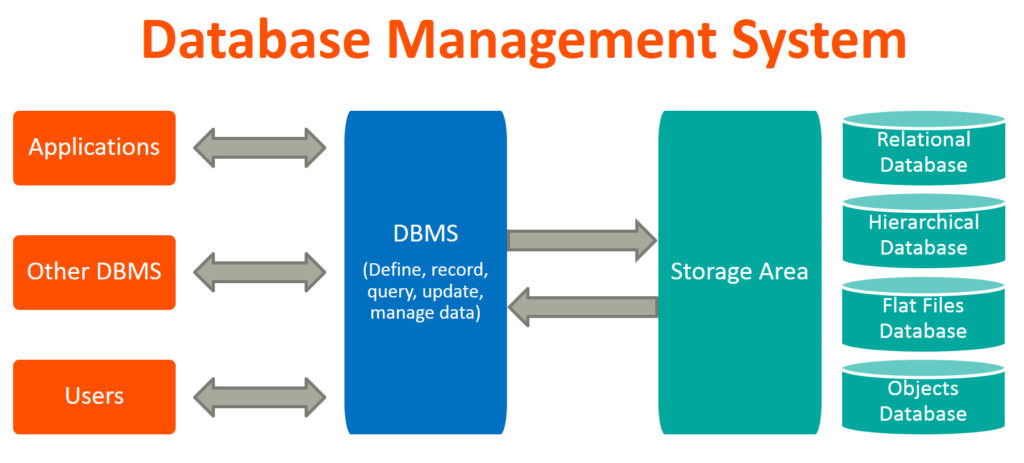
Data structures are defined as a storage format for efficient management of data. A traditional database is nothing but a data structure, that helps in storing and working with data. Each organization, from a startup to a Government entity, uses databases depending upon the scale and size of their operations. The aspect that makes databases utilitarian, is they allow users to fetch the data. In technical terms, this is referred to as requesting or querying data that is achieved by Structured Query Language, SQL.

The first-ever architecture of databases was based on a hierarchical style that made it possible to collect and store data. But that was just about it. As technology caught on with time, dragging the tide of businesses with it, data became complex. Likewise, analysts wanted databases to interoperate so they could draw better business conclusions. Thus, the database design shifted to a relational model. Today, all you need for an end-to-end data optimizing process is a Database Management System (DBMS).

Databases are no rocket science, in that they are simple tables. Tables are fields (columns) that contain the details regarding the nature of data. Rows are called records.

What is Blockchain? 

Blockchain solutions for supply chain sustainability

Blockchain is a decentral database that acts as a storage for chunks of bundled information called blocks. The reason the blocks are referred to as chains is that each block carries the hashed data of the block added to the ledger before it. This goes back to Genesis, the first-ever block that was mined for bitcoin. A hash is a code that encrypts the transactions in a given block. This code is, essentially, a pointer, a name of sorts, that uniquely identifies a block.

The bitcoin protocol makes it mandatory for every new block to contain the hash of the previous block plus the hash of the block that contains information for newly processed transactions.

But as any blockchain service providers would tell you, finding this new hash isn’t easy. Blockchain technology underpinning bitcoin adjusts hashing difficulty by calculating the total computing power of the network. The more miners there are, the harder it is to find a hash and vice versa. In return for validating blocks and helping run the Blockchain, miners are rewarded with bitcoin.

A. Defining Blockchain & Traditional Database

Defining the Traditional Database Architecture

Traditional databases are based on client-server architecture. Clients are end-users of the service that request access to a particular set of data. This request goes through a server that hosts the database. Open database connectivity is used to establish a communication line between clients and the database.

This line is further secured by the client software that is authenticated up ahead for access. In private databases, access is granted to only those who have valid login credentials and a password. An example could be confidential health records of a hospital. If a database is public and open for all, then a user account is not needed and the data can be accessed from a website. This, in turn, has played a huge role in Blockchain transforming the closed healthcare system.

Defining the Blockchain Architecture

Blockchain Technology has come off age and offers multiple architectural models such as permissioned, private, or hybrid blockchain.

Network nodes are the lifeline of Blockchain technology and they operate on a Peer-to-Peer, P2P, model. Each peer/node can correspond with a second node. There is no superiority or bias between 2 nodes in terms of responsibilities but yes, there could be a difference in total computing resources they possess. Peers of a network ensure the veracity of the Blockchain.

For the transactions to be manipulated either a 51% attack would need to happen (as mentioned above) or multiple peers would have to collude and accept blocks with falsified data. By architecture, Blockchain database technology protocols accept the longest-running, active chain. Therefore, its decentralized administration makes it safe and secure to be trusted and earns it extra points in the matchup of Blockchain vs distributed database.

B. Management of Traditional & Blockchain Database

Managing Traditional Database 

DBMS: An Intro to Database Management Systems – BMC Software | Blogs

Databases support CRUD operations i.e. you can create, read, update, and delete records. Database management is centralized and under the control of an administrator. This individual has the power to modify the database, potentially at will. Their key responsibility is to up the performance and lower database redundancy. As the database expands, so do the daily audits and the corresponding checklist of maintenance tasks.

To aid in this process, a primary administrator can divide his/her tasks and distribute work between multiple users, each assigned a minor task. This could be anything from data entry to modification.

Databases require backup storage as anything could go wrong. Data can be corrupt, servers could crash, and critical information could be lost. In such cases, the files are retrieved from backups. Backing up also allows archiving multiple versions of a database. As an example, consider an address change. Whereas you might contact relevant Government bodies to update “records” and issue you an ID reflecting the same, they will still save a copy of the last address, for record-keeping.

Managing Blockchain 

What Business Problems Do Blockchains Solve? | Formaspace

Blockchain technology decouples administration and divides it amongst all the nodes of the network that ensure it runs with their computing power. Each of the nodes stores a copy of the complete Blockchain. In wanting to change the contents of a block, its hash would have to be changed. Since Blockchain technology automatically revises the difficulty level for hashing a block, a tremendous amount of computing power would be required to change the hash of all the blocks. The only situation where that would be possible is a 51% attack, wherein the rogue actor has more computing power than the majority of the network.

As a result, Blockchain technology is proven to be immutable. Since records can’t be changed, this adds transparency to the architecture. They are also remarkably fault-tolerant as even when a few nodes (computers) are down, the rest of the nodes will ensure a 24/7 uptime.

Since no authoritarian permissions are needed to transact on a Blockchain, this makes them permissionless. Therefore, you can use Blockchain as a database but with the extra convenience of these features.

Reasons to Use a Traditional Database

1.  They are customizable

4 Customizable Gifts That They'll Love - Dash of Wellness

In the Blockchain vs database debate, the latter wins hands down in terms of customizable options. Since traditional databases are administered centrally, permissions, privileges, and set-up requirements can be optimized. The relational architecture and backup practices pave the way for a database to be relocated anywhere. Developers can add plugins to the database and improve the front end for customer-centricity.

2.  They are Stable

Data governance and the importance in arguing with data | Qlik Blog

Traditional databases can tolerate high volumes of transactions per second as permissions are centralized and the controls to update data are in the hands of a few. Client-server architecture reduces the dependency on nodes that are substituted by standalone server centers.

Database administrators revert to sharding and shrinking to optimize the speed of the network. In the event of a power outage, downtime, or any other technical glitch resulting in data loss, the backup acts as a default option to reset the last version.

3.  They Deliver Speed

How to deliver speed without losing your customers | TechBeacon

The traditional database design has undergone a lot of upgrades over the years to suit faster delivery times and high-end analytical operations. Big data analytics is a case in point.

Where Does the Traditional Database Lags – Issues That Blockchain can Solve

1.  Ethical Issues

The same centralization of power that provides for the above-mentioned advantages could also be the straw that breaks the camels’ back. Critics of the system suggest moral issues with handing over the data into the hands of a single administrator. There is an ongoing war to monetize data in every which way possible.

An open market for selling data to third-party vendors already thrives. The Cambridge Analytica scandal was an eye-washing experience that brings to light what a centralized database with a single administrator, Facebook, could do.

2.  Contingencies

Considering the case of a single administrator on top of everyone else. What happens if this individual switches to another employer? Knowledge transfers take their jolly good time not to mention the confidentiality agreements. Resetting of passwords, and appointing new administrators is a task in itself. This recruitment is a huge pain in the neck for project stakeholders.

3.  IT issues


Every organization needs a database of some kind or the other. The fact that a company stores information in a database doesn’t signify that the database is safe. The entire IT infrastructure needs to be standardized. A single loophole, given the sophistication of hackers, could sabotage enterprise operations. Security analysts must install and operate effective layers to secure traditional databases.

Reasons to Use Blockchain Technology

1.  They are Fault Tolerant

Fault tolerance through optimal workload placement

When debating Blockchain vs database, the former wins comfortably in the department of system preservation. Blockchain technology is highly fault-tolerant. Its uptime is not reliant on a few server centers but hundreds and thousands of nodes that offer processing input to run the system.

In the scenario that a few nodes are turned off, the overall efficiency of the network would remain unchallenged.

2.  They are Secure 

How to secure your website and build trust with your customers - The Business Journals

Blockchain technology is one of the most secure infrastructural investments you can make today, especially when it comes to securing mobile apps using blockchain. Each node on the network is supposed to download a copy of the blockchain for validating new blocks. To change even a single block requires each node to update its copy which in turn requires a self-defeating amount of processing prowess for an adversarial power.

3.  They Offer Transparency

Confessions of a Scrum Master - Being Transparent with "No Offense Taken" — ClearlyAgile - Agile Transformation, Certified Training, DevOps, and Agile Software Development

Provided the Blockchain is public, you can view all the transactions that have ever been recorded on it by simply downloading a copy of the ledger. Unlike a bank, where all the transfers are hidden, Blockchain technology opens the door for critics to fact-check and follow the trail of money in dubious cases.


Initial Public Offering (IPO) Process Guide For Tech Entrepreneur

Ipo Initial Public Offering Concept With People Letters And Icons Flat Vector Illustration Isolated On White Background Stock Illustration - Download Image Now - iStock

Raising Money - Raising Funds - IPO - Free Stock Photo by Jack Moreh on Stockvault.net

The best time to start a tech startup was when the dot com era was becoming mainstream. The second best time is now. But the best time to go public is evergreen. In this article, we are going to look into the IPO process – one that is designed to effectively give a chance to businesses and individuals to invest in startups that you created.  When it comes to raising funds for startups, the one preferred direction that the tech companies are moving towards is Global Initial Public Offering. With venture capitalists and crypto enthusiasts fanning the flames, a new form of raising funds for startups has now gotten mainstream for tech companies across the globe.

In fact so much so that it is soon becoming the ultimate objective of brands, especially since Uber, Pinterest, Slack, and other innovative tech companies acting as the torchbearer.

Let us get down to the basics and some present time statistics first before getting down to the process of raising an IPO.

Table of Content

  1. What is an IPO – the preferred way to raise funds for a startup?
  2. What are the benefits of an IPO
  3. The Ongoing Trend of Tech Companies Going Public
  4. Signs That You Are Prepared to Go Public Through IPO
  5. How to get IPO ready – The roadmap to navigating the process

What is an IPO – the preferred way to raise funds for a startup?

Startup Funding Stages: Seed to IPO Explained for Beginners

An Initial Public Offering or IPO as it is generally called is a process of offering the shares of a private corporation to the public through the issuance of new stock. Ever since Apple and Google went on to become public with their stocks being traded as a ticker symbol in the market, raising an IPO has become something of an endgame for emerging tech companies.

The median deal size of IPOs continue to raise year on year is only a plus side of why companies are sold on the idea of going public now more than ever.

It has become more than a process of raising capital for startups – it is now a way to prove the worthiness of a company.

What are the benefits of an IPO

Tech startups generally tend to look up to IPOs as the long term way of raising money for startup that they have created seeking one or all of the following benefits:

  • Increase in the long-term capital
  • A greater cash access and bettered liquidity
  • An opportunity for the initial founders or the investor groups to take the cash out
  • Monetization and rewards to the employees through shares
  • Augment the company’s visibility and stature in the industry

The ongoing trend of tech companies going public 

Fundraising for business startups in the technology sector is not unheard of. While generally limited to Series A to E funding and taking unconventional routes to raise money for business startup and even being a torchbearer of making ICOs a better proposition than VCs, they too have started sharing the great american dream to go public.

Initiated by Apple and Google and strengthened by Lyft, Pinterest, Fiverr, Slack, Zoom and the likes a number of tech companies are already or are getting prepared for startup fund raising through Initial Public Offering.

Here’s a visual representation of them –

But just because these tech companies felt they were ready to go public, does it mean the startup funding process is the ideal next step for your tech company as well? After all, with the world unable to give an exact answer on when is the right time to choose IPO as a startup fund raise method, how do you decide when to have an IPO?

Signs that you are prepared to go public through IPO

1.  You can forecast financial growth

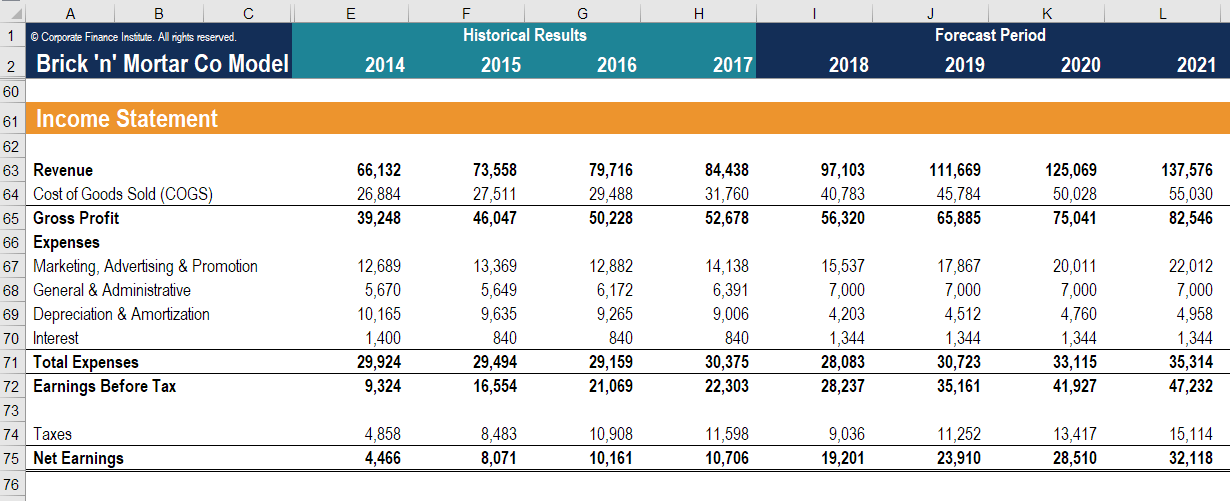
Financial Forecasting Guide - Learn to Forecast Revenues, Expenses

Accurate financial projections is key to efficient business strategy playing a massive role in a company’s growth, especially as a public company. Creating an accurate estimate of budget and forecast as your company operates privately is a key step in establishing the consistency and accuracy of financial reporting for gaining credibility with the investors.

2.  You have the best executive team

This is the Best Way to Manage Your Team - Lolly Daskal | Leadership

You have a team that has experience of being a part of a public company, who understand the nitty-gritty of running a private turned public company. In addition to a strong current team, you have also estimated the need of expanding your finance, accounting staff in addition to people handling external communications – to aid the process of going public.

In addition to your best-in-class executive team, you also have partnered with the most skilled software developers for startups that know how to digitalize and prepare a private tech company for going public.

3.  Your company is always audit-ready

Compliance Audits: What You Need to Know to Avoid a Penalty

Before going public, you would want to get in a position where you constantly close  quarterly financial statements in time. Even the companies that are backed by venture capital and private equity find it challenging to offer regular reports to their sponsors and board. By going through the exercise months in advance, businesses are able to get ready for the public reporting, stress-free.

4.  You have a strategic roadmap

How to create a roadmap that everyone can follow

A strategic roadmap is a blueprint of a company’s investment growth chart. It provides an operating strategy for growing business for providing investment returns which the prospective shareholders want from a public company.

5.  You have a strong business case for raising an IPO

Mabpharm seeks to raise capital through Hong Kong IPO

One of the most obvious reasons for getting an IPO is to gain access to the capital market and raise additional capital – the end goal of a startup investment process. An IPO is a major company evolution milestone and a symbol of your company being able to satisfy the necessary government standards and compliances.

6.  You have developed a network with investors

11 Foolproof Ways to Attract Investors

Something that makes the process of raising IPO easier and actually enjoyable, is knowing some of the key people in the investment firms. Although you must have already done your homework, let us expedite the networking process by giving you insights into which investors have been backing the tech IPO journey of companies –

How to get IPO ready – The roadmap to navigating the process

1.  Hire the best team

Use These Steps to Hire the Best Team Every Time

Selecting the best team of professionals to handle your IPO process is important for the success of your business. Here are some of the entities that should be a part of your team, in addition to the obvious inclusion of lawyers –

  • Tech Service Providers – The success of an IPO depends entirely on the software you are selling which are a result of the well-strategized software development services for startups. After all, all the tech giants who have taken the route of IPO ensured that their digital offerings were useful and best in class. Ensuring this is the work of a startup software development company. So, we would recommend choosing the best software development agency for your digital transformation needs.
  • Investment Banks – The banks act as a mediator between the companies looking to issue an IPO and the investors – while acting as an underwriter. The banks are involved in a number of processes like document preparation, issuance, marketing, filing, documentation, etc.

2.  Perform due diligence

How to perform a due diligence - Step by step guide - iPleaders

The underwriters, lawyers, and banks work together to conduct an in-depth audit of the company. Their review includes legal, tax, financial, customer verification, and market research. The intent is to create complete transparency in the company’s operations and presume risks.

3.  Build IPO prospectus

Mindspace Business Parks REIT inches closer to IPO, revises draft prospectus - The Economic Times

The IPO lawyers and company use the due diligence information for drafting the principal offering files which include IPO prospectus that should be filed as a part of IPO registration.

The IPO prospectus highlights the company’s strategy, strengths, market share, financials, investments, and products. It should also mention the risks that are involved for the investors.

IPO prospectus is subjected to expansive disclosure needs meaning it is important that the parties collaborate for ensuring the prospectus is accurate.

4.  File IPO registration statement

SEC.gov | What is a registration statement?

The IPO lawyers file IPO prospectus and the complete registration statement with SEC. This 30 days review process is subjected to reviewing and commenting by SEC. After this process, companies then complete the initial listing application round with exchange. The underwriters then file compensation information for IPO with FINRA.

5.  Pre-IPO

Although it may not be difficult for funded tech companies as they have already gone through the stage of marketing when they were raising money for their startup. They only have to do it at a much wider scale now with investment banks’ help. What you did Before IPO, investment banks popularize it to the private investors for maximizing company’s position in the market. The investors are usually hedge funds or private equity firms willing to buy shares in the company.

6.  IPO “Roadshow”

Before several weeks of the IPO, bankers and management team hold a “roadshow” – a series of presentations in which they market the IPO to prospective investors. It is usually when they first announce the offered price range and size of the shares. The intent is to gather interest from the investors for driving up the initial sales price.

7.  Initiate Trading

How to avoid common mistakes when trading in options - MyVenturePad.com

After the roadshow, bankers set up a price determining the initial share value. A few days after that, the IPO closes and stakeholders have to release their shares. After the shares have been released, investors who purchased the shares get allocation and the public trading officially begins.

Custom Software Development Supremacy- Explained

Custom Software Development Trends and Methodologies | Flexsin Blog

Understanding a clever and cost reducing way that businesses adopt to scale and solve problems in direct ways using custom software development. To be or not to be, that is the question businesses face when it comes to choosing between customized software and standard software. In some respects, the question could be the difference between the haves and have nots. Being a successful custom software development company ourselves and pushed to innovate cutting edge solutions on a habitual basis, we know first-hand what to do when.

If organizations are to transform digitally, then the installed software would have to compliment the needs equally. If you are in the middle of such a dilemma, by the end of this article you would gain clarity on the subject. Hence, we begin by answering the question, what is custom software?

What is a Customized Software? 

TEAM ELOGISOL PVT. LTD. | Home :: eLOGISOL

The software that comes pre-packaged with features is referred to as Commercial Off The Shelf or COTS. The vendor that develops it owns the responsibility of updating its versions. Enterprises slash users subscribe to it by paying a licensing fee. It is designed keeping in mind the most universal needs of the mass market. Microsoft Windows is an example of COTS. It offers the apparatus for each user to carry daily-life computational tasks without having to think twice.

On the other hand, a software that you develop, or ask a third-party to customize for you is called customized software. Since it is created unique to the needs of a particular user, it is also termed as bespoke software. Made on order, it weighs high on features that are relevant to the organization. Custom software applications are cut to fit the ongoing and upcoming business requirements.

Tasks that a standard software will take ages to complete can be accomplished in a whisker of time with custom software apps. Think of it this way, COTS is a public utility vehicle that takes the combined choices of travelers’ into consideration and drives at a speed fast enough to pacify those onboard. While custom software is that private car that you can modify as per wish and break the speed limits with.

Now that you understand what is custom software, let’s find out about its development procedure followed by a full cycle app development company.

Does Custom Software Development Process Differ from Standard?

Not at all. The software development life cycle is almost identical in each case. You traverse the same stages of basic information collection, coding, testing out the software for inconsistencies, finally moving over to deployment.

There is an unprecedented urgency in enterprises to transform digitally for sustenance. Each is looking to differentiate itself and be seen and as an innovator. Be it an in-house project, or one that is outsourced to a company like Anteelo, custom development of software involves the following stages:

Application customization

Application Customization Services (ACS) - Flexile

You would either purchase a COTS software and re-program it to requirements or build a bespoke solution. No matter what you choose, it will begin at this stage of code creation.

Application modernization

Top 5 Approaches to Legacy Application Modernization

Maturing with time, stakeholders realize that their value chains must improve and be just as impressive as their product suite. The deployed custom software will have to be modernized with features as new technologies emerge.

Application management

Why does your business need Application Management Services?

It is similar to after-sales support but one that you either do internally or let the third-party that designed the software for you do it. These envelope everything from installing the software to ensuring its 24/7 availability.

Why Choose Custom Software Development?

The reason why custom software is preferred is due to the changing market trends that makes the business transformation either costly or time consuming. Custom software application development helps businesses in building an intuitive and user-friendly software product tailored to their business requirements. It also handles various types of organizational challenges like process complexities, employee struggles, and meet the preference of customers.

Some points are discussed below for opting custom made software:-

Flexibility

Free Flexible Clip Art with No Background - ClipartKey

One of the crucial benefits of custom software companies is its flexibility. Any change required might be easily acknowledged so your platform is always updated with the ongoing patterns. A significant degree of flexibility offers effectiveness in the working process. Competitive processes are simple to automate so that the framework automatically leads the users and there is no requirement for human intervention.

Better integration

Towards better integration tests with Testcontainers - Instana

Custom programming application improvement organizations give a scope of choices to incorporating various sorts of APIs. The vast majority of the bundled programming are not viable with different programs thus incorporating another product to improve its capacities are impractical. It is this explanation; numerous organizations lean towards custom software applications over canned programming.

Future innovation

The cloud will be the centre of future innovation - Talent Germany

Having your own types of custom software will empower you to explore and welcome on board creative ideas quicker and without relying upon other innovation merchants to do it for you. This can help in more noteworthy market ability as your brand would be perceived as a forerunner instead of a late adopter for innovations that user’s long for.

App security

Mobile App Security: Tips to Secure Your Mobile Applications

The internet has an intricate dangerous environment and application security is a grave concern for modern organizations, regardless of the size. An application on the Internet is exposed to security breaches. Each organization takes measures to shield their customized software application development products against exploitation by hackers, the current circumstance is still the worst. By engaging in a presumed custom application advancement organization, organizations can take added measures to keep their information from hackers and displeased workers.

Cost reduction

Cost-reduction tactics for small businesses - Commercial Associates

At times the business do not need all the functions offered by a format yet they had to pay. On account to create custom software, you pick what you need and pay just for it. Additionally, there is something intriguing and that is off-the-shelf solutions ordinarily require monthly or yearly licensing expenses. There are already many payments in the process that if you calculate, then it will be much more costly. If you pick a custom solution, you’ll pay more at first but later on you do not have to put much effort. You can say that custom software development cost is a one-time investment.

What are the Benefits of Custom Software Development? 

It is not a good rationale to buy an inferior product, and subsequently, modify it for installation. Why wouldn’t you just create the whole thing on your own! The following advantages of custom software will help you make up your mind. The benefits can also be read as ways how custom app development can increase app development:

Vendor independent 

4 Signs of a Good Payment Partner for Independent Software Vendors

Custom design software and you shall be free from the clutches of vendors who upgrade their product based on user reception and trends than your needs. In doing so, your business circumvents fee surges caused in the name of licensing and maintenance. Then there is the possibility of the vendor ceasing operations leaving your IT department to shreds and affecting business continuity.

You would although need to hire subject matter experts to cope with a proprietary solution. But again, there is no saying how much indirect benefit you would derive from them such as mentioned in the next point.

Create white-label products

11 White Label Products to Sell Online in 2021

The resources you devote to creating a bespoke internal solution could be monetized by licensing it to similar businesses or allowing them to use it as a White Label product by making a one-time payment. A White Label product is one that you build and sell to a second organization, conferring them the right to use it under their brand name. The only catch here is to define the terms of use. Although white label solutions are not always deemed to be effective for long-term, they can be a good option, nonetheless for entrepreneurs who are just starting their journey.

High-End integration

High-End Performance Packaging: 3D/2.5D Integration 2020 - i-Micronews

Investment in COTS software becomes a catch-22 situation when you discover you have to program extensions into the system to make it worth your while. Diverting the same expenditure towards custom software applications that integrate effortlessly with other software (because you made it so) saves you much-needed energy.

Performance

Blog: Performance management simply isn't simple — People Matters

Custom software development provides for more stable and efficient IT operations as the software does all (perhaps more) that is asked of it to deliver value-adding results.

Scalability 

Performance Engineering – A One-Stop Solution for All Your Scalability, Reliability, and Capability Challenges

Nobody knows better than you the future of your venture. It becomes a self-fulfilling prophecy that you would, during the course of customized software application development, come up with something that is scalable and relatable to the needs of your company.

Optimized business process

Business Process Innovation | InfoStages Advisors

Every association has its own plan of action and in-house processes. It is hard for businesses to change their process to suit a specific application, no matter how effective and powerful it could be. Software should be planned and developed in a way to such an extent that it can align with the business model. Custom development assists with improving your business processes instead of replacing them.

Compatibility

What is Compatibility Testing? - Invensis Technologies

Most organizations have a design model in which the output generated by a specific process (software application or module) works as an input for another process. A smooth flow of data is essential while streamlining business. Utilizing different packaged programming for various processes can disrupt data flow. Building custom software can resolve numerous kinds of issues concerning the flow of data between progressive processes.

Data security

What Is Data Security?

A significant concern for some B2B and B2C organizations, data access, and security concerns influence many end-users in the market today. Supporting costly security protocols can make you pass added expenses to the services you offer to your customers. With custom development you have the ability to choose which data security technology or protocol is appropriate for your business and coordinate that in your software.

Cost effectiveness

Cost-Effectiveness Analysis | POLARIS | ADP-Policy | CDC

With custom development you can plan and stage the development process. You’re not needed to contribute an enormous amount of money first on to receive the rewards of automation. Based on your financial plan and funds accessibility, you can begin automating single processes flows in a coordinated and planned way over the long run to make development affordable software development services.

Adaptability

Learning to Change: Worker Resilience and Adaptability - Public Policy Forum

Organizational processes change with time, and as the market dynamics change, it gets important to adjust to new processes and innovations to maintain your marketing stronghold. Customized software can be effortlessly changed – New cycles and innovations can be incorporated into your current programming as and when showcasing patterns change, so you can stay side by side of your rivals.

How to Decide Whether You Need a Bespoke Solution or Not?

By tradition, companies prefer to purchase COTS software provided it helps them meet up to 80% of the following business requirements.

  • Either allow the functioning of or automate entirely B2B transactions and processes unique to the business
  • Take care of proprietary information and safeguard confidential data
  • Suffice for ad-hoc privacy issues that might arise
  • Enable integration with software already deployed by the company
  • Reduce the cost of operations and increase return on investment
  • Accord a certain level of competitive advantage to the brand

There are companies that may be fine if the software delivers 60% efficiency than 80%. The vacuum that exists they fill on their own. But that is a risky proposition, leaving things up to chance and making superficial efforts to transform digitally.

A big reason startups cover ground on legacy businesses faster than others, is because they do not hesitate to innovate. And if that means bringing in new digital solutions, so be it.

[Further Read: How We Solve the Digital Transformation Challenges Pulling Your Business Down]

Get The Requirements Ready 

Once you set your mind for custom development of software the next step is identifying collaborators to help you with project development internally. These include program sponsors, high-level stakeholders, sometimes your customers, and other miscellaneous partners.

This step is all about conveying the workforce your plans to transform digitally post which a detailed draft must be prepared listing down your Key Performance Indicators (KPI). KPIs must bear in mind:

  • To flatten out any statutory and or theoretically unachievable targets and be realistic
  • Define the role the proposed software will play in business development
  • Not to leave room for assumptions in that the end-to-end capabilities of the software are discussed with project stakeholders
  • The introduction of the software must not intervene with pre-existing COTS software
  • There must be ample proof of concept in the market to base and validate your theory on
  • The source-code used should not violate intellectual property rights and must be either open-sourced or written from scratch
  • The allocated limit of budget and time should be respected
  • If needed there can be partial diversions/pivots from the originally agreed course of action

Development Methodologies You Can Use 

You can pick any of the following software development methodologies:

Waterfall model 

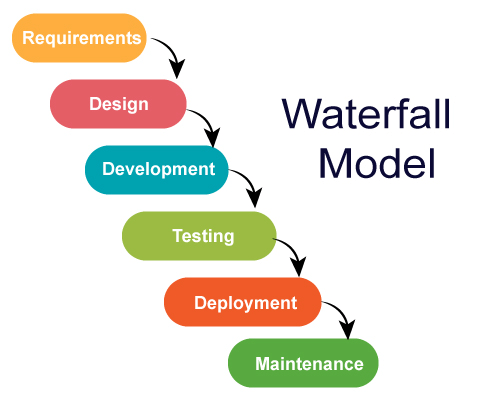
Envisaged in the 1970s, the Waterfall Model is rigid in its implementation and benefits those with a crystal clear understanding of requirements. The expectation setting is followed by rigorous project documentation. It is sequential in nature meaning one stage of the project must be finished before beginning the next. It includes the following phases:

  • Define scope
  • Re-assess the scope
  • Design
  • Implement
  • Test
  • Deploy
  • Maintain

Not that this model is out of fashion, but development teams that want to mix things up and be prepared for last-hour changes to plans, don’t like the Waterfall Model much. It is built for those who like working under ironclad rules.

Agile development

Agile Advantages For Software Development | DevCom

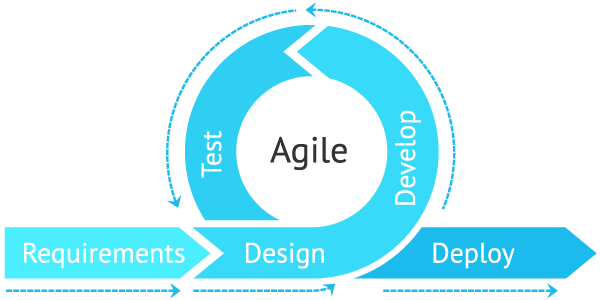
Agile is the exact opposite of waterfall, in fact it was introduced to do away with the rigid, inflexible redundancies of the waterfall model. It prioritizes business unit collaboration over documentation. Teams that go Agile, do so to wrap up coding in design sprints that are time bound mini-projects to accomplish software development faster. Customer satisfaction is the priority here, everything else takes the backseat. Here at Anteelo, we trust Agile more than other methodologies as a custom software development company. Based on experience, we can help you decide between Agile and Waterfall models easily.

Scrum

This is a nuanced approach between older models like the Waterfall and newer ones like Agile. It facilitates regular team interaction but with a relative degree of self-discipline.that team members must impose on themselves. Sprint retrospectives in scrum development last an average of two weeks during which the primary objective of software development is fragmented into smaller, more achievable goals. Developers stick to the daily briefs that are a product of demo feedback. The development is quick and results steady.

Lean 

A philosophy, methodology, or a mindset, call it what you will, it brings out tremendous productivity from teams in custom software companies. Whereas other entries in this list were specifically meant to bolster software development practices, Lean methodology was adopted from the manufacturing sector.

Agile is accomodative of flexibility, but it offers no actionable course to extend the same ideology towards business wings outside of Information Technology. Lean proposes the no-nonsense approach, nullifying wasteful practices, encouraging knowledge sharing, experimentation, innovation and faster turn-around times.

Feature driven development (FDD)

Why (and How) You Should Use Feature-Driven Development | Lucidchart Blog

Custom software design and development can be taken up via Feature Driven Development as well. FDD has been a precursor to the now omnipresent, Agile and Lean approaches. It follows a five-step development model. In the first step you take your plans to the whiteboard and lay out an overall strategy. The next step is defining the specifications of the software followed by planning around each feature holistically. Designing and building each feature make up for the last two stages respectively.

Make up Your Mind

We hope this clears the air around custom development of software. Be it on-demand, or standard solutions, Anteelo  has a track record of achievements in both categories. Our report card in the subject boasts nothing short of an ‘A’ with top industry review journals giving us a 10/10 on numerous occasions. Signing off with a saying dear to all at Anteelo.

If you are looking to develop an app that would be up to date with all the latest technologies of the current time, you should partner with a software app development company that is well-adept with the changing market needs, or you can opt for developers in your area like software development company in USA or Florida if you live in US. But make sure you choose the best to get quality results.

Steps For Effective Software Product Development in 2021

All the major elements of software product development - NewGenApps - The Technology Company with Integrity Uncategorized % %

There are a lot of things that should be spontaneous in life, like office parties, weekend trips, even tattoos but software development is not one of them! Stages of software development should be efficiently and effectively planned. If you want to develop a great software product, you need to have a proper plan and process in place. Benjamin Franklin so aptly put it – “If you fail to plan, you are planning to fail.”

Let us take you over the sequence of steps that are required for proficient software product design and development. The full cycle of product development involves several steps where the ending of one step is the beginning of another!

Table of Content:

  • SDLC for Product Development
  • SDLC stages: What are the stages of software development life- cycle?
  • How an MVP approach can make the software development process more effective?
  • Steps to lower the software development time and cost
  • Why does Anteelo trust agile methodologies?
  • The Path to Success

SDLC for Product Development

Software Development Life Cycle (SDLC) is a process for developing high quality software to meet customer expectations. SDLC includes a structure with a detailed plan to strategize, build, and maintain the product development.

Each stage of the product item advancement life cycle has its procedures and deliverables that get into the following stage. Throughout the software development process, every product begins with a thought. Then it goes through exploration, improvement, and testing, to the last service.

SDLC stages: What are the stages of software development life cycle?

As discussed above, the process of software development is a step by step method that needs to be dealt with in an efficient and effective manner.  Let’s learn about SDLC methodologies and stages in detail:

1. Idea and Concept:

Difference Between Idea and Concept | Difference Between

It all starts with an out-of-the-box idea and validating your application idea, but it is suggestable that right from the very beginning, document everything! Don’t keep your software product development ideas just inside your head. Any concept should be carefully thought out and brainstormed in order to be executed. Here are a few things that you can probe upon:

  • Define your goals
  • List out the features your software will have
  • Research other software products
  • Figure out how your product will stand out
  • Discuss the target audience
  • Sketch out what the software product will look like
  • You can be analytical and put together a user story

These simple steps will help your software product development life cycle in ways that you can’t even fathom and make the process smooth right from the start! This also defines a clear agenda that you have regarding the product.

2. Planning and Feasibility Analysis:

The Components of a Feasibility Study

Feasibility analysis, an important part of the app discovery process, will help you determine not only the technical but also the economic aspects impacting your software product development process. You need to keep a few things in mind while planning the roadmap of your product like time, resources, essential tasks, estimates, and ROI etc. An adequate amount of analysis and planning helps in foreseeing the risks that can occur during the software product design process. It will also help you in being ready with risk mitigation strategies.

3. Proof of Concept:

How Proof-of-Concept (POC) App Development Helps in Building Error-free Software Products - Aalpha India - Bangalore

Once you are through with your second step, you can go ahead and start with a proof of concept (POC). POC is one of the most important steps that software development services need to follow. This stage comes into existence way before the software development process starts. It will help you in validating your idea and you would know if the software product development steps are actually working for your business or not. It will not only confirm technical feasibility and possible expectations but also determine the potential blocks and the scope to accomplish them.

4. Design:

Logo design process: how professionals do it -

A good design is the one that doesn’t scream ‘look at me’ rather it shouts out ‘look at this product’. Software design is an integral stage of software development. Once the POC is successful, the design team conceptualizes a detailed software architecture hitting the bull’s eye when it comes to the features of the software. Product design strategy is about striking the right balance between user needs and business goals and not losing sight of either one during the SDLC.

The product design of your software will include prototypes and the final mockups, making sure that they are very customer centric. So the wireframes, standards, workflows and end goals should be defined keeping user interaction and final output in mind.

5. Proof of Value:

Proof of Value (POV) dives deeper into what the product means to your business. It helps you determine if your goals are achievable or not! Through the POV process you can easily take a single case from beginning to the end and inspect all the elements and understand the gaps on the way.

A POV basically provides a better understanding of the predicted value that the products will bring in and measure success.

6. Development and Coding:

Coding Standards and Development: A General Overview

Once we have all the key elements like the POV, design document and the functional requirement specification document, we can start with coding and development. It is all about giving life to your product! The software product development engineering team has to make sure that their coding process is accurate since it is potentially the riskiest step of the SDLC. Once the complete architecture that includes database, application programming interface and planned functionality of the solution is built, we can move towards the testing stage.

7. Quality Checking and Testing:

Pin by Kairos Technologies Inc on Software Testing | Software testing, Testing techniques, What is software

Now that your team is developing the software, quality checking and testing is one of the most important development process steps. I would highly recommend you to test, track and fix bugs simultaneously. However, once the product is developed successfully, you must have a final in-depth test as well.

You can start with these simple mobile app testing steps:

  • Releasing the product to a small group of beta testers
  • Using UX tools to keep a track of how the users are interacting to your product

You need to be 100% sure that you are not distributing buggy software to customers; this can ruin your reputation and result in loss of revenue. Testing plays a huge role in the software development procedure. I cannot emphasize it enough!

8. Deployment and Implementation:

Ready' for Implementation, 'Done' for Deployment!!

Once you are done with software development process steps like designing, coding and testing of your application, now is the time of actual installation of the crafted product. The application is now moved to production including data and components transfer. However, during the next releases, only some specific changes will be deployed. At this stage, end-users and system analysts can see, use and experiment the ready application.

9. Marketing Strategies:

12 Advanced Marketing Strategies for Amazon Sellers

Simultaneously the marketing team will keep coming up with a multi-platform approach to turn the spotlight towards your product. Out of the box strategies that will focus on telling the product’s unique story, understanding the competitive analysis, investing in digital marketing, creating social media and SEO master plans will enhance the product’s value.

10. Maintenance, Upgrades and Enhancement:

Application Maintenance | IT Company | Riyam Computer Services

You think that you have accomplished all the SDLC methodologies, well think again! The software development steps are not over yet. The final stage includes maintenance, operations and regular updates. Since this process starts post-launch, keep in mind that the customer needs are evolving every single day, which makes this step extremely essential.

The product will be upgraded, maintained, polished, redesigned and enhanced according to the feedback of the customers and the rapid development in the IT sector. I believe that this is the perfect time to vigorously modify the application’s functionalities to upgrade its performance. This way, you will be able to meet the actual needs of your target audience.

How an MVP approach can make the software development process more effective?

The full-form of MVP is – minimum viable product. The MVP will help you gain the users perspective. How? Below are some important pointers for you to keep in mind:

  • It is a ready to launch version of your software product with the sufficient amount of features that are enough for the initial users.
  • Once the feedback is received from the initial users, only then the final product is designed with all the elements.
  • The MVP process is cost effective since it saves time and accelerates the development process.

Building an MVP is not the only important task but testing its viability is just as important too. A software development company may think that the product can satisfy the needs of the customers but until and unless the MVP test is run, it cannot be said for sure.

Steps to lower the software development time and cost:

Step-1: Turn to outsourcing

More Companies Turn to Outsourcing As a Foundation for Innovation - Gorilla Logic

Outsourcing the software development process results in 40% decrease of the actual cost. You should consider your outsourcing options because:

  • Initial in-house cost cutting will save you a lot of money in the form of on-shore salaries, benefits, taxes, marketing and management costs, etc.
  • Zero pay out on software architecture.
  • You’ll be able to choose designers and developers on the basis of technical knowledge, relevant experience and lower budget criteria.

We suggest you do your due diligence and award yourself with a software product development strategy company that is capable of meeting the quality requirements and completing your product successfully.

Step-2: Leave no room for assumptions

Employee turnover: 9 reasons good employees leave | CIO

You should not be ambiguous about what you want when it comes to product development! If the requirements are not clear your product can turn into a disaster because of haphazard design, unplanned functionality and the lack of distinctness.

Documenting each and every requirement and expectation regarding your product will help you eliminate the room for vagueness. This will reduce the overall software development costs and save time for you, helping you focus on other important business problems and solutions.

Step-3: Testing is the key element

React Testing Library: The Modern Way to Test React Components | by Dilantha Prasanjith | Bits and Pieces

Make sure that the testing team is involved in every step of the way. Successful software developers reveal that they started testing for red flags, errors or bugs right from the design phase.

If the errors are found at a later stage, the intensity of rework increases! The quality check team will not only save the cost and time by reducing the chances for mid-project redesigning but also avoid sub-optimal application quality. By making software testing your ‘mantra’ you will throw light on potential risks and surface functionality conflicts.

Step-4: Prioritize the ‘must have’ features and eradicate the ‘nice to have’ features

I’m sure that we all buy gadgets and do not use about 50% of the features, same is the case with software products! They have a lot of unessential functions that your target audience will never use. Such features increase the development time and maintenance cost, so make sure your product has the most viable features.

I advise you to start with a smaller chunk of money and create a basic product. Once it turns out to be profitable, you can always expand the functionalities of the product. This step will save your time and cost. Also, carry out a proper market research to determine and forecast what your clients are embracing about your product.

Popular Software Development Methodologies

A team picks a specific set of tools and procedures for design, testing, management, and other software development processes. These choices rely on the aim that stands before the team and the objectives of the product that is to be built. Here are the most well-known software development models that an experienced teams use:

Waterfall Model

JIRA Waterfall Model - Javatpoint

This model presumes that each stage is finished before the beginning of the next one. For instance, QA engineers begin testing solely after programming is totally done.

V-shaped Model

V-Shaped Model (Sami, 2012). | Download Scientific Diagram

It is a lot like the waterfall model with a slight contrast- that is the testing occurs simultaneously with the other major stride for software development process.

Incremental model

Incremental Model (Software Engineering) - javatpoint

This model is split into builds. It implies that the product is developed with discrete squares/parts. In other terms, it means that the product is built like an enigma.

Rapid App Development Model

Rapid application development - Wikiwand

In this model, the project development is split among small teams who work simultaneously.

Agile Model

Agile Model (Software Engineering) - javatpoint

It is a sort of incremental model where each delivery is focused on better software quality. This methodology is broadly spread amongst teams and customers as it displays consistent process and fast results. Time taken to each build can be measured by weeks rather than by months.

Why does Anteelo trust agile methodologies?

The agile software development process and its most popular methodology – scrum, give you an interactive and dynamic experience. Agile methodologies will give you the power to collaborate with customers, interact with individuals and stay in constant touch with the team working on your project and produce sustainable, profitable and successful products.

It is all about accelerating the process, making it more efficient, and responding to the real needs of your customers, even if it does not align with your initial plan. Agile does help you to go with the flow and move in one direction with the understanding that you’ll change course along the way because of the constantly evolving technology and requirements. Also, this is the reason why the agile approach is really effective when it comes to startups.

The Path to Success

The most important outcome of following the above SDLC phases is that it will give fluency to the project execution process. Understand that the SDLC can be structured to the needs of a particular project in order to deliver the best product possible.

Anteelo offers custom software application development processes. The Anteelo product development team accomplishes in understanding your product, designing and developing it, testing it, and finally constantly evolving it. We align lean principles in our software development process.

Lean development principles is an agile approach which was developed on lean manufacturing principles. We assist in discovering, designing, engineering and scaling up your product. We excel in customer satisfaction, cost effectiveness, and efficient workflows.

If you are searching for a reliable custom software development company that involves the latest technologies of the current time, then you should opt expert agencies or companies in your area like software development company USA, if you live in the US. But make sure you choose the best to get quality results.

Build an Effective Personal Finance Application

How to Build an Effective Personal Finance Application | Agilie app development company blog

Let’s be honest! We all want to live in a world where our finances are managed judiciously and our money is being saved automatically. Earlier people used complex accounting systems, today’s world is way more simple because a finance app can save the day. Why worry when there is an app for everything?

According to Statista, total transaction value in personal finance is expected to show an annual growth rate (CAGR 2020-2024) of 25.0% resulting in a projected total amount of US$1,715,072m by 2024. This, in turn, is bringing the global personal finance management market on a growth spurt.

I am well aware of the fact that there are a number of such finance apps in the market today but I am here to guide you about your personal finance app idea. With the right approach, you can easily join the market leaders. So let’s get on to business, shall we?

What is personal finance?

Personal finance concepts | Maureen McGuinness | Highbrow

In simple words, personal finance entails all the financial decisions and activities that an individual makes. It is all about planning your financial short term and long term goals for example, buying a new car, investing in a new home, saving for your child’s education or planning your retirement. Certainly, it depends on various factors like your income, lifestyle, expenses, individual goals etc.

The sector is an amalgamation of multiple Fintech categories that bring the best of the domain on users’ fingertips.

With consumers getting more conscious about their earnings and savings, personal finance apps are gaining traction in the market; making both investors and startups look ahead to developing a personal finance app.

Personal finance management mainly constitutes of:

  • Budgeting
  • Planning
  • Taxes and insurance
  • Saving
  • Investing
  • Keeping emergency fund for future

Financial literacy is very important in order to make the most out of your income and savings.

What is the role of a personal finance app?

Finance apps make your life easier by helping you to manage your finances efficiently. A personal finance app will not only help you with budgeting and accounting but also give you helpful insights about money management. It gives users various investment options, tax advice, insurance inputs and above all, a proper security system. The extensive role of a personal finance app makes them a key part of the Fintech trends list.

Types of finance apps

There are many market leaders when it comes to finance apps but we can roughly divide it into two main categories – simple apps with manual data entry process and complex apps with automated entry process. Let’s dig a little deeper!

1.  Simple finance apps

Best 9 Money Management Apps for Easy Financial Planning

As the name suggests, these are the simplest apps to track income and expenditures. These apps generally work on manual information inputs.

Pros:

  • The risk factor is zero since no bank accounts are linked to these apps.
  • These apps are very cheap when it comes to the personal finance app development process.

Cons:

  • The human error rate is high because of the manual data entry process.
  • The entire process is time taking.

2.  Complex finance apps

The best budgeting apps 2021 | Tom's Guide

The complex finance apps are more advanced. They allow users to link their bank accounts and cards, through which data is synchronized automatically.

Pros:

  • These apps are generally a lot more all-encompassing. They allow users to perform a series of tasks in place of a limited few.
  • The efficiency of complex finance apps is high since they save valuable time for the user.
  • Real-time transaction updates so the user is always conscious about the money management process.

Cons:

  • The cost of the development process for these apps is generally high.
  • It is important to invest more on security since the app deals with confidential and crucial data.

Key financial app features to make your finance app a big hit

1.  Account integration

Can we use Google pay to transfer money if the other person has not registered for UPI at any platform? - Quora

Make sure your financial management software accumulates all financial accounts of the consumer, for example credit cards, debit cards, loans, mutual funds, etc. Your finance app should be a one-stop solution for everything related to or required for money management.

2.  Security

How To Increase Your Online Security? - TEXTILE VALUE CHAIN

With such confidential details and credentials comes great responsibility. This is one of the key lessons that businesses can learn from Fintech companies. Creating a finance management app is one thing but making a secure one is completely a different story. There are many technologies that can help keep your money less vulnerable and more secure. Some of these technologies are listed below:

  • Biometric security measurements: It involves unique characteristics of a person, such as voice or fingerprint patterns. With biometrics, it can be extremely difficult for someone to break into your money management app.
  • Multi-factor authentication: This adds on an extra coating of security.  Two-factor authentication process makes it even harder for attackers to gain access to a consumer’s sensitive information.
  • Real-time alerts: It is important that your finance management app notifies users in real time. Customers develop great confidence when they know for a fact that they will receive a notification if anyone is trying to access their account or personal information.

3.  AI algorithms

Top AI algorithms for Healthcare

There are many ways AI is reforming the mobile app industry in terms of user engagement and developer app revenue. Artificial intelligence algorithms will help you personalize the user experience. Let’s discuss how AI can make personal finance management more effective.

  • AI will help you incorporate expenditure categorization. This will aim to classify the cost spent on a specific category for example, medical, entertainment, groceries, investment, etc.
  • AI also looks into expenditure analytics, which automatically updates and provides you with data visualization of your money spent on each category.

4.  AI chatbots for useful advice

AI Chatbots: The Guardian Angel for your Business

AI chatbots provide access to all of a customer’s data. Further the app can analyze and provide suggestions. The solution can keep track of the spending habits, give insights into the credit scores, manage budgets etc. This enables AI-based recommendations which ultimately helps with efficient money management. The AI-based customer service chatbots are imitating human interactions and providing them desirable information/result in no time.

5.  Real time spending and tracking

Google Pay: A safe & helpful way to manage money - Apps on Google Play

A money management app should help consumers track their expenditure. This feature will come in handy since the users will save both time and money. It is important that the consumers do not have to switch apps to track where they are spending or investing their money, it should be effortlessly done on a single platform.

6.  Simplicity

Google Pay: A safe & helpful way to manage money - Apps on Google Play

No one is fond of complex procedures in a money management app because it involves crucial details. You should keep the 3 clicks rule in your head, that is, 3 simple taps should be enough to lead the consumers to wherever they want.

7.  User experience

User Experience Design in Digital Transformation | by Agata Cieślar | UX Planet

Most of the developers build an app without focusing on the design. This ultimately leads to the app’s downfall. The balance between app functionality and design is hard to maintain but is a necessity.

The design of a financial planning application must be extremely user-friendly to better customer satisfaction. To develop an efficient application with amazing user experience, you must know the target audience and where their preferences are. Not only this, you should definitely think as a user.

The user experience of your app will be a deciding factor for the consumers if they want to use it or not. Make sure your financial management software is easy to use and navigate. This will ultimately lead to business growth for your startup.

8.  Constant customer support

6,768 Call Center Agent Stock Photos, Pictures & Royalty-Free Images

24*7 customer support is of great importance. Customer support in different languages will get you a global clientele and keep your customers loyal.

9.  Alerts and notifications

B2B & the power of push notifications - Swiftcloud

It is one of the most significant features for a finance app. Notifications can help consumers in case of:

  • More expenditure
  • Low balance in the account
  • Upcoming bills to be paid
  • Great deals for investment or savings

Additional features that can help you in making a superb finance app

Here are some advanced features for your personal finance management app.

  • Currency converter
  • In-app general calculator
  • Credit score calculator
  • Tax calculator
  • Shopping list

I think you might also want to know about the teams involved in developing a personal finance application. You think, I deliver! Here you go!

Make sure your financial app development company should have a team of:

How to monetize a personal finance app?

Creating a Personal Finance App That People Will Want To Use

It is hard to associate the term “free” with “revenue”, right? Now that you are providing fintech services to your customers, how will you make money? Let’s probe how to earn money from your Fintech app further:

  1. In-app purchases: You can allow users to utilize basic features of your app for free and you can keep the premium features in the paid version. Premium features can include the advanced version of the basic ones and of course, some new functionalities will always be appreciated by the consumers.
  2. Integration with third party services: Grant consumers to use third party services that are relatable to your business. This will expand the usability, functionality and audience of your app simultaneously.
  3. In-app ads: Earning money through in-app ads is the easiest way to make money! However, my suggestion to you is, make sure that too many banners don’t pop-up too frequently in your app. That is just a huge turn-off for the user.

End note

As you have understood that there is a demand for financial application development in the market. Now, you have a basic idea about how to build an app with key features and monetize it. So, if you have an idea and want to conquer the market with it, reach out to a fintech app development company to build it. It is the right time to hire a development team of agile ninjas and skilled developers and designers to bring your idea to life.

Businesses develop their next iOS apps using Swift 5- Reasons

Why should Businesses develop their next iOS app using Swift 5 | infotech.report

Swift is a highly intuitive programming language for Apple’s operating systems like iOS, macOS, and watchOS. The programming language has been growing in popularity and it can be attributed to its unique and valuable features. Swift is a widely used language for iOS app development globally. The iPhone app development platform has evolved considerably in the past. After going through four massive version updates, Swift released the latest two versions, Swift 5.0 and Swift 5.1. The remarkable functions of both these versions play a significant role in strengthening the language. The programming language is poised to become a game-changer in the mobile app development industry, with its latest version, Swift 5.

Whether you want to grow your business as an entrepreneur or looking for ways to scale as a startup, Swift offers you all the advantages of developing the best in class, highly functional and completely customised iOS applications. That’s one of the reasons why LinkedIn, Lyft and others have upgraded their iOS mobile application in Swift.

Let us first look into what both these versions have to offer. Then, we’ll look into Swift 5 features that make the updates an ideal choice for iOS app development companies.

What was introduced with Swift 5 Update?

Apart from the revolutionary ABI stability, the Swift runtime is also now added in the present and future Apple platform’s OS versions: iOS, macOS, watchOS, and tvOS.

Swift 5 features also come with a plethora of new capabilities that act as the building blocks of Apple’s vision and give a new direction to the advantages of the swift programming language.

*For in-depth insights, head on to Swift 5 release notes.

Language Updates

1. Binary Compatibility and a Stable ABI

Shipping Binary Frameworks With Swift 5.0 | Square Corner Blog

ABI was declared stable for Swift 5 app development. As a result, Swift libraries have been incorporated in every iOS, tvOS, watchOS, and macOS, which was earlier a problematic element whenever engineers had to develop apps for iOS. The applications will now be easier to develop and much smaller in size since they will not include any libraries.

2. Standard Library Updates

On the future of Windows 10's feature releases | Computerworld

Swift 5’s standard library comes with the following new feature set:

  1. The string has been reimplemented with the UTF-8 encoding which results in faster code.
  2. Better support for raw texts in the string literals.
  3. The SIMD vector and Result types have been added.
  4. Performance improvements in Set and Directory.
  5. Enhancements in String implementation, giving flexibility for constructing text from data.

3. Additional Compiler and Language Updates

Swift mobile development facilitates exclusive access to the memory, both for debugging and releasing builds. It supports dynamically callable types which help in improving interoperability with dynamic languages like JavaScript, Python, and Ruby.

It also implements these language proposals:

  1. Handling future enum cases
  2. Literal initialization through coercion
  3. Introduce user-defined dynamic “callable” types
  4. Supports ‘less than’ operator in the compilation conditions
  5. Identity key path
  6. Flatten nested optionals emerging from ‘try?’

4. Package Manager Updates

Bro Package Manager - Icon Clipart (#5076022) - PikPng
The Swift Package Manager comes with a series of new features in the Swift 5 app development version, which includes: Dependency mirroring, customized deployment targets, target-specific build settings, and the capability to generate the code coverage data. In addition to this, the swift run command includes a capability to import libraries in REPL with building an executable.

Swift 5 also implements these Package Manager proposals from Swift evolution process:

  1. Dependency Mirroring
  2. Platform deployment settings
  3. Target specific build settings

What was introduced with Swift 5.1? 

Swift 5.1 grows on the strength of Swift 5 with features like module stability and other new features that extend the ability of language and standard library like: opaque result types, property wrappers, new APIs for String, diffing for appropriate collection types, etc.

Together, Swift 5.1 makes it easy to design APIs and lower the common boilerplate code.

Here are the features that Swift 5.1 comes with:

1. Module Stability

Family house clipart 7 » Clipart Station

Swift 5.1 makes it possible to create binary frameworks which can be shared with others who leverage language’s added support for module stability. This, in turn, makes it extremely convenient and speedy for developers to develop apps for iOS.

It defines a new text based module interface file which describes the binary framework API, enabling it to get compiled with codes with the help of different compiler versions.

2. Standard Library Updates

C Standard Library PNG Images, C Standard Library Clipart Free Download

The Swift 5.1 standard library comes with the following new features, making it extremely easy to understand how to make apps with Swift 5:

  1. Support for updating and handling diffs on the collection of appropriate types.
  2. Greater flexibility for initialization of an array.
  3. APIs for working with Strings – developing and handling contiguous strings, helper for working with Unicode text, and general initializers for Range and String.index.
  4. Identifiable protocol for extending reductions, vector swizzles, and vectors.

3. Language Server Protocol

Language Server Protocol - NSHipster

The Swift 5.1 OSS toolchain packages for Ubuntu and macOS include binaries for the SourceKit-LSP, which is an implementation of LSP for C-based languages and Swift.

4. SwiftSyntax Updates

What's new in Swift 5.0 – Hacking with Swift

It has been re-architecture with a separate focus on improving the performance by using a parser from the Swift compiler. Additionally, the performance of the syntax tree visitation and its related operations have been improved through the re-architecture of internal data structures.

5. Additional Language and Compiler Updates

Android Developers Blog: New language features and more in Kotlin 1.4

Swift 5.1 comes with these new language features:

  1. Property wrappers introducing consistent context for defining the custom access patterns for property values like – delayed initializers, thread-specific storage, atomic operations, etc.
  2. The return keyword is not needed for single expression getters or functions.
  3. Self can be used for value types and classes.
  4. The compiler synthesizes default values for the properties with default initializers.

How do Businesses benefit from it? 

Although the majority of the features introduced with Swift 5 and Swift 5.1 are in favor of Swift app builders, some of them can be translated into business benefits as well.

One of the key features that directly impact businesses – the one that the Apple industry had been waiting for since Swift 1.0 – is ABI (Application Binary Interface) stability.

Hacking with Swift Live 2019

While sounding much like a developer’s problem, what this means in practicality is that Apple couldn’t include Swift programming language support in the operating systems, because an app written in Swift 2 couldn’t run with Swift 3. Simply because it wouldn’t work with the language support binaries of Swift 3.

The solution that was available to the developers was to include the Swift libraries in the app bundle which would get downloaded from the App store. This, in turn, increased the size and the storage requirement of the application. And became one of the biggest disadvantages of the swift iOS programming language.

But with Swift 5 making ABI stable, the industry has now received a permanent solution to these user-side issues. It would enable the developers to run the application in all the upcoming Swift versions. Meaning, the code is written in the Swift 5 app development process will run on Swift 6, 7, and so on, an event that makes Swift a preferred language for Enterprises and Startups.

This move is speculated to be the one that would bring language several strides ahead in the Swift vs Objective-C comparison.

Here are the business benefits of the Swift 5 update:

  • Smaller app size: Swift 5 makes the language binary compatible. Meaning, the end result of Swift mobile development would be significantly smaller for the users to run on their new operating system – iOS 12.2, watchOS 5.2, macOS 10.14.4, and tvOS 12.2.
  • Faster Launch: Another advantage of this is the faster launch time, since every dynamic library which is used by an application (which increases the launch time) will be cached in the memory and shared among the applications.
  • Greater Performance: Users do not want to work in a broken application. And with app freeze and glitches being the biggest reason behind app uninstallation rate, it is imperative for a business to avoid it. The Swift 5’s ABI stability helps apps in behaving better and offering enhanced performance.

But.

How small is too small? Let’s answer through the help of some live cases of Swift app development for iOS –

  • Apollo for Reddit: comes with an app size of 35.7 MB. Here, the 7.5 MB is made up of Swift libraries. Now when the app gets updated to Swift 5, the size will be reduced by over 20% and come around at 30 MB.
  • Chirp an app that brought Twitter to Apple Watch comes with a size of 28.8 MB, which is inclusive of 11.6 MB made of Swift libraries. This, when updated to Swift 5, gets reduced by over 30%, bringing the size down 20 MB.
  • Readability: One of the key reasons why it is best to choose Swift is due to its readability. It is relatively easy to modify, read and write and the clean syntax renders it a special uniqueness. It requires a lesser number of lines of code than Objective-C when compared to Swift apps.

Apps created with Swift not only decrease the development cost but also the development time.

In a blog post talking about the future of Swift language, Donny Wals said, “Now that we have Module Stability and ABI Stability in Swift, the language is likely to change at a slower rate than we’re used to. We should see less radical, source-breaking changes and the language should slowly mature into a beautiful, fast and stable language that will be a great basis for your applications for years to come.”

Is it good to build an app in swift 5? Yes. The time is right for businesses with iOS apps to get the code re-written in Swift 5 and for new businesses to build apps on Swift 5 and benefit from the impeccable user experience.

MeWe App Development and Determining Its Cost

How To Determine The Cost of MeWe App Development?

When it comes to social media networks, Facebook is certainly one of the most popular choices available. However, a lot of people who care about their privacy have been looking for an alternate, and that’s where MeWe comes into play.MeWe’s CEO, Mark Weinstein, in his Wall Street Journal op-ed, wrote, “MeWe is a full-featured social network engineered with privacy-by-design that’s freemium-based with no ads, targeting or news feed manipulation. Marketers and election meddlers cannot target or boost anything to anyone. These are significant competitive differentiations.” Weinstein also adds that, “It’s gratifying to see MeWe flourishing worldwide. MeWe is the uplifting social network with the features people love, and the respect, control and data privacy we all deserve.”

Technology is taking social media by storm, let’s see the most buzzing social platform that is taking the internet and individuals into a completely new and safe arena.

What is MeWe?

MeWe - Apps on Google Play

MeWe is a social media network based on a subscription model that focuses on privacy. The MeWe site terms itself as a ‘Next-Gen Social Network’ by providing users an ad free experience.

It has become extremely popular as a business-focused product that takes enterprise networking and communication to a completely new level.

The application is found by Mark Weinstein, an entrepreneur who considered himself as one of the early developers of the concept of social media. As of now, the MeWe platform has millions of users and is thriving as a popular privacy-focused alternative to Facebook.

Earlier, Weinstein launched a company named Ello, and based on the challenges he faced during that time, he learned several lessons that allowed him to shatter the social media dominance of Facebook.

Although the platform is free to use for personal users with several features like 8 gigabytes of storage, customized stickers, voice and video support, and newsfeed, enterprises are required to pay $1.99 per month to access additional features.

Why There is a Need for MeWe App Development? 

It’s a no-brainer that Facebook is the most dynamic and popular social media network that has dominated the social cult ever since its initial launch. From job postings to community management, it includes a myriad of features that keep a user hooked and engaged to the app.

However as they made changes in their privacy policy, a lot of people started realizing that their privacy is being compromised by the platform.

According to their most recent update, Facebook has employed an algorithm that observes your behavioral patterns and deciphers them to serve you manipulated content in the application. This makes it more of a target-based platform that displays content as per your past preferences and choices.

In the wake of WhatsApp and Facebook data breach controversy, people are looking out for new social media platforms that are safe and secure. MeWe, a US based social network has come to the rescue and becomes the top downloaded social app in the Play store. MeWe app for android and MeWe app for iPhone has led to the increase of new users in the apps counting to more than 2.5 million users.

With the help of MeWe app development, you can keep your privacy protected by preventing targeting, ads, and political biases.

Essential Features in MeWe App Development 

Mobile App Development Company | Python Mobile App Development Experts

If you take a look at several social media networks available, you will notice that there are certain common features that each of them share. To be able to determine the cost of MeWe app development, you need to consider keeping these essential features in mind.

Moreover, as you introduce other specific features to your application, you will notice that the MeWe app cost will definitely bump further. With that said let’s take a look at some fundamental features required while developing the MeWe app:

What do you get with MeWe?

  • Profile creation 

Your application needs to provide users the ability to express themselves through their personal profiles. It includes allowing them to enter their personal details such as name, address, website, email, birth date, and even mobile number. 

  • Authorization 

A proper authorization mechanism acts as the foundation block of the privacy and data of your users. Therefore it’s certainly a must-have feature in your MeWe application. It involves letting users signup and login in to your platform through their phone numbers or email addresses. Additionally, it also requires a password recovery and reset mechanism, some security interventions, and several other features. 

  • Messaging 

As you’re trying to make MeWe social media platform you surely need to ensure that your users have a proper communication channel. Moreover, in addition to simply sending texts, you may also need to add the ability to send media files such as messages, videos, and stickers through chat. The development cost may even vary depending on whether you want to allow your users to have group conversations or not.

  • Search function 

To make the usability of your application easier for users, you need to include a search function that allows them to access the profile of their friends, communities of their interest, and posts they find engaging. 

  • User interface 

Apart from the crucial features, the design of an application is certainly one of the most important aspects because that’s what makes your creation unique. This may also be the costliest part of your MeWe social media app development process. While getting the user interface designed for your application, you need to make sure it looks attractive and provides an aesthetic feel to your users.

How is MeWe different from Facebook and Other Social Media Platforms? 

Unlike other social media apps, MeWe social app has a different concept which does not replicate every other social media site. The MeWe creator’s intent is very clear when it comes to marketing the platform, as it has been directly indicated in interviews that MeWe wants to be the alternative to Facebook.

This most likely clarifies why the site attempts to imitate Facebook’s UI. Users can offer thumbs up, hearts, and smiley icons to posts. They can share their posts on their different feeds. There are user profiles and separate pages, and groups feature for individuals to assemble around a particular theme or topic.

The below image will show you which are the top categories and apps used by users.

Determining The Development Cost

When you’re developing an application like MeWe, it’s evident to say that there’s no specified cost associated with it. The expenses that you may incur depend on the functionality, complexity, and comprehensiveness of your application.

Moreover, if you’re outsourcing the development part, the MeWe app development cost becomes majorly dependent on the social media app development company you hire. On the other hand, if you have an in-house team of social media app developers, you need to keep their salaries in mind while determining the estimated development cost of your application.

Additionally, as you keep adding more features, the costs will keep piling up. It’s also worth determining the total number of hours required to complete the development phase of your application, in case you hire social media app builders on the basis of hourly payment. Therefore, make sure you keep all these things in mind while determining the social media app development cost of your MeWe Application.

The Takeaway 

As Facebook made changes in its policies and tampered with its user’s privacy, people began looking for safer and more privacy-oriented platforms. This calls for the need for MeWe application development. While making an application like MeWe, you need to consider several things such as core features, UI design, and a lot more.

Additionally, to determine the costs associated with the development of this application, you may also need to consider several aspects like mode of development and required time. Hopefully, you may have found this guide helpful to come up with an estimated development cost for your application.

Still if you have any doubts, or are finding difficulty in hiring a social media app development agency in USA, just contact us.


error: Content is protected !!