Andriod’s in-app update API

We all use a lot of apps on our devices these days. One for shopping, one for banking, others for ordering food, booking tickets, buying groceries and what not. But the moment the app shows “a new update is pending” notification, we mostly ignore it. As a result, we miss downloading the latest and important feature which can further improve the experience of the app. That’s the story from a user’s end.But on the developer’s side, the story is a bit different. We want all our users to stay updated with the latest version of the app. We imagine users clicking on the “update now” button and start using the new feature almost instantly. But the harsh truth is that only a few users keep their apps updated with new versions.The reason is because most of the times, users don’t bother about opening play store to update their apps. In other words, they don’t have the interest or the time to open and update the app until the app stops doing certain tasks which they want to accomplish.

Google has come up with the solution to this problem. It offers an in-app update feature to update the app without interacting/opening the play store. With this feature, a user can download the latest features while using the app. So let’s dive in to see how we can use this feature.

The in-app update is available in Android Play Core library, that shows prompt to the user for an in-app update. There are two different ways in which we can prompt our users that an update is available.

How to work with Android's in-app update API? - Stack Overflow

Flexible Flow

If the core functionality of the app doesn’t get affected by the released features then you can use the Flexible Update flow. It allows user to download the update in the background. Once downloading is done, user will be asked to restart the app. Doing so will update the app during the restart process. The benefit of using this Flexible flow is that a user can use the app until the download process is finished. So there is no block time while using the app. User can still use the features as the downloading process is being done in the background.

Immediate Flow

If the core functionality of the app is highly dependent on the released features then you can use the Immediate Update flow. In this feature, a dialog will be prompted to ask the user for downloading and installing updates. The user can’t use the app until the downloading, installing and restarting the app.

Checking if an update is available or not – 

For a good user experience, we should always ask the user to update the app only if updates are available. We can check if an update is available or not from the backend.

For that you can use the AppUpdateManager, which will give the AppUpdateInfo object that contains the information about if we need to show the update dialog or not. The updateAvailability method returns these values for the update state :

UNKNOWN

UPDATE_AVAILABLE

UPDATE_IN_PROGRESS

DEVELOPER_TRIGGERED_UPDATE_IN_PROGRESS

Start an update –

Once you have checked for the updates and in case of updates are available then you can use

startUpdateFlowForResults() to update the app.

We will get the following request codes in onActivityResult.

RESULT_CANCELED : This will indicate that user has denied/canceled for the update.

RESULT_OK : This will indicate that user has accepted the update.

RESULT_IN_APP_UPDATE_FAILED : This will indicate that there is some problems occurred during the update.

So now we know how to use in-app update feature to update the app. It’s a good practice to use the Flexible Flow to update the app when there are very few updates and it doesn’t affect the core functionality of your app. However, you have to make a decision on which flow to use as per your requirements and the kind of app you are making. I hope I was clear and concise in my blog and I hope now you have an understanding of how in-app update API work in Android.

Role of New Engineering Managers

A few months into their new position, engineering managers start agonizing how they hardly get time to do any technical work. They feel they would soon become redundant if they don’t start contributing in the technical areas.I get it, I’ve been there.I remember the constant assault on my self esteem when I was first promoted to be a manager. Most of the things that I had learned to get to that position were all of a sudden..umm…good-for-nothing. As if all my technical chops had implemented an IDisposable interface overnight. Sigh!

If you’re going through the same phase a) please know that you’re not alone, b) understand what has changed.Earlier, as an individual contributor, it was all about  you, you, and you. There were days when you wrote great code and then there were some when you didn’t. It was either 0 or 1. Team’s success depended on you, but you were still a lone warrior.

Anteelo design - How to Become an Engineering Manager | Ohio University

But nothing is permanent. The moment you become a manager, the focal point changes. It’s not about your individual contributions anymore. It’s all about the team now and the work they are producing. You become responsible for the team’s success and failure.

The metrics of your success changes from the world of binary to the world of grays. And when the playing field changes, you need to change your perspective instead of drowning yourself in the sea of self-doubt.

This is why it’s pointless to indulge in the thought of becoming redundant. You can’t become redundant, even if you wanted to, as your job’s responsibilities have changed. You are now akin to a maestro orchestrator who needs to ensure that your team plays the most memorable symphony.

Here’s an equation by the legendary Andy Grove from his book High Output Management to help you see your managerial impact.

A manager’s output = The output of his organization + The output of the neighboring organizations under his influence

The most significant implication here? Technical work done by the manager doesn’t surface in this equation.

So what does this equation mean for you?

Output of your organization > Your individual output

You are only recognized for the quality and speed of your team — your efforts become the sum total of all of your team’s effort. Your contributions are judged and remembered by how well your team is doing.

“A leader is as good as the team.”

10 Characteristics of an Outstanding Engineering Leader

To make sure you get the best out of the team, you have to manage it well. Set the vision. Set the expectations around the desired outcome. Have one on ones with your team members. Give feedback. Seek feedback. Help set the cadence for deliveries. Run effective meetings. Manage the sprints and the plan. Manage the stakeholders. Assess the outcomes. Celebrate. Reflect. And do everything possible that helps a manager manage a team well.

Did you see the time to program anywhere in the above list? Nope.

It’s not that you can’t code or you don’t want to code. Because if you want to you WILL find time for it. But your primary responsibility becomes uniformity of the codebase, making sure the code reviews happen, and the team releases a high quality software.

Output of neighboring organization > Your individual output

You would be a rockstar engineering manager if you were to merely focus on the first part of the equation. You could be even better if you were to cast the spell of your influence on other engineering groups within your organization. Also, your growth within the organization is predicated on this particular variable.

You could influence other groups in different ways. Review their architecture. Participate in their code reviews. Share knowledge about creating better teams and software with them. Run innovation initiatives. Participate in hiring. Suggest new process initiatives.

In a nutshell, make an effort to elevate the overall quality of your entire organization.

Managing a software team vs. being in a software team are totally different things. You need a new Swiss army knife of skills when you get promoted to be a manager. Thus, there isn’t any merit in agonizing over not getting the time to do the technical stuff as that wasn’t the reason you were promoted in the first place.

Dropbox Store and JetPack in Modern Android App Architecture

Jetpack LiveData [All official development resources] | Android Topics

A few days ago, Dropbox acquired an open-source Store library. The aim behind taking the ownership was to modify it to make it more suitable to the prevailing Android developer ecosystem.

Dropbox

Now, Store also includes Google JetPack collection of libraries which poses as a solution for creating current-day Android apps.

Google JetPack makes it possible to create high-quality Android apps while accelerating the development process.

Android Development Blog

There are two objectives that this library fulfills – It leverages advanced Kotlin features in order to reduce the boilerplate code and offers high-level abstractions besides those found in the Android SDK, i.e., Fragments and [Activities]. These allow the developers to present complex tasks in an easier and simpler way.

Like in case of the traditional mobile app architecture, there are numerous components in Jetpack that developers can use independently and cover four areas – Architecture, Foundation, User Interface, and Behavior.

In fact, Google uploaded its own recommended Android app architecture along with JetPack defining the set of modules that make up an Android app and how they interact. As shown in the image, a well-architecture Android app is fundamentally based on the tenets – model-driven UI, separation of concerns, and one-directional dependencies across several modules.

However, though Jetpack offers most of the components for the creation of an Android app based on the architecture suggested by Google, there is an exception – the Repository layer.

On this matter, Mike Nakhimovich, the creator of Store states- 

“Repository currently only has a few code samples and no reusable abstractions that work across different implementations. That’s one of the big reasons why Dropbox is investing in Store–to solve this gap in the architecture model above.”

Modern Android App Architecture with JetPack and Dropbox Store

Store, while relying on a reactive design, aims to support Android app development where data flows in and out of the UI in a seamless manner without forcing the users to navigate back and forth. Mike goes on to say on this matter –

“Reactive front ends led me to think of how we can have declarative data stores with simple APIs that abstract complex features like multi-request throttling and disk caching that are needed in modern mobile applications.”

To explain this in brief – Dropbox Store helps in connecting the app model with an external data source by using a declarative interface centralizing all data-related activities.

Store aims at optimizing network usage in order to keep it at a minimum. This library was rewritten Kotlin backed by Coroutines and Flow, followed by another major change of discarding RxJava for structured concurrency paradigm which is implemented in Kotlin reactive streams.

This switch poses a big impact on ensuring all resources employed in concurrent tasks are freed whenever the task completes, says Mike.

“The big problem with RxJava’s approach to scoping background operations is that it’s too easy for engineers to forget to call dispose. Failing to dispose of active subscriptions directly leads to memory leaks.”

RxJava — Types of Observables. Understanding RxJava for Android… | by Dheeraj Andra | MindOrks | Medium

In addition, the Store also supports disk caching, memory caching with TTL and size policies, explicitly skipping the cache to fetch new data from the data source, multi-casting of responses, among many others.

Now, that Dropbox is implementing many changes in the Store for improvement, it has been set on a path of becoming a great source of resources for all Android app development developers.

Are QR Codes Failing ?

QR code, also known as flash code, is a two-dimensional barcode that records information related to an item. It can be read by a QR scanner or a mobile device with a camera. QR codes can have many usages. Scanning a barcode could lead to the  downloading of an application, a link to more information about about a business, or even personal usage like the uploading of one’s resume.

QR Codes are everywhere, on articles, buses, websites, billboards… It is a true form of advertising.  It can be playful, luxurious, or even more dangerous. But it has not yet won its credibility in the eyes of the public. Millions of people are spending their time tweeting, pinning, checking but why not flashing?

An American blogger, Sean x Cummins surveyed 300 people on the streets of San Francisco, showing them the photo of the small square, and asking them if they knew what it was? Only 11% answered “QR code”. The others suggested anything and everything, from the korean military code to the aerial view of San Francisco

The results were similar when surveying New Yorkers. The Brooklyn Museum put a code on the back of its entrance tags that served as an introduction to what visitors might find behind QR codes throughout the building. Every visitor coming in the door gets one of these tags, but only 1.77% of visitors responded by scanning the code.

Although this mobile technology seems great and useful in providing additional content in numerous media channels, its popularity is lacking.

Here is why:  We may be in 2012,  but a large large number of people do not still know what QR codes represent. The reason for this lack of knowledge is the little to no communication on the technology itself.  Previous launches of barcode scanners proved unsuccessful. QR codes must regild to show their great potential.

The problem remains that QR codes do not really bring interest to get flashed. The proposed contents have to bring a real added value to the product or to the communication, send back towards a simple web page without interest and not optimized for mobile bring nothing. And why not directly integrate the reader of flash codes in the camera, as a native app? Now, you must download a third application on the market of your telephone, an application which will not be integrated into your camera.

QR codes are obviously a powerful tool of communication on which it will be necessary to count in the next years. For marketers, QR codes provide a relatively inexpensive way of reaching out to consumers while still maintaining complete control of the resulting interaction. With creativity, the possibilities are endless. It only needs a big advertising campaign to ground the movement. Place your bets now.

International Dating? Choose the ‘Flutter’ app

By only working one day a week, Flutter aims to create a meaningful environment where users form genuine connections and feel empowered to move the relationship forward, and off of the app.

Tired of ghosting and drawn-out conversations? Dating in 2020 can feel like a minefield, especially with all the different dating apps out there. Yet, even when you find an app that you somewhat enjoy, the ability to create a real, authentic relationship can be extremely difficult. Flutter, a new dating app, is trying to change that. Instead of swiping left or right, having a mindless chat, then leaving the app, Flutter is facilitating relationships by only allowing app action on Sundays. This includes viewing, matching, and chatting with other users, with the exception of allowing you to edit your profile on other days of the week.

In late 2019, Clay Jones and Teddy Jungreis founded Flutter, on a mission to create an app that would foster genuine relationships and move away from the more common dating app trend of swiping and never actually connecting. According to Biz Journals, Jungreis explained that “Flutter forces people to exchange information quickly so they can continue to build the relationship off of the app.

While apps like Tinder and Hinge, leave people with “ghosting and mismatches and conversations that fizzle out,” Flutter is for users who want to create a serious connection.

In a unique approach to dating, Flutter only allows users to access the app features on Sundays. It all begins on Sunday morning when you are added to the waitlist. You then have until the afternoon to claim a spot and be added to the dating pool. The user then has access to view, like, and comment on profiles, and a few hours later the matches are released. This gives users a small window of time to make a move before all the information disappears forever. The app is currently offered to users in San Francisco, but they plan on expanding to New York, Los Angeles, and other cities soon.

Flutter is free and has a 4.3/5 star rating in the app store with 91 ratings in total. When Flutter launched to Product Hunt in early March, they received over 900 upvotes, an impressive number that they exhibit on their front page.


Flutter App - Dating Template by RichardCreatives | CodeCanyon

Why angularjs is a match for Web App Development?

AngularJS started as a research project by Google that ultimately became one of the most popular responsive web app development frameworks. While working with AngularJS, you can be assured of a highly dependable scalable code base. Compared to most other JavaScript frameworks AngularJS is fast, powerful, and versatile enough to integrate with other frameworks. Built by commendable brains like Adam Abrons and Miško Hevery of Google it easily stands out from other JavaScript frameworks for responsive web development. Here we explain some of the key reasons to choose AngularJS for web app development.


EASY AND FAST-PACED DEVELOPMENT

Any AngularJS development company will agree to the fact that it is an exceptionally simple and fast-paced JavaScript MVC Framework for front-end development. By adding a few attributes to the HTML a developer can quickly build an app. AngularJS is equipped to enhance the HTML code while building controls for all types of difficult functions and creating a dependency between the template and the controller. To help beginners, there are plenty of useful tutorials available. If you want to build a web app quickly with a simple interface and few crucial features, AngularJS is the ideal framework to opt for.

PERFORMANCE DRIVEN FRAMEWORK

AngularJS developers speak to the program’s unmatched competence in creating and adding new features for customizing an app. It is well equipped with state of the art features to drive app performance like filters, data binding, directives, animations, API client, routing, form validation, and many more features that are sought after for web development. With AngularJS you can easily update and improve without undertaking a bulk of coding tasks.

The best thing about this framework is that it helps to create new elements and adds new features and functions to an app without disrupting the performance. The framework offers a lot of productivity tools to help with developing new features and improving or updating the app. Furthermore, the community-shared mutual libraries allow more versatility and flexibility.


SMOOTH INTEGRATION WITH OTHER LIBRARIES

As far as collaborating with other libraries for responsive web app development is concerned, AngularJS offers smooth and easy integration. If the developers are working with other object-oriented MVC frameworks for the server-side development, they can easily integrate AngularJS for client-side development.

AngularJS, thanks to dependency injection, allows easy integration with other libraries. To create new functionalities you also have an array of libraries that can easily supplement AngularJS for a project.

ROBUST TESTING MECHANISM FOR THE WEB APPS

AngularJS comes loaded with a robust testing mechanism to ensure building an error-free and high-performance app. When you need to upgrade and fix issues, powerful inbuilt testing tools to make your job easier. The apps built with AngularJS are highly testable ensuring a high degree of performance. 5 Top Reasons To Choose AngularJS For Web Application Development | by Angular Minds | Medium

EFFECTIVE DATA BINDING

One of the most crucial reasons for choosing AngularJS is its two-way data binding capacity. With such data binding, any change incorporated into the interface directly results in changes to the app objects. Similarly, any change with the app objects results in changes to the app interface as well. This saves development time and makes incorporating changes to the app easier.

HEAVY LIFTING

AngularJS is capable of intelligent heavy lifting. AngularJS builds the controller function and dependency easily between the template and the controller thanks to intelligent heavy lifting. It is equipped to grab the required share of the app data and render it onto the device screen with the concerted output of the template and the controller.

LESS CODING

AngularJS works seamlessly with HTML coding, and that enables it to develop the app based on basic information models instead of creating rows of tasks awaiting their turns in the MVC pipeline. This ensures that the developers working with AngularJS have to write less code. Apart from this, AngularJS will also help you to scale up the capacity of the app with minor tweaks in the code base. This ease of coding actually helps to build the app faster while ensuring optimum performance.

DECLARATIVE CODING

AngularJS is one of the frameworks that are known for a declarative coding paradigm for building frequently accessible patterns. Thanks to declarative coding paradigm you can ensure more lightweight code allowing optimum ease in reading and supporting. The declarative code of the AngularJS apps does not describe all steps pertaining to the app but only ones that are absolutely required along with their expected outcomes.

USING DIRECTIVES

Just because AngularJS is patterned after AngularJS started as a research project by Google that ultimately became one of the most popular responsive web app development frameworks. Thanks to this inbuilt directives the developers can now create logic more easily with the more productive output. In case of any confusion, you can always refer to the directives to ensure better code readability.

CLIENT SIDE SOLUTION

AngularJS offers a client-side solution with great compatibility for both desktop and mobile browsers. Without requiring any modifications, AngularJS can easily be deployed across any project. This makes it an ideal framework for building any front-end app. This also ensures faster deployment across systems and browsers that offer support for JavaScript.

FLEXIBILITY OF FILTERS

In a JavaScript framework the filters work for refining the values for display. This is of great value for any web app trying to appear consistent and meaningful for the users. Filters can change the decimal value of a number to show it with full value, or it can add pagination to the pages of your website or can just change the uppercase or lowercase string of letters to the opposite. With custom filters, you can also tweak these values in your own preferred ways.

AngularJS is completely well-equipped to deliver all the attributes and features you look for in a modern responsive web app. Most important of all, it takes off a major load from the developers.

What’s the future of website scrolling?

It’s hard to create the illusion of a 3 dimensional object from a 2 dimensional image and I’m not talking about the recent craze of 3-D TV’s, mobile gaming consuls and computers. There is a way to do it though. Parallax scrolling. Parallax scrolling was first used for video games and it gave the illusion of 3-D from a 2-D image.

How does this work though? When scrolling the background images move slower than different foreground images, which creates an illusion of depth to the viewer. You will notice this type of scrolling on old video games like Moon Patrol (the first game this technique was used on) or more popular games like Sonic the Hedgehog I & II and Street Fighter II.

Recently some websites have been receiving a face-lift using parallax scrolling, truly transforming the look and feel of the site, like the Nike website. The background and various images move at different speeds allowing for the 3-D illusion. The best part about this is, it is not with old 80’s video game graphics, but can be seen on Full HD display’s. This rather old technology can is being applied in a new ways and makes for a very exciting web experience.

Where to look for Pro Design Inspo

FAIR STATE BREWING COOPERATIVE

The not- yet- open Fair State Brewing Cooperative is Minnesota’s first cooperative brewery. Their motto? “We love to brew good beer. We love the good people who love our beer.” Their website reflects this message. Scrolling through the clean design, you learn all about the new company and their commitment not only to stellar beer, but also to their community of beer lovers in the co-op. It’s an honest, simple site.

HOTELSTYLE

There’s not a lot to this website for the obscure Italian clothing store, HotelStyle, but we like the presentation of the full screen video that opens the site. The video features the kind of man your mother would not want you to talk to (when you studied abroad in Florence) modeling the company’s clothing. The angles are great.

YEP!

Yep! is an app that “creates instant meetings with fun people.” You choose an activity- a walk, a meal, a tennis match- and the app finds you a friend. In a couple short scrolls on their creative website, you not only understand Yep!’s mission but you become excited about it, too. Yep! is based in San Francisco, but we were impressed with the ability to view the website in Russian. Can’t wait to try it out.

NEOTOKIO!

The designers over at Italian design agency, Neotokio!, are currently on vacation and instead of directing you to their regular website, Neotokio! has designed a lovely scrolling popsicle that announces that they’re out of the office. Their website is not only super interactive, it’s exciting and brilliantly designed. Scrolling uncovers a site full of great content.

MEDIABOOM

MediaBOOM is a digital design agency in Guilford, CT. Their website features an impressive portfolio while animated full screen video plays in the background. Definitely check out the tour of “MediaBOOM: Interactive Capital of the World!” in 3D. Don’t skip the intro.

TCM’S SUMMER UNDER THE STARS

This website is interactive, beautiful, and educational. The movie lovers over at Turner Classic Movies has produced an awesome website for their “Summer Under the Stars.” All summer, TCM has devoted an entire day to one classic movie star. On TV, the day is filled with back to back movies featuring the actor. Online, the website provides information about the star and allows  you to reflect, via social media, on why that star was legendary. It’s all part of the network’s new marketing scheme. Today’s star? The American actress Jeanne Crain. Our favorite website this week!

Road to your company’s success: Develop Website

Anyone who has ever been involved in running a business knows that an effective product or service does not guarantee success. When your potential customers are unaware of your company’s existence, or they don’t understand how you can benefit their lives, they won’t buy your product.

That’s why strong website development is so important.  When designed by talented website developers who approach each project individually, websites can be an extremely powerful method of lead generation. The following are just a few of the ways your web presence can help you achieve success:

GETTING CUSTOMER ATTENTION

In most cases, potential customers do not stumble across websites unprompted. It’s much more likely that they’ll find your website as a result of an internet search.

By incorporating keywords into your website’s content, you’ll boost your chances of appearing in a relevant Google search, helping you achieve that critical first step: getting potential customers to know you exist.

To increase your visibility on the web, you should not only feature the keywords prominently on the homepage, but also host a blog that shares relevant information with users. Doing so gives you even more opportunities to reach the kind of people most likely to be interested in your service or product.

DEMONSTRATING YOUR PRODUCT

An intuitive website could be designed to show off to customers what exactly your product or service can do for them. For example, if you’re selling a new tool or promoting an app, a quick video embedded on the homepage to demonstrate it is an excellent visual element to include.

That said, you don’t need to rely on video. Many great websites make effective use of clean and simple graphic design to explain how a service benefits customers in easy-to-digest visual language (e.g. infographics). Whatever route you choose, if your website is organized around explaining what your product does in a concise and engaging manner, you’ll have made your way through another major hurdle on the path to success.

MARKETING OPPORTUNITIES

Although a great website can often convince someone to buy your product right away, it’s true that even your target user will not necessarily click through and convert to a paying customer. Luckily, you can build your website to clearly direct viewers towards additional marketing campaigns, such as an email newsletter. As such, marketing experts often suggest that companies include numerous lead generation forms throughout their sites.

Do you offer free estimates for your service? Include a form for that. Are you currently offering a free promotion? Make sure potential customers can easily spot the form to sign up for it on the relevant portion of your site.

ESTABLISHING CREDIBILITY

While you may be fully aware of the fact that your past clients have been thrilled with your service, it is safe to assume new customers are unaware of this fact. Fortunately, a great website easily solves this problem for you: All you need is a page which features testimonials.

Your homepage should be the main feature that grabs the attention of a customer and explains to them how you can address a need in their own life. Testimonials from previous clients help to establish your credibility because consumers are more likely to trust their peers than just the brand speaking for itself. This can be a critical ingredient in your recipe to success, getting previously skeptical people to make a purchase.

CREATING A BRAND

There is a universally accepted fact in the business world: Proper branding is key to success. Your company should have a fully-realized identity that customers recognize in the form of visual imagery, language use, and overall attitude.

The right website may be the most powerful tool you have for establishing your brand early, because it allows you to include all of the elements of effective branding. The images you display on the screen, the tone of your content, and the user experience itself will all come together to reflect the values of your company.

Your website is a representation of your unique brand, and as such it is essential to hire experts who work hard to understand what makes your business stand out. They’ll translate what they learn into a website that will set you on the course to success.

Agile Development: Build Your App

AGILE METHODOLOGY

You finally have it. After months, maybe even years, of failing to envision an app that will resonate with users, you’ve come up with The Really Good Idea: An app that fills a niche no one else has thought of, an app that fills a need users didn’t even know they had.

So, you plan. You decide exactly what you’re going to build, you get funding, you set goals, you track every step, you work an utterly absurd amount of hours, you arrive at your finished product, you release it to the world, and… no one is impressed. Your idea was not the hit you expected; users barely notice it.

Predicting what customers will want is not easy. No matter how skilled your team is, if your Really Good Idea isn’t actually as useful or appealing as you imagined, at the end of it all you’ll have merely wasted time, money, and energy.

Agile development is essentially an umbrella term for various methodologies such as Scrum and extreme programming (XP), and represents a way of avoiding this fate. The idea came about in 2001 when 17 software developers met up at Utah’s Snowbird resort and shared their ideas with one another about making the software development process more efficient and simple. The result was the Manifesto for Agile Software Development, which outlined a set of principles used to build an app that actually gives users what they want.

WHAT AGILE DEVELOPMENT IS

The emergence of agile development followed a period in the 1990s when teams were striving to create lightweight software development methods. Prior to this, many software development teams followed the “waterfall” model. This process involved following a strict set of steps to arrive at a finished product: Once the product idea was in place, teams would first analyze the software and system requirements necessary to realize the concept. Following that, they would design the software architecture, code, test for bugs and defects, and eventually introduce the finished product.

It’s a process that requires a fair amount of planning and provides little room for flexibility. The problem for app developers, though, is that all that strict regulation, combined with the sequential nature of the waterfall method, means that there’s no way of knowing whether or not users will actually be interested in a product until it is complete.

Agile development, by focusing on incremental goals, rather than just the major end goal, gives developers the opportunity to respond quickly to user reactions and modify plans to build an app that will succeed. By embracing certain key principles, including frequent delivery of software and an openness to change at any step of the process, developers can avoid gambling all of their resources on the hope that the app they are working to build will appeal to users.

THE AGILE DEVELOPMENT PROCESS

Again, it’s important to keep in mind that agile development encompasses many different methodologies. No business needs to use all of them, nor could any one business possibly use all of them. As such, the process varies depending on the project.

That said, there are basic aspects of agile development that are generally applicable. One of these is the idea of “iterations.”

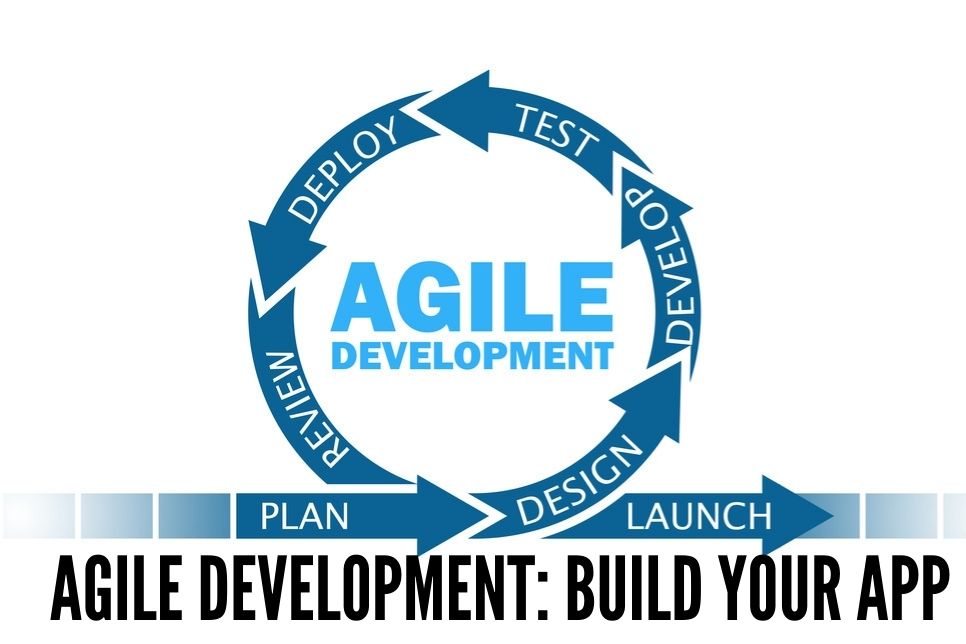
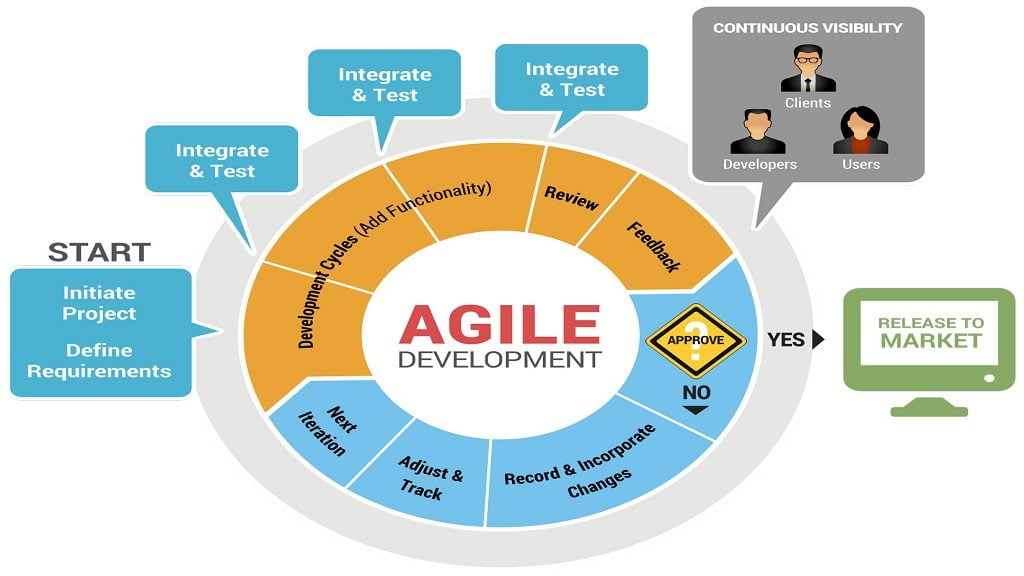
Instead of spending months working to create a complete product, which often involves a tremendous amount of planning and risk, agile app development encourages teams to spend one to four weeks developing basic iterations of an app. At the end of each cycle, the latest iteration is demonstrated. Although these individual iterations are rarely strong enough to bring to market, they allow a business to introduce new features, identify potential problems, and adapt to changing needs more quickly.

While working on an iteration, a common part of the agile development process is a daily meeting in which all team members explain what they did the previous day to reach the goal of that iteration, and bring up any roadblocks they anticipate. However, these daily meetings are usually not meant to be problem-solving conferences. If any problem-solving does occur, it only involves select members of the team, so that other team members can continue working on their piece of the project. In this way, time management and efficiency is preserved during the process.

Although milestones are a key part of agile development, they can be changed if necessary.


How to build an app using Agile Development


AGILE DEVELOPMENT ROLES

There is no one set of roles that all agile development teams adopt. Different methods encourage different roles. However, there are certain team members who are typically involved.

Usually, the development team consists of 10 or fewer people equipped with the skills necessary to plan, develop, and test a new iteration of an app. These teams are usually self-motivated, and although there is rarely a specific team “leader,” there is often one member whose role involves addressing any issues that would distract a team from its task.

Another key player often involved in agile development is a product manager who represents the interests of the customers and stakeholders. Because the development team should be focused on reaching the goals of a particular iteration, someone needs to be available who can make sure that the work being done will actually result in something of value. One of the major principles of agile development is the idea that business owners and developers should be in constant communication, and this person facilitates that.

BENEFITS OF AGILE APP DEVELOPMENT

Building a successful app almost always involves being able to adapt. Your Really Good Idea might have only been the seed for something that customers actually want. As talented as you might be, predicting what will or will not resonate with users is no easy task. Yet, some approaches to software development rely on a team’s ability to make that kind of accurate prediction.

Agile development helps to limit risk by letting teams build apps in increments. Users can test new iterations and provide feedback; additional features can be launched to see if they add to the product; teams can spot potential problems early. They can also identify potentially successful features that they might not have thought of during the early planning stages.

As Fueled strategist Aaron Cohen puts it, “The agile process allows for unparalleled flexibility and customization during the development cycle of an application. While we may be certain of fundamental features and user experiences, the interface details and specific user flows can be tweaked during development should new use cases arise or insights be learned. Our designers often create discrete graphic elements moments before the engineers incorporate them into the codebase, freeing the engineers from reliance upon product level design files and less-than-ideal graphic elements. This is one of the primary reasons why our apps, even our v1 releases, exude such an evolved design sensibility.”

To put the agile development process to use, let’s look at a real-life example: The origin of Instagram is Burbn, a check-in app that you’ve probably never heard of. The team realized it was too similar to Foursquare and as a result, they changed direction, focusing on the photography element of the product. In the world of app development, teams have to be able to pivot when a better opportunity presents itself. But by sticking to a plan that’s too rigid, this can be difficult, if not impossible.
Agile development isn’t about doing away with planning. It isn’t about being unfocused. It’s about making sure your team works in a way that allows it to make those pivots when they need to.

error: Content is protected !!