How Much Does a TikTok-like Mobile App Cost?

Full Guide on How to Make an App Like TikTok

If there is one thing common between Uber, Facebook, and Snapchat it is the fact that they are losing on their active user count and engagement rate.

And the brand that they are losing out to is one that has become inescapable and a major revolution of the entertainment world – TikTok.

The multi-faceted immersive mobile app that is present on both Android and iOS has not just ruled out its dominance in the world of the millions and billions of users around the globe but also thousands of businesses that are marking their presence in the platform to enjoy the many perks that the app has to offer.

Well.

The intent of this article is to help you join the short-video creation and distribution revolution that has been initiated by TikTok by helping you understand what it takes to develop a TikTok mobile app. We will look into the technical and monetary side of the app and in the end, the cost of video creation app development which is entirely TikTok focused.

Before we go on with the article and look at factors like the top players in the industry, the funding rounds that have been held in the segment, the technical aspect of the app and the costing element the application, let us first give time to looking at how TikTok managed to become the top-grossing application of the world.

The international version of Chinese hit platform, Douyin, TikTok took very less time to enter and rule the mobile entertainment industry. The app which allows users to lip-sync dialogues and re-enact their favorite scenes from different movies and music videos has become a go-to entertainment hub for almost every teen and pre-teen in the world.

The app which has Artificial Intelligence powering its every single move has defeated a number of hot-shot businesses of the world with its engagement and revenue numbers.

Here are some statistics that prove how big the TikTok market is and how the app is ruling the world while setting new standards in the Entertainment app sector and how you can too whether you make TikTok app for iOS or build TikTok for Android

A guide to the app TikTok for anyone who isn't a teen.The latest TikTok statistics show a picture that TikTok has placed itself at the top of the market acquisition pyramid. Does it mean that a monopoly picture has been drawn in this specific entertainment sector?

Well, the answer is no.

TikTok, in spite of being the most installed and immersive of all the apps in the category, is not the only one that the users are following, there are a number of other similar apps in the domain that have been keeping the category up and running.

Also, the demand that the segment is seeing is something that has acted as a catalyst for other businesses, like yours, to enter the in-demand market segment. So, all in all, the list of TikTok competitors is not limited to just these names.

Fundings in the Segment

Top five alternatives to TikTok video app | Deccan Herald

It is not just the market demand and emerging competitors count that has seen a rise ever since the TikTok app, earlier Musical.ly started witnessing a high demand from the world. There has been a sharp rise in the number of investors as well, who have shown their interest in putting their money into apps working around video creation and sharing.

Here are the three major funding rounds that hit the category between 2017 and now.

  1. Bytedance – The parent company of TikTok received funding of around $3 Billion from the SoftBank group in October 2018. The use that they cited for this fund round is international expansion. The company plans on taking the Chinese platform across the globe.
  2. Clip – The multi-lingual app which allows users to develop and edit videos alongside an active chat functionality, raised $6 Million in Series A funding round led by Matrix Partners, where the platform’s present investors Shunwei Capital, and India Quotient were also there.

While these are just two high-level funding rounds that the app category has witnessed, there have been a number of other funding sessions in the segment as well.

One thing and probably the sole thing that has been driving the attention of both investors and end-users towards the interactive video creation and sharing platform is the set of features that it comes with.

Let us look into it next.

While on a high-level the main feature of TikTok like the application is the ability to make videos and share them on the platform for other users to view and react to it. The app gives users the facility to lip-sync either some movie dialogue or some song or even the voice of other users.

But when you deep-dive into it from a business front which is looking to enter the same entertainment space as TikTok app and others in the domain, there are a number of other features that you have to attend to in order to make the whole experience immersive and entertaining for the users.

For the context of this article, since you are just starting up in the industry, what we would recommend is making an MVP first that would contain all the must-have features that have to be present in your app as it hits the store and become the answer to How to Create an App like TikTok. The features that you read here are what would go into answering ‘How much does it cost to make an app like TikTok’

Let us look at what they are –

The Must-Have TikTok Features

When you invest in TikTok app development, you don’t just invest in one application but two – User Side of the App and Admin Panel.

Let us look at the features which should be present in both the versions, individually that come together to answer how TikTok works.

User Application Features

Login

Triller: What It Is and How to Use It

The first and supposedly the most attractive screens of an app – Login screen is the one that you will have to pay the most attention to. At this stage, you should aim for having a small form to make users enter the app also they should be given the facility to log in through their social media account to save those extra, unnecessary steps.

Video Section

What is Triller? Here's a primer on what you need to know

Since the whole concept of TikTok like app runs around Videos, this has to be the one section that gets the maximum attention from both development and users front. Here, you will have to give users the option to not just create and share their videos but also save them in the draft to be published on a later time. The users are also given the facility to share their videos on social media.

Notifications

How to Use Triller-Music Video Maker App: Social Video Platform | dohack

The app should send over real-time notifications to the users with respect to followers’ addition, the likes, and shares activity that they make on your videos, and when people they follow make a new update on their profile.

Settings
What Is Triller? Here's the Triller Guide You've Been Waiting For

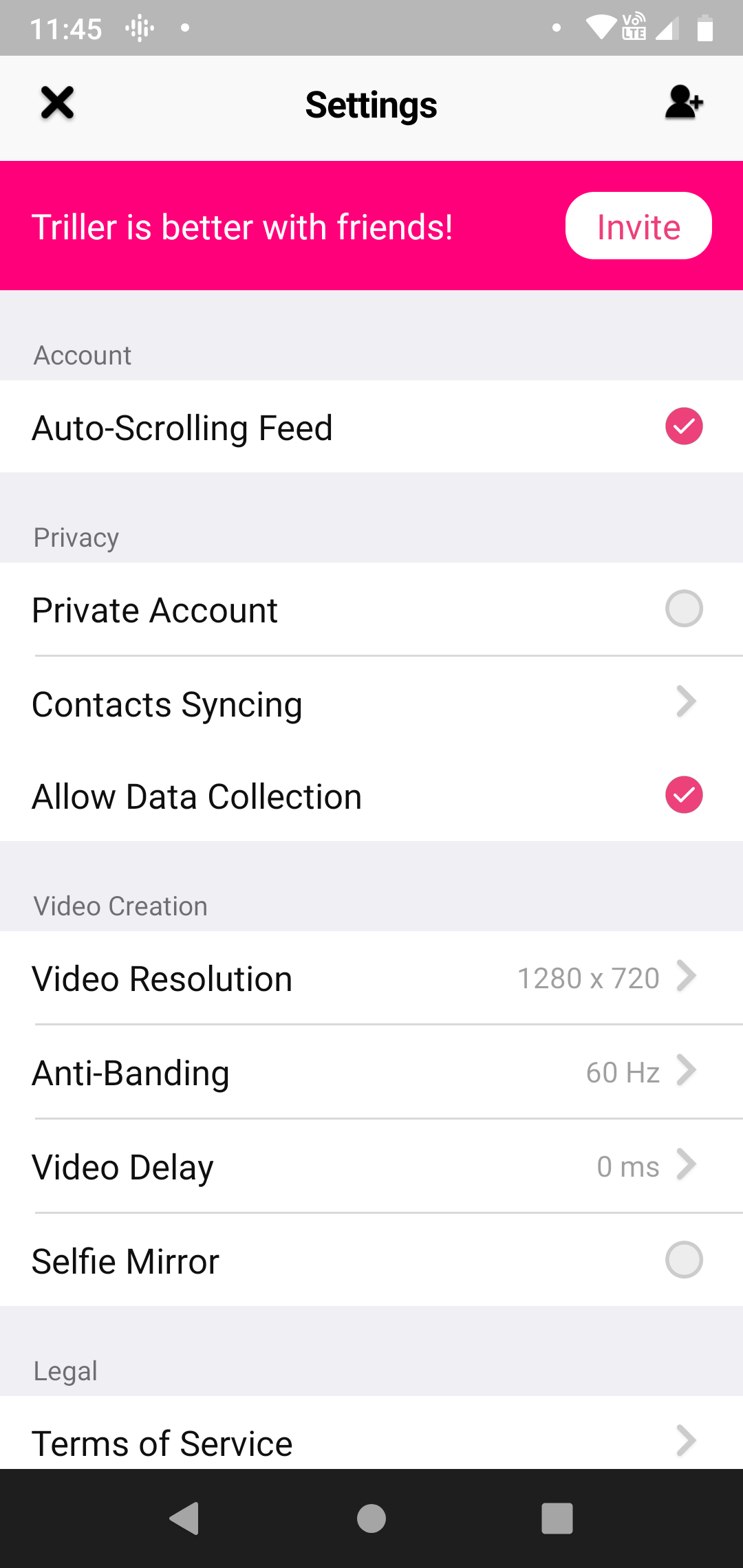
Under the Settings section, users will be able to manage their profile, change their password, manage blocked users, work around the app settings, and contact the parent company in case of any dispute.

Admin Panel Features

Admin panel features – Product – Facelet

Admin side of the TikTok application will give the admins the facility of doing the following tasks – user management, content management, notification management, manage the flagged videos, and handle reports.

Now that we have seen one technical aspect – App Features let us attend to the other technical element that would help define the whole development process and ultimately the TikTok app cost – Technology Stack.

The Technology Stack we Base Our TikTok Application Development On

TikTok is one of the most innovative apps out there in the entertainment sector of mobile app development domain. The technology stack, in a scenario like this, has to be prepared to back this level of innovation and scalability.

Let us look at the Technology Stack that you can use to back your TikTok like application.

Now that we have looked at both – the Marketing and Technical side of TikTok like app, it is time to look at the business cum revenue side of the app.

My Data Science Tech Stack 2020 - DEV Community

  1. Frontend- Native
  2. Backend- Python
  3. Database-Postgre SQL
  4. Cloud- AWS, Google Cloud Storage, Azure
  5. Media Server Configuration- HTTPS, RTMP & HTTP
  6. Video/Audio Transcoding- FFMPEG, Amazon Elastic Transcoder

It has always been a very commonly searched question on the internet, which a number of users around the globe seek an answer to – ‘How do Brands like TikTok or Dubsmash earn money?’

So, next let’s look into the ways TikTok makes money and has managed to become one of the highest revenues generating brands of not just the entertainment industry but of the whole world, before we head on to revealing the cost to develop TikTok app.

How Does TikTok Like Apps Make Money?

While there are a number of ways video creation apps like TikTok can form their monetization model like Subscription and Influencer Promotion, etc. The models that TikTok uses to generate their Million worth revenue streams include –

A. In-App purchase

In-App Purchases: a mobile app developer′s key to ′consumer lock-in′ | Science| In-depth reporting on science and technology | DW | 13.03.2015

TikTok gives the users the option to buy stickers and emoticons to react to live videos that get streamed on the platform.

The in-app purchases themselves have got the brand around 275 percent in users spending and approximately 3.75x year-over-year revenue, bringing the revenue count to over $3.5 million globally.

B. Advertisement

Selection through Advertisement – Aarika

In-app Advertisement also proves to be a great monetization method for the TikTok app and others in the same category.

In order to place their advertisement on the platform which is visited by millions and millions of users on a daily basis, brands tend to shell out a huge amount of money.

If you too are fretting over your app’s Monetization model, what we would recommend is either going for either of the ones that TikTok follows or start a subscription-based model, wherein you lock a few features in the app in return of some amount or you can charge the influencers for getting a placement in the platform.

With this, we have seen all – the state of TikTok like apps, the demand they are able to garner from the world, the other major players in the industry, the set of features and technology stack that makes TikTok like apps what they are, and lastly the monetization model that they carry.

It is now time to get on to the most crucial part of it – How much would TikTok like App Cost?

Well, here’s the answer to it.

What is the Cost of TikTok Like App Development?

The TikTok app cost lies in the valuation of a number of factors – features, allocation of resources, and the technologies to use.

Assuming that you are going with the exact set of features that we mentioned above, the TikTok app cost when you look at the MVP of the TikTok like the app will come somewhere around $80,000 to $100,000.

While this is the absolute base amount, it will increase as you add more features in the application like Artificial Intelligence, High-End Animations or Blockchain for handling the in-app purchase segment of your application.

With this, you have seen all that is required to get started with the entertainment revolution and what is left now is getting started, which has just one step in between – Getting in touch with our social networking app development experts who will hand-hold through the process.

Our Experience with TikTok Like App Development

Our team recently worked on to create a musical video app like musically that was based on the idea of TikTok, which took around 6 months to finish the whole ideation to the development process and is set to hit the app markets very soon.

While there were some challenges associated with the creation of app like TikTok in line with AI integration that we faced initially, the learning and application curve was fairly low and we were able to overcome them in very little time.

Keeping the technical complexities aside, there were some business model issues that our clients were facing in terms of finding the right demographics, the promotion plan to follow to take the limelight away from TikTok, and the revenue model selection – Solutions to which lied with our Business Analysis Team, who would love to pass them on to you.

Understanding the Internet of Things’ influence on Healthcare

IoT in Healthcare: Benefits, Use-Cases and Challenges

Internet of Things in healthcare has more benefits than one can imagine.

The application of IoT in healthcare can improve the way things work in the medical world. From improved machine control to virtual medical assistance, IoT use cases in healthcare is the future. It can save the lives of patients with a fast diagnosis of diseases as well as finding an apt cure for it.

The application of the technology has become so far-fetched that there is hardly a question on What is IoT or how it works.

Like every new piece of technology, it has both advantages and disadvantages associated with it. IoT in healthcare has its own challenges and limitations which can impede the usage of the technology. But going by the joint advancement efforts of skilled IoT app development company and healthcare application development company, it can be ensured that we are reaching a time when the solution will remain safe.

Where Does IoT Fit in Healthcare?

IoT in Healthcare: Benefits, Challenges and Applications | ValueCoders

A lot of times it happens that patients don’t get medical attention on time which can harm their health severely. The delay is caused due to many reasons- unavailable rooms in the hospital, traffic on the road, unavailability of extra doctors, delay in the identification of diseases, etc.

Most of the time, people have no idea that they are suffering from an illness. To identify any signs, a visit to the doctor is required. If heart rate checkups, blood pressure level, sugar level, etc. are regularly monitored then patients can be alarmed about any upcoming threats to their health.

Also, sometimes going to the doctor for something as simple as a stomach ache and paying a heavy fee is just not worth it. These could be easily solved if there was a way to connect doctors and patients virtually.

Internet of Medical Things (IoMT) is a network of connected devices that collect data in real-time. IoMT is one of the key applications of IoT in healthcare and has the potential to solve medical issues. According to the IoT trends 2021, the IoT in healthcare market size was $22.5 billion in 2016 and is expected to reach $72.02 billion in the year 2021. It will provide personalized care and individual data-driven medical solutions.

Not only will IoMT be able to prevent any upcoming diseases but also will be able to cure the ones that have already been caused. The technology has been made as wearables so that patients can be monitored easily without visiting the doctor.

The Internet of Medical Things has divided segments for each medical issue being faced by the healthcare industry. The on-body segment focuses on customer health wearables and other medical-grade wearables. Some products used in this segment are Fitbit, Samsung medical, etc.

The in-home segment aims at an individual’s personal health tracker solutions. This segment includes personal emergency response systems (PERS), telehealth virtual visits, and remote patient monitoring (RPM).

The community segment consists of five components: Kiosks that dispense products and provide services, mobility services to patients’ vehicles, emergency response intelligence, point-of-care devices that act like medical camps, and logistics that keep a record of all the medical equipment and goods.

Another segment is the in-clinic segment. This segment includes IoMT devices that can be used inside a clinic to provide services. The medical solutions of the in-clinic segment also provide point-of-care devices.

The last segment of IoMT is the in-hospital segment which includes various solutions for several areas of management. Asset management monitors, personnel management, patient flow management, inventory management, and environment and energy monitoring are some of the devices in this segment.

If we look at the role of IoT in healthcare sector at a stakeholder level, we can see the technology making an industry-wide impact.

For patients 

Internet of things in healthcare: applications, benefits, and challenges

Wearable devices like glucometer, heart rate cuffs, fitness bands, etc. give patients access to personalized attention. The constant tracking ability that these devices offer can have a major impact on people who live alone as it can send alerts to their family members.

For physicians 

IoT News - How to Apply IoT in Healthcare: Best Approaches and Use Cases - IoT Business News

Through the mode of wearable and home monitoring devices embedded with IoT technology, physicians are able to track patients’ health a lot more effectively. The data gathered from the IoT devices can help doctors identify the best treatment and monitoring process for patients.

For hospitals 

Hospital Room of the Future: IoT in Everyday Healthcare

In hospitals, IoT devices embedded with sensors can be used for tracking the real-time location of medical enablers and equipment such as defibrillators, wheelchairs, oxygen pumps, nebulizers, and other similar monitoring devices. In addition to equipment, it also enables the analysis of the deployment of the medical staff at multiple locations.

These devices can also help with asset management such as environmental monitoring and pharmacy inventory control, for example, refrigerator temperature and humidity control.

Through its multi-stakeholder involvement, IoT solves a number of pain points that are prevalent in a healthcare ecosystem.

  • Inefficient patient care
  • Medical process mistakes
  • Supply chain management
  • Medical research
  • Rural healthcare management

What are The Benefits of IoT in Healthcare?

IoT in healthcare is helping the way hospitals attend to the patients. While the rapid population growth is not helping to control the increased illness, old age, and other health issues, the introduction of IoT in healthcare may do it. IoT can also reduce the cost of medical treatment to a great low. The following are a few of the most noteworthy advantages of the Internet of Things:

Simultaneous reporting and monitoring

Internet of things in healthcare: applications, benefits, and challenges

IoT in the healthcare industry has enabled doctors to monitor the real-time conditions of a patient which can prevent any emergency situations like heart failure, diabetes, asthma attack, cardiac arrest, etc. The impact of IoT in healthcare has made it easy for doctors to attend to multiple patients in a matter of minutes.

The medical reports of patients including blood sugar levels, ECG reports, X-rays, etc. are stored in the cloud and can be accessed with a mobile device whenever needed.

End-to-end connectivity and affordability

Practo | Video Consultation with Doctors, Book Doctor Appointments, Order Medicine, Diagnostic Tests

The Internet of things in healthcare applications can allow a better connection and use of the latest technology to enhance connectivity and data sharing. With technologies like Bluetooth, Wi-Fi, and other features, tracking and identifying illness becomes easy and less time-consuming.

This also reduces the overall time and cost of treatment. With technology, the cost of treatment will reduce by a huge sum, allowing patients to be treated easily.

Data analysis and data assortment

10 Top Data Analysis Tools for 2021

The use of IoT in healthcare involves storing massive data about the patient’s medical history. The IoT device also has to send data to other devices without any issues occurring in the process. Manually analyzing such huge data is impossible but devices can do it.

IoT devices can gather, analyze, track, send and receive data with the help of a cloud base. The cloud base is required as the size of data is huge and cannot be saved on the server. What can help make this adoption further and make it more efficient in terms of data storage and transfer is the Blockchain of Things.

Real-time tracking and alerts

Internet of things in healthcare: applications, benefits, and challenges

Imagine how many lives can be saved with emergency alerts sent by patients. The Internet of Medical Things has made this possible. With the help of a device, a patient’s medical information is recorded in real-time and can be sent to the doctor. In the case of any threat, the doctor will be informed immediately and can provide assistance accordingly.

Check-up on the go

Remote Patient Montioring in Kenya | Online Medical Consultation Platform | Afyabora Blog

With the help of IoT healthcare devices, patients can easily contact doctors on their mobile devices and get immediate assistance. With the latest IoT devices, doctors can identify any ailments on the go all the while saving travel costs and time. IoT in healthcare will also be able to dispense medicines from machines as per their prescription. This will be done by connecting the patient’s device with the medicine dispensing machine.

Internet of Things (IoT) Use Cases in Healthcare

The Internet of things healthcare is being used for some great work in the healthcare industry. From monitoring the patients to virtually assisting them, applications of the Internet of Things are immensely vast and diverse. Here are some of the use cases of IoT technology in healthcare:

Remote patient monitoring

IoT in action as NHS England trials remote patient monitoring

It is one of the most common use cases of the technology in healthcare that an IoT mobile app development company works around. The applications are built to collect health vitals like blood pressure, heart rate, temperature, etc from the patients that are not physically present in the healthcare facility. The algorithms can then help analyze the vitals and recommend treatment or simply create an alert.

Reducing wait time

IoT Healthcare: Disrupting the Medical Industry with Innovations

Often a patient’s condition gets worse while waiting for things to be arranged or rooms to clear out in a hospital. With IoT in the healthcare industry, the waiting time can be reduced by more than 50%. When it comes to occupancy, IoT can track all the rooms and find the empty ones for the incoming patients who need immediate assistance.

Keep track of hardware maintenance

Every hospital has devices, machines, and equipment that are used to sustain human lives. Availability of these tools is necessary in order to save as many lives as possible. With IoT technology, hospitals can not only track the types of equipment but also be informed when a piece of equipment is about to fail. This helps the hospital in getting new devices before it’s too late.

Tracking employees and patients

Smart patient tracking with RFID and IoT

A hospital has huge buildings and it becomes impossible to track where each and every employee or doctor is at a particular moment. It is the same for all the patients as well. With IoT technology, tracking the patients and the staff is easy.

This technology is also being used to track the assets of the hospital for security reasons. It is a highly efficient technology to track objects or people without any additional cost or efforts.

Drug management

Medication Management | Psychiatry Cloud

Medicines are now being monitored by IoT devices to ensure the proper dosage and tracking of the effects of the medicine. It can also remind patients to take their medicine on time and in the right amount. If there is an overdose or underdose of medicine then the patient will be alerted.

Identification of chronic diseases

Geisinger AI to Target Patients at High Risk for Chronic Diseases

The Internet of things healthcare technology identifies any chronic illness a patient is suffering from. How that works is: a patient enters his symptoms and the device matches it with the already existing information to identify the disease.

Wearable devices like Fitbit are great trackers of heart rate, sugar levels, and blood pressure levels. Healthcare app development solutions for wearables and mobile apps have made people more health-conscious and aware of their medical conditions.

A few examples of the Internet of Things applications in healthcare

Healthcare IoT devices are specimens of technical brilliance. These come in handy with loads of benefits of IoT like minimizing the waiting time for emergency rooms, patient, staff, and inventory tracking, discipline in drug management, and checking that critical hardware is available at all times.

Hearables

Meet the 3D scanning company that wants to make hearables a better fit

The hearing aid has been around for ages thanks to the genius of Miller Reese Hutchison. With time, these devices underwent massive changes and are the ones currently powered by IoT have transformed the manner of interaction for people with hearing loss. These hearables are synced with smartphones via Bluetooth. Sounds can be filtered, equalized, and tailored to create real-world sound.

Moodables

More on Moodables - CCS Insight

Stress can often cause declining mental health and there are times when patients with mental disorders or neurovascular problems need to uplift their moods. They are wearables mounted on the head that pass low-intensity currents to the brain. These electrical impulses help to alleviate the pain and lighten up the mind.

Smart pills

Internet of things in healthcare: applications, benefits, and challenges

Smart pills are edible IoT pills that are used to monitor our body functioning and alert if any anomaly arises. They have micro-sensors that are ingestible and dissolve in the stomach. The body too is attached to a device that accumulates the data transmitted via the sensors. One can easily access the data through their smartphones. This is one of the IoT advantages which proves how powerful the technology is.

Healthcare charting

What is a Medical Chart, and Why It's Important? - Continuum

Patient charting by doctors requires a lot of time and effort. It’s a fascinating thing to know how IoT is implemented and through voice commands, doctors can summon a patient’s vital clinical information like medical history, demographics, diagnoses, medications, treatment plans, progress notes, immunization plans and schemes, allergies, tests (X-Ray, cardiology, radiology, urine, blood, etc.) and the results. Augmedix is one such device that does that.

Computer vision technology

A major development of IoT in healthcare projects is the drones which have proven to replicate visual perceptions ergo influencing decision making. These drones are powered by AI and have been known visually impaired people to alert about obstacles and avoid them.

Challenges Faced in Internet of Things (IoT) Based Healthcare System

Even though IoT is being helpful in the healthcare industry, it has its limitations and challenges. Let us look at the adoption challenges of IoT in healthcare:

Privacy and security

Keeping privacy and security simple, for you

Though the IoT benefits in healthcare are many yet we cannot ignore the challenges it is facing. The biggest threat to healthcare in IoT is data privacy and security. The massive data that is being transferred and stored on a regular basis can be hacked and used against the patient and the doctor.

Hackers can create fake IDs to buy drugs and medicines only to misuse them further. A solution to this pestering issue, however, lies in following the compliance set up by the government for healthcare application development USA.

Multiple devices and protocol integration

IOT in Healthcare | Explore Features, Benefits, Challenges & Applications

Everyone owns a different device and this difference in devices is causing problems with the performance of the technology. The internet of medical things has yet to find a solution regarding the compatibility of different devices with the Internet of Things network. The connectivity of different devices slows down the entire process of data transfer, analysis, and retrieval.

Overloading and inaccuracy

10 Ways to Overcome Information Overload

Storing patient data means storing an impossible amount of data. Even with the internet of healthy things, the huge amount of data is becoming difficult to manage by the doctors. If this continues then the decision-making will be affected putting many lives in danger all at once. The more devices being connected to the network, the more will be the inflow of data.

Cost of the technology

How much does artificial intelligence (AI) cost in 2020? - Azati

It must be a surprise to see Internet of Things cost in the challenges section. But the truth is IoT can reduce the treatment cost for a common man but hasn’t been able to do it yet. The Internet of things and healthcare have yet to make things cost-effective and it will take time. It has created the medical tourism situation where people travel to developing countries to get the treatment at a much cheaper cost. The cost of IoT app development is also higher than the usual cost of mobile app development.

The Future Scope of Internet of Things in Healthcare

How IoT will affect the world of healthcare? – Geospatial World

IoT has a lot of potentials and it’s not only in healthcare. Many IoT healthcare companies are working on new ways to use this technology to help our medical world. According to the IoT healthcare market trends, the industry is expected to grow to $8.9 trillion in the year 2020.

Even though IoT has challenges and limitations, it will not stop the technology from growing. The need for IoT in healthcare is huge and it can help the industry immensely. It can reach every patient from all over the world and connect doctors with patients. There is no denying that IoT has already made a huge impact and is only set to grow further.

It is a matter of time when the medical industry will be run mostly by IoT technology and will be treating patients in less time and low cost of treatment. Google and Apple are companies trying to make IoT and healthcare success and soon we shall see iOS and Android devices interacting with our medicines.

We at Anteelo have  IoT app developers in New York and India that are ready to help you with your app idea. We have a proven track record for making IoT real-time applications. Contact us today!

Improving meeting by integrating them & Collaboration Technology

The future of work in technology | Deloitte Insights

Are your meetings like the weather? You know, everyone complains about them, but no one seems to be able to do anything about it. We’ve all endured long, boring meetings that feel endless. And we’ve all struggled through an exhausting, frantic week overfilled with back-to-back meetings. The higher your job title, the more time you likely spend in meetings. Some CEOs, for example, do little else.

Even worse, many meetings fail to achieve their goals. Nearly half the respondents to a recent survey of office workers called too many meetings their No. 1 time-waster. In another survey, respondents rated about 1 in 10 meetings as poor.

Despite these challenges, your organization can dramatically improve its meetings. The key, which I’ll explain in more detail below, is using collaboration products and services that are integrated. Rather than working individually, these integrated products and services can provide you with a true meeting solution that’s seamless from beginning to end.

Wrong-way down

If the solution is that simple, then why have past attempts to improve meetings failed so miserably? Two main reasons:

1. Process focus

Structures Drive Poor Financial Adviser Behaviour - Organisations That Matter

Many past approaches at improving meetings focused too heavily on avoiding certain behaviors. For example, some business leaders forbade the use of PowerPoint. Others ruled that no meetings could run longer than 30 minutes. Still others ­— including celebrity execs Mark Cuban and Elon Musk — went as far as instituting policies of no meetings at all!

But few of us have the level of autonomy needed to completely forbid the use of PowerPoint or hour-long meetings. Even if we did, PowerPoint can be useful, and long meetings are sometimes necessary. As a result, these process approaches rarely work.

2. Standalone tech

5 Stubbornly Standalone Tech Toys - TheStreet

Until recently, the marketplace was overwhelmed with far too many collaboration products. Most of these products were designed for standalone use, meaning they could not be easily integrated with other products. While some level of product integration was possible, that work had to be done by the user. Unfortunately, many users already had IT budgets and staff stretched thin, so they tended to put this integration work on the back burner, often permanently.

The integration solution

What’s new is the emergence of collaboration solutions that are truly integrated. Now you can deliver a seamless process from the minute a meeting is booked all the way to its post-meeting notes. Integration also means that all meeting participants can benefit from this seamless experience, regardless of their location and which devices (and operating systems) they use.

The Surprising Science Behind Successful Remote Meetings

Here’s an example of how your meetings could be enhanced with an integrated solution:

  • Before the meeting: The meeting organizer tells their AI-powered voice assistant to review the participants’ smart calendars, select a date and time that works for all, review the meeting-room calendar to find an available room at a convenient location, and finally email invitations to all intended participants. Each participant can join via a common interface — and on any device from any location.
  • During the meeting: Meetings can be started automatically, either by recognizing the chairperson’s device or with a voice assistant. Remote workers participate via integrated video and chat solutions. The entire team collaborates using a smart whiteboard and document-sharing capabilities.
  • After the meeting: Videos, text-based notes, PowerPoint decks and other meeting materials are automatically shared with all participants, regardless of whether they use a PC, tablet or smartphone – and regardless of which operating system (Windows, iOS, Android, etc.) these devices run on.

In the near future, meetings could become even more productive with the help selected technologies now in the early stages of development. For example, AI transcribing services will provide written transcripts, accurately capturing and identifying the spoken contributions of all participants. Similarly, auto-summarization tools will automatically generate a short set of text notes after a meeting ends, informing participants of the project’s status, new tasks and more.

Get help here

While selecting an integrated meeting solution is easier than it’s ever been, that’s not to say it’s simple. Today’s solutions are not one-size-fits-all. You still need to consider your organization’s unique needs and requirements. Only then will you be able to select the best possible solution. A trusted partner like Anteelo can help you evaluate integrated meeting solutions and find the one that’s right for your needs.

Digital IT support gets smarter, transform employee experience

How Will Technology Shape HR in the Future - Great People Inside Sweden

When companies prioritize their digital transformation initiatives, modernizing IT support might not be at the top of the list.  But there’s nothing that creates a bigger drain on employee productivity and ultimately impacts business outcomes more than a disruption in an employee’s critical work activities, compounded by an unsatisfactory interaction with IT support and service desks.

The traditional, non-standardized service desk is facing a variety of challenges. Digital solutions are increasing across the entire IT landscape, introducing extensive change and escalating requests for support. When service desks themselves move from manual to digital processes, they will need more skilled expertise (which many enterprises lack), along with a disciplined approach to understanding how to apply and introduce automation – tasks made more difficult by constrained budgets.

Meanwhile, the nature of workforce support is changing in today’s gig economy as companies rely more on contractors who expect an intuitive and agile experience when dealing with the service desk – and as expectations among all employees for superior customer service continue to rise. People want personalization. They want to connect on their own terms, whether that’s getting proactive guidance from a virtual agent, talking to a smart bot, choosing self-service from a system that anticipates their needs, connecting to a human agent, or receiving face-to-face support.  And they want their problem resolved quickly and painlessly – ideally without even having to ask for help.

What is Robotic Process Automation (RPA)?

Forward-thinking companies are increasingly moving to digital service desks that take advantage of AI, machine learning and advanced data analytics to more efficiently and effectively respond to the expectations of today’s workers. Moving to a modern service desk also lays the groundwork for a future in which the service desk proactively detects and fixes problems before they occur, without the employee even knowing about it. And eventually, the service desk will become more like a personal digital assistant, anticipating employee actions and automating low-level functions through technologies like robotic process automation (RPA).

Of course, companies can’t accomplish these goals all at once. The preferred method of transforming the service desk is to take a phased approach that provides quick wins and builds a solid foundation for next steps.

Characteristics of a digital service desk

What is an enterprise help desk? 4 big business benefits - Zendesk

Here are the three phases of a good digital IT service desk journey:

  1. Reactive: In this phase, companies take advantage of embedded analytics, AI and machine learning to provide a self-service experience that is intuitive and simple to use, while at the same time is contextually aware and adapts dynamically to the employee’s environment. On the backend, unified support is unified across IT, HR and facilities functions to provide an end-to-end channel that is engaging and fast. An always-on virtual agent or service bot offers an “on demand” dedicated support agent that can converse in natural language to help employees instantly. The agent is plugged into the company’s knowledge bases and ITSM system.
  2. Proactive and predictive: Captured analytics from the employee device provides data that enables machine learning and AI tools to identify issues that are likely to crop up. The system then automatically takes action to resolve the issue. This smart support detects and proactively prevents disruptions before they occur, keeping employees productive and lightening the load on the service desk.
  3. Digital assistant: The final step would be an advanced use of analytics, AI and RPA to understand an employee’s work routine and orchestrate actions on that employee’s behalf. Taking mundane tasks off an employee’s plate gives them more time to be amazing by focusing on what they do best to benefit the business.

There are many benefits associated with transforming the traditional service desk:

  • Providing exceptional customer service in a support desk context is a cornerstone to empowering workers, making employees feel more engaged and valued.
  • The use of automation, AI and self-service channels frees up support staff for higher level activities and helps the IT department control service desk costs.
  • Finally, business outcomes are improved because employees are operating at peak efficiency.

Digital support desks enable enterprises to deliver new levels of employee experience, optimize support and establish a competitive edge – everything today’s enterprises demand.

The steps to reskill your workforce for the Age of Automation

Article: Future-proof your workforce: Reskilling & Upskilling for the digital age — People Matters

The age of automation is radically disrupting work as we know it. By 2022, seventy-five million jobs in 20 economies are expected to disappear, just as 133 million new jobs are created. And by 2030, McKinsey predicts that 375 million workers will need to find new work, as automation increasingly takes over traditionally human tasks.

Coping with this unprecedented change will require both a new way of working and what the World Economic Forum (WEF) and others are calling a “reskilling revolution.” WEF research suggests that, at minimum, 54% of all workers will need either reskilling or upskilling by 2022.

Fortunately, some organizations are already aware of this urgent need. Research by McKinsey discovered that 66% of surveyed executives saw “‘addressing potential skills gaps related to automation/digitization’ within their workforces as at least a ‘top-ten priority.’” A few organizations are even ahead of the reskilling curve, already making investments in programs designed to prepare workers for new roles:

  • JPMorgan Chase invested $350 million in a five-year global initiative called New Skills at Work. The investment will create new training programs, bolster collaboration and communication, enable research, and build upskilling opportunities.
  • Amazon’s Upskilling 2025 will reskill 100,000 workers by 2025. An investment of $700 million is earmarked for reskilling employees across all areas of the organization, including corporate, warehouse, retail, and transportation.
  • AT&T has invested one billion dollars in Future Ready, an internal program designed to reskill more than 100,000 workers.

The risk of not reskilling

Reskilling schemes benefit workers, employers and governments – European CEO

JPMorgan Chase, Amazon, and AT&T know that keeping pace with the age of automation will require employees who are agile, flexible, and adept at learning. But what will happen to organizations that don’t address the need to reskill the workforce?

Organizations slow to adapt won’t fall behind overnight. They’ll fall behind slowly until it’s too late to catch up. The problem is, with the age of automation, that if you get behind on something this big—reskilling— you can’t double or triple your pace to keep up. People can’t adapt that fast. And organizations probably don’t have enough money to buy all the talent they need.

Five action steps to take now to address reskilling for the age of automation:

The Five Steps to Argumentalizing Instruction | Argument-Centered Education

  1. Identify the risk areas for automation. Certain areas will be obvious—rote processes, tasks that can be done faster and more efficiently via automation. Other areas won’t be as obvious: Experts predict that jobs such as insurance underwriting, pharmaceutical discovery, and long-haul trucking will be automated by 2030.
  2. Identify what skills the company needs to succeed long term. Look at what the organization needs to continue existing work, as well as expand into new areas of work. What challenges are showing up in the marketplace and what key skills will help overcome those challenges?
  3. Examine existing employee skills. Can employees transition to different areas of the organization or will they need to be completely reskilled? If they need to be reskilled, do they currently lack hard or soft skills? Can new skills be learned on the job or will employees need formal training, and if so, for how long?
  4. Determine the right training for the right skill. While videos and microlearning are useful for just-in-time learning, effective reskilling in the age of automation will require far more than a library of courses. Technology and self-paced courses have a role to play, just not the starring one. A mix of learning modalities—instructor-led, microlearning, coaching mentoring—will provide employees with the best opportunity to learn and retain complex skills.
  5. Communicate with everyone. Every employee at every level needs to understand how critical reskilling is to the future of the organization, and by extension, their own futures. Informing all stakeholders on a regular basis about the organization’s plans for the future can alleviate the fear of change and job loss, thus keeping employees motivated and engaged.

Wait and see? Or act now?

7 Benefits of Business Process Automation

For organizations that want to remain competitive in the age of automation, a “wait and see” approach isn’t a viable option. It’s death by a thousand cuts for companies that don’t start to change now.

But getting started doesn’t require a major investment. I recommend organizations begin today by making small adjustments in the right direction—adjustments that over time add up to successful and sustainable change. Figure out the skills you are going to need. Communicate with everyone about upcoming changes. And use the right training for the right skill. Create small course corrections now so that your organization is on the right track and employees are more adaptable and engaged.

Digital transformation on the basis of risk: From hype to reality

Is Digital Transformation Hype or Reality? - Part 1 of 4

The digital movement is real. Consumers now possess more content at their fingertips than ever before, and it has impacted how we do business. Companies like Airbnb, Uber, and Waze have disrupted typical business models, forcing established players in different industries to find ways to stay relevant in the ever-emerging digital age. This post is not about that. Well, not in the strictest sense.

There are countless articles explaining the value of being digital. On the other hand, there are very few articles about how to get there. Let’s explore how to get there together, through an approach that I have named Risk-Based Transformation. RBT’s strength is that it puts technology, application, information, and business into one equation.

An approach that fits your specific needs

Smart Cities

I’m relocating very soon, and with that comes the joys of a cross-country journey. Being the planning type, I started plotting my journey. I didn’t really know how to start, so I went to various websites to calculate drive times. I even found one that would give you a suggested route based on a number of inputs. These were great tools but they were not able to account for some of my real struggles, like how far is too far to drive with a 5- and 3-year-old.

Where are the best rest stops where we can “burn” energy — ones that have a playground or a place to run? (After being cooped up in a car for hours, getting exercise is important!) How about family- and pet-friendly places to visit along the way to break up the trip? What about the zig-zag visits we need to make to see family?

The list goes on. So while I was able to use these tools to create a route, it wasn’t one that really addressed any of the questions that were on my mind. Organizations of all sizes and across all industries are on this digital journey but often the map to get there is too broad, too generic, and doesn’t provide a clear path based on your unique needs.

A different approach is needed, one in which you can benefit from the experience of others, whilst taking the uniqueness of your business into account. Like planning a trip, it’s good to use outside views in particular to give that wider industry view; however, that’s only a piece of the puzzle. Each business has its own culture, struggles, and goals that bring a unique perspective.

RBT framework

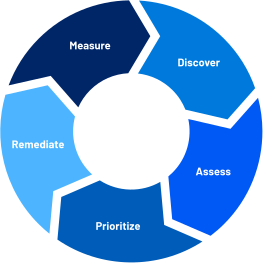
To help with this process, I have created a framework for RBT. At a high level, RBT takes into account your current technology (infrastructure), application footprint, the value of the information, and risk to the business. From left to right, the least weight to the highest. This framework gives a sense as to where to start and where the smart spend is. See flow below:

Risk-based Vulnerability Management | Tenable®

Following this left to right, you can add or remove evaluation factors based on your needs. Each chevron has a particular view, in a vacuum if you will, so the technology is rated based only on itself. It will gain its context as you move through each chevron. This will give you a final score. The higher the score, the higher the risk to the business.

Depending on your circumstances, you can approach it David Letterman style and take your top 10 list of transformation candidates and run it through the next logic flow (watch for a future blog on how to determine treatment methodology). Or, as we did with a client recently, you can start with your top 50 applications. The point is to get to a place that enables you to start making informed next steps that meet your needs and budget to get the most “bang” for your investment.

The idea behind this framework is to use data in the right context to present an informed view. For example, you can build your questionnaires on SharePoint or Slack, or another collaboration platform that also allows the creation of dashboard views. You can build dashboards in Excel, Access, MySQL, or whatever technology you’re comfortable with in order to build an informed data-driven view, evaluating risk against transformation objectives. The key is that you need to assign values to questions in order to calculate consistent measurements across the board.

A living framework

Real-Time Maps with a Raspberry Pi, Golang, and HERE XYZ - HERE Developer

Many years ago, when you plotted your cross-country drive on your map it was based on information from a fixed time. This was the best route when I drew the line on the map. Now, personal navigation devices hooked into real-time data change that course based on current conditions. In the same way, the RBT model is a living framework; it should have regular iterations in order to have course corrections as you go forward.

The intent of this framework and thinking is to build a context that makes sense for your needs, and then present data in a context that allows for better planning. That better planning should lead to a more efficient digital journey as we all continue to stay with, or ahead of, the curve.

If you have enjoyed this, look forward to my next post. There I will detail how the RBT framework is applied and the treatment buckets methodology.

Learn to deploy the game-changing Windows Virtual Desktop

What is VDI? | Virtual Desktop Infrastructure | VMware Glossary

The recent surge in ransomware and data breach incidents illustrates the vulnerability of IT workplace environments and the huge impact that these attacks can have on the entire organization. In response, companies are increasingly looking to desktop virtualization as a way to run the desktop OS in a remote data center where it can be better protected against such attacks. Historically, the implementation, operation, and management of a virtual desktop infrastructure (VDI) have been complex, and when done incorrectly, can create risk.  In a typical VDI deployment, a significant amount of infrastructure has to be managed and maintained, including the servers/virtual machines, load-balancers, networking systems, and endpoints. VDI is costly in terms of IT staff time, hardware, and software licensing. On top of that, companies need to make sure there are high-availability and disaster recovery systems in place so that end users are still able to work in case of a system outage. And unfortunately, in many cases, real-world deployments have failed to deliver the consistent performance that end-users require. But all that is about to change thanks to Microsoft’s announcement of Windows Virtual Desktop (WVD). This disruptive new service enables companies to run Windows-based VDI in the Microsoft Azure cloud, with multiple Windows 10 users active simultaneously on the same virtual machines, and with each user’s data isolated from every other user.

Why Windows Virtual Desktop is a game-changer

Windows Virtual Desktop provides significant benefits over on-premises and competing for cloud-based deployments:

1. Reduces cost: Compelling new licensing models reduce complexity and provide significant cost savings. For one thing, companies don’t need to maintain separate Windows Server licensing agreements. For another, WVD includes Windows 7 extended support — without requiring added end-of-life support payments — so companies dealing with legacy applications that only run on Windows 7 can still benefit from moving to cloud-based VDI as part of a broader digital transformation effort.

8 Things That Will Be LESS Expensive in 2018

2. Provides safe, secure access in a simplified environment: A free control plane – the software that orchestrates the creation and management of desktop and app session hosts — authenticates users and determines where to direct their desktop connections. This means companies no longer must set up separate virtual machines for functions like web access, diagnostics, application gateways and request brokers.

What Is SASE - Secure Access Service Edge? - Cisco

3. Drives efficiency with integrated Microsoft components: WVD, co-resident with Office 365 and your OneDrive data in Azure, drives fast response time and efficiencies. Microsoft will continue to optimize performance, as they own all the components.

Microsoft Windows' future is all about users

4. Facilitates workforce flexibility: From a business perspective, WVD opens up new employee use cases, securely and cost-effectively embracing the gig economy movement of using independent, short-term contractors, for example. With WVD, contractors can bring their own devices to the office and establish secure connections to the Azure cloud in order to access the applications and data they need to do their jobs.

Workplace Flexibility Can Impact How You Attract, Hire, And Retain Talent

How to optimize your WVD deployment

Windows Virtual Desktop (WVD) Deployment | Support Remote Workers

WVD is an important addition to an enterprise VDI ecosystem, a true game changer that can help companies cut the costs and complexity associated with desktop lifecycle management, as well as deliver rock-solid security.

However, enterprise VDI ecosystems frequently are complex because they contain some workloads that still need to stay on-prem for various security, privacy, regulatory, or availability reasons.  A modern desktop and application virtualization solution will need to manage all these delivery systems together as a whole.

Here are three ways to get the most out of your enterprise Windows Virtual Desktop deployment:

  1. Accelerate adoption: Start your deployment using your existing control plane to allow easy adoption and easy workload balancing with your current delivery infrastructure. While this approach comes at an additional cost, it facilitates rapid adoption.  For simple out-of-the-box WVD support, Citrix Virtual App and Desktop Services is ready for WVD from day 1.
  2. Track and manage the user experience: Add end-to-end user experience monitoring across all delivery systems — optimizing both the network and the endpoints which is particularly important when rich collaboration tools like Microsoft Teams is in use. And as these new delivery models are introduced, you can use these monitoring tools to compare and contrast cost alongside performance.
  3. Review your endpoint strategy: Use the change to revisit endpoint management and leverage new advancements in hardware and software thin-client systems. Harden endpoints to reduce the attack vector and simplify management at the device level through a next-generation edge device OS. Leverage management systems to gain an insightful, end-to-end view from endpoint systems.

In short, WVD is a major disruptor in the desktop virtualization space and an important component to consider including in your digital workplace transformation journey.

WVD offers a secure and cost-effective cloud-based digital workplace solution. However, given the complexity of deployment, you might also want to consider partnering with an experienced managed service provider that delivers an end-to-end solution with WVD and the relevant components – and makes sure WVD meets your specific business, IT and employee needs.

Is Blockchain the Key to High Efficiency for Startups?

Is Blockchain the Key to High Efficiency for Startups?

Blockchain – the concept/technology as powerful as the Internet itself has moved from the time when it was deemed to be overhyped to now when it has become an important part of a number of industries, banks, and government.

While the technology has made a prominent place in a number of processes on a very high-level and have found associations among a number of big brands like –

A general assumption has been formed that the disruptive technology is only practical for big names of the world and has, as a result, made itself very unapproachable for mass usage, unintentionally.

Our intent today is to remove the assumption and make Blockchain Startups a technology occurence that can be implemented on mass scales by businesses and industries of all size and across all categories. While, there have already been several use cases of Blockchain in Enterprise setup, it is the startups that need to reform with the power of Blockchain at the back of them.

Something we are going to attend to in this article.

This article is for you to get acquainted with the abilities of Blockchain for startups and how it can be used to not just make your business efficient but also mark it as a brand that is highly innovative. We will help you identify the ways Blockchain Startup can impact and make your processes a lot easier. And in case you wish to dive deep in the technology’s ABC, head on to our handbook on Entrepreneur’s Guide to Blockchain.

Now without further delay, let us get on to what can Blockchain do for YOU.

What can Blockchain do For Your Startups?

Can make you early adopters

How to Reach Early Adopters | BuySellAds Content Portal | For Advertisers

Just like the starting days of the Internet, the Blockchain world is underdeveloped to a huge extent. There are a number of critical elements that will have to be addressed before Blockchain becomes a mass phenomenon.

For startups that are willing to act as fast movers and follow the plant the flag strategy, there is a golden opportunity to conceive and grow a community before space becomes too overly crowded with Blockchain business applications.

By investing time and resources to develop a business model with Blockchain at the center of the processes or even a major part of the working mechanism, will automatically give startups an edge over others working in the same domain – something that all startups need in a time where there are thousands of businesses working in the same category, fighting for the same piece of market.

Can Replace Antiquated Processes With Digital Systems

Is Blockchain the Key to High Efficiency for Startups?

A number of startups operate on some or the other form of the legacy software or outdated infrastructure, which not just increases the cost of conducting business but also make them inefficient and inconsistent to a great extent. Plus, a great number of vital processes are manual in nature, meaning they are subject to the risk of human error to a massive extent.

With Blockchain for small businesses, startups will be able to solve a great amount of these issues. The technology is known to decentralize the pool of data segregated among a great number of different processes – something that solves the startups’ needs to rely on manual labor to collect and process data.

Can Secure Their Data

Is Blockchain the Key to High Efficiency for Startups?

Cybersecurity is a point of concern for companies of all sizes across industries. The global spending on cybersecurity based services and products like automation and IoT is estimated to increase by $1 Trillion by the coming five years.

Noting the incredible security proof that Blockchain systems come with, they are poised to soon become the de-facto mode of gathering and organizing the enterprise data – and a primary answer behind the question on why do companies use Blockchain.

All the data gathered in the ledger gets automatically encrypted with the newest and greatest of the cryptographic methods, the warehouses are only accessible through a key-value mechanism which validates and authorizes the identification before granting access.

Moreover, the decentralized mechanism of Blockchain for small business reduces the security risk to a great extent. As the distributed system cannot get manipulated by any single entity, it is impossible for hackers to change the data without notifying everyone in the network – something that protects against corruption and give the control back to the actual users.

Now that you have seen how Blockchain can make your startup more efficient, let us look at the ways you can employ the technology in your startup to make your business more efficient, transparent, and decentralized. The answer which is same as one to Why do Companies use Blockchain.

Ways Blockchain for Startups Business can be Employed for Better Processes

Here are some of the top-most applications for Blockchain in your business –

1. Payment and money transfer

Bank service, buy, donation, finance, money transfer, payment, salary icon - Download on Iconfinder

One of the most common applications of Blockchain in a startup is seen in use of technology in the payment and money transfer domain.

The present day story is that Blockchain is ready to transform transactions and startups are known to deal with a number of vendors across the world, for availing low-cost, high quality services. Blockchain with its cryptocurrency element comes in handy for making cross-border payments easier and a lot more cost effective than the traditional mode of payments, which are crippled by high transfer charges.

2. Contracts Creation and Abiding

Is Blockchain the Key to High Efficiency for Startups?

As you are just starting, there are a number of contracts that you will have to get binded into – with your interior designers, your food and beverage vendor, your offshore software development company and a number of other third-party stakeholders.

With so many contracts to be made and ensured to be followed, use of Blockchain in business can come in very handy, through the Smart Contract route. Since we have already talked about the concept in our Smart Contract guide before, we won’t get too much into the depth into the mechanism here, but what we can tell you with respect to Contracts and Blockchain is that it is impossible for any of the involved party to break the Smart Contract.

3. Distributed cloud storage

Is Blockchain the Key to High Efficiency for Startups?

A distributed cloud-storage comprises solutions around peer-to-peer decentralized cloud storage. By using the combination of cryptography and Blockchain to protect the files on both – transmission and in nodes – decentralized cloud storage makes your files unhackable and Blockchain a useful element of your startup.

In layman terms, distributed cloud storage system comes into existence when every element of the cloud storage, like processing, transport, and storage of data is put into the blockchain ecosystem. Once that happens, every data – how it moved, who accessed it, and how it was governed can be seen by everyone who has the access to the Blockchain. A system of this type help in offering full accountability, traceability, and transparency for cloud, and entities which are either using or managing the cloud.

4. Protection of Digital Identity

8 easy ways for anybody to protect their digital identity

Another crucial application of Blockchain in businesses is Identity Management.

Identity management is something that the world suffers from. No matter what business or team size you belong to, you are never truly safe from your identity being leaked on the internet and in worst case scenario, in the hands of the hackers.

In the case of startups, what happens is that they – in an ode to seek growth and efficient performance – sign up and subscribe to a number of websites that in some cases can be malicious.

Blockchain, in this case, can be used as a platform to protect identities from fraudulent activities. The technology can help businesses handle the problems of reconciliation and authentication faced by a number of industries. Moreover, it allows businesses the freedom to develop encrypted digital identities that replace usernames and pin codes with comprehensive security elements that are capable of saving the institutions and their customers’ valuable resources and time.

5. Supply Chain Management

Is Blockchain the Key to High Efficiency for Startups?

There are a number of different ways Blockchain can be used in business when it comes to the Supply Chain Management process, to make it more real-time, accessible, transparent, and efficient. Here are the different applications of Blockchain in SCM –

Provenance Tracking

In the blockchain-powered supply chain management process, provenance tracking and record keeping become very easy for the product information can be easily accessed through RFID tags and embedded sensors. Everything about the product, straight from origination to its present status can be tracked via Blockchain. Along with this, the provenance tracking can also be used for detection of frauds in any part of supply chain.

Cost Reduction

When Blockchain is used in supply chain for speeding up the administrative processes, the additional costs occurring in the system gets automatically reduced with the transactions’ security guaranteed. Secondly, elimination of intermediaries and middlemen in the supply chain lowers the chances of product duplicacy, frauds, while saving them a lot of money. The payments made can even be processed by the suppliers and customers in supply chain with cryptocurrencies rather than them relying on the EDI.

Establishing Trust

Having trust in complex supply chains with many participants is necessary for smooth operations. For example, when a manufacturer shares his products with suppliers, he/she should be able to depend on them for following factory safety standards. Also, when it comes to regulatory compliances such as custom enforcers, trust plays a vital role. The immutable nature of blockchain in the supply chain is well-designed to prevent tampering and establishing trust, marking trust as the primal application of Blockchain in business.

6. Quality Customer Support

What is quality customer service? - Quora

There are two ways through which Blockchain is used in Business for increasing the quality of customer support.

  1. Data Cleansing Whether it’s due to inept data import tools or human negligence, CRM users all over the world have to deal with inaccurate or duplicate data at some level.  With blockchain in place, a customer can have their very own personal block that presents companies with a unified and accurate picture of their personal information, past transactions, subscriptions, etc. Hence, blockchain helps these companies circumvent the issue of inaccurate, obsolete and duplicate data records altogether. This consequently yields better insights into customers and helps businesses engage them more effectively.
  2. Loyalty Programs Loyalty programs aim to drive profits by adding value to the customer experience. However, due to their variable mileage, volatile value and associated privacy concerns, they prove to be cumbersome for customers and yield a low ROI. However, in a manner very similar to cryptocurrencies, brands can make use of blockchain to reimagine and reinvigorate their loyalty programs. With blockchain, consumers would have a single decentralized wallet that is compatible with all brands. They would not be bound by the rules and limitations of individual brands and point redemption would be greatly simplified. The consumer will have far greater control over the whole experience and brands will complete for their wallet by offering them better deals.

7. Advertisement and Promotion

The need for promotion while necessary for businesses of all size is something that is unignorable for startups who are just starting up and are in need of awareness in the market. Even after being one of the most important elements of a business, advertisement industry is filled with a number of loopholes that makes it unnecessarily expensive and opaque for the startups.

When Blockchain is introduced to the mix, there are a number of things that get sorted and  streamlined on the promotion front.

Let us look at the benefits of using Blockchain in your business in terms of decentralized advertising.

  • Better Audience Targeting

How to Find and Target Your Social Media Audience (Free Template)

Earlier, as marketers, we used to rely on more than one sources to get information on users’ buying habits. But now with blockchain, advertisers will get the freedom of creating buyers’ demographics by getting the necessary information straight from the buyer themselves. The technology will gather all the information that the users wish to share their buying pattern and get them to the advertisers.

  • Reliable Ad Buys

5 Things You Must Do Before Jumping Into Paid Internet Advertising

The problem with online advertising is the lack of knowledge related to the fact that it is absolutely difficult to know whether the people who clicked on the ads were genuine buyers or paid clickers. However, since blockchain is transparent, advertisers can easily make out if the clicks that they are getting, even coming from the population they are targeting or not. This way, the ad buys would prove itself to be of value to money.

  • Ad Verification

How to Make Ad Verification More Transparent in 2019 | MarTech Advisor

Many times, it so happens that you see a banner advertisement on Facebook listing price of the product as N, but when you visit the site, the number is shown as X. The identification and rectification of issues such as these are the tasks done by the Ad verifiers, whom the networks pay heavily to. However, blockchain helps ensure that the actual information is exactly same as what shown in an advertisement. It reduces the heavy cost that is associated with the ad auditing process.

  • Management of Advertisement Inventory

Internet BillBoard | Ad inventory and campaign management for publishers and advertisers

Ad inventory, as we all know is the space that advertisers have for ad selling. It can be calculated on the monthly basis. The information that goes into the whole ad inventory management cycle – number of space, length of the advertisement, maintaining records of which day is assigned to which brand, the amount that has to be charged space placement wise etc. – are way too much to handle manually. By using smart contracts and blockchain, brands can not just manage the inventory better but also get payments from advertisers on time.

8. To Generate Funds

Arushi Jain Discusses Ways to generate Funds To Start a Business

One of the biggest sign of success for any startup and also the one which helps them grow to their maximum ability is the amount of investments that they receive. The moment your startup gets backed by investors, you don’t just become an establishment to look out for but also get sufficient funds to support your growth and expansion needs.

Now, when we talk about generating funds or raising investments, there are quite a few options available to the startups and entrepreneurs – Crowdfunding, Angel Investments, Venture Capitalist, Bank Loans, Small Business Administration Loans, etc. While out of all of these modes of generating funds, Venture Capitalist has established itself as the most preferred form of raising fund as entrepreneurs get not just funds but also the experience of VC investors, ICO (a Blockchain powered mode of raising fund) is soon replacing the VC model.

There are a number of reasons that have not just brought the demand for VC and ICO at an equal stage but have also increased the fund investment count for ICO fund model. But, the ones that make ICO ideal for you are:

  • Easier:

Compared to the VC fund model that asks for entrepreneurs to come prepared with validating market and financial response that proves how your startup or idea is a success, ICOs have a lot fewer benchmarks to follow, making it easier for entrepreneurs to raise funds through the ICO route.

  • Global:

While VC funding operates within a set geographical boundary, ICO can be raised from investors in the UAE while you are in Australia.

  • Speedy:

As opposed to the VC funding timeline to raise funds, ICO lasts for around 30 days, only. Making it a lot speedy for entrepreneurs to raise money.

So, here were the several benefits that come tagged with the integration of Blockchain in a startup. But, these benefits like all the genuine, validated benefits, don’t come without their set of challenges.

Specially when the technology is as disruptive and less explored as Blockchain, the instances of businesses facing a challenge in its implementation is very obvious.

Let us look at what challenges Startups face and the probable solutions there can be to overcome and adopt the technology in the business process.

Challenges Startups have to overcome

Complexity in Regulations

Insurers Wrestle with Integration, Complexity and Regulations (Part 2) - Accenture Insurance Blog

The biggest obstacle facing enterprise blockchain adoption is the lack of regulations safeguarding entrepreneurs if something goes wrong. While, there are a number of regulations coming up aimed at bettering the Blockchain adoption rate, the time when you will have a legal regulation in place is still far away.

Presence of Legacy Systems

What is a legacy system? | Freeport Metrics

Startups that wish to actually benefit from Blockchain will have to have a DLT based infrastructure, something that requires technical know-how and capital. The solution to this is investing in skilled Blockchain developers who know how to integrate the technology in the existing system and then integrate on a small scale rather than going all in.

High Hack Incidents

For something anointed to be highly secure, Blockchain doesn’t come sans hack and security breach instances. The internet is filled with Blockchain hack events causing people a loss of millions and millions of money, making safety the biggest factor keeping Blockchain receive full Enterprise adoption.

The solution to this challenge is employing Private or Permissioned Blockchain ecosystem instead of Permissionless or Open Blockchain. By making Blockchain permissioned, you add another security level to the mechanism, making it completely unhackable. Also, since the number of stakeholders, in this case, lowers, the throughput time increases by manifold, making it easier to handle multiple transactions at one time.

Now that we have seen how Blockchain can make Startups more efficient and the probable challenges along with the ways you can conquer them, it is time to look into the Blockchain platforms that you will have to work around to employ the technology in your startup.

Enterprise Blockchain System Platforms

Here are the platforms that we have been trusting for the development of enterprise grade Blockchain system for your Startups –

  • Hyperledger Fabric
  • Quorum
  • VechainThor
  • R3 Corda
  • Hedera Hashgraph

As you could see, the enterprise blockchain systems usually have a lot more throughput, lesser latency, and a lot less complex consensus protocols compared to the standard public blockchains such as Ethereum or Bitcoin.

With this, you not just know why to invest in Blockchain for bettering your startup efficiency and the various applications of Blockchain in your business but also how to establish yourself as an innovative company but also what platforms to use to make it possible. What is left now is to get in touch with our Blockchain app developers and get started with the bettering of your startup.

Ingredients for Creating Customer Engagement with Interactive Chatbots

Improve Your Customer Service with Chatbot Support

The chatbots have made strides since their inception almost a decade back. There are many of them who gives customer support on Slack and yet others aim at lonely people keeping company with their surprising wit.

The potential of these chat based bots is game changing and there are many experts who even predict that these will eventually dislodge the apps with their uniquity, usage depth and importance in our daily lives.

Almost all of the technology majors are putting all their investments behind AI, which is in turn is based on machine learning and Big Data, as they are continuously trying to reach what may be termed as nearest to human intelligence. The bots in the present times are for initiating dialogues and to spur conversations with the customers.

However, there are many instances when these bots go bad. Some of these may tell the same thing repeatedly and yet some others are unable to answer the simplest questions, as the designers mistakenly overlooked that the humans often ask questions which are unpredictable and silly.

A poorly designed chatbot user experience will quickly turn a customer engagement into a terrible user experience. The users generally have high expectations from these bots powered by Artificial Intelligence. It is these which are taking customer experience to the next great level. The UX experience rendered by these bots must be able to make the customer feel as if the chabot is speaking in its own human language.

The foundations on which these bots are based on are not only dependent on the programming skills but there are lots of dependencies on the chatbot UX design. The usability of the bots is determined by how much they are able to answer the queries asked by their users.

Here are some UX elements that builds successfully the most engaging and interactive chatbot:

1. Smart Chatbot

Smart Chatbot: The Most Effective Chatbot For Business

AI must have the ability to comprehend in-depth human behaviour. Not much cross questioning is required, but they must be able to answer all the queries from the humans. Your bots appear with a smarter personality  with fully incorporated AI and language interpretation in place.

2. Visual Representation

Chatbots: the Definitive Guide 2021

Humans prefer to think that the bots used by them are more like friends who are answering all their queries in the form of some useful information, rather than one human machine interface or for that matter a robot.

There are many users who quite annoyingly ask repeated silly questions to their bots, so that they must be designed in such a way, that the most polite and non-offensive answers are provided with.

3. Chatbots with Compact Replies

Introduction to Chatbots: How Do Chatbots Work [FAQ & Examples]

Short and simple answers are what attracts your  users. If the chatbot is unable to reply in lengthy sentences, then they must be programmed in such a way that the replies are made in short and compact sentences.

The conversation with these bots is made more engaging and interactive with videos and photos to explain something in further details.

4. Escalation System in Chatbots

Elements for Interactive Chatbots Building Customer Engagement

These bots also need some human supervision as it is not always possible to get all the answers based on them. There are some levels of interactions which require customer interactions to be carried out with the company executives.

The best of the UX for chatbots ensures that the bots are programmed in such a manner so that it understands when to escalate the query to a higher level supervisor. This will make it possible to resolve the customer issues, without causing any delays whatsoever.

The bots that are developed must ensure that the bots say the right things at the right time. You can involve a set of random people to test the bot, whether it has the right effect. This will be successfully bring out those areas which were overlooked earlier. Once the flaws are rectified, these chatbots can be successfully displayed to millions of users. The chatbots must not be the ones that performs some mundane activities, but must be designed as a specialized purpose-driven bots that engage your target audience.

Anteelo is one of the best custom chatbot development company, that have seen an outstanding pace of growth, in a matter of two years time. They have worked in many verticals like restaurant, health, learning, entertainment and many more. They believe in delivering user-centric apps for their customers, utilizing cutting edge technologies.

Snap’s Lens Studio App lets you make your own AR animations!

Snap releases Lens Studio, a tool for creating your own AR effects - The Verge

If you are a Snapchat user, you would agree that the Snapchat’s Lenses is the best thing about the app. You can add amazing AR filters and elements to your pictures and share with friends.

Till now, the Augmented Reality filters in the app were limited, but now the Snap has introduced an AR animation creation tool, called Lens Studio App, which will encourage people to create and share their own AR filters.

Do you know? Snapchat is the first company to introduce Augmented Reality lenses to the public.

Lens Studio App for AR Creation

Create Your own AR animations with Snap's Lens Studio App

Lens Studio desktop app is the simpler version of what Snap’s own team is using for creating AR filters. It is free to download for Mac or Windows, and easy to use.

In Lens Studio, one can design static or animated objects, 2D cutouts, floating picture frames, windows to the other world, 3D objects and much more. These filters and objects can be seen using the rear camera in Snapchat and react when you tap, look at or approach them. Isn’t it interesting?

Making AR has never been easier - Lens Studio by Snap Inc.

The Augmented Reality filters you create are firstly verified by Snapchat’s moderators to ensure that they are not related to weapons, stereotypes, violence, nudity, hashtags, hatred, violence or some illegal activity. Once verified, you get a Snapcode which you can share with the other users via social media, print materials, website, or other means.

The users can scan the code and use the Augmented Reality filter for next 24 hours. This time limitation to use a snapcode is expected to be discouraging for the overuse of a particular lens, limiting the burnout among the developer’s friends and viewers. However, it is an opportunity for the developers to update their code and provide a better user experience.

“This has been an amazing year for AR as a technology,” says Eitan Pilipski, who leads Snap’s camera platform team. “We are really excited to take this AR filters tool, and make it as simple as possible for anyone using Snapchat.”

Snap has partnered with seven AR development companies to build ‘world lenses’ for the rear-facing camera and ‘face senses’ for selfie camera, namely Media MonksAvatar LabsTriggerFishermen LabsNorth KingdomHaus, and VidMob. Besides this, the company has said that the regular users would be facilitated with the opportunity to develop AR face filters, though no definite timeline is mentioned.

Snap Simplifies Lens Studio with 'No-Code AR' Tools & New Templates, Invests $3.5 Million in AR Development « Next Reality

Snapchat is also looking forward to initiating various Lens Studio challenges, where they will offer rewards to AR app developers who create Lenses as per the proposed theme or use case. Right now, it is assumed that the recognition will be given on the new Lens Studio website. However, it can be expected to be switched to the Snap’s app to drive developer’s interest in the platform.

The release of AR animation creating tool is supposed to be not limited to hobbyist or developers. Rather, it is expected to be great medium for the companies to advertise their products/services. It’s also taken into an acknowledgement that the Snapchat has experienced a fall in its user engagement, and has introduced this feature to remain in the competition; there’s no proof that offering World lenses to everyone around will put Instagram on notice.

error: Content is protected !!