Digital Twin Technology in aircraft MRO

digital twin technology


Commercial air travel is safer than ever, according to a recent study published in Transportation Science. Data compiled by MIT professor Arnold Barnett shows that in 2017 only eight of more than 4 billion boarding air passengers around the world died in air accidents.  The risk of death for boarding passengers fell by more than half from 2008 to 2017 compared to the prior decade.

Aerospace companies nonetheless remain under tremendous pressure to continually improve flight safety because any fatality is a human tragedy, say nothing of the damage accidents can do damage to business, brand, and shareholder value. Ensuring aircraft are safe begins with design and engineering and extends through the manufacturing, maintenance, and repair processes.

But airplanes aren’t like a fleet of taxis consistently housed in a common garage and maintained by a group of workers familiar with the vehicles and who have ready access to repair and performance records. Planes can be located almost anywhere, yet they still need daily maintenance. That’s just the beginning of the challenges. As Steve Roemerman writes in Aerospace Manufacturing and Design:

Maintenance needs of one plane can differ drastically from another identical model. No two planes are exposed to the same conditions or usage and therefore do not need the same support on the same schedule.

An aircraft’s location, for example, directly influences the time between maintenance. Other factors – such as incomplete maintenance logs, unexpected issues, fleet usage, age, and weather – also make it difficult to create accurate maintenance schedules. In many cases, unexpected issues are only evident after starting repairs, causing major delays or strain on expensive personnel.

Bottlenecks in production and repair can be caused if aerospace manufacturers or airline maintenance and repair organizations (MROs) are unable to coordinate the availability of parts for a specific plane with the availability of the right specialists and mechanics. The inevitable result of prolonged maintenance delays is elongated manufacturing lead times or in-service aircraft availability reductions.

In addition to safety and aircraft availability, proper maintenance is important to flight schedules. Passengers are familiar with the frustration of waiting onboard as a repair team tries to fix an unexpected equipment problem that is delaying takeoff. Such delays have a negative impact on an airline’s reputation, particularly in a world where disgruntled passengers can vent their dissatisfaction on social media in real time from the tarmac.

Digital Twin on aircraft

To improve aircraft safety and to increase the efficiency of manufacturing, maintenance, and repair, aircraft manufacturers and MROs are harnessing tools such as artificial intelligence (AI), digital twins, and predictive analytics. Though the aerospace industry has been using analytics and digital twins for at least two decades, the proliferation of data from connected devices combined with AI-powered analytics and high-performance computing (HPC) has allowed engine and aircraft manufacturers, along with MROs, to achieve even greater cost and time efficiencies while continuing to raise the bar on passenger safety and satisfaction.

Digital twins are virtual models of products, processes, systems, services, and devices. These digital replicas produce data for building prescriptive models that can pinpoint problems and solve them in the virtual state. Connecting and tying this maintenance data in with the initial manufacturing design phase and the volumes of data collected during operation  allows aerospace manufacturers to optimize design and production processes, saving time and money and leading to better and safer aircraft.

The benefits of digital twin extend beyond the manufacturing process. Aerospace manufacturers are continually seeking ways to anticipate and address longevity requirements. These also encompass maintenance efforts. Building resilience into an aircraft benefits everyone. “When an aircraft engine manufacturer uses digital twin technology, the resulting data is used to predict exactly when to bring the aircraft in for inspection, “They can ingest engine usage for every flight, including the physics of the engine blades to see and measure how the engine is operating … virtually.”

While MROs have been slow to implement data-driven solutions, the projected increase in the world airline fleet along with the need to support both aging aircraft equipment and newer aircraft and systems – is forcing these companies to adopt smart technologies to take full advantage of growing volumes of sensor data, as well as data trapped in silos.

AI and predictive analytics can be deployed by MROs to leverage data created by connected aircraft engines and devices, allowing them to accurately forecast when parts can be expected to fail. Using prescriptive analytics, potential outcomes to a parts failure can be analyzed to determine the best solution.

“Robust analytics can drive streamlined material staging, more efficient labor planning, and more effective equipment check programs,” according to a white paper on how MROs can use data to drive actionable analytics. “When data and analytics streamline engine and component service, carriers can reduce AOG (aircraft on ground) times, minimizing the revenue impact of flight delays, and therefore maximizing uptime for crucial revenue-producing assets.”

By embracing AI, digital twins, and advanced, actionable analytics, players in the aerospace industry can position themselves to take full advantage of their data, technologies, workforces, and processes. This will enable an airline’s MRO to be more resilient.

Human-Centered AI


Unlocking human potential in the AI-enabled workplace

For all the hype and excitement surrounding artificial intelligence right now, the AI movement is still in its infancy. The public perceptions of its capabilities are painted as much by science fiction as by real innovation. This youth is a good thing, because it means we can still affect the course of AI’s impact. If we pursue AI purely with the goal of automating our lives, we risk pushing people aside. We would end up marginalizing human contributions, instead of optimizing them. Instead, we should pursue AI with the goal of augmenting our lives — as a means of benefiting humanity rather than devaluing it. Think of this path as human-centered AI, which seeks to free up people for more creative and innovative work. The technology is the same, but the goals of the systems we build are different. There’s a fine line between automation and augmentation. So, how can you ensure you’re pursuing human-centered AI? Start with how AI is built.


AI development models: The factory vs. the garage

When I was a kid, my dad’s hobby was woodworking, specifically building furniture, and he did it in our garage. What I remember was how he used the most of his space. My mom insisted that she be able to park her car in the garage, and that his tools should have homes when he wasn’t in the middle of a project. When he was in the middle of something, the garage could look a little chaotic, but it was never cluttered. Everything had a purpose and a home. The garage was designed to fit the needs and constraints of his environment.

Unfortunately, when creating AI we too often think of factories rather than garages. In any factory the goal is efficiency at scale. To achieve efficiency, design is separated from production, and then production is tuned for peak performance. This performance tuning makes many humans in factories simply extensions of tools. To judge whether a factory is set up well, the key metric of production is velocity.

A factory approach doesn’t make sense for something as abstract and virtual as AI development. Compared to a physical factory, software production is cheap to change over and doesn’t require capital investment to be ripped out and replaced. And turning developers into high velocity code assembly lines wastes a huge opportunity to cultivate highly trained, creative, innovative people.

An alternative is to approach AI development similar to the way my dad approached woodworking in his garage. A developer is not an executor of code but a creator. Tools exist to affect the creator’s vision, and the vision adapts based on the productive experience. Design and production work in tandem. The goal isn’t peak performance; it is innovation. The key metric is achievement.

You can recognize this “garage model” when you see people creatively building toward a project or goal. we invest time upfront making sure we all understand and can articulate the goal of project — the thing we are going to build. AI is more than code and technologies; it is an approach to problem solving. It’s a good approach that we think more people should use, but it’s still just a means to an end. The goal is what matters. When my dad started projects in his garage, he didn’t incrementally explore his way to a finished piece of furniture. He had a piece of furniture in mind and an initial plan of how he was going to make it.

Artificial Intelligence And Surveillance – Where Do We Draw the Line | Robot background, Computer robot, Artificial intelligence

The Applied AI Center of Excellence

When it comes to AI, a garage isn’t only a physical place. In the Applied AI CoE we run garages with teams of people sitting all over the world. A small AI garage will have a leader and a team of three to eight people. Larger garages will see that pattern fractal or reorganize outward to handle greater complexity. A key thing I have had to remember as an AI garage leader is that my role is not to direct work or control the ideas. This would create a factory and stymie innovation. Instead, my role is to set the initial vision or goal of a project and then prune ideas to maintain focus — in other words, my biggest contribution is to keep the garage clean. For me and other garage leaders, this can be difficult — especially if the leader was the one who originated the idea, but even when that was not the case, it can be hard to let go. Success belongs to the team; failure belongs to the leader. It’s natural to want to control away failure, but then the garage model would be lost.

This distinction between the factory and the garage is critical — performance vs. innovation. In a garage model, the people developing AI are centered in the process, and this creates a foundation for a system that reinforces human-centered AI. By increasing the number of people who have a personal stake in how AI is developed, we create an AI that has a stake in the people who use it.

What can a garage do for human-centered AI?

We have used AI garages to do such things as create apps that help people fight decision fatigue, recognize when someone is paying attention or is distracted, use the weaker constraints of the virtual world to reconnect people to the physical world, and create AI Starter libraries to share what we’ve learned.

These examples show that we believe effective AI capabilities don’t push people to the side. Instead, they place humans at the center, augmenting what people can do and how well they can do it. We achieve these things because our AI development model, the “garage model,” is similarly human-centered.

User Research Methods via Phases of Product Development

User research is one of the best ways to know what users want and how they interact with your product. It’s performed in order to improve the product as per the feedback gathered at different stages of product development. One of the mistakes that designers and PMs make is that they assume user research needs to be done only in the beginning. However, if you want to build a product that conforms to the needs of the user, research must be a continuous process. At the onset of the product development, user research is required to validate the idea. But when a product is out in the market, user research is needed to understand if users are liking it or not. It’s important to understand users’ needs and their pain points. It’s important to know how they interact and use your products/services, and what kind of challenges they experience while using them.

For this reason, different user research methods are used at different stages of product development. In this blog, I’ll talk about the research methods in detail. But first, let’s see the various stages of product development-

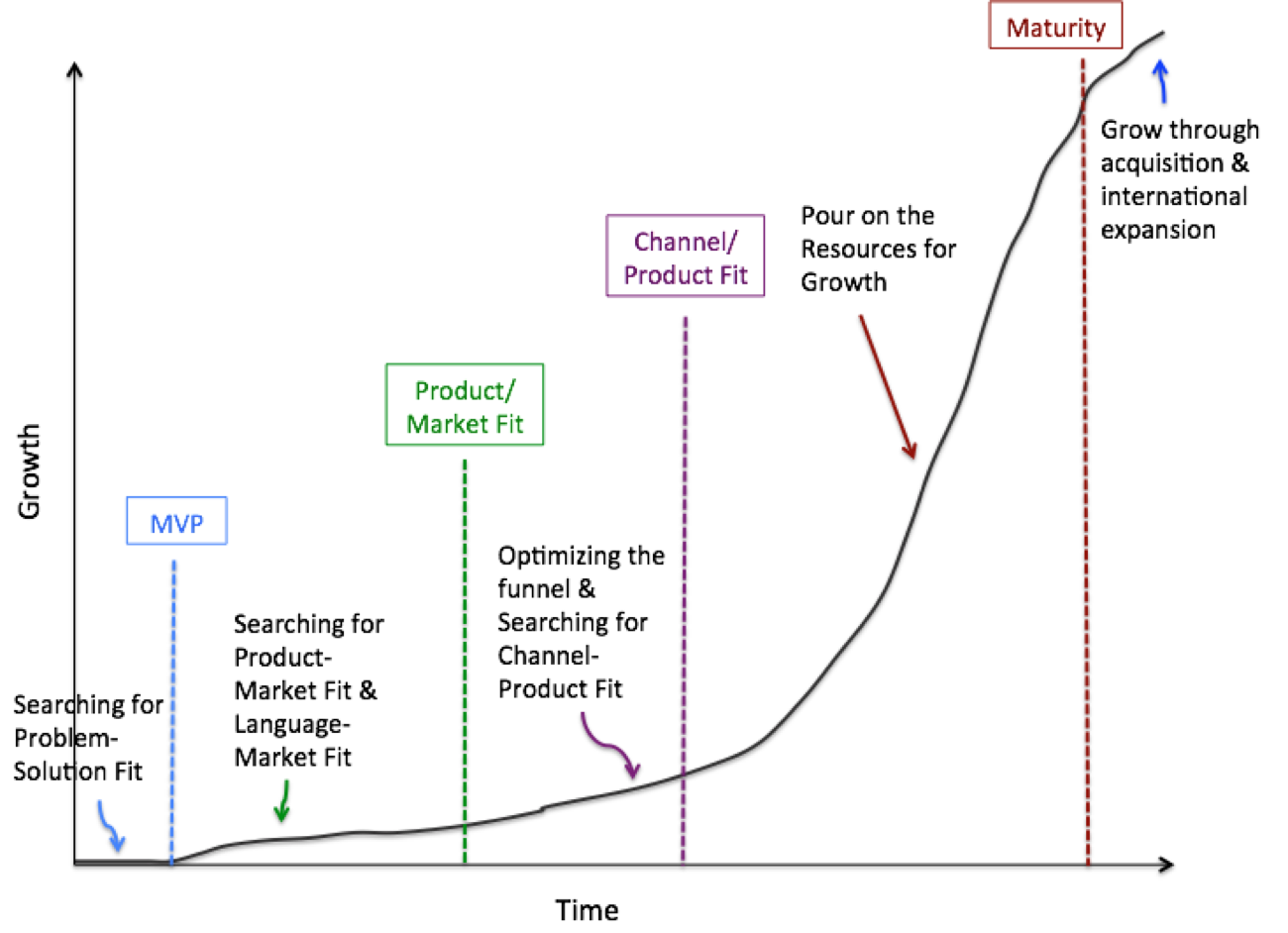
Discovery stage (from an idea to an MVP)

POC vs Prototype vs MVP: Which Strategy to Prefer?

Discovery stage starts with an idea. You have a picture in mind about what you want, and the problems you want to solve. But you need to validate your hypothesis.

You need to collect and analyze information about your end users, and their problem areas. You need to get an in-depth understanding of their goals, and challenges that might arise in implementation.

User research in this phase is required to validate those product ideas/hypotheses. When user research is done right, it helps in gathering valuable feedback on the ideas and saves precious time from building unwanted features.

Growth and maturity stage (from MVP to a full-fledged product)  

5 Phases of the Startup Lifecycle: Morgan Brown on What it Takes to Grow a Startup | by Lauren Bass | Tradecraft | Medium

The growth/maturity stage of the product is when the MVP is already launched in the market and people have already started using the product. The product/service has got enough traction and is on the verge of getting popular.

At this stage, user research is required to understand how users are interacting with the product– are they satisfied with the product, what more would they like to be included, how would they rate the product, where do they feel stuck while using the product, etc.

Good user research helps in iterating over the existing product to build new features, improve existing ones or remove unpopular features. It also helps in getting feedback on the existing features on the product.

Implementing user research in the discovery stage, one can visualize the real pain points of users and build a product that solves users’ problems.

In post-launch user research, one can see how users use a product and what are the gaps that prevent them from accomplishing their goals.

There are different user research methods for each stage. So, first, let’s see the whole spectrum of methods that are available.

A landscape of user research methods

User Research Methods: Gain Unfiltered Insights | Table XI

Nielsen Norman Group has conceptualized a variety of user research methods. I’ll be talking about the most common ones used by Product Managers/Design Leaders.

If you want to understand user’s attitude or what users say, then most common methods are-

Surveys :- They consist of a series of questions which give you quantitative information from a large sample set.  It can be used for both validating a hypothesis or gathering feedback from users. Therefore, surveys can be used in both discovery and post launch stages.

User interviews:- They are one-on-one discussions with users to gather qualitative information. Interviews are usually conducted in a small sample set.

They can be used in various ways – exploration to discover the pain points of the users, discovering new ideas for products/features, to test a hypothesis or to know the likes or dislikes of a user.

User interviews can also be used in both discovery and post launch stages.

Contextual inquiries:- In these sessions, users are observed as they perform tasks in their natural environment. This is a method to gather first hand information from the users. In other methods, you only listen as the user tells how he/she performs a certain task. In this, you can observe the user doing these tasks.

This method can also be used in both discovery and post launch stages.

In the discovery phase, one can observe the end users of the product in their environment while they work. This could give insights on what is repetitive in nature and how technology can remove those brainless iterations.

In the post launch stage, we can observe the end user using the MVP and observe where users get stuck or what are the blockers for them. Is there something which is manual and can be easily automated to make users’ life easy?

User feedback:- In user feedback, users give their opinion on the product. This is typically gathered through a link, feedback form, recommend button, etc. One example of gathering user feedback is through Net Promoter Score (NPS) which is a form of user feedback used to know whether a user would want to recommend the product to others.

This is done in the post launch stage of the product in order to improve the existing features.

All of the above methods help build empathy with the users and understand their attitude, likes/dislikes towards product usage.

If you want to understand what people do or how people use your product (also called as usability of the product), then most common research methods are-

A/B Testing :- It’s a quantitative method that allows you to compare two versions of a product and figure out which one works better. It’s used in making incremental changes in a product. There are tools available that allow you to run 2 versions of the same thing. 50% of the users will see one version and another 50% will see another version. Therefore, with A/B testing you could experiment with headlines, button texts or two layouts of the same page.

A/B testing can be used only in the post launch stage of the product.

Eye tracking/Heat maps:- Heat maps allow you to evaluate which sections of the website or app users engage with the most. There are many tools available that allow you to track how users engage with a hyperlink, button, or in what pattern they read the content. This kind of study is very critical to understand what users really care about and what attracts their attention.

It can also be used for the post launch stage of the product.

A case study

Don't Waste More Time Writing Bad Case Studies. Use These Tips Instead. | TechnologyAdvice

To help you understand how research methods vary in different product development stages, let’s take an example of a hypothetical product.

We want to build a virtual mental-health helpline that would help people seek support for disorders like anxiety, depression, etc. This helpline is especially targeted for those who are bearing the brunt of the pandemic and are unable to go out and seek clinical help. Let’s call our hypothetical product –  “Lumos Solem”. (Lumos Solem is the incantation of a Harry Potter spell that produces a blinding flash of sunlight)

In the discovery stage

As a product owner/manager, we would first need answers to some basic questions to validate the idea.

  • Would users be comfortable in using SMS/video to share their problems?
  • How comfortable would the users be in a virtual setup?
  • Who would be my target audience? What age, demographics?
  • What are the most common mental health problems that the helpline would address?
  • Should we get experts on onboard? Who would talk to the people seeking help?
  • Would people get a choice on who they want to talk to? Or will there be an automatic redirection to the first available person?

At this stage the user research methods that one can use to get answers to above questions can be–

  1. Surveys
  2. Interviews

For conducting the survey–

  1. Define the objective of the survey
    • In our case, it could be “To understand the user behaviour towards a virtual mental health platform”
  2. Identify the target audience and the sample size you need
    • In our case, an example of the target audience could be the most vulnerable  age group – 30- 80 age group and living in metro cities. Sample size can be a mix of middle aged and senior citizens.
  3. Frame the questions in an open and non-leading manner to gather the maximum insights without bias. Questions for Lumos Solem could be –
    • What does mental and emotional health mean to you in your everyday dialogue?
    • Do you feel the urge to talk to someone and just blurt things out to lighten your head? If yes, then what kind of communication could help you in expressing your thoughts?
    • What kind of answers do you seek in your daily routine which affects your mental or emotional wellbeing?Make the answers as multi-choice so that analysis is easier.

After that carry out the survey using any available tool like Google Forms and analyze the data to derive insights. This will help validate the hypothesis we assumed.

For interviews, follow the same steps as above. The only difference here would be to make a rough script, inform the participants the purpose of the discussion.

In growth and maturity stage

Let’s suppose Lumos Solem is in the market and we’ve started getting our innovators & early adopters on the platform.

Now it’s the time to build/remove features and collect analytical data using usability tests. In the post-MVP stage you can ask questions like-

  1. Analytics shows that users are dropping at the onboarding. Why?
  2. Those users who get past user-onboarding, drop off at the payment link. What can we do to retain them?

Product Life Cycles | Boundless Marketing

The user research methods that one can use to get answers to above questions can be–

Feedback form:- Feedback form after every virtual session can help you collect useful information about the quality of interaction. It can be for both mental-health experts as well as the users. This will give users a chance to share what they like or dislike about the service. You are also likely to discover blind spots like technical glitches hampering the quality of conversations, etc.

A/B testing:- If consultation with health experts is paid, you can experiment with the wording of the payment link. The idea is to make users trust in the process. If users are dropping off at the payment link, then you can A/B test the features of Pay now/Pay Later and see if they stay when given an option to pay later.

Heatmaps:- Heatmaps can be used to see what common problems people look for in FAQs. The area where heatmap is densely colored will indicate that users are most interested in reading about a particular topic. This data will help you refine your features so that users can find it easier to accomplish their tasks.

User interviews:- Conducting 1:1 user interviews with experts and users can also help in understanding the problems they are facing in a virtual helpline. At times, people hesitate in sharing their opinion in written format but are more vocal about sharing it in person. In such cases, user interviews come handy.


To conclude,  each user research method has its advantages and disadvantages. The choice of the method will be based on the nature of the product, stage of the product, the users and the answers you’re looking for.

There is a difference between what users say/think and what users do. If you want to know what users say then surveys, interviews and contextual inquiries are suitable to get the information. But if you want to know what users actually do then methods like A/B testing and heat maps are helpful.

I hope I was able to pass on some clarity of which methods to use during a particular product development stage.


AI’s Possibilities in Healthcare: A Journey into the Future

Artificial intelligence in health care

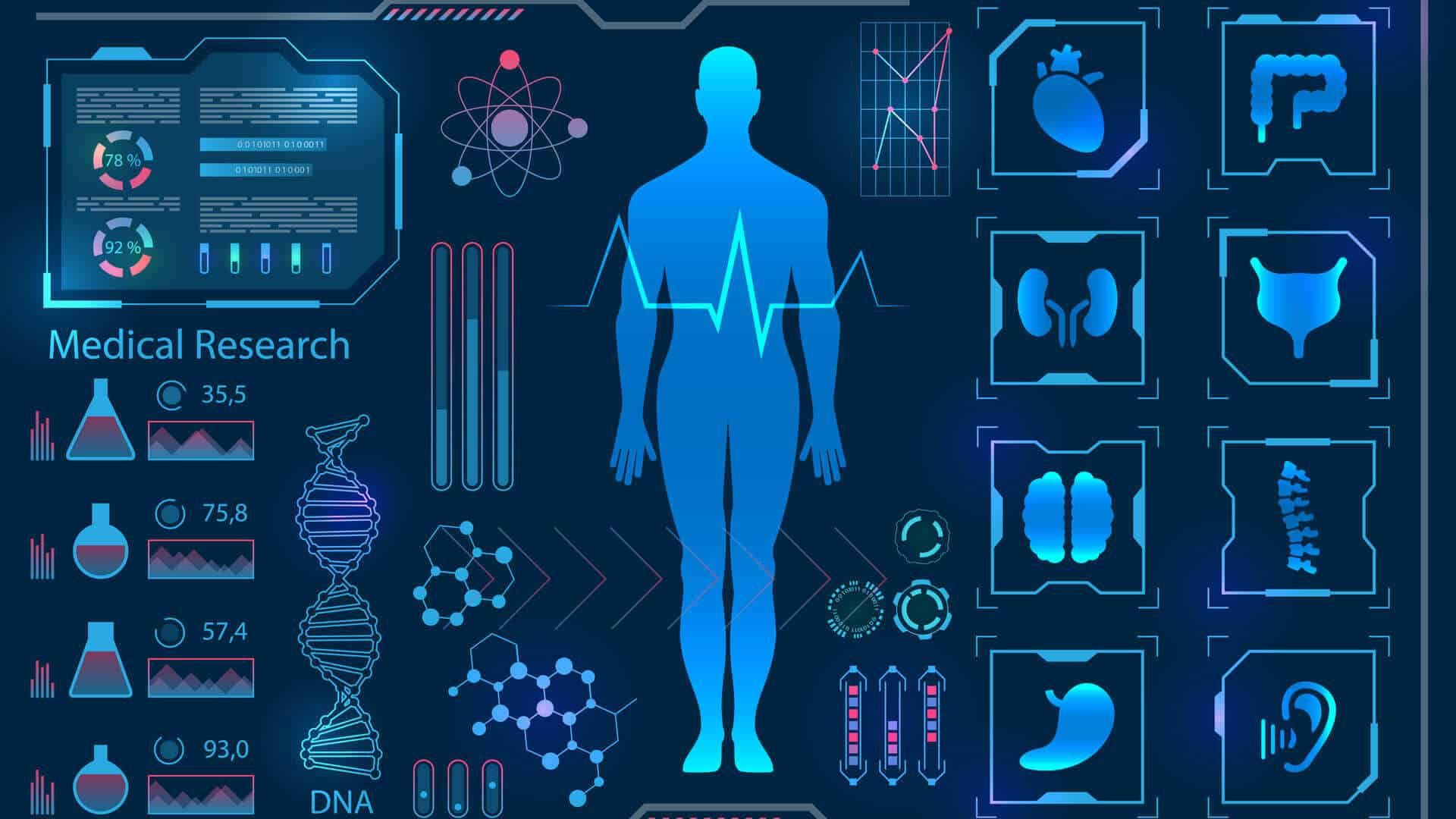
Artificial intelligence (AI), machine learning and deep learning have become entrenched in the professional world. AI-style capabilities are being embraced and developed globally (over 26 countries/regions have or are working on a national AI strategy) for many different purposes — from ethics, policies and education to security, technology and industry, the scope is broad and multi-faceted. If, like many others, you are unclear as to what this new terminology means, below is a diagram depicting the hierarchy of AI, machine learning and deep learning for you to consider. In healthcare, the opportunities are vast and significant. Just from a financial point of view, AI has the potential to bring material cost savings to the industry.

But where should you start, and where do the opportunities lie?

AI And Human Accountability In Healthcare

Where to start with AI

First, look at where money is invested — in other words, which start-ups are attracting investors and what is their focus. Rock Health (the first venture fund dedicated to digital health) shows that the top four areas for venture capital investment between 2011 and 2017 were research and development, population health management, clinical workflow and health benefits administration. More than $2.7 billion was invested over 6 years, across 206 start-ups.

Another venture capital and digital health community, Startup Health, which also keeps track of global investments, found that funding is doubling every year for companies which use machine learning technology to enhance health solutions. The companies that focused on diagnostics or screening, clinical decision support and drug discovery tools received the largest share of funding for machine learning in 2018 — i.e., $940 million.

Delving into AI’s opportunities

Perhaps the biggest opportunity lies in assisted robotic surgery, with a potential cost saving of US$40 billion per year. AI-enabled robots can assist surgical procedures by analyzing data from pre-op medical records and past operations to guide a surgeon’s instrument during surgery and to highlight new surgical procedures. The potential benefit to the healthcare organization and the patient from this approach is noteworthy: a 21 per cent reduction in length of hospital stay because robotic-assisted surgery ensures a minimally invasive procedure, thus reducing the patient’s need to stay in the hospital longer.

Surgical complications were found to be dramatically reduced, according to one study into AI-assisted robotic procedures involving 379 orthopedic patients. Robotic surgery has been used for eye surgery and heart surgery. For example, heart surgeons have used a miniature robot, called the Heart Lander, to carry out mapping and treatment over the surface of the heart.

Another valuable use of AI is in virtual nursing assistants. One example is Molly, an AI-enabled virtual nurse that has been designed to help patients manage their chronic illnesses or deal with post-surgery requirements. According to a Harvard Business Review article, assistants like Molly could save the healthcare industry as much as US $20 billion annually.

Diagnosis is another exciting development for AI, with some promising findings on the use of an AI algorithm to detect skin cancers. A Stanford University report found that deep convolutional networks (CNNs) performed as well as dermatologists in classifying skin lesions. Other exciting breakthroughs in AI-assisted diagnosis include a deep-learning program that listens to emergency calls, analyses what is said, tone of voice and background noises to determine whether the patient is having cardiac arrest. Astonishingly, a study from the University of Copenhagen found the AI assistant was right 93% of the time, compared with 73% of the time for human dispatchers.

A fourth potential use for AI lies in digital image analysis, which could help to improve future radiology tools. In one example, a team of researchers from MIT developed an algorithm to rapidly register brain scans and other 3-D images. The result reduces the time to register scans with accuracy comparable to that of state-of-the-art systems.

With so much potential to be gained from AI, healthcare organizations will need to enhance their skills in AI and related capabilities. Decision-makers need to inform themselves about the potential and what is required to achieve those objectives, and then ensure that their teams are properly trained. Culture change in understanding how AI can be used to solve current and future problems is paramount to the future of next-generation healthcare and life sciences organizations.

AI in Transportation

AI in Transportation – Current and Future Business-Use Applications | Emerj

Why AI?

You may have heard the terms analytics, advanced analytics, machine learning and AI. Let’s clarify:

  • Analytics is the ability to record and playback information. You can record the travels of each vehicle and report the mileage of the fleet.
  • Analytics becomes advanced analytics when you write algorithms to search for hidden patterns. You can cluster vehicles by similar mileage patterns.
  • Machine learning is when the algorithm gets better with experience. The algorithm learns, from examples, to predict the mileage of each vehicle.
  • AI is when a machine performs a task that human beings find interesting, useful and difficult to do. Your system is artificially intelligent if, for example, machine-learning algorithms predict vehicle mileage and adjust routes to accomplish the same goals but reduce the total mileage of the fleet.

If you’re in travel and transportation, here’s how to make sense of the terms analytics, advanced analytics, machine learning and AI.

AI is often built from machine-learning algorithms, which owe their effectiveness to training data. The more high-quality data available for training, the smarter the machine will be. The amount of data available for training intelligent machines has exploded. By 2020 every human being on the planet will create about 1.7 megabytes of new information every second. According to IDC, information in enterprise data centers will grow 14-fold between 2012 and 2020.

And we are far from putting all this data to good use. Research by the McKinsey Global Institute suggests that, as of 2016, those with location-based data typically capture only 50 to 60 percent of its value.  Here’s what it looks like when you use AI to put travel and transportation data to better use.

Lack of Action in Congress on Autonomous Technology Could Hinder States, Lawmaker Warns | Transport Topics

Here’s what it looks like when you apply industrialized AI in travel and transportation.

Take care of the fleet

Get as much use of the fleet as possible. With long-haul trucking, air, sea and rail-based shipping, and localized delivery services, AI can help companies squeeze inefficiencies out of these logistics-heavy industries throughout the entire supply chain. AI can help monitor and predict fleet and infrastructure failures. AI can learn to predict vehicle failures and detect fraudulent use of fleet assets. With predictive maintenance, we anticipate failure and spend time only on assets that need service. With fraud detection, we ensure that vehicles are used only for intended purposes.

AI combined with fleet telematics can decrease fleet maintenance costs by up to 20 percent. The right AI solution could also decrease fuel costs (due to better fraud detection) by 5 to 10 percent. You spend less on maintenance and fraud, and extend the life and productivity of the fleet.

Take care of disruption

There will be bad days. The key is to recover quickly. AI provides the insights you need to predict and manage service disruption. AI can monitor streams of enterprise data and learn to forecast passenger demand, operations performance and route performance. The McKinsey Global Institute found that using AI to predict service disruption has the potential to increase fleet productivity (by reducing congestion) by up to 20 percent. If you can predict problems, you can handle them early and minimize disruption.

Take care of business

Good operations planning makes for effective fleets. AI can augment operations decisions by narrowing choices to only those options that will optimize pricing, load planning, schedule planning, crew planning and route planning. AI combined with fleet telematics has the potential to decrease overtime expenses by 30 percent and decrease total fleet mileage by 10 percent. You cut fleet costs by eliminating wasteful practices from consideration.

Take care of the passenger

The passenger experience includes cargo — cargo may not have a passenger experience directly but the people shipping the cargo do. Disruptions happen, but the best passenger experiences come from companies that respond quickly. AI can learn to automate both logistics and disruption recovery. It can provide real-time supply and demand matching, pricing and routing. According to the McKinsey Global Institute, AI’s improvement of the supply chain can increase operating margins by 5 to 35 percent. AI’s dynamic pricing can potentially increase profit margins by 17 percent. Whether it’s rebooking tickets or making sure products reach customers, AI can help you deliver a richer, more satisfying travel experience.

Applied AI is a differentiator

If we see AI as just technology, it makes sense to adopt it according to standard systems engineering practices: Build an enterprise data infrastructure; ingest, clean, and integrate all available data; implement basic analytics; build advanced analytics and AI solutions. This approach takes a while to get to ROI.

But AI can mean competitive advantage. When AI is seen as a differentiator, the attitude toward AI changes: Run if you can, walk if you must, crawl if you have to. Find an area of the business that you can make as smart as possible as quickly as possible. Identify the data stories (like predictive maintenance or real-time routing) that you think might make a real difference. Test your ideas using utilities and small experiments. Learn and adjust as you go.

It helps immensely to have a strong Analytics IQ — a sense for how to put smart machine technology to good public use. We’vefit built a short assessment designed to show where you are and practical steps for improving. If you’re interested in applying AI in travel and transportation and are looking for a place to start, take the Analytics IQ assessment.

The MLOps principles for AI Development

Automation & AI – Network Software & Technologies

Many companies are eager to use artificial intelligence (AI) in production, but struggle to achieve real value from the technology.

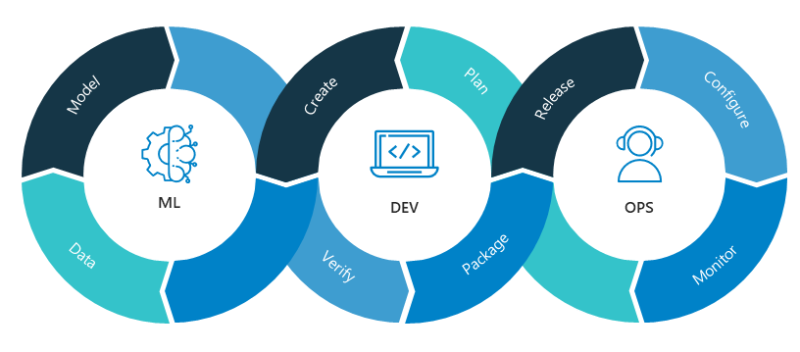
What’s the key to success? Creating new services that learn from data and can scale across the enterprise involves three domains: software development, machine learning (ML) and, of course, data. These three domains must be balanced and integrated together into a seamless development process.

Most companies have focused on building machine learning muscle – hiring data scientists to create and apply algorithms capable of extracting insights from data. This makes sense, but it’s a rather limited approach. Think of it this way: They’ve built up the spectacular biceps but haven’t paid as much attention to the underlying connective tissues that support the muscle.

Why the disconnect?

Focusing mostly on ML algorithms won’t drive strong AI solutions. It might be good for getting one-off insights, but it isn’t enough to create a foundation for AI apps that consistently generate ongoing insights leading to new ideas for products and services.

AI services have to be integrated into a production environment without risking deterioration in performance. Unfortunately, performance can decline without proper data management, as ML models will degrade quickly unless they’re repeatedly trained with new data (either time-based or event-triggered).

Professionalizing the AI development process

The best approach to getting real and continuous value from AI applications is to professionalize AI development. This approach conforms to machine learning operations (MLOps), a method that integrates the three domains behind AI apps in such a way that solutions can be quickly, easily and intelligently moved from prototype to production.

What is MLOps? | NVIDIA Blog

AI professionalization elevates the role of data scientists and strengthens their development methods. Like all scientists, these professionals bring with them a keen appreciation for experimentation. But often, their dependence on static data for creating machine learning algorithms –which they developed on local laptops using preferred tools and libraries – impedes production AI solutions from continuously producing value. Data communication and library dependency problems will take their toll.

Data scientists can continue to use the tools and methods they prefer, their output accommodated by loosely coupled DevOps and DataOps interfaces. Their ML algorithm development work becomes the centerpiece of a highly professional factory system, so to speak.

Smooth pilot-to-production workflow

Pilot AI solutions become stable production apps in short order. We use DevOps technology and techniques such as continuous integration and continuous delivery (CICD) and have standard templates for automatically deploying model pipelines into production. By using model pipelines, training and evaluation can happen automatically if needed – when new data arrives, for instance – without human involvement.

Our versioning and tracking ensure that everything can be reused, reproduced and compared if necessary. Our advanced monitoring provides end-to-end transparency into production AI use cases (including data and model pipelines, data quality and model quality and model usage).

Using our innovative MLOps approach, we were able to bring the pilot-to-production timeline for one U.S. company’s AI app down from six months to less than one week. For a UK company, the window for delivering a stable AI production app shrank from five weeks to one day.

The transparency of AI solutions, and confidence in their agility and stability, is critical. After all, the value lies in the ability to use AI to discover new business models and market opportunities, deliver industry-disrupting products and creatively respond to customer needs.

Significance of Data ethics in healthcare

Is medicine ready for artificial intelligence? | ETH Zurich

Over the past few years, Facebook has been in several media storms concerning the way user data is processed. The problem is not that Facebook has stored and aggregated huge amounts of data. The problem is how the company has used and, especially, shared the data in its ecosystem — sometimes without formal consent or by long and difficult-to-understand user agreements.

Having secure access to large amounts of data is crucial if we are to leverage the opportunities of new technologies like artificial intelligence and machine learning. This is particularly true in healthcare, where the ability to leverage real-world data from multiple sources — claims, electronic health records and other patient-specific information — can revolutionize decision-making processes across the healthcare ecosystem.

Healthcare organizations are eager to tap into patient healthcare data to get actionable insights that can help track compliance, determine outcomes with greater certainty and personalize patient care. Life sciences companies can use anonymized patient data to improve drug development — real-world evidence is advancing opportunities to improve outcomes and expand on research into new therapies. But with this ability comes an even greater need to ensure that patients’ data is safeguarded.

Trust — a crucial commodity

The data economy of the future is based on one crucial premise: trust. I, as a citizen or consumer, need to trust that you will handle my data safely and protect my privacy. I need to trust that you will not gather more data than I have authorized. And finally, I have to trust that you will use the data only for the agreed-upon purposes. If you consciously or even inadvertently break our mutual understanding, you will lose my loyalty and perhaps even the most valuable commodity — access to all my personal data.

Unfortunately, the Facebook case is not unique. Breaches of the European Union’s General Data Protection Regulation (GDPR) leading to huge fines are reported almost daily. What’s more, the continual breaches and noncompliance are affecting the credibility of and trust in software vendors. It’s not surprising that citizens don’t trust companies and public institutions to handle their personal data properly.

The challenge is to embrace new technology while at the same time acting as a digitally responsible society. Evangelizing new technology and preaching only the positive elements are not the way forward. As a society we must make sure that privacy, security, and ethical and moral elements go hand in hand with technology adoption. This social maturity curve might now follow Moore’s law about the extremely rapid growth of computing power, which means that — regardless of whether society has adapted — digital advancement will prevail.  But we can’t simply have conversations that preach the value of new technology without addressing how it will impact us as a community or as citizens.

Trust is a crucial commodity, and ensuring that trust means demonstrating an ethical approach to the collection, storage and handling of data. If users don’t trust that their data will be processed in keeping with current privacy legislation, the opportunities to leverage large amounts of data to advance important goals — such as real-world data to improve healthcare outcomes or to advance research in drug development — will not be realized. Consumers will quickly turn their backs on vendors and solutions they do not trust — and for good reason!

Rigorous approach to privacy

Health Data Privacy: Updating HIPAA to match today's technology challenges - Science in the NewsEthics and trust have become new prerequisites for technology providers trying to create a competitive advantage in the digital industry, and only the most ethical companies will succeed. Governments, vendors and others in the data industry must take a rigorous approach to security and privacy to ensure that trust. And healthcare and other organizations looking to work with software vendors and service providers must consider their choices carefully. Key considerations when acquiring digital solutions include:


  • How should I evaluate future vendors when it comes to security and data ethics?
  • How can I use existing data in new contexts, and what will a roadmap toward new data-based solutions look like? How will my legacy applications fit into this new strategy?
  • How will data ethics and security be reflected in my digital products, and how should access to data be managed?
  • How can I ensure I am engaging with a vendor that understands not only its products but can also handle managed security services or other cyber security and privacy requirements before any breach occurs?

Using technology to create an advantage is no longer about collecting and storing data; it’s about how to handle the data and understand the impact that data solutions will have on our society. In healthcare — where consumers expect their data to be used to help them in their journey to good health and wellness — that’s especially true. Healthcare organizations need to demonstrate that they have consumers’ safety, security and well-being at the heart of everything they do.

IT – The remote worker’s toolkit

IT the remote worker's toolkit

Enterprise clients have looked to automate IT support for several years. With millions of employees across the globe now working from home, support needs have increased dramatically, with many unprepared enterprises suffering from long service desk wait times and unhappy employees. Many companies may have already been on a gradual pace to exploit digital solutions and enhance service desk operations, but automating IT support is now a greater priority. Companies can’t afford downtime or the lost productivity caused by inefficient support systems, especially when remote workers need more support now than ever before. Digital technologies offer companies innovative and cost-effective ways to manage increased support loads in the immediate term, and free up valuable time and resources over the long-term. The latter benefit is critical, as enterprises increasingly look to their support systems to resolve more sophisticated and complex issues. Instead of derailing them, new automated support systems can empower workers by freeing them up to focus more on high-value work.

Businesses can start their journey toward digital support by using chatbots to manage common support tasks such as resetting passwords, answering ‘how to’ questions, and processing new laptop requests. Once basic support functions are under digital management, companies can then transition to layering in technologies like machine learning, artificial intelligence and analytics among others.

An IT support automation ecosystem built on these capabilities can enable even greater positive outcomes – like intelligently (and invisibly) discovering and resolving issues before they have an opportunity to disrupt employees. In one recent example, DXC deployed digital support agents to help manage a spike of questions coming in from remote workers. The digital agents seamlessly handled a 20% spike in volume, eliminated wait times, and drove positive employee experiences.

Innovative IT support

Innovative IT supports

IT support automation helps companies become more proactive in serving their employees better with more innovative support experiences. Here are three examples:

Remote access

In a remote workforce, employees will undoubtedly face issues with new tools they need to use or with connections to the corporate network. An automated system that notifies employees via email or text about detected problems and personalized instructions on how to fix is a new way to care for the remote worker. If an employee still has trouble, an on-demand virtual chat or voice assistant can easily walk them through the fix or, better yet, execute it for them.

Proactive response

The ability to proactively monitor and resolve the employee’s endpoint — to ensure security compliance, set up effective collaboration, and maintain high performance levels for key applications and networking – has emerged as a significant driver of success when managing the remote workplace.

 For example, with more reliance on home internet as the path into private work networks, there’s greater opportunity for bad actors to attack. A proactive support system can continuously monitor for threat events and automatically ensure all employee endpoints are security compliant.

Leveraging proactive analytics capabilities, IT support can set up monitoring parameters to match their enterprise needs, identify when events are triggered, and take action to resolve. This digital support system could then execute automated fixes or send friendly messages to the employee with instructions on how to fix an issue. These things can go a long way toward eliminating support disruptions and leave the employee with a sense of being cared for – the best kind of support.

More value beyond IT

Companies are also having employees leverage automated assistance outside of IT support functions. These capabilities could be leveraged in HR, for example, to help employees correctly and promptly fill out time sheets or remind them to select a beneficiary for corporate benefits after a major life event like getting married or having a baby.

Remote support can also help organizations automate business tasks. This could include checking on sales performance, getting recent market research reports sent to any device or booking meetings through a voice-controlled device at home.

More engaged employees With the power to provide amazing experiences, automated IT support can drive new levels of employee productivity and engagement, which are outcomes any enterprise should embrace.

Hey! Get Ready for a Virtual Desktop World

The new age of the remote employee is upon us. Close to half the workforce in the U.S. never worked from home before the worldwide healthcare crisis, Statista reports. Today, 44% work from home five days a week. Companies had to scramble to adapt their services and systems so that business could continue. Now, they are making significant long-term changes for a workplace that will never be the same. Under today’s circumstances virtual desktops will become more widespread – in some cases, even becoming the rule rather than the exception – as companies rethink their overall strategy for employee experience.

Finding new ways to manage in a virtual desktop world -- FCW

Cloud migration also has a role in driving the growth of the desktop virtualization market, which was valued at $6.7 billion in 2020 and is expected to nearly double by 2026, according to Mordor Intelligence.

There are many other factors in favor of moving to virtual desktops. One is that companies  are broadening use of virtual desktops across their workforce to give employees more flexibility. Another is that they are making themselves attractive to a wider pool of remote talent with hard-to-find expertise who don’t want to move to take a job. Desktop virtualization is also a vital asset for providing business continuity.

Virtual desktops save costs, which has become a higher priority for many companies that need to offset the revenue declines they have experienced.

With a virtual desktop model, there’s less complexity for IT operations, especially when businesses partner with service providers to implement and operate fully managed end-to-end virtual desktop infrastructure and applications.

Addressing security concerns

Microsoft Previews MSIX App Attach for Windows Virtual Desktop -- Redmondmag.com

IT security and policy compliance has always challenged desktop virtualization deployments and is probably one of the biggest reasons some companies have been hesitant to adopt it widely. With the ability to take advantage of the native Azure security features in Windows Virtual Desktop (WVD), including multi-factor authentication, company leaders can be more confident about tightening security and compliance.

Assuring the right cyber-security foundation was in place for desktop virtualization was a major goal for one of our customers in the U.K. public sector, so that it could maintain compliance with its IT security standards and policies. We were able to address that issue for its 2,000-plus users with our Virtual Desktop and Application Services solution based on Azure-native WVD, which leverages our comprehensive virtual desktop infrastructure (VDI) and managed desktop virtualization and application service offerings including managed security services.

Our customer’s timeline and constraints called for us to move fast, and we deployed a turnkey solution that included design and implementation – as well as ongoing support – in just 6 weeks. Now the project is expanding to increase the number of business applications and the organization has the flexibility to quickly and easily expand the solution for more users.

Recently we became one of the first Microsoft partners to receive the WVD Microsoft Advanced Specialization certification, which recognizes our expertise in deploying, optimizing, and securing VDI on Azure with WVD. This attests to our understanding and experience in helping businesses create the right VDI design and model – public cloud or hybrid deployments – for WVD. We’re proud of this recognition and validation of DXC as a trusted provider to deliver a comprehensive solution for WVD environments.

Data Centric Architecture

Data Centric architecture

The value proposition of global systems integrators (GSIs) has changed remarkably in the last 10 years. By 2010, it was the waning days of the so-called “your mess for less” (YMFL) business model. GSIs would essentially purchase and run a company’s IT shop and deliver value through right-shoring (moving labor to low cost places), leveraging supply chain economies of scale and, to a lesser degree, automation.

This model had been delivering value to the industry since the ‘90s but was nearing its asymptotic conclusion. To continue achieving the cost savings and value improvements that customers were demanding, GSIs had to add to their repertoire. They had to define, understand, engage and deliver in the digital transformation business. Today, I am focusing on the value GSIs offer by concentrating on their client’s data, rather than being fixated on the boxes or cloud where data resides.

In the YMFL business, the GSIs could zero in on the cheapest, performance compliant disk or cloud to house sets of applications, logs, analytics and backup data. The data sets were created and used by and for their corresponding purpose. Often, they were tenuously managed by sophisticated middleware and applications for other purposes, like decision support or analytics.

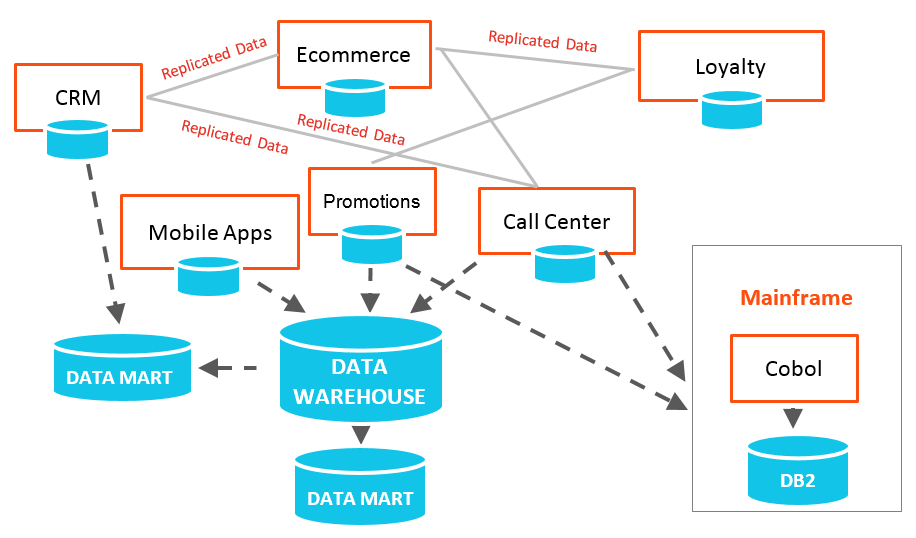
Getting a centralized view of the customer was difficult, if not impossible. First, it was due to the stove piping of the relevant data in an application-centric architecture. In tandem, data islands were created for analytics repositories.

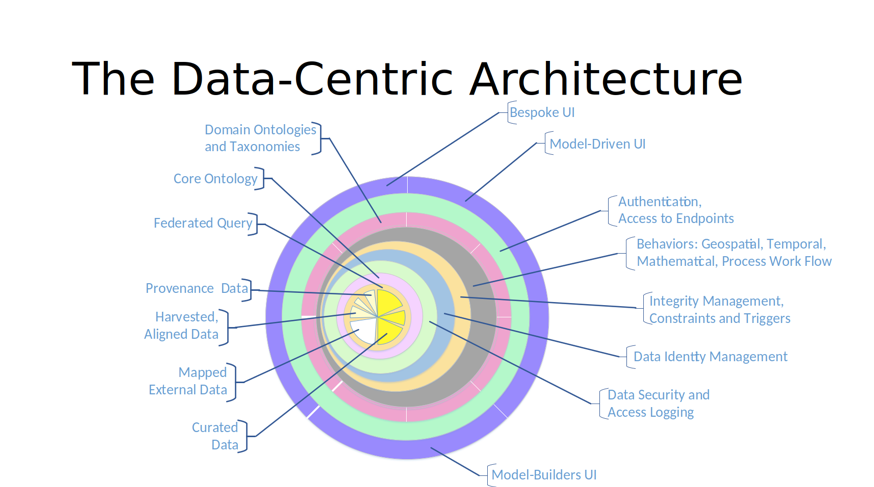
Now enters the “Data Centric Architecture.” Transformation to a data-centric view is a new opportunity for GSIs to remain relevant and add value to customer’s infrastructures. It is a layer deeper than moving to cloud or migrating to the latest, faster, smaller boxes.

A great way to help jump start this transformation is by rolling out Data as a Service offerings. Rather than taking the more traditional Storage as a Service or Backup as a Service approach, Data as a Service anticipates and provides the underlying architecture to support a data-centric strategy.

It is first and foremost a repository for collected and aggregated data that is independent of application sources. From this repository, you can draw correlations, statistics, visualizations and advanced analytical insights that are impossible when dealing with islands of data managed independently.

It is more than the repository of the algorithmically derived data lake. A Data as a Service approach provides cost effective accessibility, performance, security and resilience – aimed at addressing the largest source of both complexity and cost in the landscape.

Data as a Service helps achieve these goals by minimizing, simplifying and reducing the data and its movement within and outside of the enterprise and cloud environments. This is achieved around four primary use cases, which range from enterprise storage to backup and long-term retention:


Each of the cases illustrates the underlying capabilities necessary to cost effectively support the move to a data-centric architecture. Combined with a “never migrate or refresh again” evergreen approach, GSIs can focus on maximizing value in the stack of offerings. This approach is revolutionary.  In past, there was merely a focus on the refresh of aging boxes, or the specifications of a particular cloud service, or the infrastructure supporting a particular application. Today, GSIs can focus on the treasured asset in their customer’s IT — their data

error: Content is protected !!