An Introduction to Big Data Analytics| What It Is & How It Works?


What is Big Data? Let's answer this question! | by Ilija Mihajlovic | Towards Data Science

Big data is a term that describes datasets that are too large to be processed with the help of conventional tools and also is sometimes used to call a field of study that concerns those datasets. In this post, we will talk about the benefits of big data and how businesses can use it to succeed.
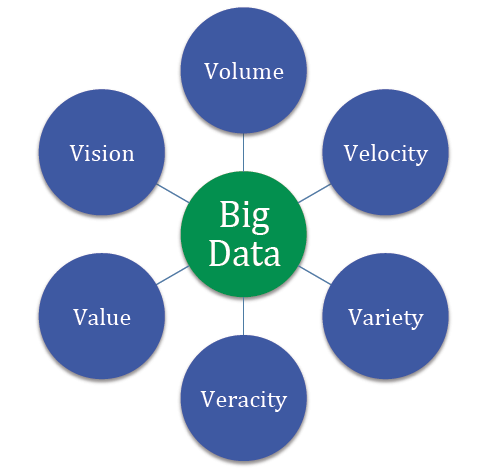
The six Vs of big data
Tourism Intelligence International – Big Data

Big data is often described with the help of six Vs. They allow us to better understand the nature of big data.

Volume

As it follows from the name, big data is used to refer to enormous amounts of information. We are talking about not gigabytes but terabytes ( 1,099,511,627,776 bytes) and petabytes (1,125,899,906,842,624 bytes) of data.

Velocity

Velocity means that big data should be processed fast, in a stream-like manner because it just keeps coming. For example, a single Jet engine generates more than 10 terabytes of data in 30 minutes of flight time. Now imagine how much data you would have to collect to research one small aero company. Data never stops growing, and every new day you have more information to process than yesterday. This is why working with big data is so complicated.

Variety

Big data is usually not homogeneous. For example, the data of an enterprise consists of its emails, documentation, support tickets, images, and photos, transaction records, etc. In order to derive any insights from this data, you need to classify and organize it first.

Value

The meaning that you extract from data using special tools must bring real value by serving a specific goal, be it improving customer experience or increasing sales. For example, data that can be used to analyze consumer behavior is valuable for your company because you can use the research results to make individualized offers.

Veracity

Veracity describes whether the data can be trusted. Hygiene of data in analytics is important because otherwise, you cannot guarantee the accuracy of your results.

Variability

Variability describes how fast and to what extent data under investigation is changing. This parameter is important because even small deviations in data can affect the results. If the variability is high, you will have to constantly check whether your conclusions are still valid.
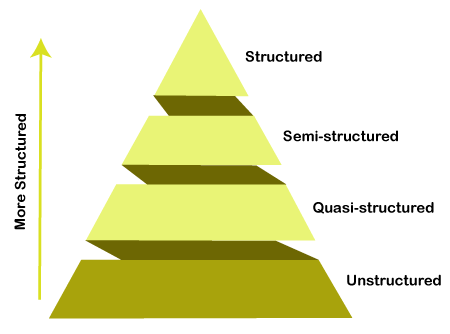
Types of big data
 Data Characteristics - JavaTpoint

Data analysts work with different types of big data:

  • Structured. If your data is structured, it means that it is already organized and convenient to work with. An example is data in Excel or SQL databases that is tagged in a standardized format and can be easily sorted, updated, and extracted.
  • Unstructured. Unstructured data does not have any pre-defined order. Google search results are an example of what unstructured data can look like: articles, e-books, videos, and images.
  • Semi-structured. Semi-structured data has been pre-processed but it doesn’t look like a ‘normal’ SQL database. It can contain some tags, such as data formats. JSON or XML files are examples of semi-structured data. Some tools for data analytics can work with them.
  • Quasi-structured. It is something in between unstructured and semi-structured data. An example is textual content with erratic data formats such as the information about what web pages a user visited and in what order.
Benefits of big data
5 Benefits of Analytics

Big data analytics allows you to look deeper into things.

Very often, important decisions in politics, production, or management are made based on personal opinions or unconfirmed facts. By analyzing data, you get objective insights into how things really are.

For example, big data analytics is now more and more widely used for rating employees for HR purposes. Imagine you want to make one of the managers a vice-president, but don’t know which to choose. Data analytics algorithms can analyze hundreds of parameters, such as when they start and finish their workday, what apps they use during the day, etc., to help you make this decision.

Big data analytics helps you to optimize your resources, perform better risk management, and be data-driven when setting business goals.

Big data challenges
Challenges| Mercury Fund

Understanding big data is challenging. It seems that its possibilities are limitless, and, indeed, we have many great solutions that rely heavily on big data. A few of those are recommender systems on Netflix, YouTube, or Spotify that all of us know and love (or hate?). Often, we may not like their recommendations, but, in many cases, they are valuable.

Now let’s think about AI-systems that predict criminal behavior. They analyze profiles of criminals and regular people and can tell whether a person is likely at some point to commit a crime. These algorithms are reported to be quite effective.

However, their predictions are not as effective as to give them legal power, mostly because of the bias: algorithms are prone to make sexist or racist assumptions if the data is racist or sexist. You have probably heard about the first beauty contest judged by AI. None of the winners were black, probably, because the algorithm wasn’t trained on photos of black people. A similar fail happened with Google Photos that tagged two African-Americans as ‘gorillas’ ― for the same reason. This demonstrates how important the gender-race sensitivity perspective is when choosing data for analysis. We should improve not only the technology but also our way of thinking before we can create technologies that effectively ‘judge’ people.

How to use big data
How Brands Use Data  - 5 Real World Examples | InfoClutch

If you want to benefit from the usage of big data, follow these steps:

Set a big data strategy

First, you need to set up a strategy. That means you need to identify what you want to achieve, for example, provide a better customer experience, improve sales, or improve your marketing strategy by learning more about the behavioral patterns of your clients. Your goal will define the tools and data you will use for your research.

Let’s say you want to study opinion polarity and brand awareness of your company. For that, you will conduct social analytics and process raw unstructured data from various social media and/or review websites like Facebook, Twitter, and Instagram. This type of analytics allows assessing brand awareness, measuring engagement, and seeing how word-of-mouth works for you.

In order to make the most out of your research, it is a good idea to assess the state of your company before analyzing. For example, you can collect the assumptions about your marketing strategy in social media and stats from different tools so that you can compare them with the results of your data-driven research and make conclusions.

Access and analyze the data

Once you have identified your goals and data sources, it is time to collect and analyze data. Very often, you have to preprocess it first so that machine learning algorithms could understand it.

By applying textual analysis, cluster analysis, predictive analytics, and other methods of data mining, you can extract valuable insights from the data.

Make data-driven decisions

Use what you have learned about your business or another area of study in practice. The data-driven approach is already adopted by many countries all around the world. Insights taken from data allow you to not miss important opportunities and manage your resources with maximum efficiency.

Big data use cases
6 Use Cases in Retail

Let us now see how big data is used to benefit real companies.

Product development

When you develop a new product, you can trust your guts or rely on statistics and numbers. P&G chose the second option and spends more than two billion dollars every year on R&D. They utilize big data as a springboard for new ideas. For example, they aggregate and filter external data, such as comments and news mentions, using Bayesian analysis on P&G’s product and brand data in real-time to develop new products and improve existing ones.

Predictive maintenance

Even a minor mistake or failure in the oil and gas industry can be lethal and cost millions of dollars. Predictive maintenance with the help of big data includes vibration analysis, oil analysis, and equipment observation. One of the providers of such software is Oracle. Their machine learning algorithms can analyze and optimize the use of high-value machinery that manufactures, transports, generates, or refines products.

Fraud and compliance

Digitalization of financial operations can prevent credit card theft, money laundering, and other such crimes. The USA Internal Revenue Service is one of the institutions that rely on processing massive amounts of transactions with the help of big data analytics to uncover fraudulent activities. They use neural network models with more than 600 different variables to be able to detect suspicious activities.

Last but not least

Big data is the technology that will continue to grow and develop. If you want to learn more about big data, machine learning, and artificial intelligence in research and business, follow us on Twitter and Medium and continue reading our blog.

A Digital Divide has emerged as a result of Remote Working

Coronavirus reveals need to bridge the digital divide | UNCTAD

Like many others, my family and I have done our best to enjoy the unexpectedly large amount of time we have together at home due to social distancing guidelines. Adjusting to the new normal, we have relied heavily on Internet access not only for work and school, but to stay sane and keep the peace. My wife and I both continue to work from home, frequently videoconferencing and collaborating with colleagues. The kids finished the school year online and now they are starting the new school year with a mixed arrangement of physical and virtual learning. Many hours of streaming video have been consumed. This isn’t an experience we want to repeat, but I believe it would have been far more difficult and stressful if we lacked the connectivity needed to remain productive, informed, and entertained during these times. Without that high-speed connection to the digital realm, this experience would feel more like we were stranded in a country where we didn’t speak the language — surrounded by activity yet unable to participate. It would create the very real feeling of “looking in from the outside.” The rapid onset of social distancing or stay-at-home measures has created just this feeling for a large number of people. Across the world, many people were suddenly thrust into unfamiliar remote working situations. And with the global percentage of households connected to the internet at only 55%, many organizations, in turn, discovered a digital divide that needed to be bridged for some employees. For example, some companies successfully stood up the infrastructure and processes necessary to support new remote capabilities, only to find that some of their employees lacked the connectivity or technological proficiency to be productive remote workers.

These current circumstances have placed the digital divide –not always apparent to many companies previously — into sharp relief. They’ve shown that digital life skills and work skills – not to mention the access to technology and connectivity needed to enable those skills — are as essential to us now as hunting and horseback riding were to our ancestors. Like STEM education, an emphasis on digital skill-building could help many people be more productive and could provide them a better work environment, more income, and a brighter future.

Infrastructure and processes to bridge the digital divide

Other related questions around remote work abound, especially in terms of corporate infrastructure. Would employees be able to use devices they already owned to perform their jobs, or would they need to be supplied with equipment? Where would that come from and how would it be prepared to access corporate data? And many were unprepared and unsure if their network was up to the task when demand suddenly shifted from inside the enterprise to requests from remote workers.

Processes were another big issue. In addition to addressing where we work, enterprises have had to consider how we work. What tasks does a company perform that must continue and could those be adapted for remote access? For some, the work needed to turn this into a distributed, remote work process was well documented. Team-oriented jobs, however, required more reengineering and may not have been as well defined.

Remote working: temporary or permanent?

The future of work: How technology enables remote employees

Over the past few months, we have been helping our global enterprise customers adopt to this new environment and discussing the future of workplace. Many are debating whether remote work is a temporary fix or a permanent shift. In every case, I’m sure they will be reflecting on this experience and its challenges – and the digital divide in particular – to help them improve their resilience and that of their employees. These lessons will heavily influence the investments they make going forward in all areas of technology, training and business process reengineering.

Reducing risk in digital transformation of Organizations

How to reduce risk in your digital transformation projects

Digital transformation and enterprise risk management can be thought of as parallel highways. That’s because any transformation effort will introduce new risks and change to the organization’s overall security posture. As organizations continue their digital transformations, the transformation of security and risk management must be an integral part of that journey. Organizations must integrate security and risk management into DevOps and Continuous Delivery (CD) processes. The ultimate goal is to have resilient systems that can not only withstand cyber attacks, but also carry out mission-critical business operations after an attack succeeds.

Taking the analogy further, imagine that each of these highways has three lanes: one for people, another for process, and a third for technology.

People in an organization form its culture. For digital transformation to succeed, many organizations will need to transform the culture around risk. That might include inculcating respect for personal information, and organizations consciously building digital services with privacy in mind. The workforce needs to be adept in using digital tools such as cloud, APIs, big data and machine learning to automate and orchestrate the management of a digital security threat response.

Process relates to how an organization overhauls its business processes to be agile and yet secure at the same time. This might involve moving from ITIL behaviour to DevOps or other proactive operational approaches. Prevention is important, but the ability to respond to manage digital threats is much more relevant, as this proactive behavior coincides with DevOps principles.

Technology can present new risks, but can also help address risk. Many top technology companies, for example, are using technologies to automate processes in a way that’s secure. Some common best practices include building loosely-coupled components wherever possible on a stateless/shared-nothing architecture, using machine learning to spot anomalies quickly, and using APIs pervasively to orchestrate the security management of digital entities in a scalable manner.

Three paths — people, process and technology — are changing how enterprises reduce risk.

From a CIO’s perspective, each new digital entity and interaction adds risk: Who is this user? Is this device authorized? What levels of access should be allowed? Which data is being accessed?

Leading organizations will securely identify these users, devices and other entities — including software functions and internet of things (IoT) endpoints — and they’ll do so end-to-end in an environment where services are widely distributed.

Advance Enterprise Digital Transformation Efforts By Mobile Apps

How can Mobile Apps Reinforce the Enterprise Digital Transformation

Irrespective of which industry you look at, you will find entrepreneurs hustling to kickstart their digital transformation efforts which have been lying in the backdrop since several business years. While a considerably easy move when you have to alter your digital offering according to the customers’ needs, things become a little difficult when you start planning digital transformation for your business. A difficulty that mobile applications can solve. There are two prime elements which businesses need to focus on when planning to digital transform their workflow and workforce: adaptability and portability. And by bringing their processes and communications on mobile apps, they are able to hit both the targets in one go. Here are some statistics looking into why enterprises need to count mobile application in, in their digital transformation strategy –

Although the above graph should be a reason enough to take mobile apps seriously, there are some other numbers as well.

  • 57% of the digital media use comes in through apps.
  • On an average, any smartphone user has over 80 apps out of which they use 40 apps every month.
  • 21% of millennials visit a mobile application 50+ times everyday.

While the statistics establish the rising growth of mobile apps, what we intend to cover in the article is the pivotal role mobile applications play in digital business transformation. To understand it from the entirety, we will first have to look into what is digital transformation and what it entails.

What is digital transformation?

Digital transformation means using digital technologies for changing how a business operates, fundamentally. It offers businesses a chance to reimagine how they engage with the customers, how they create new processes, and ultimately how they deliver value.

The true capabilities of introducing digital transformation in business lies in making a company more agile, lean, and competitive. The end of the long term commitment results in several benefits.

Benefits of digital transformation for a business

  • Greater efficiency – leveraging new technologies for automating processes leads to greater efficiency, which in turn, lowers the workforce requirements and cost-saving processes.
  • Better decision making – through digitalized information, businesses can tap in the insights present in data. This, in turn, helps management make informed decisions on the basis of quality intelligence.
  • Greater reach – digitalization opens you to omnichannel presence which enables your customers to access your services or products from across the globe.
  • Intuitive customer experience – digital transformation gives you the access to use data for understanding your customers better enabling you to know their needs and delivering them a personalized experience.

Merging mobile app capabilities with digital transformation outcomes 

How can Mobile Apps Advance Your Enterprise Digital Transformation Efforts | Pixeled Apps | iOS & Android Mobile App Development

The role of mobile applications can be introduced in all the areas which are also often the key areas of digital transformation challenges that an enterprise faces.

  1. Technology integration
  2. Better customer experience
  3. Improved operations
  4. Changed organizational structure

When you partner with a digital transformation consulting firm that holds expertise in enterprise app development, they work around all these above-mentioned areas in addition to shaping their digital transformation roadmap around technology, process, and people.

In addition to a seamless integration with the digital transformation strategy of an enterprise,  there are a number of reasons behind the growing need to adopt digital transformation across sectors. Ones that encompasses and expands beyond the reasons to invest in enterprise mobility solutions.

The multitude of reasons, cumulatively, makes mobility a prime solution offering of the US digital transformation market.

Here’s how mobile apps are playing an active role in an enterprise’s 360 digital transformation.

How are mobile apps playing a role in advancing businesses’ internal digital transformation efforts?

1.  By utilizing AI in mobile apps

The benefits of using AI for bettering customer experience is uncontested. Through digital transformation, businesses have started using AI for developing intuitive mobile apps using technologies like natural language processing, natural language generation,  speech recognition technology, chatbots, and biometrics.

AI doesn’t just help with automation of processes and with predictive, preventative analysis but also with serving customers in a way they want to be served.

2.  An onset of IoT mobile apps

The time when IoT was used for displaying products and sharing information is sliding by. The use cases of mobile apps in the IoT domain is constantly expanding.

Enterprises are using IoT mobile apps to operate smart equipment in their offices and making the supply chains efficient, transparent. While still a new entrant in the enterprise sector, IoT mobile apps are finding ways to strengthen their position in the business world.

3.  Making informed decisions via real-time analytics

In the current business world, access to real-time analytics can give you a strong competitive advantage. Mobile applications are a great way for businesses to collect users’ data and engage with them through marketing transformation messages designed around the analytics based on their app journey.

You can use real-time analytics to know how your teams are performing, analyze their productivity, and get a first-hand view into the problems they are facing in performing a task and how it’s impacting the overall business value.

4.  Greater portability


Portability in an enterprise ecosystem enables employees to work as per their convenience. While it shows less impact in the short term, in the long run, it plays a huge role in how productive a team is.

By giving employees the space to work as per the time and location of their choice, you give them the space to boost their creativity fuel and in turn productivity. One of the results of using software that enabled our employees to work according to their terms and conveniences for us was greater business expansion ideas and an increase in overall productivity of the workforce.

Tips to consider when making mobile apps a part of the digital transformation strategy

If at this stage, you are convinced that mobile applications are a key part of digital transformation efforts, here are some tips that can help your strategies for increasing the ROI on your enterprise app –

Adopt mobile-first approach – the key factor that separates enterprise apps that are winning is how they don’t treat apps as the extension of their websites. Their software development process is strictly mobile-only. This in turn shapes their entire design, development, and testing processes.

Identifying the scope of mobility – the next tip that digital transformation consulting firms would give you is analyzing the operations and workflows for understanding which teams, departments, or functions would benefit from mobility the most. You should not start reinventing a process which works okay, you should look for areas which can be streamlined, automated, or valued through mobility.

Outsourcing digital transformation efforts – when we were preparing An Entrepreneur’s Guide on Outsourcing Digital Transformation article, we looked into several benefits of outsourcing digitalization to a digital transformation strategy consulting agency. But the prime benefit revolved around saving businesses’ efforts and time which goes into solving challenges like – absence of digital skillset, limitations of the agile transformation process, or the inability to let go of the legacy systems.

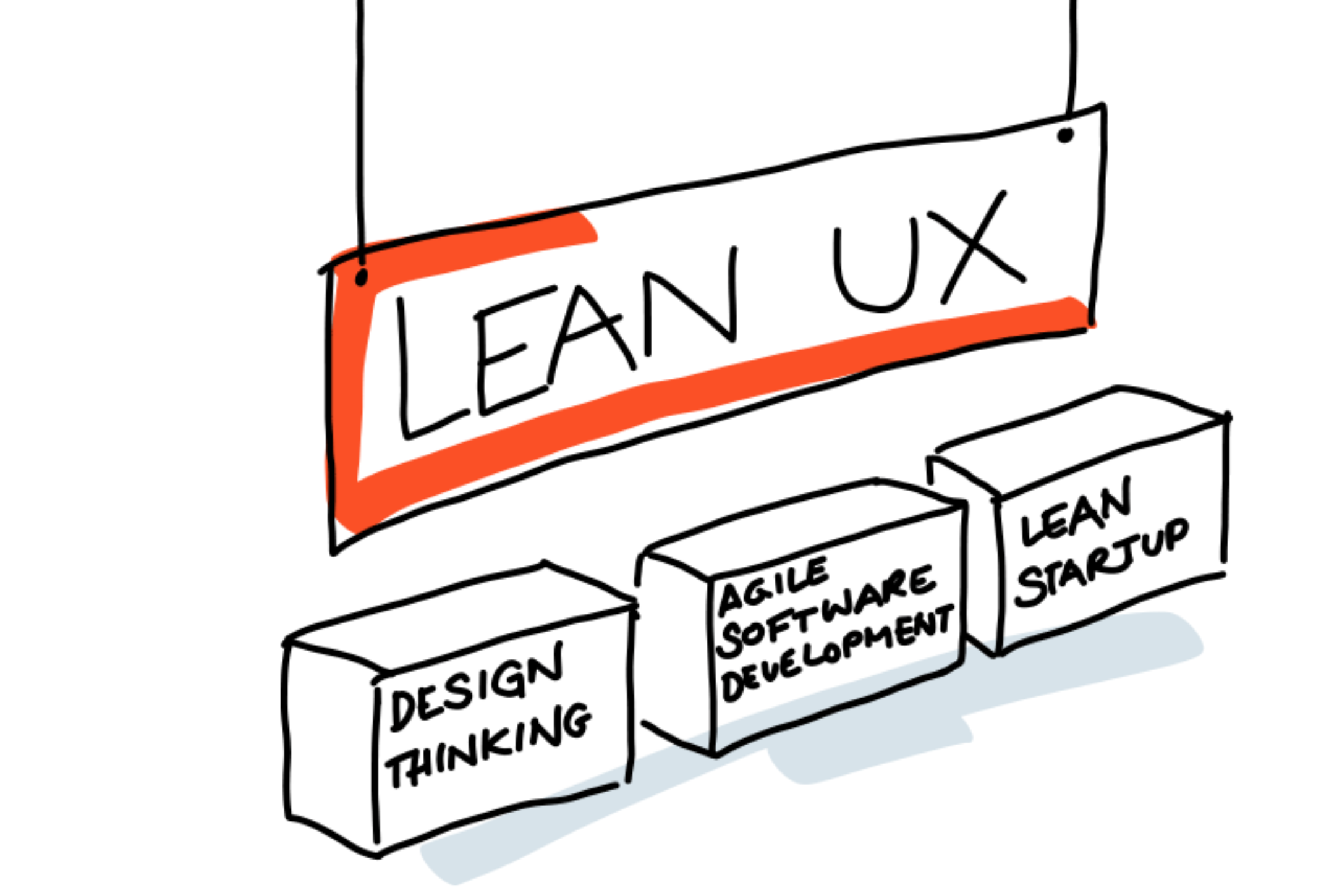
Lean UX – The Evolution of User Experience in the Lean Methodology

Lean UX

You’ve landed your first UX job. Now what? You’re probably excited about what’s in store for you in this career path – and a tad overwhelmed. I’ve written this article as an attempt to ease your nerves. Some of what you read, you may already be aware of. And if you feel some of them sound more like life hacks than design tips – it’s probably because they are.

Show Initiatives

If you’re new to the workplace, chances are the heavy-lifting hasn’t started yet. You’re relatively free, and it’s a great time for you to say yes yes to doing any and all kinds of work – even if it wasn’t part of the job description; even if you don’t think you’re good at it

Being forthcoming and approachable about the kind of work you’re open to doing signifies that you’re open to learning everything there is to the job. Say yes. Make mistakes. It’s all good. Most UX designer jobs are entry-level positions, hence having a host of ancillary skills will help you grow in the organisation faster. Opening yourself up to new kinds of work will only help you holistically as a designer.

Forget the job description; be a generalist

It’s easy to get caught up in the rat race, so here’s a protip- don’t!


It’s typical of the most design professional to get trapped in the title race that we forget to think about what eventually matters – our overall growth as a designer. An exceptional UX designer is almost always a generalist and being one involves proficiency not only in design but also in subjects like empathy, communication, content writing, business and strategy, just to name a few.

Find real users to test ideas on


One of the most neglected steps in the design process is testing your product on real users before launching it. Don’t get us wrong- having a revolutionary concept is great. But until you get feedback from someone who is going to use it every day, it will remain just – a novel concept! And no, your teammates aren’t your real users, their feedback isn’t going to help much.

Look for a mentor


Differing opinions can sometimes be key to new insights. You need to blend with the people and find someone who can speak to you candidly and help you navigate life in the organisation and profession alike. Scan your workplace or industry and find a mentor with the skills and professional drive that you wish to emulate. A good mentor can impart nuggets of wisdom that you may not find in self-help manual or guide.

Sketch first

No matter how far we get with technology there is no alternative for putting pen to paper. Since it’s still early days in your design career, refrain from designing directly on the screen. Even if you are a master at visualizing an idea down to the last pixel in your head, we end up losing many details by the time we reach the final product. Sketching is the quickest way to translate an idea in your mind into the real world. You can come up with multiple iterations of your idea quickly. No time is wasted figuring out which font size or color to use, or what kind of roundness a button should have.

Lean UX

Get into the habit of writing


Writing – stories, blogs, journaling – helps in bringing about clarity to your thoughts, which is difficult to achieve if it’s all just locked inside our head. In addition to sketching disparate blueprints, consider fleshing out concept notes that you can develop into products later. When you make writing a habit, you start to notice that it translates to your designs as well. Writing microcopy is an essential skill for UX designers, which can make or break their design. A product’s true value is almost always conveyed through the copy used. Creativity in the spoken word will help you refine your UX designer portfolio.

Get design inspirations, but do not copy

By habit, designs of most designers tend to get heavily influenced by sites such as Dribbble, Behance or by apps with “cool” interfaces. What they miss out to understand is that each design is created to solve a specific problem. It’s obtuse to mindlessly copy these designs without understanding the reasoning behind them. Try to adopt a problem-solving attitude to design; look at each product from a customer’s viewpoint and build experiences to keep them coming back for more. This methodology will give you a definite edge in the industry.

Seek and respect feedbacks


In your career as a designer, your thoughts and ideas will be challenged by your clients, peers, and sometimes by yourself (which I highly recommend doing). Defending the designs we make is almost a knee-jerk reaction we’re all guilty of, and while it is your job to communicate to the client why you did what you did, don’t get too attached to your designs. Instead, learn to love the feedback you receive and probe deeper to understand the underlying reason for the feedback. Being receptive to feedback will also help people around you feel more forthcoming in sharing their honest views.

Don’t stick to a single process

The traditional design process that we are used to struggles to keep up with the changing needs of stakeholders. Every new project comes with its own set of challenges – the client wants the product yesterday, they don’t have time for user research, and, likely, the design process you’ve sworn by all this time doesn’t fit in with the project plan. The only way to adapt to these changing needs is by adopting newer design processes that can positively impact the project. Read up about processes like Lean UX and Design Sprints. Read up about design strategy from the greats. They’ve changed the way we work and collaborate with teams and clients (and users) on a project. Understanding these processes and identifying when to apply them is key to becoming a master of your craft.

Attend workshops


Design workshops expose you to influential thought-leaders from the industry. They teach you firsthand about real-world problems and solutions. Also workshops are a good way to find a mentor from your field and speak of your interests to a wide variety of people interested in the design discipline.

Conclusion

One last thing, but it’s necessary. The first project you work on won’t be perfect – a lot of them won’t be. The first article you write won’t be perfect either. And neither will the workshops you conduct. And that’s okay. Perfection shouldn’t be your end goal. Design is an iterative process. And we’re all still figuring it out. Might as well enjoy the process while you’re at it.

Why Rich Animations is a great design trend

Why Rich Animations are crucial for design | Design, Animation, Design  inspiration

In today’s world, the animation plays a crucial role in communication. It is incredibly versatile and can communicate abstract, complex and multidisciplinary concepts in an effective and easy manner. Gone are the days when people said: “ Animation is just a small part of interface design or product design and it is not essential “. Today, they are not used merely as eye candy, but as a powerful tool meant to enhance user experience. They are like heartbeats that brings life and soul to interfaces and products.

Latest web developments have allowed animations to be implemented easily which has given us designers truckload of opportunities. Simple or elaborate, animation can fascinate the users at every step. In this blog, I would like to highlight 5 ways you can use rich Animation’s to bring life to your designs:

Storytelling and fun way to convey any message

Who doesn’t like Stories? Probably no one. Animation can be used for storytelling and through them, even the most difficult concepts can be conveyed easily to the users. For example, previously, most brands were using the tutorial videos to help their users understand the process and benefits. But, today, the animation is ruling this space; pick up any app they are generally supplemented with ‘Splash Screens’ or step by step messages to guide users through the usage of the app.


Furthermore, it adds up to the personality of a website or mobile app, basically, your digital presence. Whether it is a long scroll of seamless sections of a website or showcasing of vision and capabilities, your story or action can be told in a fun and elegant manner. For instance, one of our clients, Hakunamatata, in space of Information Technology & Services wanted to communicate their strength in the development space through a website, hence, to highlight this we used ‘Unusual Navigation’ and empowered with many micro-interactions.


We believe, the animated design is a story best told; it adds an extra zing of awesome sauce that pushes the designs over the edge, bringing the very design to life in a subtle and friendly way which prompts the user to interact and explore more.  You should check out this website to experience the zing I was talking about.

Interactive and Intuitive

Intelligent animations are very engaging and enable users to focus, get feedback, and communicate efficiently with the brand and its digital interface; this creates a pleasant illusion close to natural interaction as with physical objects. This is the very reason why Apple and Google give so much importance to animation and interactions in their guidelines.


Interactive animations put the user in the driving seat and impart a feeling of having complete control over the navigation while they go through an astounding interactive journey. This amazing website takes users through the interactive journey of  Rome’s history. It is the most engaging history book you would come across and a user would feel like they are living the entire era.


Another, important thing to take note of is how a designer can effectively declutter his designs by concealing and revealing options with smooth animations and interactions which can be very useful while designing content/options heavy designs. A classic example would be the Android tray pulling animation with options.

Visual feedback and Micro interactions

These days we see a lot of animations giving visual feedback in the form of effects, transitions, animated colors, icons, and seamless backgrounds. They provide an unmatched user experience, because a user knows he is hovering on a clickable button or a link, and not just some content. Using Animation, the user is made aware of the progress and other features in an instance. An animated interface has the power to entertain the user with a fun loader while they wait for the page to load, inform them with a progress bar, load the animated skeleton of the layout, seek attention with beautifully animated signals when needed, alert a user about an error, help them navigate and what not! Micro-interactions also evokes emotions and feelings for the action. Animation applied for micro-interactions are hardly noticed by the user, however, as with all the small and simple elements of the interface, a lot of intelligence and understanding goes into designing micro interaction which boosts user’s interaction with the interface.


 Great and beneficial for designers as well

Animations, not only helps the designer to make a delightful presentation of their designs, but it also enables the designers to discover a lot of potential improvisation while they prototype or animate their designs. I would say every designer should keep animations and interaction in mind while designing an interface, which is nothing but interaction designing.

When the designer does this, not only he takes the wireframes to the design stage, but he also takes the design to the next level for better development, where he has already visualized how a user is interacting with the interface. It speaks volumes about the attention to detail the designer has put into it, as he eliminates bugs, errors, missing links, and dig into a lot of innovative UX with his “ Interaction Thinking “.


An animated design is a living thing! Period.

Not only it is as satisfying as the ‘fidget spinner’, but it supports the very essence of real life interaction and it creates feelings and perception close to what we humans experience while interacting with a physical object.  It speaks to you, plays with you, emotes with you, and understands you- Just like your best buddy.


The animation is the future of design and interfaces, which is very obvious with the evolution of VR and AR interfaces, where animation is the key property used to design them. People don’t just buy products, they actually buy the interfaces, the lively designs, and those appealing interactions.

SVG, Canvas, WebGL? Visualization options for the web

So, if you are creating an innovative product or design, take heed as the future is animated designs. Technologies such as SVG animations and WebGL, which supports us designers to make use of rich animations and interactions to enhance and add life to designs, which eventually impacts millions of lives.

Android or iOS: Mobile Platform App For Startups in 2021

Which Mobile Platform Should Startups Choose in 2021: Android Or iOS? - You Startups

Back in 2008, the iOS App Store was launched with 500 apps. Today that number has skyrocketed to 1.85 million apps that are available for users to download. Android users have a bigger app universe to browse from that consists of over 2.56 million apps available in the Google Play Store. It is safe to say that we are living in the digital era! To prove we are in the digital era, let’s recall the numbers. Did you know that the number of smartphone users worldwide surpasses 3.5 billion? As per the Statista- Smartphone User forecast, it is estimated to further grow by several hundred million in the next few years. There are 7.94 billion devices connected worldwide and this number is more than the number of people in the globe! Hence, there is no denying the fact that mobile applications are an integral part of our daily lives. Keeping the above data in mind, many entrepreneurs are planning to start a mobile app centered business. If you are amongst those businessmen who are looking forward to creating a mobile app, then the first question to address is – which is better among Android vs iOS development?In this article   you will walk through certain factors that will influence your choice, and embibe you with the iOS and Android App Development Platform.

Let’s get right to it.

Apple vs Android: Market Share

Innovative Mobile App Ideas for Successful Startups in 2020 [Updated for 2021]

According to Statista, in 2020 the market share of Android and iOS was 86.6% and 13.4% respectively and these numbers are expected to reach 87.1% for Android and 12.9% for iOS in 2023.


Looking into the above graph, you can conclude that Android is a clear winner in the mobile operating system market share worldwide and is expected to remain so in the years to come. It is so because the Android startup apps are the most adopted ones for almost every smartphone vendor other than Apple.

Also, Android is an open source platform that allows and makes it easy for mobile phone manufacturers to add their own look to the operating system.

Apple vs Android: App Downloads

According to Statista Market Forecast 2016–2021, there will be 196 billion annual downloads from Google Play store by 2021, all thanks to growing smartphone and app adoption worldwide.

While from the iOS store there will be 42 billion downloads. Android again wins when it comes to app downloads worldwide and it is expected to enormously grow in the years to come.


After reading all the above facts and data  it is highly advisable for you to  make yourself familiar with the process of startup app development.

We have curated a complete guide on apps for startups, with A to Z information about the process of getting your idea live on a mobile application. In this article, we will answer all the questions that every entrepreneur who is new to the app industry might have.

Which Is Better – iOS Or Android?

Android vs iOS development is a never ending debate between software developers. The quest to- Which platform should startups choose has no one word answer. There are solutions that depend on various factors that an entrepreneur should consider before making a decision.

Let’s go through all the factors one by one:

1. Demographics

There is no denying the fact that Android smartphones have a larger demographic than apple users.

Also, there is no denying the fact that Apple is considered a high end device in which users are willing to purchase apps. So, Apple users are generally found in prosperous parts of the world.

For example: The USA is considered among the highest revenue making countries, thus you will find a larger number of iOS users there.

As per the reports by Statista, currently there are more than 113 million iPhone users in the United States, accounting for about 47 percent of all smartphone users in the United States. So if you are targeting the western demographic, I suggest you to hire iphone app developers.


2. Fragmentation

In simple words, fragmentation refers to when users are running different versions of a mobile operating system and using different mobile hardware models or mobile devices.

We are aware that iOS devices and their release cycles are controlled by Apple alone. As a result, once a year Apple synchronizes iOS version releases with device releases. Hence, fragmentation issues are less.

However, when we talk about Android, fragmentation issues occur constantly, further making life of the android application developers difficult at the time of testing and quality control. Thus, Android fragmentation increases development cost and maintenance time.

3. Design and development

In terms of designing, Google Material Design has a greater influence on UI and UX. Mobile app developers feel that when it is about coding mobile apps then Swift is a much easier language to start as compared to Java.

However, design and development is one factor that depends less on the platform and more on the skills of your partnered mobile app development company. When you are linked with a brand that has it specialization in the development of both Apple and Android apps, it is of the least matter about which platform requires less developmental efforts as both are done within equal efforts.

Now that we are aware of the factors involved, let us discuss the reasons to go for android startup apps and iphone startup apps separately.

Why Choose Android Startup Apps?

A pop of color and more: updates to Android's brand

You should go with Android first if your audience is not concentrated on any one specific demographic or target audience. Also, if there are a good number of customization elements in your mobile app, go with Android.

Below are the advantages of using Android.

1. Greater user base

Majority of users globally use Android devices as compared to other devices, which gives you a large pool of potential users. Not having an android app for business means losing limitless opportunities and audiences for your product or services.

2. Open source platform

Android is an open-source platform which means Google doesn’t charge any fee for using this platform. Wherein, Google also provides Android app development tools and technology for free to the developers. Thus Android app cost is comparatively lesser than iOS app cost.

So, it is a cost-effective solution for your startup budget.

Hardware device manufacturers such as Samsung, Oppo, Xiaomi, etc., all use Android as their default OS.

3. Customizable apps

Android app development allows the app developers to customize the applications as per the business requirement. This means your business app development will get done with the right requirements and required flexibility which might not have been possible with any other platform. It is always a good idea to hire an android app development company that can help you with your startup app.

4. High ROI

The moment you publish your app on the store, you get a big pool of potential users that you can tap into. Since you have such a wide market to target, the return of investment on your android app would be instant and always on a higher end considering your Android app development cost.

5. Compatibility

One of the biggest advantages of choosing an android app over iOS is that there’s no restriction on devices that is to be used for building an android app. You can build an app on any device, be it Windows desktop, Mac, or the Linux system.

The fact that makes Android a go-to platform for all the sectors with interoperability needs is that it allows you to expand your brand across devices and systems .

We now understand the advantages of choosing android apps. Let’s dig deep and see what are the reasons to go for iOS app development for your startup.

Reasons To Choose iPhone Apps

You should place your startup’s first mobile app on iOS by investing in a sound reputed iOS app development company if you wish to come in the sight of the app store’s target demographics.

Let us discuss the advantages of choosing iOS apps for startups:

1. Security

Security is the utmost requirement for any business because sensitive enterprise data is lodged in apps. Android apps are a big risk when it comes to security while iPhone users are cushioned against hacking and malware. When you compare the iPhone vs Android on the basis of security, iPhone apps protect firmware and software through stringent security measures such as :

  • Integrated data handling systems
  • Measures to prevent duplication of data
  • Measures for loss of security by data encryption


2. Revenue

The ones that have a greater ROI than Android apps are the iPhone apps.. The best revenue generation opportunities that you can get from your iOS application development process, is to keep an eye on the mistakes, tips and tricks, and other related information would be a big advantage. You can look for iOS app development services that can help you with your vision.

3. Established customer base

The biggest USP of Apple is its established customer base. Apple is a pioneer in technology and applications. Apple has a well-established niche of its customer base that swear by Apple’s quality and performance and are loyal to the brand. That’s why it is said that once a smartphone user experiences the iOS platform, they will never be satisfied by any other OS and will stick to Apple. 

4. Low fragmentation and testing

As discussed earlier, Apple generally develops just one updation on its existing OS every year. Also, the number of Apple devices are lesser than Android-based ones. Thus, Android apps should be tested comprehensively to get its better functioning on all the versions of Android OS.

On the other hand, iPhone apps just have to meet testing criteria of its previous iOS versions. This constantly reduces testing time and guarantees a rapid time to market for its apps. This also results in saving apple app development cost.

Wrapping Up

After reading the write up you must have understood that there is no right or wrong answer, it all depends on your requirements. We have seen specific scenarios favouring the iOS platform and others suggesting us to go for Android.

By keeping all the above information in mind, you can contact a mobile app development company that will help you build your app without worrying about the operating system.


Hiring Challenges in Design Studio and How to Solve them

Hiring Challenges in Design Studio

Being an HR is one thing but being an HR in a design studio is a different ball game altogether. And, if you are hiring for the stream of UX and UI in India, the most sought-after skill today, well buckle up, it is not going to be an easy ride. But, after reading this article, I am sure you would be well prepared.

Fairly disrupted industry w.r.t. Quality vs. Cost

The first step for every HR is understanding the market space and expectations to chalk out an in-house budget for each role. But, like every other industry, this would not be an easy task. Since the industry is fairly new, you would come across many expectations that are exuberantly high as compared to experience. The best way to go about this is defining budgets based on your company’s standards and later it would just be a matter of finding a suitable candidate.

A readily available portal for hiring designers

We all are extremely used to various hiring portals that provide us with a varied number of services, but, in this industry, you must create your own channel. Use your networks, be more responsive and visible, visit design colleges and make ample use of references. This would definitely save a lot of your time and energy. Basically, keep your antennas switched on always!

Outstanding communication skills

This would come as a surprise but there will be instances where you would fall in love with designer’s creativity & skills but would be in two minds because communication would not be their strength. It’s advisable to chalk out the level of communication required for each role and your new team will be joining in no time because not every role calls for exceptionally good communication.

Designers are always BUSY

This is an amusing trait, you would find thousands of applicants but the ones who are willing to prove it out to the world and ready to go that extra mile is comparatively less. If your selection criteria demand’s some time off their current lifestyle don’t be disappointed if you do not receive a lot of responses. In fact, this would serve as an amazing yardstick in filtering out candidates.

Start-up Culture & Design Studio Culture – It’s Lethal

Most of the dedicated design studio in India are in Start-up phase and we all know that the culture is already laid back with a lot of flexibility. But, design studio goes an extra mile here because designer’s function differently and they are disciplined in their own way. But, sadly rest of the world does not function like this. So, hiring the right attitude and character becomes absolutely critical; next time when you are out on a look for some designer make sure this is always ticked off.

Robotic process automation (RPA) Pitfalls and How to Avoid them

What is Robotic Process Automation (RPA)?

Robotic process automation (RPA) has the potential to save companies significant amounts of money by shifting mundane, repetitive tasks, such as data extraction or data translation, from humans to robotic software agents.  In fact, the McKinsey Global Institute estimates that half of the activities that workers are currently paid $15 trillion in wages to perform globally could be automated with current technologies. An example of RPA would be a robotic agent that automatically opens and reads word documents or spreadsheets, identifies and extracts the necessary data, and transfers the data quickly and accurately to the appropriate business processing system. When it works right, RPA can speed up business processes, reduce manual data entry errors and free up employees to be more productive. RPA is also the first step on the road to higher value activities like machine learning and AI.

Unfortunately, many companies that have launched RPA projects have been disappointed when the savings have failed to meet lofty expectations. Other organizations have achieved early successes with proofs of concept, but have been unable to scale beyond the “low hanging fruit” processes.

In order to avoid the pitfalls that have prevented companies from realizing the full benefits of RPA, there are several key points to keep in mind, particularly when it comes to deciding whether to deploy assisted or unassisted RPA.

The Pitfalls of RPA Adoption and the Perils of Jumping in Too Quickly | Nearshore Americas

The first mistake companies make is jumping ahead and trying to grab quick and easy wins before doing the necessary strategic planning required to support a scalable, long-term and sustainable RPA deployment.

For example, companies need to make sure they don’t try to automate processes that are inherently inefficient because simply doing the wrong things faster doesn’t help the company achieve lasting business process improvement. Companies also need to analyze business processes in a holistic, end-to-end way, otherwise speeding up one part of the process might just create a bottleneck somewhere else.

For many companies, it’s tempting to implement unassisted RPA in which the software agent operates without human intervention. That can lead to early wins, but it can also lead the company into a dead end where they run out of projects that lend themselves to unassisted RPA.

Unassisted RPA requires processes that can be completed with simple decisioning, but it turns out that these processes are few and far between in the real world.

Assisted Vs Unassisted Robotic Process Automation (RPA)

The real value of Robotic Process Automation will only be realized when companies adopt assisted along with unassisted RPA, combining the speed and accuracy of robots with the complex decision-making and creative abilities of humans. By working in tandem, humans and robots can achieve the efficiency goals that companies are seeking. And RPA, if done with the requisite strategic planning, can serve as the foundation for the organization’s business process automation journey to more complex, higher-value technologies like cognitive computing, machine learning and AI.

Learn these 5 scaling RPA secrets to transform your organization

Robotic Process Automation (RPA) for Manufacturing: driving efficiency further - The Manufacturer

With robotic process automation (RPA) pilots almost everywhere, creating industrial scale has emerged as the new challenge for IT departments and shared service centres (SSCs) alike. The organisation, processes, tooling and infrastructure required to quickly develop a few in-house robots cannot simply be incremented at scale. Enterprises need to re-design their entire approach.According to a survey by HFS Research, the biggest gap in RPA services capabilities is not in RPA planning and implementation, but rather in post-implementation.

Here are five ways to meet the key challenges we hear from both IT and SSC executives about scaling robotics:

Top 5 RPA Questions that Customers Ask & Our Answers - CiGen | Robotic Process Automation | RPA

  1. Begin with the end in mind and start looking at an operating model strategy that supports the bots where they will eventually be running. However, whether you manage the bots from a centralised production environment or on agents’ desktops, there is no way around the IT department once you’ve decided to scale robots. IT departments have to make technical resources and support staff available; manage the configuration, software distribution and robot scripts; provide and maintain security access; plus track and respond to incidents. Unfortunately, it takes time and effort to configure such processes, and IT can have more pressing priorities, but presenting a clear operating strategy can help spur them on.
  2. If a business continuity plan has not yet been devised, it needs to be. If systems go down, the bots need to be re-started along with the entire software stack. Some organisations create mirrored environments they can switch to in case of extended system failures.
  3. Leverage the cloud. Cloud is generally acknowledged as the way forward for large-scale RPA operations. Cloud makes it possible to provision extra bots with one click, for example, to address sudden peaks in transactions. Cloud also enables efficient, consumption-based models. However, some large enterprises have ring-fenced clouds due to regulations in critical industries, such as in defence or banking, and this needs to be considered.
  4. Bring corporate security policies into force. Can hundreds of robots running in parallel access all corporate systems that require a human being’s credentials? They do not have an address, ID badge, a manager, an office, or a birth date – which may be mandatory to comply with existing corporate security policies. Corporate security policies need to reflect the new complexities.
  5. Realize that constant change is a rule, not the exception, for bots. Some companies leave the technical changes to IT, but manage the functional changes in the business units (finance, human resources, etc.) that own the business process, and this approach does provide more speed to resolution. For the same reason, the relevant business units can also maintain re-usable libraries of standard information. Things become more complex, though, when third parties are in the picture, like tool vendors, RPA consultants and/or business process outsourcing (BPO) providers. In fact, governance is most often cited by IT and SSC leaders as a key challenge here. It is common that RPA investments do not progress past development and test phases due to governance roadblocks. A preferred approach tends to be establishing a centre of excellence — typically within the enterprise SSC organisation — with responsibility over the policies, governance and tool/vendor selection for RPA. Still, once bots take a significant share of workload from human agents, does it make sense to keep the SSC and IT under separate organisations? And also, what is the impact on the human workforce? As we train bots to act as humans, businesses need to train and acclimatize their human workforce to co-operate with bots, understand how they operate and where to intervene.

In summary, RPA is a very hot topic currently and whilst a lot of the hype these days is around enabling technologies to accelerate the development of robots, the real challenge in scaling up your RPA digital workforce lies in better operating model design, a flexible cloud-based platform and of course, better appreciation of human nature.

error: Content is protected !!