Top IoT Trends that Every Entrepreneur Must Watch Out in 2021

Top 35 IoT Terms You Need to Know

IoT – the concept which started taking leap decades ago has today not just gotten mainstream but has also marked a presence, across industries and the globe.

With its market size poised to be 1.6 trillion by the time we reach 2025, entrepreneurs and businesses from all corners are finding opportunities to enter the segment.

In this article, we are going to look into the IoT trends and its advantages, which would act as a torchbearer for businesses looking for an area to expand into.

And since we are well past the stage where we address what is IoT and how IoT works, and what are the advantages of IoT, let us jump straight to IoT app development trends in the world.

But before that, here’s a quick synopsis of the IoT market to set the tone of the article.

18 Striking IoT Trends 2021 and Beyond

1. Rise in number & types of IoT devices 
The Negative Impact of Manufacturing Technology in Business

2017 ended with 8.4 billion IoT connected devices, 2018 saw the number increase to 9.2 billion. The 2021 number is all set to be 20.8 billion by the time the year ends.

It is not just the number of connected devices which is on a rise but also the types. Here are the different IoT device types that are expected to go mainstream this year:

  • Voice Assistants
  • GPS Trackers
  • Smart Bands or Fitness Bands.
  • Smart Locks
  • Smart Smoke Alarms
  • Amazon Dash button
  • Smoke Detectors
  • Child Monitor
  • Doorbell Cameras
  • Home mesh Wifi Systems
  • Fitness Devices
  • Wearables
  • IoT based Security Systems
  • Security Cameras

2. Consumer IoT (CIoT) and Industrial IoT (IIoT)
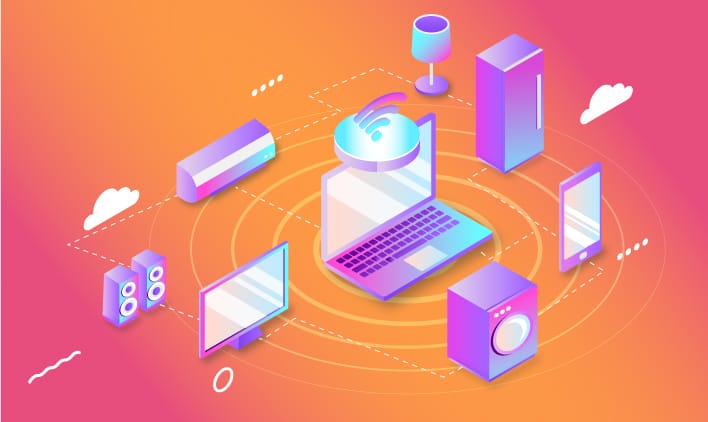
IoT Trends For 2020

CIoT is an IoT ecosystem that assists organizations with improving user experience by utilizing “insight” on users’ Internet-connected gadgets.

The customer IoT market is active for the last five years and is giving indications of slowing down. The Industrial Internet of Things on the other hand will start getting more attention as more and more companies start building modern industrial systems that want the adoption of IoT. Utilizing industrial IoT can decrease the probability of unexpected episodes in data transmission, information processing, or centralized administration.

3. Smart homes will become a norm

Smart Homes Will Soon Be The Norm, Not The Exception - Inman

Even people who discarded smart homes as devices for pretentious youngsters are now finding it difficult to ignore the capabilities the technology comes with. While it started with a steady growth, the demand for connected home devices will see a sharp rise in the years to come.

This demand, in turn, will increase the need for the manufacturing of connected electronic devices.

4. Cloud & edge computing 
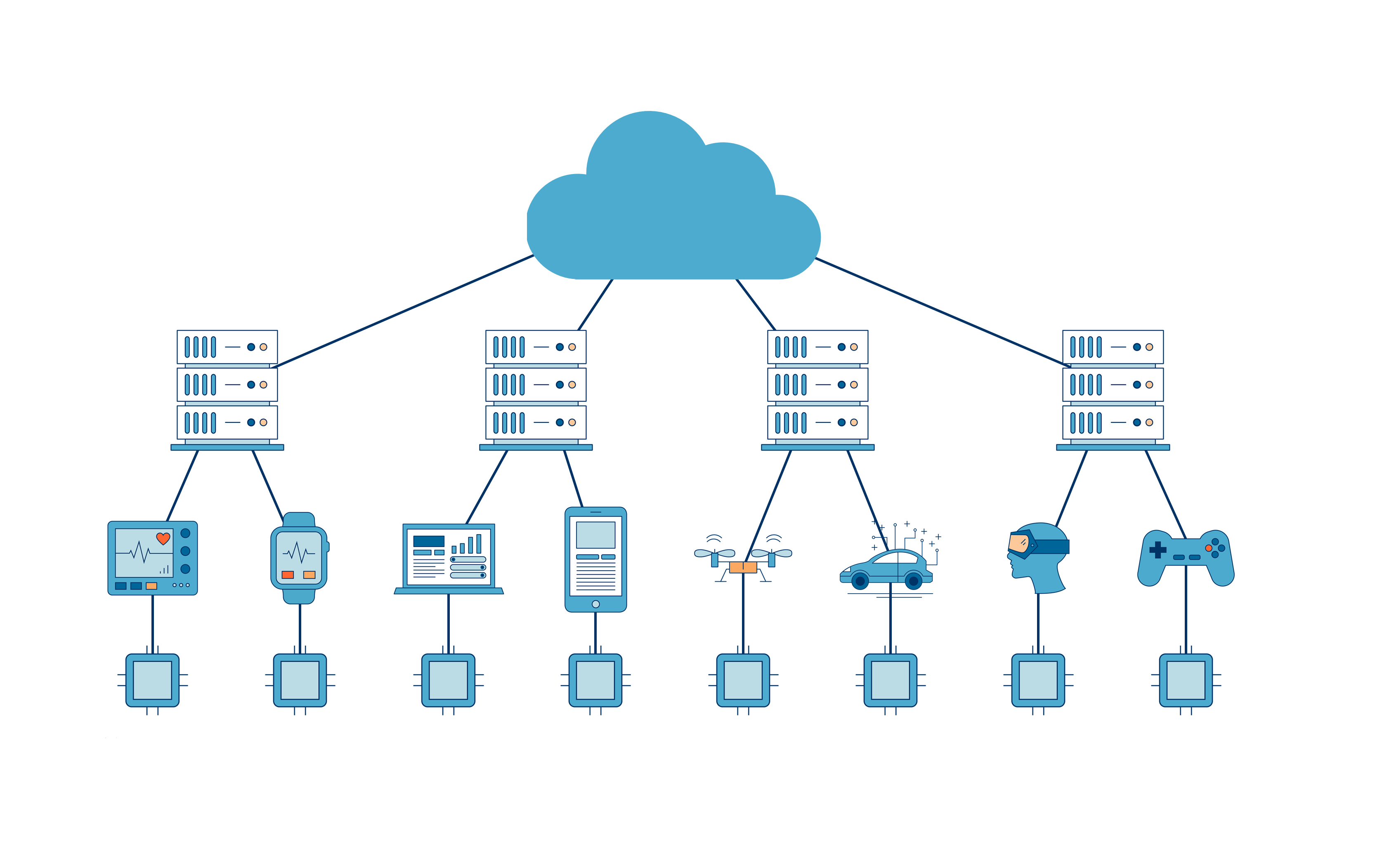
The Edge Computing Ecosystem: From Sensors to the Centralized Cloud - CB Insights Research

For a long time, the IoT devices have been relying on the cloud for storing their data. But the IoT application development industry has now started wondering about the implications of utilizing storing, calculation, and analyzing data to limit.

They are demanding that instead of sending the data from IoT devices to cloud, the data should first be transferred to local devices which are closer to the edge of the network. This local storage helps in sorting, filtering, and calculating the data and sending a part or the whole data to the cloud, thus reducing the traffic to network.

Edge computing offers a series of benefits to an IoT application development company and developers, which makes it one of the key emerging trends in IoT technology –

  • Better management of large amount of data which every device sends
  • Lowered dependency on cloud helping apps perform faster with reduced latency
  • IoT based mobile apps consumes less bandwidth.

5. A greater focus on IoT security 

10 Biggest security challenges for IoT

With the adoption being on a rise, more and more devices are getting connected to the Internet of Things. And as the network is expanding, the volume of data is also expanding and there is more information which is at risk.  In fact, the security vulnerability has also become a prominent answer of what are the challenges in IoT domain.

This greater use of IoT tools and technologies must be accompanied with a greater boost to IoT security awareness and training. The year to come will see machine to machine authentication overlapping, biometric logins becoming a norm, and technology combinations like IoT and big data, machine learning, and artificial intelligence being used to eliminate data infractions.

6. Greater personalization

Tips for Greater Personalization | Simantel

There would hardly be any industry left which has incorporated IoT in its offerings and is not taking advantage of personalization. With the help of beacon and sensors, the retail domain will be able to deliver next-level service offerings, through the use of IoT technology. Likewise, sectors like Healthcare and Edutech will also be able to deliver customized value offerings to their end customers.

This time can also be seen as a golden period for marketers looking to make a unique impact on their customers.

7. Incorporation of artificial intelligence, big data, and machine learning 
future-medical-technology-controlled-by-ai-robot-using-machine-learning-artificial-intelligence - The Arab Hospital Magazine

There was once a time when the goal of IoT was to collect data coming in from multiple sources. But today, the intent has become to not just collect data but also extract useful information from it.

Incorporation of next gen technologies like Big Data, Artificial Intelligence, and Machine Learning will define the trends and implications of IoT in the coming time.

Using the data analytics tools in the connected devices, businesses will be able to decisions around both predictive and preventive measures. And soon it will become a part of the latest IoT trends, both of the present time and the future.

8. Blockchain for IoT security and BaaS will become mainstream

IoT and Blockchain: Challenges and Risks

Although an extension on the security section, the integration of IoT and Blockchain deserves special attention of Blockchain development companies.

There are some pestering issues that IoT faces which have been adversely affecting the overall IoT growth trends and its mass adoption – Scalability, High Cost, Security, etc. being a few of them. A majority of these issues can be traced back to the centralized network.

Being centralized, there is minimal to zero guarantee in terms of security, especially since the data is held by a specific party.

Blockchain, being decentralized eliminates the issues of lack of security and control being with one party. The plethora of benefits that the combination of IoT and Blockchain offers makes it one of the important trend in IoT technology.

9. Smart cities will start flourishing

Five Technologies that any Smart City Needs to Cater - BW Smart Cities

What has been lying in the background for some years now, Smart Cities will become a thing of reality in the time to come. 2021 and the years to come will see the inception of several internet of things applications, which would be directed at improving environmental, social, and financial elements of urban living. The tech spending directed towards smart cities and the efforts to build IoT architecture, which is anticipated to reach $80 billion by 2050 will become a prime ingredient in the goal to improve the quality of living and sustainability.

10. SaaS will emerge as a norm
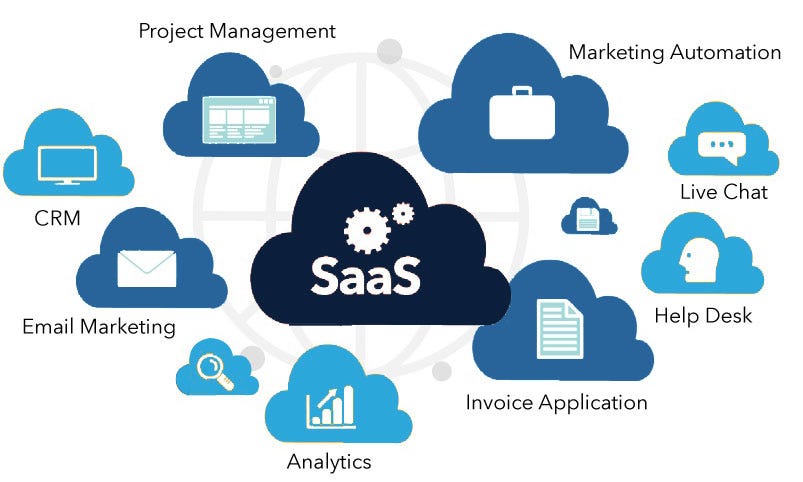
Saas, Paas, & Iaas- Decoding the 3 Cloud Computing Service Models | by Cuelogic Technologies | Cuelogic Technologies | Medium

It is impossible to talk about the technology without mentioning the benefits of cloud computing in IoT. By making data accessible in real-time, SaaS will find itself getting explored by a number of businesses as part of IoT trends 2021.

The time to come will see more cloud vendors coming in the picture for becoming an active part of the dependency that mass IoT adoption will bring alongside.

11. Unified IoT framework 

IoT Platform - For All Your Virtual Security Solution Needs!

The absence of a unified IoT framework is something that has been a major challenge for the IoT industry for a long time. The fact that not many companies work around a shared central platform, affects the adoption process to a huge extent.

Solving the issue through Blockchain will be one of the major IoT trends 2021. Blockchain driven ecosystem will bring all the data in one place with a decentralized operation model where the information will not be in control of any one entity.

12. Increased consumer adoption

What is Product Adoption? 4 Examples to Increase Adoption

One of the prime IoT market trends and the time to come will see IoT being used for not just personal or consumer based use but also industrial use. A validation of this can be seen in the numbers that the IoT connecting devices were set to grow to over 3.7 billion by 2019 and to over 50 billion by the time next year ends.

While the consumer based adoption of IoT is well talked about, we will look into the industrial internet of things in much detail in the next section.

As of now, the future of IoT lies in worldwide adoption.

13. Location tracking and wireless sensing will become a lot more relevant 

One of the major IoT Mobile App Development Trends will be seen in efficient tracking of location and wireless sensing.

With 5G prepared to come on the forefront, apps will get new capabilities on these fronts. According to Gartner, wireless sensing will be used for the creation of drone and virtual assistants, in addition to being helpful in object recognition, and medical diagnostics.

14. Greater efficiency and personalization in customer service 

The Importance of Personalization in Customer Service | by Kritagya Pandey | Becoming Human: Artificial Intelligence Magazine

There are several use cases of how is IoT shaping up the future of better customer service. Operative majorly at the back of IoT and Big Data convergence, customer experience is poised to become a lot more personalized in the coming time. The combination of both is what would help in achieving true omni-channel customer experience, which is a need of every modern day business, irrespective of what industry they belong to.

15. Voice will become the new mode of communication

16 Types of Modes of Communication with Examples - Leverage Edu

Voice search, while already extremely hyped in the market, will see new demand flourishing this year. This time, it will be around IoT devices – for summoning them, connecting them with other devices.

This operation has majorly been done by algorithms, but from this year, you will see the operation becoming voice centric.  

16. Predictive maintenance will witness a rise

Using predictive analytics in health care | Deloitte Insights

The next-gen manufacturing tools will make use of built-in sensors and advanced programming for performing predictive analytics and forecasting the potential issues much before they actually happen.

This will not just lower the downtime but the data based predictive analytics will also eliminate guessing games from the preventative maintenance strategies. It will enable engineers to schedule and then initiate maintenance when the machines are dormant.

17. Automotive revolutionizing interaction between cars and people

SMART CAR – Revolutionizing the future of car technology

The employment of IoT in the automotive sector has brought in a vast development in the field of fleet management, connected cars, maintenance systems, and in-vehicle infotainment and telematics.

An idea of auto cars is basically based on the establishment of the IoT, autonomous vehicles are about connectivity. This implies that the vehicle is remotely controlled by IoT and automated vehicles are a forthcoming entity.

IoT car support system assists an individual to take essential steps to prevent the parts of the vehicle/car from abrupt breakdown. Like dashboard indicators of a vehicle, this framework alarms the driver about the possible breakdowns. In any case, the alarms are sent to the driver’s phone, before the issue even happens. This assists the driver with making cost effective and efficient strides to evade component failure while driving.

18. Better workforce management

Why You Need Better Workforce Management for a Productivity Boost

The use of headlights in recording the hours is expected to turn into an ordinary practice. Headlights are normally used to send messages to customers through smart phones. Decreasing the expense will expand the use of beacons in dealing with the work force. Beacons can be utilized to monitor personal and schedule tasks. All the information from these frameworks can promptly be used to populate the solutions of performance management.

Beacons can be generally used to screen the safety of the employee. This applies to circumstances where fitting safety equipment should be utilized. The health sector can utilize signals to screen the activities of doctors, medical professionals and nurses. This incorporates admittance to medical records and the use of medical equipment. IoT is quite possibly the most important subversive methods on the market.

These 18 IoT technology trends for 2021 that you just read are only the tip of the iceberg. The adoption of the technology would go above and beyond when it comes to changing the lives of millions, through connection.

On the note of changing lives, let us look at all the prospective industries IoT would touch in the coming year and how they would become new trends in IoT.

Industries That Will Get Affected by IoT in 2021

Although there are a plethora of industries which will witness IoT redefining their processes, there are a few which will play on in a front foot mode when the emerging trends in IoT are being defined.

A. Consumer electronics 

Supply chain pain points: Consumer electronics

The functionality of the IoT ecosystem depends entirely on the devices it interacts with. While there are already a number of IoT driven consumer devices operative in the market, there will be more to come in the coming time.

Here are some of the device types that will go mainstream in the coming time –

  • Next-gen locks to secure vehicles, home, and other personal belongings
  • Smart appliances which regulate power consumption
  • AI driven thermostats that adjust room temperature according to the weather outside.

B. Healthcare

Support Operation Goodwill & Cheer and Feed Framingham's Frontline Workers This Holiday Season - Framingham SOURCE

The IoT trends in healthcare will touch every single aspect of the sector. IoT implementation in healthcare will affect not just the software but also the hardware systems of the industry.

Several new personal healthcare devices like wearables will enter the market, enabling consumers to monitor their own health. Another Internet of Things trends in the healthcare sector will be seen in several hardware coming into existence allowing medical officials to track staff and patients, while monitoring the medical equipment.

C. Manufacturing 

Manufacturing - Overview, History, Economic Impact

The industry is one of the major sectors to become a part of industrial IoT trends 2021. Manufacturers from across the globe have already started investing in embedded devices for monitoring assets and equipment.

Commonly called smart manufacturing, Use of IoT in manufacturing improved the productivity and efficiency of operations.

D. Automotive

Automotive Suppliers | Siemens Digital Industries Software

Majority of the IoT next six year’s growth will be seen coming from the automotive and industrial sectors, according to an IDC report. The two domains alone would highlight a yearly growth rate of 60% in the IoT sector, solely at the back of the growing number of complexities of sensors which capture data from machines, automobiles, and other industry based assets.

E. Financial service

9 Effective Financial Services Marketing Techniques | DAP

With users opening up to the idea of conducting their financial services on different devices, the IoT trends in the financial domain will become too prevalent to ignore by financial software development companies.

The time to come will see introduction to smart cash points having connected vending machines that would allow consumers to take loan, accept deposits, transfer money, and undertake a plethora of other financial transactions straight from a device.

Apart from new financial models, the IoT trends in insurance industry will come in the forefront with the industry expanding their offerings to accommodate the risks and needs of connected devices and ecosystem.

F. Retail

How Smart Devices and IoT Are Reshaping the Retail Industry

The IoT trends in retail will see the industry seeing physical and eCommerce getting combined. Instead of visiting the stores, consumers will soon be able to try on outfits at home through the power of Virtual Reality. The grocery industry will also witness an overhaul with IoT changing food consumption, farming, and the overall supply chain.

The time to come will witness an Omni-Channel retail, powered by IoT app trends.

G. Energy 
Energy Security | OSCE

The incorporation of IoT in the energy sector will lead to the industry becoming a lot more efficient and streamlined in terms of energy management. The impact of IoT in the energy sector will majorly be seen in the following areas through the mode of smart cities and smart homes –

  • Cost Saving
  • Better energy consumption and management
  • New data source offering transparency in the system.

H. Education and training 

Education and Training | NYS Joint Commission on Public Ethics

The last but very impactful trends in IoT applications will be seen in the training and education domain. In the time to come, IoT will become a very important skill that a modern-day engineer or marketer should understand. Noting the heightened rise, we are going to see more courses lineup aiming at IoT specific studies.

We will also see businesses invest in boot-camp courses within offices to give their employees an exposure of the technology in action.

Challenges Of IoT
An Introduction to the Internet of Things

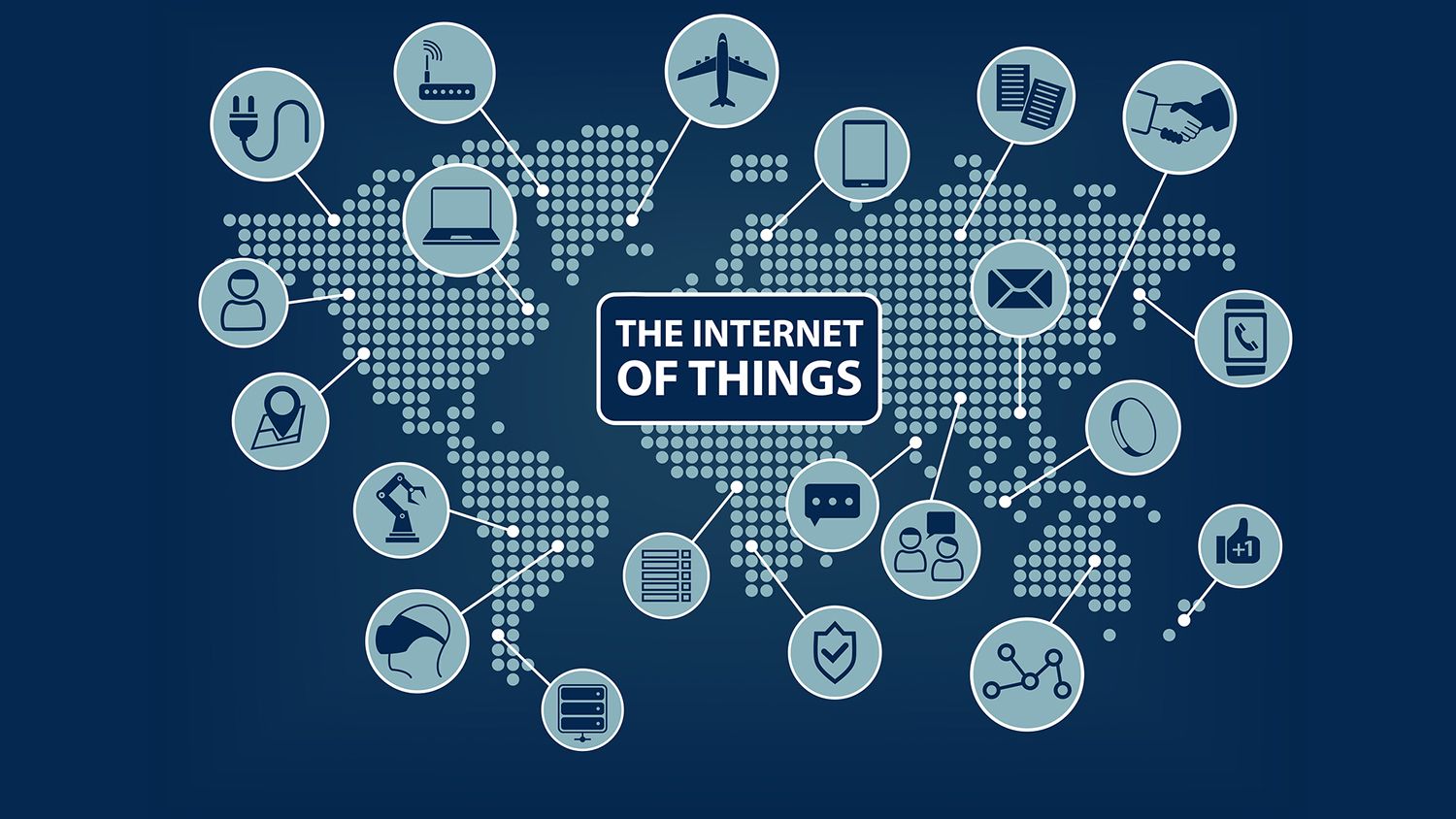
At present, there are four fundamental drivers of the IoT market: the ever-growing Internet connectivity, smartphone devices, and sensor devices with lower costs, great investments are filling the IoT. Also, there are four challenges for the growth of the IoT market: worries about cybersecurity, privacy, application process issues. Innovation is yet scattering.

The Internet Of Things is facing problems in many areas such as IT, Healthcare, Data Analytics and so on. Let’s discuss some of the challenges.

Scalability

Billions of internet-enables devices get associated in an enormous network where large volumes of information need to be processed. The system that stores, examines the information from IoT gadgets should be scalable. In the present period of IoT evolution everyday objects are associated with one another through the Internet. The raw information acquired from these gadgets need enormous information investigation and cloud storage for understanding helpful information.

Interoperability

Technological principles in many regions are still divided. These technologies should be joined to help us in building up a typical structure and the standard for the IoT gadgets. As the standardization cycle is still lacking interoperability of IoT. This absence of interoperability is preventing us to move towards the vision of associated everyday interoperable smart items.

Connectivity issues

In its present form, the IoT uses a centralized, server-client model to give availability to the different servers, workstations and systems. This is very productive, since the IoT is yet in its earliest stages, however what happens when billions of devices are all using the network simultaneously.

According to updated reports from Gartner, more than 20 billion individual units will connect to the IoT by 2021. It’s just a matter of time before users start to experience significant bottlenecks in IoT connectivity, efficiency and overall performance.

Conclusion

While these above mentioned emerging IoT technologies trends will be a good starting point, you will still need someone to help you with getting started with a full-fledged business in the IoT sector. And so, the next thing to follow after being accustomed with what is the future of IoT is getting in touch with an IoT app development company who would hand hold you towards future and next-gen offering.

You can also opt for companies in your area like IoT app development company USA, if you live in the US or any other area where you reside. But you have to be careful while choosing a company or developer to get quality results. Check the expertise and knowledge of the blockchain development company before finalizing any prospect.


PHP vs Python: Features & Comparison in 2021

Python vs PHP in 2021 - Comparison, Features & Applications

Has it ever happened to you that you try to achieve something but the end result was totally unanticipated?

Sometimes good things are an accident – Electricity, Discovery of America, Gravity, and PHP.

Wait, what?

Actually, PHP was never intentionally designed. Rasmus Lerdorf, a Danish software engineer attempted to design an easy common gateway interface by using the C language that would help him track views on his CV. Little did he know what he had created for such a menial task is going to change the face of web applications.

As for Python, the language has its own fan following spread worldwide.

What is there to see is how these two fare when put under juxtaposition. Yes! We are talking about the popular battle of PHP vs Python.

So, why don’t we begin the first round by discussing what they are, individually?

What is Python?

PHP vs Python: Features & Comparison in 2021

Well, of course, it’s not a snake (pun intended).

For real, Python is one of the few best web programming languages for web development that is winning the hearts of many around the world. It is a non-complex object-oriented, high-level, interpreted language, possessing amazing built-in data structures connected with dynamic typing and binding. It is features such as these that make developers choose this language for efficient and effective app development.

What is more, it is a scripting language that is proficient in binding and combining numerous components together. To add another jewel to its crown, it favors cross-platform development, making it ideal for web and mobile app development.

In fact, Python had recently won second place as the most popular language on Github, beating Java to dust and is one of the most loved languages.

Features of Python programming language

Fast in nature

PHP vs Python: Features & Comparison in 2021

There is no compiling in Python, for the programs are added to the interpreter which runs them directly. This is something that happens for the rest of the programming languages. It is very easy and quick to get access to the feedback on your Python code like recognizing errors, etc. Due to reasons like this, Python has the ability to execute and finish the programs speedily in comparison to other languages.

Supports test-driven development

PHP vs Python: Features & Comparison in 2021

With Python app development, coding and testing go hand-in-hand, something that is a tried and tested way to the efficacious development process. Developers are able to develop prototypes of the applications as Python allows them to refactor the code.

Amazing standard library

PHP vs Python: Features & Comparison in 2021

Another probable feature of Python programming language that enabled it to beat Java on Github, is its collection of impeccable libraries. Python’s robust standard library supports the programmers in choosing modules as per the requirements demand. Here every module allows developers to add other multiple functionalities even when the process is about to complete and that too without any additional coding.

Support for Big Data

Support for Highly Scalable Big Data Systems

If you have been looking forward to working on the Big Data technology but aren’t sure what should be in your tool set, then trust me, Python will be all you need to start with. This programming language is being used extensively in Big Data development; simply because it is faster and has a lot of libraries in store, that are in harmony with Big Data.

Highly compatible

A Brief History of Python

Python is the first choice of developers who want to do away with the recompilation process. It is because along with supporting numerous OS like iOS, Android, Windows, etc., it allows developers to use Python interpreters to run the same code on all platforms and even modify it without performing recompilation. And on top of it, it allows programmers to check the code almost instantly when the changes are made.

Advantages of Python 

  • Object-oriented and cross-platform programming language
  • Portable in nature due to WORA functionality
  • Highly readable, making it easy for beginners
  • It is open-source, a feature which makes it easily accessible
  • It is a constantly evolving language

Disadvantages of Python 

  • Slightly in-effective in mobile computing and browsers
  • Design restrictions: Duck-typing may cause run-time errors
  • Delayed testing of web applications
  • A little too simple for certain tasks

What is PHP?

PHP - Wikipedia

Speaking of the name itself, it has a little kick to it. The acronym does not fully describes its full form which is Hypertext Preprocessor. It is also an open-source scripting language (means a script-based program) that is server-side in nature facilitating development for every web app development company.

Additionally, it is possible to embed PHP in HTML to create dynamic web pages for web applications, database apps, and E-Commerce apps. In fact, developers consider it to be a pretty friendly language as it can connect with databases like Oracle, MySQL, etc.

Features of PHP

Highly flexible and scalable

AFS Retail Execution - a flexible and scalable solution to help you win at the shelf - AFS

To be successful, a language should be flexible and scalable enough to give a wiggle room to programmers to have fun, something which PHP clearly offers. It can be easily integrated with other programming languages, namely, Java and others. The components built with this language are reusable.

There are many extensions available to enable different functionalities, that help in defining many kinds of project requirements.

Fast loading speed

X-men - Quicksilver HD wallpaper download

Speed plays a crucial role in making any programming language a favorite of developers. PHP is considered to be a high-speed rendering language as it easily establishes a connection with the database to fetch the requested data in less time as compared to many languages out there in the market.

Supports Cross-platform development

Best 10 Cross-Platform App Frameworks to Consider in 2020

PHP is no way behind Python in catering multiple platforms, i.e, it is also a cross-platform language that helps developers in creating web applications for operating systems such as UNIX, LINUX, Windows, and more. What is more, it also supports Apache and MySQL database.

Loosely typed language

PHP is denoted as a loosely typed language as it supports variable usage without even declaring its data type. It will be taken at the time of the execution based on the kind of data it has on its value.

Error Reporting

40 Best PHP Libraries For Web Applications in 2020

One of the amazing features of PHP is that it has a function that generates a warning notice when something is wrong, allowing the developers to address the issues in real-time.

Advantages of PHP

  • Has an enormous ecosystem
  • Object-oriented and open-source language with an active community
  • Interoperability- has numerous pluggable frameworks
  • Supports first-class debugging

Disadvantages of PHP

  • Threaded and slower execution
  • No Internet of Things community support
  • Limited visibility and control
  • Externally dependent

PHP vs Python: Battle begins

Now, let’s see how Python Compares to PHP and vice versa.

1. Performance and speed

How to test your Internet speed, and which package is right for you – Stephouse Networks

Speed is often synonymous with great performance in web applications. And in the case of PHP vs Python performance for web applications, it is no different.  It is crucial for web apps to perform error-free while processing millions of requests at a time. PHP is considered to be much more effective at speed. Though PHP 5.x was fast, PHP 7.x broke its own records, leaving average Python programs to dust. It completes the tasks almost 3 times faster.

2. Syntax and code readability

Python vs Java: Who Is Winning the Battle of Codes? | by R Sharma | codeburst

Syntax plays a prominent part as a point of difference between PHP and Python. To be brief, the syntax of PHP kind of resembles that of the C language. The programmers have to be careful and need to use curly brackets, operators, and additional characters. What is more, developers can also ignore the white spaces while the compilation is on-going, bringing the additional usability that will assist in structuring the code into logical components.

As of Python, the syntax is made on the separation of codes with spaces and tabs, expediting the process of coding to a great extent. Moreover, Python’s syntax is readable which makes it easy for beginners to learn it effectively.

3. Price

It is a good thing that both languages are open-source which means nothing but that they are free to use. In fact, developers have advocated that these even though free in nature, maybe better than some of the paid frameworks.

4. Library Support

What gives Python an edge in the battle of PHP vs Python 2020 is that it has exceptionally extensive and well-developed library support for all types of applications developed using Python. Some of the most preferred libraries that developers use in Machine learning development along with others are TensorFlow, Theano, Scikit, etc.

Though PHP is lagging behind, it also has packages repository “Packagist” that is pretty popular among the developers.

5. Web frameworks

Web application framework: What it is, how it works, and why you need it

Both PHP and Python have loads of responsive and incredible web frameworks to start with. For Python-based web frameworks, some that stand out the most are Django, Bottle, CherryPy, Pyramid, and more.

As for PHP-based web frameworks, we have Laravel, Codeigniter, Zend, Symphony, and so on. As both Python and PHP programming languages provide a pretty good variety of choices to the developers, beginners are still a little bit more inclined towards Python’s Django framework because it is mighty fast.

6. Debugging

To give you the verdict on this point of comparison of PHP and Python before even diving deep into it, we have to say that it is a draw.

You ask why? Well, if Python has “Python Debugger” (PDB), a well-documented and facile debugger, then PHP has its “XDebug” package; both offering the most basic debug features – stacks, path mapping, breakpoints, and more.

7. Front-end feasibility

Web programmers also look forward to developing the layout or the front-end of their websites and portals using numerous effective tools along with languages like Bootstrap, CS, Angular, etc. Python here provides numerous opportunities for the developers to adopt the same techniques and later combine it with Python code by employing frameworks.

This way, designers can easily design websites, whereas the backend developers find it easy to use via a much subtle and understandable language like Python. So, definitely, Python here wins over the PHP.

8. Usability

Small Business Website Usability

It is prominent to consider the architecture of the languages before we conjecture anything in favor of either language.

The fact that both Python and PHP are object-oriented translate into that they compress code modules containing some functions and data in objects. So, any developer who is even a little bit familiar with object-oriented programming can use either of the languages.

9. Maturity

Website Usability Testing: How To Get Started Today | Hotjar Blog

On the grounds of maturity, Python is inevitably the winner since it was first introduced in 1989 by Guido van Rossum and released in 1991. Its latest update 3.8.0 was released recently on 14 October 2019. It is the most mature and secure among the technologies which make the fundamental building blocks of the intricate mosaic that is the IT industry.

As for PHP, it was created in 1994 by Rasmus Lerdorf. Though not as mature as Python, it still has created a still in the market with its features. The very first manifestation of PHP was a simplistic set of Common Gateway Interface (CGI) binaries that were written in the C language. The latest version of PHP is 7.2.7.

10. Package Management

Speaking of Python, its package managers are effective in organizing the code and keeping the backups along with the version numbers. It helps the developers track their progress while helping businesses perform regular updates on the activities.

As of PHP, though is package management, however, it doesn’t match up to the PIP, a tool to manage and install Python packages. It allows developers to install, upgrade, and even uninstall while using a wide range of sources for external as well as internal libraries.

11. Market Popularity

Market share importance for businesses

If you want to judge or compare two things, market popularity tops the list of points of comparison, because it indicates why developers and programmers love something.

Looking at this graph above we can surmise that Python is the most searched on the web in the US as compared to PHP.

It has been observed that 7,212,664 websites have been developed using PHP, and as for Python, the number amounts to be 146,702. What is more, PHP is leading in countries like the US, Japan, Germany, and other 150+ countries. In a survey by w3techs.com, as you can see in the graph, it is evident that as of May 29, 2019, PHP was the most popular language based on traffic.

12. Versatility

Python in comparison to PHP is evidently versatile in nature as it is an ideal choice for developing websites integrated with Machine Learning and AI. It comes with an abundance of libraries that support these technologies and facilitate their integration into the web apps.

13. Well-thought-out design

24 of the Best Mobile App Design Tools | BuildFire

While comparing PHP vs Python for backend, we found that Python, as compared to PHP, is fairly easy to grasp. Python has a well-thought-out-design (refers to the method used to insert code) than PHP. This means that developers find it easy to program for backend with Python than they do with PHP. It is simply because Python is a flexible yet robust programming language, something that PHP lacks.

14. Documentation

Importance of Project Documentation in Project Management [Updated]

Well, it is a draw. Both languages have an abundance of documentation spread across the internet. Any beginner can easily find resources and documents related to any aspect of these languages and can get answers to even the most complicated queries- All thanks to their communities.

15. Environment Management

Speaking of environment managers, Python is extremely lucky in this regard. There are some terrific breed applications to manage the environment. One such example is Virtualenv – a system that is used to install and use numerous versions of Python simultaneously and switch them as often as needed with ease.

Though PHP also has an analog for Virtualenv known as VirtPHP.  However, it is advised to use containers.

16. Learning Curve

Starting with PHP, being a straightforward language, it has a fairly low learning curve. It is ideal to learn PHP for short-term projects, but if you want to learn something that gives long-term benefits then Python is your match.

Though on its own PHP is easy to learn, however in comparison to Python, PHP has a steep learning curve for Python is the most readable and easily comprehensible language. It is because the language uses a much simpler syntax.

17. Community Support

Community Support – The SpiritTech

Both languages enjoy the support of active communities. It is a crucial aspect for a beginner to consider before committing oneself to a particular language, simply because the learning process is full of doubts and queries and having strong support resolves half the issues.

However, we have to admit that community support of PHP is outstanding, given how actively they have been deprecating the language’s outdated aspects.

18. Salary and Job opportunities

Salaries | Indeed.com

While considering the payscale of both languages, we found that Python developers, on average, make somewhere around $120,024 every year in the United States. Whereas, PHP developers make an average of $86,017 per year.

In fact, you can see in the image above that Python developers, globally make nearly $63k, whereas PHP did not even make it to the list accumulated by Stack Flow.

Final Thoughts

To end this discussion, we would state the most obvious – both languages are differently capable in all aspects. One may surpass the other in one aspect and may lose in others. They both have their own set of features and functions to perform.

They are a paradox in themselves; there are many similarities between PHP and Python,  and at the same time are dissimilar as well in many aspects.

Nevertheless, Python has emerged to be the winner in most of the comparison points such as documentation, job opportunities, salary, etc. So, it is up to an individual which one they choose based on their requirements.

Hey! Avoid these React Native App Development Blunders


Is React Native A Healthy Investment For Mobile App Development? | Hacker Noon

With over 1.6k active contributors working to make React Native a success, the glitter of a bright framework future has not gone unnoticed by developers looking to make a name in the cross-platform world.

The demand of app development with react native is getting from the developers is not just the doing of the fact that the industry has grown to an extent where it is now comparing Native and React Native modes of development. The demand is also driven by the constant updates that makes the framework advanced.

This demand, though, can only go so far. Ultimately, on a ground level, developers will have to learn their way around the development process. Especially on the front of understanding and avoiding React native app development mistakes which can ruin the users experience and their skills.

We have divided the article into four sections to ease the process of getting accustomed with the errors occured during React Native app development and know what it would take to become a developer that commits minimal mistakes.

Why do Developers Love React Native?

1. Because React Native uses JavaScript

Online javascript tutorial for beginners step by step

JavaScript is one of the languages which a developer starts their career with. And so they have a very detailed resemblance with the subject matter. The fact that React Native relies heavily on JavaScript brings down the learnability curve to a great extent.

2. They get to build native applications

10 Benefits of Native Mobile App Development

Even though the developers work on JavaScript, they don’t use web view for rendering React Native components. The one reason why you should choose React Native is because it renders real native elements, giving developers the flexibility to use platform specific components such as activity indicator, which gives very platform a recognizable, native-like* feel.

*It is impossible for a cross-platform developer to build fully native applications. The difference will be extremely visible on the UI and UX front.  

3. A straightforward installation process

How To Install WordPress | Web development design, WordPress web design, Web design

The installation method must always be direct, i.e. minus any complicated steps. The React Native framework can be installed through the Node Package Manager, which is extremely easy for developers with JavaScript background to follow. And even if you lack the understanding of JS, React Native will prevent you from the hassle of downloading binary from the source.

4. Greater productivity

The Secret to Greater Productivity

The key to building app faster lies in the developers’ productivity levels. While the reliability on JavaScript already makes the process easier, it also comes with a live reload feature and the freedom to use any IDE or text editor of their choice.

5. Strong community backing

Platform Engineering as a (Community) Service

React Native has gained a lot of popularity ever since its launch in 2015. Developers and businesses from all across the globe and industrial background have chosen to go with React Native at the back of the plethora of benefits it offers.

This high demand has in turn resulted in the creation of a strong widespread community working on adjusting the React Native pros and cons on a daily basis.

6. It is truly cross-platform

Best 10 Cross-Platform App Frameworks to Consider in 2020

When we say React Native is a cross-platform app development framework, we don’t just mean using React Native for mobile app development. Using React Native, developers get to expand their skills to smart TVs, smart watches, Windows devices, and even VR headsets.

Even amidst these and several other un-mentioned benefits of React Native development, there are some challenges that inherently come associated with React Native app development. Challenges that experienced developers have come to accept and work around. To eradicate the challenges, wherever you are located, be it Los Angeles, New York, etc, it is advisable to hire a company with app development with react native in New York to build and develop custom react native apps with the latest features.

The thing to note here is that these challenges that you are going to read next in no way imply that we are against React Native. It simply implies that like any other in the process to be perfect framework, there are some prevalent React Native limitations as well. There are in fact, several considerations to be made when developing React Native apps 

Challenges Associated with React Native App Development 

1. Dependency on Native app developers

Android Developers Blog: Native Dependencies in Android Studio 4.0

Noting how JavaScript works, developers sometimes have to rely on native developers as well. Especially when you have to put heavy computational operations in the application. These apps type force developers to offload computation to the native part of app, which in turn requires a native developer.

2. Limitations in Abstraction Layer

Promises and Limitations: Translating Microbiome Research to Practice - AGA Perspectives

In order to add more functionality in the React Native apps, an abstraction layer is added on native platform. Abstraction Layer in itself comes with some persistent issues – the issues to avoid in React Native app development – like:

  • Identifying bugs which gets encountered in the abstraction layer is extremely difficult.
  • High dependency on third-party services and libraries
  • Dependency on implementing custom designs

3. Zero support for multiprocessing or parallel threading

Multithreading VS Multiprocessing in Python | by Amine Baatout | Contentsquare Engineering | Medium

React Native comprises of a single Javascript thread because of which developers might observe slow performances when they want to execute any processes in parallel.

4. iOS deployment is particularly difficult

Apple reimagines the iPhone experience with iOS 14 - Apple

In case of React Native, developers find it particularly annoying when they decide to test their iPhone app on any testing services besides Apple’s Testflight, especially since they will have to deal with issues of obtaining provisioning profiles and necessary certificates.

The process is not very difficult on Android though, as it is very smooth and hassle-free to test and deploy Android apps.

As mentioned before, React Native, like any other framework doesn’t come free of challenges. It ultimately comes down to the experience of the developers. For a newbie or less skilled react native developers these challenges would appear as deal-breakers, while for skilled developers it won’t.

The only difference that stands between a skilled and unskilled React Native developer is the knowledge of mistakes that should be avoided in order to build an error free React Native app.

What makes React Native challenging for some is not just the inherent framework limitations but also the React Native app development mistakes that developers unknowingly commit. 

The 7 Common React Native App Development Mistakes

1. Wrong estimation

Missing the Target - The Friends of Israel Gospel Ministry

  • Layout for iOS and Android version – Yes there will be a number of reusable components, but there could also be different layouts. In fact, the mere structure of an application page can be different on iOS and Android completely.
  • Forms – you should estimate the validation layout as well. When you create app in React Native, you are supposed to write more codes compared to when you create a Hybrid app on suppose Cordova.
  • If creating Web app – You should check all the different endpoints which are offered by the backend. And because you will have to handle the logic in the app, it should all be coded correctly. You should understand the database structure, how the entities are connected, etc.

[ALSO READ: Top Local Databases for React Native App Development {A 2020 List} ]

2. Wrong redux store planning

The only introduction to Redux (and React-Redux) you'll ever need | by Hristijan Stevanoski | JavaScript in Plain English

As a developer when we get an innovative project, we focus more on planning the app layout and less on the data handling part of it.

Redux helps in storing the data correctly and managing, debugging app states. When planned right, it can be a powerful tool for managing the app data. When not, it can mess up many things.

Another point to not in case of Redux app development is that is not extremely suited for small projects. Even small changes will ask you to write long lines of codes. So, it’ll be better if you choose to go with it for large scale applications and avoid it when choosing React Native for startups.

3. Not reading external modules’ codes

Have you tried Pylance for VS Code? If not, here's why you should. | by SJ Porter | Towards Data Science

It is not uncommon for us developers to save time through external modules. It makes things easier and faster, especially since they come with documentation.

But, most often than not, modules break or they might not work as anticipated. This is the reason why developers should read the code and treat the step as one of the React Native best practices. Doing it helps to know what is wrong with the module and even how it can be solved.

4. Mutation of state inside render function

Upgrade/Migrate your Vue 2.x projects to Vue 3.0 | by Jonathan Ma | Medium

The image above highlights how the Datastore and View are interconnected. The datastore contains all your data in component and the view is rendered on the basis of state. It then consumes new state from data store and shows it on the screen.

In order to achieve that, React has a setState() function where the new object state is taken and compared to the previous state.

Finally, a new state is added after merger with the previous state and sent to the state datastore.

This cycle is available all throughout the lifetime of a component when you develop application in React Native.

Now, if you mutate the state directly, the lifecycle gets messed up and it corrupts all the previous states. This leads to app behaving abnormally or even crash. This will also result in you losing track of the states across component and will lead to you writing custom code in place of React. Additionally, you’ll end up having an unmanageable code and a heavy app.

5. Left “console.log” statements

JavaScript Basics: Console.log(). Today we are going to learn the basics… | by Erica N | Level Up Coding

Console log statements are extremely handy. They even provide help with debugging the app execution. But what happens when you leave the log statements in the app?

This can turn out to be a serious issue if you keep the render methods and logics inside, especially those which are asynchronous for they can lead to a bottleneck in JavaScript thread. All this ultimately leads to the application becoming slower.

6. Using stateless component for gaining React Native performance

Stateless Component vs Pure Component | by Vikas Singh | Groww Engineering

Some developers still think that what was true before React 16 is true even now.

Stateless component basically means that the component does not extend any class. It basically takes the argument as display and props in the DOM. It comes with benefits like –

  • Easy testing ability
  • Fast implementation
  • Does not use state or the local variables

With the time changing, it has today become wiser for developers to use pure component when they create React Native apps. Here’s why –

  • Performs shallow compare – This is a special win for complex UI applications as it lowers the render operations. The reason behind it is that it comes with a life cycle method known as shouldComponentUpdate which automatically does shallow comparison and then check if re-render is needed. In case of stateless component, re-render happens when parent component re-renders. But in the case of pure component, re-render only happens when a change is detected in the states or props.
  • Performs side effects – Developers can even send AJAX request inside componentDidmount or can perform some other DOM operations.

7. Not optimizing React Native images

React Native Image Performance. For the second installment of this… | by Adam Stanford | Medium

Optimizing the images in apps built with React Native should be a high priority task. It helps to resize the images locally and then uploading them to cloud storage like the s3 by server and getting the cdn link which then can be returned using API.

Following this process, helps make the image loading process fast.

While these are only 7, there can be a series of others as well. As a developer, your ultimate aim should be to make as few mistakes as possible.

Let us conclude the article by looking into what it would entail to become a developer who doesn’t commit these React Native app development mistakes.

How to Become a Mistakes-Proof React Native App Developer?

First thing first, there is not even a single developer on planet Earth who doesn’t commit mistakes.

Even developers with 10-15 years of experience commit mistakes. Your aim at the end of this article should not be to become a developers who doesn’t commit mistakes. It should be that you don’t commit the React native app development mistakes mentioned in the article and ones which are generally categorized as common in the mobile app development industry.

There are two ways to do that. Ways to become better React Native app developers –

A. Enroll in courses and keep brushing up your skills

Want to brush up your skills? This is how internships can kick-start your career - Education Today News

Enrolling in courses at the beginning of your career can be a great starting point on the present and future grounds.

Brushing up on the skill is equally necessary for when you are skilled and have years of experience. What happens is when you expand your career and work on a variety of projects, you most often than not lose sight of the technical understanding that you started with. Thus, it always comes across as a plus point to get back to the basics and revise things from scratch.

B. Associate with a company that focuses on training

Top 9 Human Resources Training Courses | AIHR Digital

This part is more valid for newbie developers compared to their experienced counterparts. When you are just starting your career you should associate yourself with a mid-sized company that has Team Leaders to hand-hold you through the practical application of what you learned on an academic level.

The reason I say mid-sized company is because a small sized company usually operates in a time crunch model, so will be working under the expectation that you will be on your A game since the day one. Considering this, it will always be better if you partner with a mid-size business who will focus on your learning.

Knowing the mistakes that can ruin the users experience can be a good starting point for developers who take their job seriously. And another good starting point would be to get associated with a mobile app development company that understands how mistakes are a part of learning and helps you grow.

If you are searching for a company in app development with react native in NewYork, California, Texas, and so forth, send in your queries to sales@appinventiv.com.

FAQs about React Native App Development Mistakes to Avoid

How to Write Effective FAQs: Complete With 10 Best Examples

Q. How do you improve react native performance?

There are multiple ways to improve the performance of your React native application:

  • Avoid unnecessary renders
  • Use PureComponent instead of Stateless
  • Optimize the JSON data
  • Lower the app size

Q. Why use Redux with react native?

Redux tool helps in storing  and managing the data, debugging app states. When planned right, it can be a powerful tool for managing the app data. Although considered beneficial, Redux is best suited for the development of complex applications as compared to simple apps, for the number of codes are higher.


Role of Technology in Real State during Pandemic

The Future Of Real Estate Tech: How We Got Here And What's Next In An Exploding New Ecosystem

For a few years now technology has been a driving force behind innovations in the real estate sector. But when it comes to complete digitalization, real estate tech has not been one of the pacesetters.

A situation that the industry was forced to correct in 2020.

COVID-19 driven traveling restrictions and the fact that it brought open houses to a halt brought the usage of technology to the forefront, marking a new beginning for several real estate tech firms on the way.

As the present situation stands, the longer the pandemic stays, the greater will be the chances of digitalization efforts sticking with the real estate software development process in the long run. For an industry whose technology adoption spotlight was substituting home viewing with a video, the technological advancements in store will be nothing less than a true revolution.

When you look at these forced real estate technology advancements from a real estate tech firm front, will be nothing less than good news. By using next-gen technologies like Blockchain, AI, AR/VR, etc. the proptech industry will be able to keep its growth momentum intact.

Let us, deep-dive, into the state of real estate and technology combination and how it is setting a new trend for the real estate technology startups – one that would continue post-pandemic.

The pandemic has dramatically expedited the merger of real estate and technology in a way that the sector is on the path of becoming contactless and technologically rich. With a plethora of new efficiencies been brought about by technological innovations, the functioning of property management stands to change for the good.

Here are some of the most glaring technologies which are helping the sector sail through the coronavirus crisis:

1.  Automation of business practices

5 Best Practices that Drives Business Values from Test Automation

One of the most important and yet common examples of technology in the real estate industry has been the arrival of automation. Touted as the by-product of artificial intelligence in real estate, automation can be seen across marketing, engagement practices, and business processes. Here are a few automation areas that have risen in popularity during the pandemic:

  • Lead generation through website forms
  • Omni-channel syncing of leads
  • Lead nurturing through drip emails or automated workflows
  • Transaction and tasks management
  • Financial and accounts automation
  • Property inspection automation through Spectora

2.  Virtual home tours

How To Show Your Home During the Pandemic: The Definitive Seller's Guide to Virtual Tours and More - Perfect Agent

By far one of the most loved pandemic-driven technology in real estate industry is the virtual home tour. Going by an AppFolio survey, “71% of property management companies said their priority of virtual showings has increased,” and “64% believe they’re here to stay.”

The technology going beyond 2D photographs, video conferencing tools, and interactive 3D models pose to be a tool that makes COVID showing process an unprecedented success.

Virtual showings come with the value of extending beyond the current climate. It offers prospects greater flexibility in the apartment hunting process. With conveniences ranging from easing schedules, visiting houses in far-away areas virtually, etc. virtual property showing is something that is going to stay.

3.  Cloud adoption

Adoption of cloud computing shows why you need to go for it

The one issue that real estate technology ventures have been trying to solve across the years is the reliance on papers. Streamlining of real estate procedures keeping digital platforms at the center is a grand step businesses could take for continuing to serve buyers/sellers through the stay-at-home orders.

The benefits of this disruptive technology in real estate can be seen in:

  • Reliable security and storage
  • Reduction of operational costs
  • Gives real-time sharing and accessibility feasibility

4.  Streamline paperwork with Blockchain

20 Ways Blockchain Will Transform (OK, May Improve) Education

In a traditional real estate economy, the property management process is considered to be highly complex, especially since multiple stakeholders are a part of it.

Property management can either be done offline through manual paperwork or through independent software. A result of this is that information remains confined to a database – a problem that property technology startups aim to solve.

However, with the increasing role of blockchain for property transactions, the future of real estate can be changed.

Real estate mobile app development done on the premise of a blockchain-based property management system uses smart contracts that can ease the process surrounding signing the lease agreements to complying with filing maintenance requests and cash flow.

A secondary field where a real estate software development company can see Blockchain impacting the real estate apps sector is deed management.

Defect in deed paperwork can make it illegal to proceed with deed management process until the issue is resolved. In case an issue emerges, property owners are liable to pay heavy legal fees ensuring the accuracy of property titles. The application of Blockchain in real estate can be applied here to make the paperwork secure and transparent.

Parting Words

Looking at the future of the real estate sector, technology inclusion would continue to grow and restructure how transactions are conducted, thanks to COVID-19. One key factor that pandemic won’t change however is the need for personal relationships. Property agents, investors, brokers, and lenders must continue to develop their influence sphere. When you partner with a real estate app development company you must keep the human part of the process into consideration.

Andriod’s in-app update API

We all use a lot of apps on our devices these days. One for shopping, one for banking, others for ordering food, booking tickets, buying groceries and what not. But the moment the app shows “a new update is pending” notification, we mostly ignore it. As a result, we miss downloading the latest and important feature which can further improve the experience of the app. That’s the story from a user’s end.But on the developer’s side, the story is a bit different. We want all our users to stay updated with the latest version of the app. We imagine users clicking on the “update now” button and start using the new feature almost instantly. But the harsh truth is that only a few users keep their apps updated with new versions.The reason is because most of the times, users don’t bother about opening play store to update their apps. In other words, they don’t have the interest or the time to open and update the app until the app stops doing certain tasks which they want to accomplish.

Google has come up with the solution to this problem. It offers an in-app update feature to update the app without interacting/opening the play store. With this feature, a user can download the latest features while using the app. So let’s dive in to see how we can use this feature.

The in-app update is available in Android Play Core library, that shows prompt to the user for an in-app update. There are two different ways in which we can prompt our users that an update is available.

How to work with Android's in-app update API? - Stack Overflow

Flexible Flow

If the core functionality of the app doesn’t get affected by the released features then you can use the Flexible Update flow. It allows user to download the update in the background. Once downloading is done, user will be asked to restart the app. Doing so will update the app during the restart process. The benefit of using this Flexible flow is that a user can use the app until the download process is finished. So there is no block time while using the app. User can still use the features as the downloading process is being done in the background.

Immediate Flow

If the core functionality of the app is highly dependent on the released features then you can use the Immediate Update flow. In this feature, a dialog will be prompted to ask the user for downloading and installing updates. The user can’t use the app until the downloading, installing and restarting the app.

Checking if an update is available or not – 

For a good user experience, we should always ask the user to update the app only if updates are available. We can check if an update is available or not from the backend.

For that you can use the AppUpdateManager, which will give the AppUpdateInfo object that contains the information about if we need to show the update dialog or not. The updateAvailability method returns these values for the update state :

UNKNOWN

UPDATE_AVAILABLE

UPDATE_IN_PROGRESS

DEVELOPER_TRIGGERED_UPDATE_IN_PROGRESS

Start an update –

Once you have checked for the updates and in case of updates are available then you can use

startUpdateFlowForResults() to update the app.

We will get the following request codes in onActivityResult.

RESULT_CANCELED : This will indicate that user has denied/canceled for the update.

RESULT_OK : This will indicate that user has accepted the update.

RESULT_IN_APP_UPDATE_FAILED : This will indicate that there is some problems occurred during the update.

So now we know how to use in-app update feature to update the app. It’s a good practice to use the Flexible Flow to update the app when there are very few updates and it doesn’t affect the core functionality of your app. However, you have to make a decision on which flow to use as per your requirements and the kind of app you are making. I hope I was clear and concise in my blog and I hope now you have an understanding of how in-app update API work in Android.

Role of New Engineering Managers

A few months into their new position, engineering managers start agonizing how they hardly get time to do any technical work. They feel they would soon become redundant if they don’t start contributing in the technical areas.I get it, I’ve been there.I remember the constant assault on my self esteem when I was first promoted to be a manager. Most of the things that I had learned to get to that position were all of a sudden..umm…good-for-nothing. As if all my technical chops had implemented an IDisposable interface overnight. Sigh!

If you’re going through the same phase a) please know that you’re not alone, b) understand what has changed.Earlier, as an individual contributor, it was all about  you, you, and you. There were days when you wrote great code and then there were some when you didn’t. It was either 0 or 1. Team’s success depended on you, but you were still a lone warrior.

Anteelo design - How to Become an Engineering Manager | Ohio University

But nothing is permanent. The moment you become a manager, the focal point changes. It’s not about your individual contributions anymore. It’s all about the team now and the work they are producing. You become responsible for the team’s success and failure.

The metrics of your success changes from the world of binary to the world of grays. And when the playing field changes, you need to change your perspective instead of drowning yourself in the sea of self-doubt.

This is why it’s pointless to indulge in the thought of becoming redundant. You can’t become redundant, even if you wanted to, as your job’s responsibilities have changed. You are now akin to a maestro orchestrator who needs to ensure that your team plays the most memorable symphony.

Here’s an equation by the legendary Andy Grove from his book High Output Management to help you see your managerial impact.

A manager’s output = The output of his organization + The output of the neighboring organizations under his influence

The most significant implication here? Technical work done by the manager doesn’t surface in this equation.

So what does this equation mean for you?

Output of your organization > Your individual output

You are only recognized for the quality and speed of your team — your efforts become the sum total of all of your team’s effort. Your contributions are judged and remembered by how well your team is doing.

“A leader is as good as the team.”

10 Characteristics of an Outstanding Engineering Leader

To make sure you get the best out of the team, you have to manage it well. Set the vision. Set the expectations around the desired outcome. Have one on ones with your team members. Give feedback. Seek feedback. Help set the cadence for deliveries. Run effective meetings. Manage the sprints and the plan. Manage the stakeholders. Assess the outcomes. Celebrate. Reflect. And do everything possible that helps a manager manage a team well.

Did you see the time to program anywhere in the above list? Nope.

It’s not that you can’t code or you don’t want to code. Because if you want to you WILL find time for it. But your primary responsibility becomes uniformity of the codebase, making sure the code reviews happen, and the team releases a high quality software.

Output of neighboring organization > Your individual output

You would be a rockstar engineering manager if you were to merely focus on the first part of the equation. You could be even better if you were to cast the spell of your influence on other engineering groups within your organization. Also, your growth within the organization is predicated on this particular variable.

You could influence other groups in different ways. Review their architecture. Participate in their code reviews. Share knowledge about creating better teams and software with them. Run innovation initiatives. Participate in hiring. Suggest new process initiatives.

In a nutshell, make an effort to elevate the overall quality of your entire organization.

Managing a software team vs. being in a software team are totally different things. You need a new Swiss army knife of skills when you get promoted to be a manager. Thus, there isn’t any merit in agonizing over not getting the time to do the technical stuff as that wasn’t the reason you were promoted in the first place.

Are QR Codes Failing ?

QR code, also known as flash code, is a two-dimensional barcode that records information related to an item. It can be read by a QR scanner or a mobile device with a camera. QR codes can have many usages. Scanning a barcode could lead to the  downloading of an application, a link to more information about about a business, or even personal usage like the uploading of one’s resume.

QR Codes are everywhere, on articles, buses, websites, billboards… It is a true form of advertising.  It can be playful, luxurious, or even more dangerous. But it has not yet won its credibility in the eyes of the public. Millions of people are spending their time tweeting, pinning, checking but why not flashing?

An American blogger, Sean x Cummins surveyed 300 people on the streets of San Francisco, showing them the photo of the small square, and asking them if they knew what it was? Only 11% answered “QR code”. The others suggested anything and everything, from the korean military code to the aerial view of San Francisco

The results were similar when surveying New Yorkers. The Brooklyn Museum put a code on the back of its entrance tags that served as an introduction to what visitors might find behind QR codes throughout the building. Every visitor coming in the door gets one of these tags, but only 1.77% of visitors responded by scanning the code.

Although this mobile technology seems great and useful in providing additional content in numerous media channels, its popularity is lacking.

Here is why:  We may be in 2012,  but a large large number of people do not still know what QR codes represent. The reason for this lack of knowledge is the little to no communication on the technology itself.  Previous launches of barcode scanners proved unsuccessful. QR codes must regild to show their great potential.

The problem remains that QR codes do not really bring interest to get flashed. The proposed contents have to bring a real added value to the product or to the communication, send back towards a simple web page without interest and not optimized for mobile bring nothing. And why not directly integrate the reader of flash codes in the camera, as a native app? Now, you must download a third application on the market of your telephone, an application which will not be integrated into your camera.

QR codes are obviously a powerful tool of communication on which it will be necessary to count in the next years. For marketers, QR codes provide a relatively inexpensive way of reaching out to consumers while still maintaining complete control of the resulting interaction. With creativity, the possibilities are endless. It only needs a big advertising campaign to ground the movement. Place your bets now.

International Dating? Choose the ‘Flutter’ app

By only working one day a week, Flutter aims to create a meaningful environment where users form genuine connections and feel empowered to move the relationship forward, and off of the app.

Tired of ghosting and drawn-out conversations? Dating in 2020 can feel like a minefield, especially with all the different dating apps out there. Yet, even when you find an app that you somewhat enjoy, the ability to create a real, authentic relationship can be extremely difficult. Flutter, a new dating app, is trying to change that. Instead of swiping left or right, having a mindless chat, then leaving the app, Flutter is facilitating relationships by only allowing app action on Sundays. This includes viewing, matching, and chatting with other users, with the exception of allowing you to edit your profile on other days of the week.

In late 2019, Clay Jones and Teddy Jungreis founded Flutter, on a mission to create an app that would foster genuine relationships and move away from the more common dating app trend of swiping and never actually connecting. According to Biz Journals, Jungreis explained that “Flutter forces people to exchange information quickly so they can continue to build the relationship off of the app.

While apps like Tinder and Hinge, leave people with “ghosting and mismatches and conversations that fizzle out,” Flutter is for users who want to create a serious connection.

In a unique approach to dating, Flutter only allows users to access the app features on Sundays. It all begins on Sunday morning when you are added to the waitlist. You then have until the afternoon to claim a spot and be added to the dating pool. The user then has access to view, like, and comment on profiles, and a few hours later the matches are released. This gives users a small window of time to make a move before all the information disappears forever. The app is currently offered to users in San Francisco, but they plan on expanding to New York, Los Angeles, and other cities soon.

Flutter is free and has a 4.3/5 star rating in the app store with 91 ratings in total. When Flutter launched to Product Hunt in early March, they received over 900 upvotes, an impressive number that they exhibit on their front page.


Flutter App - Dating Template by RichardCreatives | CodeCanyon

Agile Development: Build Your App

AGILE METHODOLOGY

You finally have it. After months, maybe even years, of failing to envision an app that will resonate with users, you’ve come up with The Really Good Idea: An app that fills a niche no one else has thought of, an app that fills a need users didn’t even know they had.

So, you plan. You decide exactly what you’re going to build, you get funding, you set goals, you track every step, you work an utterly absurd amount of hours, you arrive at your finished product, you release it to the world, and… no one is impressed. Your idea was not the hit you expected; users barely notice it.

Predicting what customers will want is not easy. No matter how skilled your team is, if your Really Good Idea isn’t actually as useful or appealing as you imagined, at the end of it all you’ll have merely wasted time, money, and energy.

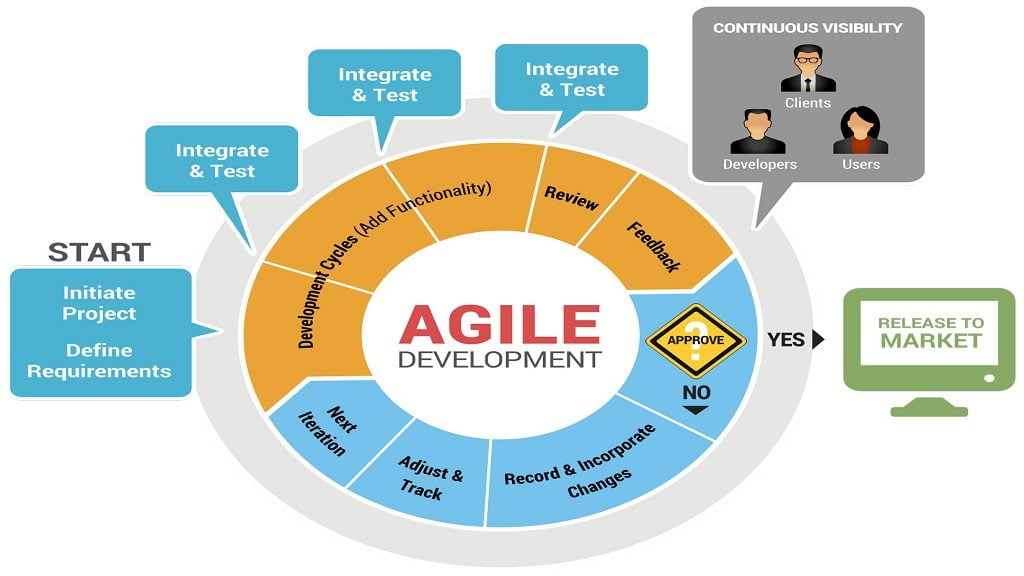
Agile development is essentially an umbrella term for various methodologies such as Scrum and extreme programming (XP), and represents a way of avoiding this fate. The idea came about in 2001 when 17 software developers met up at Utah’s Snowbird resort and shared their ideas with one another about making the software development process more efficient and simple. The result was the Manifesto for Agile Software Development, which outlined a set of principles used to build an app that actually gives users what they want.

WHAT AGILE DEVELOPMENT IS

The emergence of agile development followed a period in the 1990s when teams were striving to create lightweight software development methods. Prior to this, many software development teams followed the “waterfall” model. This process involved following a strict set of steps to arrive at a finished product: Once the product idea was in place, teams would first analyze the software and system requirements necessary to realize the concept. Following that, they would design the software architecture, code, test for bugs and defects, and eventually introduce the finished product.

It’s a process that requires a fair amount of planning and provides little room for flexibility. The problem for app developers, though, is that all that strict regulation, combined with the sequential nature of the waterfall method, means that there’s no way of knowing whether or not users will actually be interested in a product until it is complete.

Agile development, by focusing on incremental goals, rather than just the major end goal, gives developers the opportunity to respond quickly to user reactions and modify plans to build an app that will succeed. By embracing certain key principles, including frequent delivery of software and an openness to change at any step of the process, developers can avoid gambling all of their resources on the hope that the app they are working to build will appeal to users.

THE AGILE DEVELOPMENT PROCESS

Again, it’s important to keep in mind that agile development encompasses many different methodologies. No business needs to use all of them, nor could any one business possibly use all of them. As such, the process varies depending on the project.

That said, there are basic aspects of agile development that are generally applicable. One of these is the idea of “iterations.”

Instead of spending months working to create a complete product, which often involves a tremendous amount of planning and risk, agile app development encourages teams to spend one to four weeks developing basic iterations of an app. At the end of each cycle, the latest iteration is demonstrated. Although these individual iterations are rarely strong enough to bring to market, they allow a business to introduce new features, identify potential problems, and adapt to changing needs more quickly.

While working on an iteration, a common part of the agile development process is a daily meeting in which all team members explain what they did the previous day to reach the goal of that iteration, and bring up any roadblocks they anticipate. However, these daily meetings are usually not meant to be problem-solving conferences. If any problem-solving does occur, it only involves select members of the team, so that other team members can continue working on their piece of the project. In this way, time management and efficiency is preserved during the process.

Although milestones are a key part of agile development, they can be changed if necessary.


How to build an app using Agile Development


AGILE DEVELOPMENT ROLES

There is no one set of roles that all agile development teams adopt. Different methods encourage different roles. However, there are certain team members who are typically involved.

Usually, the development team consists of 10 or fewer people equipped with the skills necessary to plan, develop, and test a new iteration of an app. These teams are usually self-motivated, and although there is rarely a specific team “leader,” there is often one member whose role involves addressing any issues that would distract a team from its task.

Another key player often involved in agile development is a product manager who represents the interests of the customers and stakeholders. Because the development team should be focused on reaching the goals of a particular iteration, someone needs to be available who can make sure that the work being done will actually result in something of value. One of the major principles of agile development is the idea that business owners and developers should be in constant communication, and this person facilitates that.

BENEFITS OF AGILE APP DEVELOPMENT

Building a successful app almost always involves being able to adapt. Your Really Good Idea might have only been the seed for something that customers actually want. As talented as you might be, predicting what will or will not resonate with users is no easy task. Yet, some approaches to software development rely on a team’s ability to make that kind of accurate prediction.

Agile development helps to limit risk by letting teams build apps in increments. Users can test new iterations and provide feedback; additional features can be launched to see if they add to the product; teams can spot potential problems early. They can also identify potentially successful features that they might not have thought of during the early planning stages.

As Fueled strategist Aaron Cohen puts it, “The agile process allows for unparalleled flexibility and customization during the development cycle of an application. While we may be certain of fundamental features and user experiences, the interface details and specific user flows can be tweaked during development should new use cases arise or insights be learned. Our designers often create discrete graphic elements moments before the engineers incorporate them into the codebase, freeing the engineers from reliance upon product level design files and less-than-ideal graphic elements. This is one of the primary reasons why our apps, even our v1 releases, exude such an evolved design sensibility.”

To put the agile development process to use, let’s look at a real-life example: The origin of Instagram is Burbn, a check-in app that you’ve probably never heard of. The team realized it was too similar to Foursquare and as a result, they changed direction, focusing on the photography element of the product. In the world of app development, teams have to be able to pivot when a better opportunity presents itself. But by sticking to a plan that’s too rigid, this can be difficult, if not impossible.
Agile development isn’t about doing away with planning. It isn’t about being unfocused. It’s about making sure your team works in a way that allows it to make those pivots when they need to.

Delve into the world of Machine Learning (ML)

For years, many industries have explored ways to incorporate artificial intelligence (AI) into their services because it provides a competitive edge. Since it is an evolving technology, the exploration of AI has brought about sub-concepts. One of the more significant concepts of AI is machine learning (ML), coined by Arthur Samuel in 1959 as “the field of study that gives computers the ability to learn without being explicitly programmed.”

MACHINE LEARNING

So, let’s talk a little more about machine learning and what it is. Just as Samuel described, machine learning is a subset of AI where computer algorithms are used to automatically learn from data and information, without being explicitly programmed.

By learning from data and information, the system is able to change and improve its algorithms on its own. The learning algorithm enables the system to identify patterns in observed data and build predictive models based on the observations. Because ML is used in situations where perfection is not expected, the goal is not to achieve perfect predictions but to achieve predictions that are good enough to be useful.

Just like the rest of the tech world, machine learning is not a simple concept. It’s important to note that the concept of ML is broken down into smaller subsets based on how much data the system is provided: supervised learning, unsupervised learning, and reinforcement learning. The type of learning is determined on if the information it’s fed is labeled or not.

PREDICTIVE ANALYSIS
The most popular application of ML is predictive analysis, which uses historical data to make predictions or recommendations for future events. You know how your phone starts to provide suggestions of words to use as you’re typing out a text? That’s predictive analysis at work. The system has recorded patterns of the words you actively use in order to provide suggestions for responses in the future.

Predictive analysis is used across a multitude of apps, like e-commerce, social media, finance, and even transportation. E-commerce apps use predictive analysis to provide consumers recommendations for other products to consider purchasing. The system detects patterns in items that are commonly purchased together and generates suggestions based on these patterns. Social media does the same, but instead of suggesting products, it recommends people to follow. As mentioned earlier, the system collects demographic data from users and (using unsupervised learning) creates patterns to make these suggestions to users.

There are tons of budgeting apps that will use your banking information (after giving permissions to link) to help you manage income and spending. The system analyzes your transaction history and detects patterns to offer appropriate suggestions for spending. That maps app you use to find the best route to get from work to home uses ML, too. The system records past traffic patterns associated with the time of day to provide recommendations for your commute. ML is in use all around you, and you may not have even realized it until now.

You’re probably asking yourself how the system undergoes training. The type of ML that you’re trying to use determines how much training the system has to undergo. The amount of training for the system is determined by how much data is initially provided to the system. Data is the center of ML, without it, the system wouldn’t know how to do its job. Before we dive into why and how we use the different types of ML, let’s talk about what they are first.

SUPERVISED LEARNING

Supervised learning is the process of ML when the system is initially provided data where the algorithm’s inputs (x) and their respective outputs (y) are correctly labeled. Because the input and output data are labeled accordingly, the system is trained to recognize patterns in the data with the algorithm. In future scenarios, this allows the system to receive inputs and produce correctly labeled outputs based on the pattern. Supervised learning is beneficial because it can be used to predict outcomes based on future input data without human interference, like when social media automatically recognizes someone’s face after you’ve tagged them in a picture. When you tag your Aunt Sally in a picture (y), social media stores the facial features of Aunt Sally (x). When you upload pictures of Aunt Sally in the future, social media recognizes her facial features (x) and automatically tags Aunt Sally (y).

UNSUPERVISED LEARNING

In unsupervised learning, data is fed to the system, but the outputs are not labeled accordingly like they are in supervised learning. Unsupervised learning allows the system to observe the data and determine patterns with the information it is given, rather than being trained to recognize the pattern. Once the system has stored the patterns it created, future inputs are assigned to a pattern (created by the system) to produce an output. Unsupervised learning is beneficial because it can show patterns in data that may have been overlooked when observed by humans. Unsupervised learning is used when social networks make recommendations of friends to follow; these recommendations are based on patterns created by demographic data individuals share online. If you went to University X and studied calculus, the algorithm is trained to recognize and recommend other individuals that went to University X and studied calculus as people you may know.

REINFORCEMENT LEARNING

Though it is a separate classification, reinforcement learning is a type of unsupervised learning. Similar to unsupervised learning, the data provided to the system is not labeled, so the system is left to create its own patterns. Where reinforcement differs from unsupervised is that when a correct output is produced, the system is told that this output is correct. This type of learning allows the system to learn from its environment and its experiences to explore a full range of possibilities. It is quite literally, learning through reinforcement. When Spotify makes a recommendation for a song (based on a pattern it noticed in your music selection) you are given the option to “thumbs up” or “thumbs down” the recommendation. When you indicate “thumbs up” or “thumbs down,” Spotify utilizes reinforcement learning because it’s learning your music taste based on what you tell their system.

MACHINE LEARNING APPLICATIONS

Why all the hype about machine learning? Well, because it is the next step in achieving artificial intelligence, and is a big step for app developers. ML gives apps the ability to improve and adjust based on user data, without developers influencing it to do so. This technology is saving time for developers (which saves you money) by enhancing the user experience with accuracy on what users want. While there is a multitude of uses for machine learning, two significant ones are image processing and predictive analysis.

IMAGE PROCESSING

Image processing is a very common application of ML, one that you probably see every day. It is used through supervised learning where an algorithm is used to detect various objects in a given image. Much like a child is taught that shapes with five sides are pentagons, the machine is taught to recognize objects in images. The machine is trained by providing a set of labeled images containing different objects; when given future inputs, the machine will identify objects within those inputs and label them. Apple’s Face ID feature is an example of image processing; when you set up Face ID, there is a series of steps you undergo to train the system (iPhone) to recognize your face. These steps include taking photos of your face from multiple angles so the system can analyze your face store this data. After being trained, the system recognizes your facial features as a means to unlock the phone.

PREDICTIVE ANALYSIS

The most popular application of ML is predictive analysis, which uses historical data to make predictions or recommendations for future events. You know how your phone starts to provide suggestions of words to use as you’re typing out a text? That’s predictive analysis at work. The system has recorded patterns of the words you actively use in order to provide suggestions for responses in the future.

Predictive analysis is used across a multitude of apps, like e-commerce, social media, finance, and even transportation. E-commerce apps use predictive analysis to provide consumers recommendations for other products to consider purchasing. The system detects patterns in items that are commonly purchased together and generates suggestions based on these patterns. Social media does the same, but instead of suggesting products, it recommends people to follow. As mentioned earlier, the system collects demographic data from users and (using unsupervised learning) creates patterns to make these suggestions to users.

There are tons of budgeting apps that will use your banking information (after giving permissions to link) to help you manage income and spending. The system analyzes your transaction history and detects patterns to offer appropriate suggestions for spending. That maps app you use to find the best route to get from work to home uses ML, too. The system records past traffic patterns associated with the time of day to provide recommendations for your commute. ML is in use all around you, and you may not have even realized it until now.

error: Content is protected !!