Hosting Perplexity? Explained: the Different Types of Web Hosting

How to choose Best Web Hosting Service for your Blog/Website – STA

Baffled by all the different types of web hosting? Unsure what they all are or which is the right one for you? You’re not alone. To help, this post will look at each different type of hosting and explain what they are.

What is web hosting?

Before we discuss the different types of hosting, it is helpful to understand what hosting is and why you need it. Essentially, your website is a set of files that you are sharing over the internet with other people. As a website, you want these files to be accessible all the time and easily found by anyone looking for the information you publish. To make this happen, your website content and the software that makes your website work have to be installed on a special kind of computer called a webserver. A webserver is connected to the internet 24/7 and enables your web pages to be downloaded to someone’s browser for viewing or interacting with. The webserver, therefore, is where your website is hosted and the company that provides the webserver is your web host or service provider.

The other important thing to mention is the operating system. Generally, all hosting is either run on Windows or Linux operating systems. While Windows is the most popular operating system for home computers, most website software is designed to run on Linux. When purchasing hosting, you will need to choose the operating system that your software needs.

Here’s an overview of different hosting types.

Shared hosting
What is Shared Hosting? Uses, Advantages, Examples and Plans of Shared Hosts

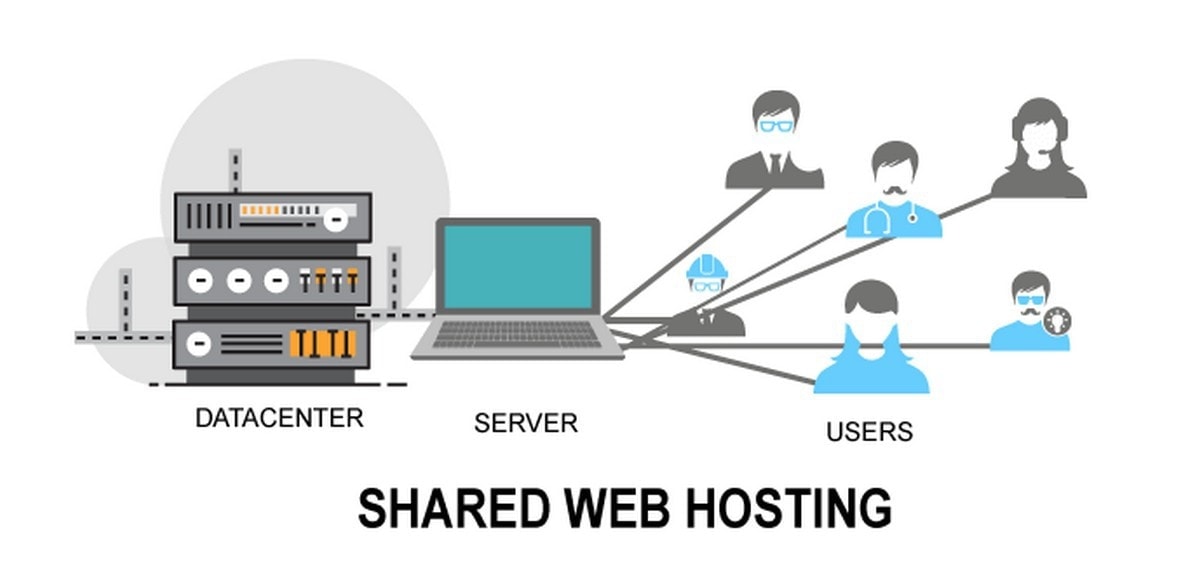
Shared hosting is the cheapest and most popular form of web hosting and is suitable for small business or personal websites. What makes it inexpensive is that the web host takes one large server and divides up the storage space for many different users. In effect, you will be leasing a small slice of a large hard drive.

While this slice can be big enough for all your website’s files and data, the downside of shared hosting is that you also have to share all the other web server resources, such as RAM and CPU. If lots of other users have busy websites, there may be times when your website is affected and loads slowly or performs poorly on people’s devices. It is similar to having too many programs running on your computer and finding that they lag or freeze.

Specialised shared hosting

The Best Shared Web Hosting Services for 2021 | PCMag

Today, lots of web hosts offer specialist forms of shared hosting. In many instances, this is done by configuring the web server so particular types of website software can perform optimally. You may, for example, see WordPress, Joomla, Magento or Drupal hosting and these packages will also include other features to improve the hosting or make things easier for users of those types of software.

Additionally, some hosts offer shared hosting with particular types of control panel, such as the cPanel hosting here at Anteelo. cPanel is a leading control panel whose user-friendly interface and comprehensive range of tools make it a breeze to manage your website. You may also find shared hosting packages that are specially designed for business users or bloggers.

VPS

VPS Hosting | Windows, Linux, & cPanel | Atlantic.Net

A virtual private server (VPS) is the next step up from shared hosting. It uses clever virtualisation technology to create several small, virtual servers on a single physical server. The difference between shared hosting and VPS is that your VPS is completely independent of all the other VPS on the physical server, so you don’t have to share resources or endure the issues this can cause. You even get your own operating system.

The other chief difference is that a VPS package is much bigger than a shared hosting package. In essence, it is like a mini dedicated server, giving you substantially more storage, CPU and RAM. This makes it ideal to run large websites, multiple websites or other types of application for your business. The surprising thing about VPS is that they are cheap, costing from as little as £15.59 a month (at time of publication).

Dedicated server

What Is a Dedicated Server? Learn the Basics

With shared hosting, a user gets a small share of a large webserver. The term ‘dedicated server’ simply means that you get that entire server dedicated for your own use. This provides you with enormous amounts of disk space together with substantial processing power and RAM. This is ideal for bigger businesses that need to run large websites, store lots of data and run critical business applications which need to be online all of the time. Compared to VPS, these can be much more expensive solutions.

Cloud hosting

5 Best Cloud Hosting Companies In 2021 - Productivity Land

The cloud is a vast network of interconnected servers hosted in huge data centres. Using virtualisation, websites can be moved instantaneously from one physical machine to another, even across geographical locations. This means if there is a problem with the physical hardware, a cloud-hosted website or application will never go offline.

Cloud’s virtual technology also means that companies that need extra computing resources at a moment’s notice, can instantly have it at their disposal – and in enormous quantities. What’s more, the cloud is paid for on a pay as you go basis, so you only pay for the resources you need as and when you need them. You can scale up or down at any time.

Accessible over the internet, cloud hosting brings with it many of the benefits of connectivity – flexible working, working from home, collaboration, etc. It’s scalability also makes it ideal for carrying out big data analytics or making use of technologies such as AI, machine learning or the Internet of Things.

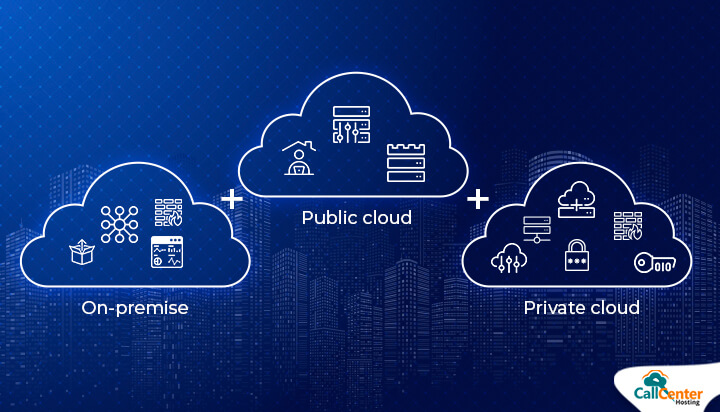
There are three different types of cloud hosting: public, private and hybrid. Public cloud is where the hardware, software and other infrastructure are shared with all the other cloud tenants and managed by the web host, whereas in a private cloud those resources are used exclusively by you. Hybrid cloud is where a company makes use of both private and public solutions, often with dedicated servers included in the mix.

Managed hosting

Managed Hosting Services: How Can Customers Benefit? - ITSM.tools

Managed hosting is not a different type of hosting solution but a feature of many of the above. It is a service provided by the web host to manage your server for you. This will typically include looking after the physical hardware, ensuring the server is working optimally and updating the operating system on your behalf. For certain types of hosting, this form of server management is included in your package.

Enterprise hosting

7 Best Managed Hosting Service Providers 2020 - Cloud7

Some companies have extraordinarily complex IT needs which require bespoke hosting and support solutions. Service providers, like Anteelo, have the infrastructure and expertise to offer these tailored solutions, often referred to as enterprise hosting.

Conclusion

As you can see, there is a wide range of hosting solutions available, ranging from the basic shared hosting needed to run a small website to the complex solutions needed by large companies to run a range of critical applications. Hopefully, this post will have given you a clear idea of what these types of hosting are and which is most relevant to you.


Samsung Integrates Blockchain into Their Business Model

Samsung smartphones: Samsung expands blockchain support on Galaxy smartphones, Telecom News, ET Telecom

Blockchain is no longer a hyped technology. It made its own significant identity, beyond the technology behind cryptocurrency, and entered the business world significantly. The domain has made a room for itself in almost every niche industry and business, proving it to be nearly impossible to overlook the charisma of this technology. Seeing this, various startups and established brands entered the exciting space of Blockchain – with Samsung emerging as the torchbearer.

Samsung, the tech giant based in South Korea, took various steps towards establishing its presence in the Blockchain market. A few of the announcements and efforts they put in this direction are:-

1. Investing in Blockchain-Specialized Startups and Tools

Investor outlook 2021: Challenges, growing trends, and expectations from the Indian startup ecosystem

Last year, Samsung invested around USD 8.1M in a Blockchain-based company Blocco and $4M in ‘KZen Networks’. While, this February, they partnered with HYPR – a Blockchain biometric encryption firm in the USA – and made an investment of around $1M.

2. Developing its Own Ethereum-Based Blockchain

Understanding the Cryptocurrency Market - Blockchain Technology Explained | Toptal

The tech giant also took a step towards developing its own ‘Blockchain mainnet based on Ethereum platform’, which was announced to be either a private blockchain or a hybrid one. Also, they announced working on their own crypto token, called ‘Samsung Coin’ which would be used for crypto exchange or as a payment solution in the Samsung Pay app.

3. Adding Storage for Private Cryptocurrency Keys

Currency.com Vs BitMex Exchange Comparison | UseTheBitcoin

Earlier this February, Samsung added storage for private cryptocurrency keys in their Galaxy S10 model devices. They introduced a wallet that enables users to store Bitcoin, Ethereum, and other such cryptocurrencies on their devices as well as make contactless payments using cryptocurrency.

4. Declaring Blockchain a Part of their Digital Transformation Network

Blockchain – The next of everything – SOURCING AND SUPPLY CHAIN

In the month of May, the president and CEO of Samsung SDS disclosed that Blockchain will be one of the top technologies they will focus upon under their ‘Digital Transformation Network’.

5. Announcing Launch of New Products for Blockchain Integration

Blockchain Transmission Protocol (BTP) Working Group Update: ICON Joins Forces with the Polkadot Ecosystem | by ICON Foundation | Hello ICON World | Apr, 2021 | Medium

Also, they announced last month that they will be launching three new products to simplify the process of Blockchain integration with other platforms for entities that are trying to embrace the technology.

6. Releasing a Software Development Kit (SDK)

Software Development Kit Example

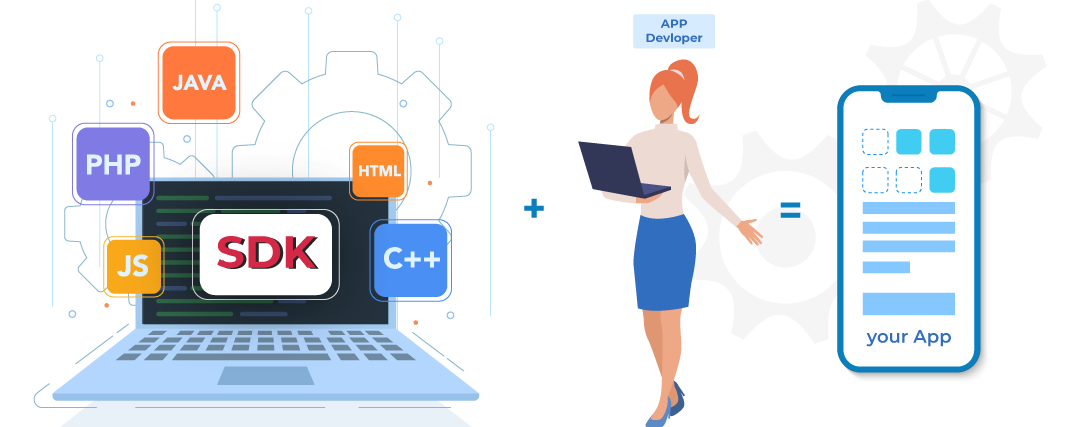
Samsung also unfolded new opportunities for Blockchain experts. They released a new software development kit (SDK) having a myriad of tools and functions for developing Blockchain and dApps.

This SDK provides developers with an opportunity to handle their Blockchain accounts easily and effortlessly and make transactions seamless by abstracted transfer APIs for every cryptocurrency. It also offers a payment gateway to software developers for cryptocurrency remittance with its UI.

Above all, it gives an opportunity to link not solely to but also to any cold wallet including Ledger and Trezor devices. It renders access to a ‘Blockchain specialized browser’ for decentralized web applications that offers a set of features related to easing the process of crypto payments and tools to predict fees using live crypto exchange rates. And in addition to this, it provides Blockchain and Ethereum developers with a chance to retrieve transaction history from Samsung’s ‘blockchain proxy node’.

These efforts, as a whole, are making it easier to cut down the cost of App development, except when you already have your own wallet logic.

7. Connecting dApps to its Blockchain Wallet

WalletConnect

Another significant step that the Samsung team took towards building their presence in the Blockchain arena is the integration of decentralized applications to its Galaxy S10 wallet. The tech giant introduced 4 dApps to its wallet back in March, added 6 more apps into the list the day before yesterday, and today, they announced the addition of one more application into the list.

With this, the list of decentralized mobile applications that entered into the environment of Samsung’s Blockchain wallet are:-

  • Cosmee – a dApp for sharing beauty content.
  • CoinDuck – a merchant payment service.
  • Enjin – a Crypto-based gaming platform.
  • CryptoKitties – a platform for Crypto-collectibles.
  • The Hunters – a Crypto-based gaming platform.
  • MyCryptoHeroes – a Blockchain-powered gaming decentralized application.
  • Berry Pick – a social media dApp that rewards active users.
  • Misetoktok – a dApp to monitor air quality and pollution level in real-time.
  • Syrup Table – a network for reviewing and rating restaurants.
  • X-Wallet – a decentralized wallet application that supports Ether, Binance Coin, and Bitcoin.
  • Lympo – a Blockchain-based health and fitness startup that rewards LYM tokens, which can now be transferred to Samsung Blockchain Wallet and converted in real fiat money.

Besides, they also hinted that Pibble, Forecasting, and many more apps might be a part of this list – giving an indication that Samsung is planning to turn its Blockchain wallet into an App Store – just like Google Play Store and Apple App Store.

8.Collaborating for Blockchain-based Self-Sovereign Identification System

Majority of Consumers Globally Think Connected Devices Are “Creepy” – Gadget Voize

Samsung went into a consortium with popular tech giants and banks –Telcos, KT, LGUplus, KOSCOM, KEB Hana Bank, and Woori Bank – to create a blockchain network for deploying mobile authentication service.

With this service, the companies will cut down the intermediaries in the process and add the functionalities of transparency and security. They will empower users to safeguard their own data, including that related to the institutions and companies they have been a part of. Or better say, the will aid users to have a control on their data.

Currently, they are aiming to employ this blockchain-based self-sovereign authentication system to simplify job and hiring process by making it easier for users to verify and upload their documents and apply for a job.

However, they are planning to extend this service to various other domains and processes, such as hospital and insurance services and membership services in holiday resorts.

These efforts and investments have not just brought Samsung into the limelight of innovativeness, but have also established it as an example for other conglomerates to follow.

Emerging trends expected to impact eCommerce Businesses

The Future Of E-Commerce

While the rise of internet shopping has led to the slow decline of the high street, last year also saw a reduction in online sales. With trading conditions likely to remain challenging during 2019, eCommerce businesses will need to be at the top of their game if they are to make headway. Doing this means keeping abreast of the latest developments in eCommerce businesses and taking advantage of those which are likely to bring the greatest benefits. In this post, we’ll look at the new trends set to have an impact this year.

Improving the customer experience

15 Proven Techniques to Improve Customer Experience (CX)

Social media and review sites give consumers enormous power to influence each other in their buying decisions and one of the things they are increasingly making judgements about is the experience they have when shopping with a business. This experience covers every aspect of their interactions with you, from their first encounter (e.g., seeing an advert) to after sales and beyond.

What are they looking for? In short, quite a lot. They want brands whose values they can identify with; websites that load quickly, are easy to navigate and work on any device; and purchasing processes that are simple, secure and fast.

In addition, customers prefer ecommerce sites that provide personalised recommendations and offers based on their previous interactions and this means businesses will need to collect more data and do more analyses in order to make recommendations that actually appeal.

Following the purchase, they want a speedy delivery and an easy, no-quibble returns process. Ideally, they want standard delivery to be free and to have all this backed up by easy to contact, friendly, customer service.

Developing trust

Developing Trust on Your Team

The consumers’ concept of trust has developed over recent years and businesses need to take these changes on board. Yes, this still means they need to trust you with their banking details when making purchases – so things like SSL certificates remain essential. However, with so many data breaches taking place, they want guarantees that any personal data you hold on them is going to remain secure and not end up being sold on the dark net. Following on from the Cambridge Analytica scandal, trust also means not having their data sold or used by third parties – particularly for use by political analysts or by insurance companies.

Trust is also increasingly linked to a company’s values and this means having moral integrity. The recent case of the clothing brand that sold fake fur coats which turned out to be made from real fur, is a prime example of something that can damage trust. The high-profile cases of people dying from allergic reactions because food retailers didn’t adequately label their foods is another example. Indeed, the online demonisation of those companies perceived to be at odds with today’s shifting values means, in order to gain the trust of the general public, all businesses need to do the right thing, whether it concerns LGBT rights, race and gender equality or supporting the more vulnerable members of society.

Using AI

Companies are using AI to hit business goals, even though they can't explain how it works - TechRepublic

Live chat is a key tool for enhancing the customer experience, however, it can be an expensive service to offer. Having staff available 24 hours a day to deal with customer queries isn’t cheap and the more successful your business gets, the more agents you will need.

Thankfully, there is now an alternative and cheaper solution that is expected to take eCommerce businesses by storm over the next couple of years and that is the AI chatbot. AI chatbots are essentially computer programs that can understand a customer’s questions and provide human-like responses about your products and services. Unlike humans, they can deal with unlimited customer enquiries at once and operate at all hours of the day.

The other advantage of a chatbot is that it can be used to generate sales. It can do this by sending automated prompts to get users chatting about a product they are interested in, it can offer them discounts or even make personalised recommendations based on their session data.

The progressive web app

What are Progressive Web Apps and How Do They Work?

With 60% of internet surfing taking place on mobile phones, the key focus over the last few years has been to develop responsive websites. However, the majority of our mobile surfing time is spent on apps, not websites. Rather than developing their own apps, many businesses are using a new format to tempt app-loving mobile surfers – the progressive web app.

The progressive web app is a website that uses APIs to let it function and appear just like an app. It works on all types of devices but, unlike a website, doesn’t need to be downloaded on a phone as it is cached and stored on the home screen. It also gets rid of the issues that businesses with separate apps and websites have, such as when a customer puts an item in a basket on the app but finds its not there on the website.

The use of progressive web apps will enable businesses to provide a multipurpose web portal that better suits our preferences of surfing on mobiles and computers but which works seamlessly between the two.

Conclusion

Hopefully, this post will have given you an insight into the emerging trends set to develop eCommerce over the next year. With the trading challenges facing online business, adopting some of these trends can be a way to keep your company ahead of the competition and help you meet your targets for the coming year.

Predictions for the Cloud service in 2019

Predictions for the cloud in 2020 - Information Age

2018 saw important technological advances in cloud computing that made businesses take a fresh look at how it could help them achieve their goals. In 2019, we are likely to see a further shift towards the collection and use of data, including that gathered from business processes and external data sets.

To enable businesses to make the most of this, we’ll see organisations move from standard infrastructure as a service (IaaS) solutions to cloud services with more advanced features, such as AI, machine learning, blockchain and analytics. Hand in hand with this, we are also going to see more organisations adopt hybrid and multi-cloud environments which provide them with a more effective infrastructure and a better set of tools to achieve their aims. As a result, here at Anteelo, we believe the cloud trends mentioned below will become increasingly widespread as more businesses continue to develop their use of cloud technology.

A shift to hybrid and multi-cloud infrastructures

Why You Need To Shift To A Hybrid Cloud Infrastructure?

While many businesses have adopted cloud technology in some form or other, performance concerns and compliance requirement mean the majority of companies still run mission-critical applications and handle sensitive data in-house. In order to continue their move towards a cloud environment, companies will look at using a wider range of cloud options.

Public cloud will still be used as a cost-effective way to handle many processes, however, rather than rely on a single provider, many organisations will opt for a multi-cloud approach using a variety of hosting solutions for different purposes. At the same time, some workloads are more suited to private cloud networks and this means we’ll see an increase in the use of hybrid cloud infrastructures being developed.

While this mix of in-house, private cloud and public cloud architecture is obviously more complex, their integration will give enterprises the opportunity to build the most effective infrastructure it needs to drive the business forward.

A move towards open cloud technology

Reasons to Move to the Cloud. – ON – Belleville

The shift to hybrid, multi-cloud environments naturally leads to the adoption of open cloud technologies. Doing so helps companies avoid vendor lock-in and gives them greater freedom to choose the right solution providers. Indeed, using open cloud technology improves the interoperability of platforms, apps and data which is ideal for businesses looking to create diversely hosted infrastructures.

Increased adoption of containers

Turbocharge Your Cloud Transformation With Containers And Serverless Technology

Another consequence of companies moving towards a multi-cloud strategy is that they will want to deploy their apps across their multiple cloud platforms. This will lead to the increasing adoption of containers which will enable migration between various IT environments to take place easily and quickly. Key to this will be the use of the open source tool, Kubernetes, which enables the deployment and management of container-based applications.

An emphasis on security

Blog: Remote Work Places an Emphasis on Endpoint Security Solutions

Any move to a hybrid cloud setup means enterprises will need a more sophisticated approach to security. Using the services of multiple cloud providers means they will need to consistently manage all the threats to their applications and data across all vendors. An important aspect of this will be the need to get developers to integrate security features into their apps during development in order to ensure better app visibility, protection and control.

Skilling up

Why we will need up-skilling courses in 2019 to get successful careers - Education Today News

Adopting a hybrid, multi-cloud approach means IT teams will need to develop new skills and practices in the way they operate. While relying on managed services may still be appropriate in some situations, there will be an increased need for staff with skills in using cross-platform tools, automation and data integration.  The training up or recruitment of specialists, such as cloud architects, service brokers and automation engineers may be a necessity.

Rapid growth in edge computing

Growth of Edge Computing in Asia | Vertiv Insights

The huge rise in the numbers of connected devices and the emergence of 5G networks means that 2019 will see edge computing grow rapidly. Its use will enable companies to significantly benefit from the analysis of all the valuable data being harvested from sensors and other IoT devices in operation. Whether to gain customer insights, improve operation efficiency or for real-time condition monitoring, the use of interoperable technologies enables edge locations to remain synced with the company’s system to ensure it has a consistent overview of the wider network.

Conclusion

As you can see, the big development in 2019 is the move towards a hybrid, multi-cloud strategy where enterprises create bespoke IT solutions that combine public and private cloud service with in-house IT. Hand in hand with this will be a move to open source cloud technology, the increased adoption of containers, a stronger emphasis on security, the skilling up of IT teams and a rapid growth in the use of edge computing.

7 Proven Methods for Boosting Website Traffic

How to Get More Traffic to Your Website - Webify Geeks

According to retail analyst, GlobalData, over 50% of UK consumers now shop online, with spending predicted to grow 30% by 2024. Indeed, by 2021, Statista forecasts 93% of internet users in the UK will be shopping online. While this is fantastic news for online businesses, it comes hand in hand with a growth in competition as more companies launch websites: 84% had them in 2018 compared to 70% in 2007. To be successful in such a competitive marketplace, companies will need to find ways of increasing website traffic and in this post, we’ll explain some of the main ways to achieve this.

1. Online advertising

5 Hot Online Advertising Trends in Europe

For companies with new websites or those which struggle to get listed in search engine results, online advertising is often the chief method of attracting customers to your website. The main way to advertise is with Google and Bing, using paid search ads that appear in search results or display ads that appear on other websites. Alternatively, you can also advertise on social media sites. All of these options allow you to target specific audiences and track the progress of your campaign, helping to ensure your advertising budget is spent effectively. It can, however, be an expensive strategy.

2. Content marketing

Content and Content Marketing Are Not the Same. Here's How to Frame the Top 11 Content Formats.

Internet users aren’t always looking for products or services; quite often what they are seeking is information or ideas to help them solve problems. Providing content on your website which solves those problems can massively boost the number of people who visit as it can be found in search results and shared on social media. If that content subtly mentions and links to a product or service that you supply, it increases the chances of a sale. Take, for example, someone with a small garden looking for ideas to spruce it up. They find a blog article from a garden centre called ’10 ideas for revamping a small garden’ in which they find a picture of a table and chair set they like, together with a link to the product page. From this article, the visitor solves their problem and the garden centre makes a sale. This technique is widely used by businesses in all sectors.

3. Social media marketing

15 Awesome Examples of Social Media Marketing

If businesses don’t want to pay for advertising on social media, they can always use these sites to promote their brand, their web content and their products or services. Social media is great for posting links to your website and with the ability to use eye-catching images and video, it can be a highly effective way to increase traffic, especially as other users can spread the word by liking and sharing your posts.

4. Improve SEO

Improve Your SEO Work by Unleashing Your Creativity

Search engines are the main way consumers find the things they are looking for online, so optimising your website for them is vital if you want to improve the chances of your web pages ranking well in search results.

While the crucial factor in SEO is providing high-quality, fresh and relevant content on your pages, you must not overlook all the other key ingredients. These include having a well-structured, easily navigable website and placing relevant keywords in the titles, subheadings, meta descriptions and content.

5. A mobile-friendly website

Why Having a Mobile-Friendly Website Matters | D Custom

A mobile-friendly or responsive website is a necessity in today’s online market. The main reason for this is the fact that users spend more time online on their phones than they do on laptops or other devices. Increasingly, users are also shopping more on mobiles too. According to Statista, at the end of 2018, smartphones generated the largest share of online retail revenue in the UK with many sources predicting the amount spent using mobile devices would double over the next few years to around £40 billion.

There are many reasons for this growth: there are more phone users, there is better internet access away from home, there are easier ways for people to pay using their phones and, importantly, more companies are providing mobile-friendly websites. For businesses, the last point is crucial, as without a mobile-friendly site, the growing market of smartphone shoppers won’t be able to fully access your store. That’s an issue which also makes search engines downrank sites which aren’t mobile-friendly.

6. Make use of email marketing

How To Make Use of Email Marketing To Successfully Communicate with Prospects and Clients - Tomo360

Email marketing has the highest ROI of any marketing technique and is very inexpensive to implement. There are various ways to grow an email list, such as using a pop-up that offers an incentive to sign up (e.g. 10% off your first order) or asking customers to sign up during the checkout process (e.g. ‘Get updates of our new products and latest offers’).

Once visitors have signed up, you can send marketing emails to them for free with links to your website included. Today, many companies combine email marketing with the use of personalised product recommendation software which tracks what a visitor has been looking at on the website and sends out emails with links to relevant products. This personalised form of email marketing can significantly increase traffic to your site.

7. Security and speed

What Happens When You Sacrifice Security for Speed (And Common Ways Security Gets Sacrificed) | Threat Stack

Two other factors which can affect traffic numbers are security and speed. If your website is marked as ‘not secure’ on browsers, many users will not visit even if it appears in search results. Additionally, according to Google, 53% of visitors will abandon the site if it takes over three seconds to load on their devices. Solving these problems requires the installation of an SSL certificate on your website to make it secure and ensuring that the site is optimised to make it faster. Speed can also be increased by ensuring that your site is hosted on high-performance servers and that your hosting package provides all the resources to cater for the traffic your site needs.

Conclusion

The first step to increasing online sales is getting more people to visit your website. This has become increasingly difficult to achieve as growing numbers of businesses go online and compete for customers. That said, the internet market continues to grow, with more people spending more money online. Hopefully, the ideas presented here will help your business generate more online traffic.

Cloud-automated IT eliminates shorcomings of Traditional IT model

Cloud Computing Risks, Challenges & Problems Businesses Are Facing

For small and medium-sized companies, the traditional IT model of an on-premises network built and operated with an in-house IT staff is often fraught with problems.  IT teams are stretched to capacity simply keeping the lights on and there are always going to be issues with systems performance, network reliability, end user productivity, data recovery, security and the help desk.  Staffing is another constant challenge. And if companies decide to outsource some IT functions, they end up with multiple service providers, which creates additional headaches.

The problem is highlighted in the 2018 State of the CIO survey conducted by CIO Magazine, in which CIOs said their role is becoming more digital and innovation focused, but they don’t have time to address those pressing needs because they are bogged down with functional duties.

The common business challenges reported in the survey are often symptoms of needs that are misaligned with technologies and service providers, plus the lack of budget to address the problems.  Those challenges typically revolve around:

  • security and disaster recovery
  • lost productivity due to downtime and end users waiting for support
  • shadow IT and users not following security training
  • escalating or unpredictable costs
  • outdated infrastructure
  • shortage of talent
  • multiple tech providers and systems working at cross-purposes

Smaller businesses that may have turned to traditional managed service providers quickly discover these services lack seamlessness and result in reactive support challenges. According to the Ponemon Institute’s State of Endpoint Security Risk Report, 80% of these reactive issues can be eliminated through standardization and automation.

Moving to a cloud-based IT infrastructure

Why Your Business Should Be Adopting Cloud-Based IT Services - Consolidated Technologies, Inc.

Cloud-automated IT services can address these challenges and free up IT teams so they can align their strategies with the business.  Cloud-automated IT does all this by providing seamless, proactive support, enterprise-level security and compliance, redundant systems, highly available virtual desktops, continuous upgrades, predictable costs and improved end user productivity. The cloud-based IT infrastructure is managed by a team of experienced, knowledgeable, highly trained professionals who apply industry best practices.

Aligning the technologies in the IT infrastructure and having experts managing them delivers several key benefits:

  • Cost predictability: Not only are ongoing costs for an IT infrastructure that supports the business predictable and easy to budget for, surprise costs for disasters like outages, ransomware and security breaches are essentially eliminated.

Cyberlink - Reduce Variable Costs with Predictable Pricing Icon [9.27.17]-01 - CyberlinkASP

  • Reduced Friction and Risk: By standardizing on best-in-class, constantly updated technologies, friction is reduced between equipment, vendors, integration points, and service providers. This results in stronger security, performance, and ease of use.

Reduce Operational Risk with Effective Workflow Management

  • User Satisfaction and Productivity: If you’ve ever muddled through a few days of work on a loaner laptop you understand how important the user experience is to employee satisfaction and productivity. VDI and proactive management deliver a better computing experience and increased productivity. Instances can be refreshed just like you would with a cell phone.

60+ Customer Satisfaction Survey Questions You Can Borrow

With cloud-automated IT, the entire IT infrastructure moves to the cloud in a well-planned, efficient manner. The service provider helps create a personalized upgrade plan based on the specific needs of the organization, does a health check on existing applications, makes sure everything is configured properly and updates applications to the latest releases.

And cloud-automated IT goes far beyond simply lifting and shifting existing systems to the cloud. It is a holistic approach that aligns cutting-edge technologies and fully managed services to provide smaller companies enterprise-grade IT that can make a significant impact on the security and effectiveness of the business.

How Analytics Can Assist Businesses in Ensuring Safety

The Ultimate List of Free Analytics Tools | Quantcast

the growing threat of cyberattacks, many are turning to analytics to help protect their systems and comply with regulations. Here, we’ll take a close look at what security analytics is and how it can benefit businesses.

Security analytics – an overview

How to improve security analytics and operations | CSO Online

Like all forms of data analytics, security analytics involves the collection and aggregation of a wide range of data from numerous sources. The purpose, however, is to analyse this data to discover vulnerabilities and threats to the security of a company’s systems and data. Data can be gathered from firewalls, routers, network traffic, antivirus software, OS event logs, businesses apps, cloud resources, ID verification and access management logs and endpoint data. It also uses employee and user behaviour data and third-party threat intelligence information. This is then analysed using specially developed security algorithms which seek out patterns and sequences that give insights into potential, emerging or existing threats.

Modern cybersecurity analytics tools also employ AI and machine learning, which enables them to learn from past experiences to continually improve their ongoing threat detection. So, as new threats evolve, they will be able to detect these too. Of crucial importance is that this is done in real-time so that threats can be dealt with proactively and stopped before an attack inflicts damage.

Ways in which security analytics can be used

Stay Ahead of the Security Analytics Market With These Best Practices

Security analytics can be used for a wide range of measures. It can detect links in network traffic activities which signify the emergence of a potential attack. It can discover attackers threatening to infiltrate a system’s endpoints, such as its laptops and mobile phones. It identifies vulnerable, compromised or prohibitively shared user accounts. It blocks unfamiliar communications channels, preventing data being copied, downloaded or transferred without authorisation. It can also safeguard against identity theft by stopping users from sending their details to other sites.

Security analytics can even be used to protect against internal threats; monitoring employee activity to identify intentional or negligent behaviours which put the system’s security at risk. It does this by employing algorithms that uncover suspicious actions which indicate threats or vulnerabilities.

Compliance is another area in which security analytics can play an important role. Here, it can help automate compliance requirements, such as the gathering of log data, the management of data networks and the monitoring of data actions, enabling the company to compile reports and detect users not working in compliance with internal IT policies. Where incidents occur, security analytics can also assist in any forensic investigation, unearthing the activities and sources of the related events.

The benefits of using security analytics

6 Benefits of Security Analytics for Security and Risk Professionals - Download Whitepaper (PDF) » OnlineWhitePapers.com

The chief benefit of using security analytics is that, aside from detecting threats and potential security breaches, it also alerts the company when these incidents are likely to happen and before they actually do. In this way, its insights enable the company to be proactive in its security.

With threats coming from a wide range of sources, such as hacking, malware, ransomware, phishing, internal sabotage and negligence, and with cybercriminals using far more sophisticated tools, some of which also make use of AI and machine learning, many businesses can see real value in security analytics.

Security in the cloud

What is cloud security? | Kaspersky

For businesses using cloud-based systems, it is possible that your vendor already provides a wide range of robust security measures to protect your systems from cybercrime. Here at eukhost, for example, our cloud servers are protected with enterprise-class security. We work in partnership with Fortinet to offer next-gen FortiGate firewalls which feature intrusion prevention and inflow virus protection systems that detect and isolate threats before they reach your server.

In addition, we provide extensive VPN features, DDoS protection, email security, SSL certificates, email signing certificates and more. For added peace of mind, we also provide the industry-leading Veeam backup solution, designed for cloud infrastructures. It features virtual machine backups, replication and encryption which keep your data secure in case of system failure, data corruption, bad updates, ransomware or human error.

When it comes to compliance, the security we provide helps companies meet regulations such as GDPR and PCI DSS. With regard to the latter, all our cloud servers are PCI compliance capable and we can provide the server environment required for this purpose.

Conclusion

As threats become increasingly more advanced, it is good to know that technologies to protect IT systems, such as security analytics, are being developed and deployed to combat them. The best place to host such big data analytics, of course, is in the cloud. It’s reassuring, therefore, that the cloud, itself, already comes with a range of robust security measures to protect you, whether you use security analytics or not.

How Google Home and Amazon Echo Will Affect the Content of Your Website

Amazon Echo vs. Google Home: Which Voice-Controlled Speaker Is Right for You?

The way we interact with the internet is changing. Many of us now use voice to search online and the answers we get are increasingly being spoken to us. This isn’t just happening on smart speakers, which are becoming commonplace, it is also being used on phones, computers and even on devices like smart TVs. If this is the future of how we use the internet, it is obviously going to affect the content that organisations place on their websites and in this post, we’ll look at what changes are likely to be needed.

Why you need to act now

It is estimated that by 2020 over half of all internet searches will be done by voice. This is due to a number of factors. First of all is the low price of smart speakers. You can pick up a basic Amazon Echo Dot or a Google Home for around £30; cheap enough to put several around the home so voice searches can be done anywhere without having to touch a keyboard.

Hand in hand with their low price are the consistent improvements in natural language processing. Computers can now understand what we say and speak back to us in intelligible ways and their ability to do so is getting better all the time. While, for the time being, what we can do with voice search is fairly limited, the scope of their abilities will no doubt expand to help us in ways we currently haven’t begun to fathom.

For website owners, this means that what you publish on your sites will increasingly be read out to the searcher rather than being presented to them visually and this will impact how that content is created in the first place.

Voice search results

Voice Search SEO Study: Results From 10k Voice Searches

One of the biggest differences between voice and keyboard searches will be in the way that search results are presented. As we all know, when we search using a keyboard and screen, we are shown a list of search results and click on the one that most appeals to us. This is why most websites strive to be on the first page of results.

With voice search, this isn’t always going to happen. Where there is a screen on which to view the results, for example when using Cortana, Siri, or Google Assistant on a computer or phone, the results may show up as we are used to. However, on smart speakers and other devices, reading out a long list of titles and snippets would not be user-friendly; instead, the google search engine will make the choice for us and read out what it considers to be the most appropriate answer.

Indeed, even screen-based search is moving in this direction. Type a question into Google , today, and before it presents a list of websites to look at, it will show you what it considers to be the best answer in the knowledge graph at the top of the page. This is a move which keeps the visitor on a Google page and reduces the chances of any other web page being visited.

What’s the solution for website owners? It means that for voice searches, it is even more crucial that the titles and metadata are focused on the search query and, in doing so, provide answers in themselves that can be read out. Websites that can feature in the knowledge graph are the ones which are most likely to be visited.

The rise of natural language generation

Deep Learning for NLP: An Overview of Recent Trends | by elvis | dair.ai | Medium

With the use of AI and machine learning, the information supplied by voice searches is going to get more sophisticated. At present, it uses natural language processing to understand your enquiry and then uses this to identify the most relevant content to speak back to you. In the future, it will go beyond this. With natural language generation and AI, the search engine will be able to gather the essential information from the internet, perhaps taking small elements from many different sites and will reformulate these into a single, cohesive and comprehensive answer. So, rather than speaking out verbatim what it finds, it will generate specific answers to specific questions. For example, if you ask what restaurants are the best in your local area, it might search all the various review sites, looking beyond star ratings, to consider the actual text individuals write in their reviews. In addition, it may also take into consideration the browsing and purchase history of the customer in order to offer what it considers the appropriate response. In this sense, search engines will morph into concierges offering personalised customer services.

Will there be an end to screen searches?

There will always be a need for screen searches. If consumers want to purchase something, they usually want to see it first. Indeed, it goes against freedom of choice not to give a customer options and if they removed these, google search engines will lose massive revenues from their advertisers. This is perhaps why so many smart speakers with screens are already being produced, in order to give us the best of voice and screen searching.

How will this affect content creation?

How will Artificial Intelligence affect content creation for digital marketers?

All these developments point to several changes that websites need to make to help them stay relevant in the age of the voice search.

Firstly, the content published on a webpage needs to be structured and written in a way that makes sense when read aloud. This means writing in a way which sounds natural and using vocabulary that communicates information clearly. Accurate punctuation, which is essential for ensuring meaning is communicated clearly, will become more vital than ever.

Another factor is in creating different content for different searchers. The use of subject orientated terminology might be suitable for some readers but not for others. A search engine could determine the level of understanding that a searcher has and look for search results that the user could understand when the website was read out to them. For some businesses, therefore, the solution would be in creating both a layperson’s and a subject specialist’s page.

Graphical data is one area, in particular, which needs to be looked at carefully when considering voice searches. Tables and lists work very well for visual searches and can save users lots of time when they look for information on your site. However, when read out, they don’t always make the best sense and it would be easier to understand if the information was put into sentences and paragraphs. The obvious answer to this is the development of a new type of responsive site – one which provides different versions depending on whether the results are shown or read. This, however, is a development for the future. For the time being, it may mean making both sets of information available.

SEO also has a part to play in helping websites do well in voice searches. Indeed, Google recommends that SEO focuses on making it simple for the search engines to understand what the content is about. This should be done through the use of titles, meta descriptions, headings and subheadings as well as using proper descriptions rather than just keywords in image alt-tags. Just remember that most of these things need to work for visual consumption at the same time.

Conclusion

With the advance of voice search technology and the popularity of smart speakers, we are moving into a new era of internet use where there is less need to be stuck to a screen to find the information we want or to carry out actions. For website owners, this will push you towards creating content that is suitable for both kinds of search and which makes sense when read aloud.

Ways cloud hosting is similar to Santa

Best Christmas Deals Of 2017 - Cloud Hosting, Web Dev, Marketing Tools Discounts

You might think it Christmas crackers to believe a beardy, old sleigh driver donning a red hat, has anything remotely in common with an internet-based hosting solution – but you’d be wrong. Both of them, in their own unique ways, can bring us many benefits. So, as Christmas approaches and we begin to let our minds wander away from work and towards the festivities, here’s a more seasonal and humorous post for you to enjoy. Here are the reasons why cloud hosting is like Santa Claus.

When it comes to running critical operations, Santa relies on his sleigh just as much as businesses need their applications. Downtime for either can be disastrous. Sleigh failure can result in millions of unhappy children waking up to empty stockings – an unimaginable reputational disaster for the world’s most trusted brand. For others, the standstill caused by server failure not only damages reputations but can also result in significant losses.

Neither Santa nor businesses like downtime

Coronavirus pandemic pushes start of holiday shopping earlier than ever | Chattanooga Times Free Press

While Santa relies on magic reindeer dust to keep his sleigh in action, for businesses, the best option is to migrate to cloud hosting where the possibility of downtime due to server failure is non-existent. The virtual nature of a cloud environment means that it delivers consistent performance with guaranteed 100% uptime. This is because its hyper-converged design protects against everything from hard disk failure to an entire server failure, enabling critical apps to be always available.

Reindeer fast performance

A Beginner's Guide to Website Fast performance (Creative One Solutions)

Speed is essential for both Santa and modern businesses. For Santa, dropping off presents to the world’s 2 billion children in a single night means he has to work fast. It’s been scientifically calculated that he needs to travel at approximately 650 miles per second to get everything done in time and to achieve this, he needs more than your average reindeer. Indeed, the average reindeer can only manage 15mph and most of those would be flagging after half an hour of pulling all that weight.

What makes everything possible for Santa is that he uses the cloud. Rather than taking the sleigh over rugged terra firma, riding high in the cloud provides an almost friction less environment to travel and where gravity has less of an impact. This massively improves his speed.

That same cloud, or one very similar to it, can also help boost the speed of your data. Indeed, as data is weightless, it can travel even faster through the cloud than reindeer, almost at the speed of light. And with high-performance servers featuring powerful Intel Xeon CPUs and super-fast SSD drives you can perform critical tasks quicker than an elf can say ‘Merry Christmas’.

Santa has been so impressed with cloud technology, he’s now adopted load balancing to prevent his sleigh tipping over on tight corners. For cloud hosting users, load balancing maximises speed and capacity utilisation so that when servers are busy, the load is distributed. This ensures that no server suffers from performance problems and, with multiple data centres at their disposal, cloud providers can always ensure optimised performance.

Both Santa and cloud hosting save you money

Why small businesses should save for a rainy day

Whether you are buying presents for your children or cloud hosting for your business, it is important that what you buy offers you value for money. What’s great about the cloud is that you can save on the costs of running a data centre and the capital expenditure needed to pay for hardware. Everything you need is provided by the host. There will be no need to pay for premises, electricity, physical security, maintenance or insurance.

Similarly, with Santa, those who have well-behaved children can save on the cost of buying presents. Instead of spending a fortune on Amazon, simply get your ‘nice list’ kids to write a letter to Santa and put it in the nearest post box. Doing this automates the process of putting presents in stockings and under the tree on Christmas Eve. Although a small delivery fee of a mince pie and a shot of something warming is required, the savings are dramatic, especially when your child has an eye for expensive electronic gadgetry.

Unfortunately. If you have naughty kids, you’ll have to supply your own presents or make do with the small bag of coal that ‘bad list’ children get left.

Both come with expert little helpers

When you have significant workloads, it pays to have experts on hand to help you get things done. Santa, for example, has an army of elves who spend their days creating the presents, wrapping them up and loading them onto the sleigh. They’ll also manage the naughty and nice list and organise the presents in a way that enables delivery to be done with awe-inspiring efficiency.

If Santa has a technical problem, Mrs Clause offers 24/7 support, together with tea and biscuits, to help him find an effective solution. Last year, for example,Rudolph’s nose was a bit dim and Mrs Clause provided the right type of carrot to add to Rudolph’s food ‘til the luminous glow was restored.

Users of cloud hosting also benefit from expert little helpers. Working away behind the scenes is an army of engineers and technicians who ensure that your hosting is expertly managed. They’ll monitor and maintain the servers, update the software, scan for intruders and malware,and generally make sure your hosting is working as effectively as possible.

At the same time, should you have any issues, a good cloud host will provide their own 24/7technical support. While they may not know one end of a reindeer from the other, they will have expert skills in helping you with all your hosting needs and will be available by phone, live chat or ticket.

Wrapping up

So, as you can see, it is possible to compare Santa with cloud hosting. Comparing,however, doesn’t mean you have to choose between them. If you’re clever and have been good all year, you can have both. Now, that is good tidings.

5 Advantages of Using the Cloud with a Bring-Your-Own-Device (BYOD) Policy

Bring Your Own Device" Policies Need to Protect Both Employees and Businesses

If you have not come across BYOD before, it stands for Bring Your Own Device and is when businesses allow their employees to use their own laptops, tablets and smartphones for work, instead of supplying them themselves. When BYOD is used in conjunction with a cloud-based system, it brings many benefits. In this post, we’ll look at what these are.

Greater flexibility.

Greater Flexibility as the New Mantra for Higher Education | teachonline.ca

When businesses with cloud-based systems begin to offer BYOD, it enables employees to work away from the office whilst still being able to access the system over the internet. This means that where ever an employee is, they’ll still be able to access the data and files they need.

As a result, it offers companies a great deal of flexibility. For example, if there is no need for an employee to be physically in the office to carry out their work, they can work from home, using their own laptop. If this applies to enough staff, it is possible to use smaller office premises cutting the cost of business rents, rates, utility bills, maintenance and insurance.

It also enables companies to offer more flexible working conditions which are better suited to those who need to work around things like childcare. As a result, talented individuals who would have been put off by rigid 9-5 routines may be willing to work for you.

Keep employees happy and reduce training costs

Reduce The Cost Of Training Employees With These Simple Techniques - eLearning Industry

We all have our preferred devices for work; some like to use Windows computers, while others prefer to work with Apple Macs. When you supply your own devices, it is easier for a company to lease these in bulk and as a result, everyone gets the same thing.

It can, however, be difficult for those who have always used Windows to work with a Mac and vice versa. It can take them time to learn the new skills and even require training to take place. Until they are up to scratch, their productivity levels will be less than expected. Giving them the chance to use their own device removes these obstacles and leads to higher morale and improved job satisfaction.

App compatibility and employee collaboration

Is team collaboration app compatible in all platforms? - Quora

If you think that application compatibility may be an issue with BYOD, you’ll be relieved to know that many apps can be used across a range of different operating systems and devices. For example, Office 365, perhaps the most widely used business suite, works with Windows, Mac, iOS and Android, enabling your employees to work anywhere, any time with its email and other applications. In addition, with Team Sites, which is included with Office 365, employees can improve collaboration while in different locations, editing documents simultaneously and taking part in online conferences.

Cuts the cost of device leasing

22 Ways to Reduce Overhead Costs for Small Businesses

The obvious advantage of BYOD is that if employees are using their own devices to work, you don’t have to buy or lease them. Developments in computer technology mean that whether purchased or leased, hardware will become dated and even obsolete within a few years. As a result, there is the constant cost of replacing it. BYOD gets rid of this cost.

In addition, if your IT department provides maintenance for BYOD devices (it’s worth doing as your staff will still have IT issues which might affect their work) it’s unlikely this will need as much input as it would with hardware provided internally. Staff generally take care of their own devices better than they do company devices and they are more likely to understand how to sort out minor errors themselves.

BYOD is compatible with data security

What Is BYOD ? Challenges and Opportunities

With the introduction of GDPR, one concern about BYOD is whether its use could ensure that confidential information and customer data remained secure. The answer is yes, provided that it’s properly regulated and monitored and that only those employees who need to use the data are given access to it.

Key to ensuring data is secure is having sound password management, including making sure that employees are trained on password safety and that strong passwords are used when connecting to business systems.

At the same time, employees must agree to regularly back up their systems and update software to more secure versions when they are released. This will prevent any security holes in older versions being exploited by hackers. If using software such as Office 365, these apps will be updated automatically.

Conclusion

For companies that use cloud computing, the option to allow employees to bring their own devices offers a number of advantages. It increases their flexibility, it keeps employees happier, it enables them to continue to use the same apps, it saves money and, if implemented wisely, is compatible with GDPR and other regulations.

error: Content is protected !!