The Roadmap to a More Scalable Ethereum Experience (Ethereum 2.0)

CYBAVO - Ethereum 2.0 launching today

  • Ethereum 1.0 is getting upgraded.
  • Ethereum 2.0 is going to be the new face of App industry because of its speed, scalability, cost-effectiveness, and other such benefits.
  • Ethereum 2.0 will be ready within 18-24 months, in the form of 7 different phases.
  • Ethereum 2.0 Phase 0 is expected to be live this year.

Ever since Ethereum was launched back in 2015, the developers were having sky-high hopes from it. While Buterin and Co., the company behind the evolution of this blockchain-based distributed computing platform, made significant changes in its consensus model and scaling solutions, the developer’s demand for an integrated experience of all these changes was not yet fulfilled.

But this Monday, the history of the Ethereum platform changed. The company announced an OS upgrade, known as Ethereum 2.0 (Serenity) – a glance of which we are going to cover within the next 3 seconds.

Ethereum 2.0: What It Is

Ethereum's Co-Founder Vitalik Buterin Donates Over $1 Billion To India Covid Relief Fund And Other Charities

Ethereum 2.0, according to Van Loon, is a distinct Blockchain from the existing Ethereum Chain, where the hard fork of the current blockchain is not mandatory for proper functioning. Instead, the value in Ethereum 2.0 is transmitted from ‘Proof of Work’ chain through a one-way deposit Smart contract.

With this attended to, let’s have a look into the reason behind the idea of launching this upgrade, or better say, have a comparison of Ethereum 1.0 and Ethereum 2.0

Ethereum 2.0 vs Ethereum 1.0: What Everyone Ought to Know

Ethereum Vs Ethereum 2.0 [Key Differences] » CoinFunda

When it comes to comparing the two OS versions, the reasons that come up as the igniting force behind the introduction of Ethereum 2.0 are the following challenges associated with current Ethereum:-

  1. Scalability:- Ethereum was launched with an aim to be the world computer that manages all the financial transactions and host dApps and Smart contracts without being impractically slow. However, Ethereum 1.0 is not able to fulfill this requirement while operating with PoW (Proof-of-Work) algorithm – something that gives the scope of introducing other more scalability-friendly platforms in the many Blockchain guide meant for entrepreneurs.
  2. Security:- Though not a major issue, the security level and considerations associated with Ethereum 1.0 are not advanced. They have to be improved, which is what Ethereum 2.0 is focusing upon.
  3. A Solution for Difficulty Bomb:- The developers have been continually compelled to shift from PoW to PoS by slowing down the mining rewards. However, this is increasing the difficulty associated with the process, and in the absence of any solution, it has been resulting in a dead end. Ethereum 2.0, in this case, will come up as a solution for the dApp developers to make better applications.

Now as we are familiar with the secret behind launching Ethereum 2.0, let’s dig deeper into what includes in this upgrade and when it will be live.

Ethereum denotes a series of updates that will make Ethereum make better and faster by focusing on two prime goals:-

  1. Introducing PoS (Proof of Stake) consensus mechanism that will eventually eradicate the need to invest in PoW (Proof of Work) mining.
  2. Introducing Sharding which will boost speed and throughout of the ETH transactions.

Now, when talking about the series of updates, the Ethereum 2.0 is making the update live in different phases. An outcome of which is that the 7 phases of the evolution of Ethereum 2.0 is expected to hit the market – with the Phase 0 just gone live.

Wondering what these different phases are? What will be included in each phase and when are they supposed to be made available to developers? Let’s cover this in the next section of the blog.

Different Phases of Ethereum 2.0

Phase 0: PoS Beacon Chain

Ethereum 2.0: Beacon Chain PoS Upgrade Launches - CoolWallet

The Beacon Chain is a PoS-enabled chain that will run in parallel to Ethereum’s Proof of Work chain and enable a Blockchain app development company to reap the benefits of the network without investing their time and energy into the process of re-learning the parameters of the platform. It is estimated to enter the market this year itself.

Phase 1: Basic Sharding

Understanding Database Sharding | DigitalOcean

In this phase, shard chains will work in sync with the Beacon chain. They will aid developers with higher transactional speed and instant output delivery in transactions, which will eventually upgrade the scalability.

Shard chains will be responsible for managing transactions and exchange of account data and will be live in the world in 2020.

Phase 2: EVM State Transition Functioning

Ethereum Virtual Machine (EVM) - Wiki | Golden

Proposed to enter the market in 2020-2021, this phase of Ethereum 2.0 Serenity will be related to the advent of new EVM (Ethereum Virtual Machine) which will be upgraded via the eWASM (Ethereum Web Assembly). This new virtual machine is predicted to perform code execution more swiftly and effectively while supporting many more programming language.

Besides, this phase will also witness the introduction of better protocol standardization to enhance the network security.

Phase 3: Light Client State Protocol

What is a light client and why you should care? | Parity Technologies

The fourth phase of evolution of Ethereum 2.0 will begin in 2022 and will cover everything related to the improvement of network in terms of security, scalability, and decentralization.

Phase 4: Cross-shard Transactions

This phase will be basically related to mind mapping of the complete architecture and will be seen somewhere around 2022.

Phase 5: Tight Coupling with Main Chain Security

The sixth phase of Ethereum 2.0 Serenity will be associated with internally fork-free sharding and data availability proofs.

Phase 6: Super-Quadratic or Exponential Sharding

What Is Sharding? | BTCMANAGER

The last phase of Ethereum 2.0 (Serenity), which will go live by the end of the year 2022, will be related to managing recursive shards.

The process of evolution of Ethereum 2.0, with 7 seven phases is announced to be completed within 18-24 months. This implies we will be able to enjoy 100 times more scalable network by the year 2022 along with other facilities like transition of Ether tokens from old chain to new one.

Natural Language Intent Recognition (Part 3) of the NLP Anthology

Rasa NLU in Depth: Intent Classification

Natural Language Intent Recognition: Intelligent Audio Transcript Analytics Using Semantic Analysis to Understand User’s Intent

In the modern business landscape, timing is everything. Quickly identifying user’s intent can help you get a leg up your competition. How? It can enable you to respond actively to a potential customer’s interest and multiply your chances of influencing the key decision-makers through meaningful conversations.

But, if you receive thousands of customer interactions a day, detecting customer intent in your unstructured data is challenging. The good news is that you can automate intent classification with artificial intelligence, so you can identify intent in thousands of emails, social media posts, and more in real-time and prioritize responses to potential customers.

Raise your hand if you’re a business that’s finding it increasingly complex to detect user intent from voluminous unstructured data sets containing long-wielded sentences and juxtaposed multiple objectives. Chances are your hand is up.

The good news is that you now have a solution to this.

What is Intent?

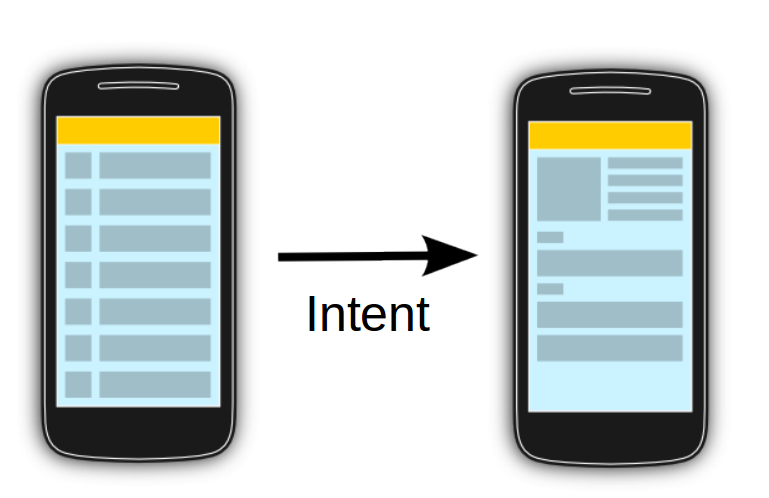
Android Intents - Tutorial

Simply put, refer to anything a user wants to accomplish

Now talking from a technical perspective, we define intent as a single or group of 2-3 contiguous sentences that can solely convey an idea with its necessary context. Extracting the call intent can lead to many downstream applications, such as better content creation and planning.

3 Challenges in Natural Language Intent Recognition

We discussed some challenges in part-1 of this 4-blog series. Here we discuss three more challenges specific to intent recognition (or intent classification).

  • There can be multiple intents present across the call transcript like we discussed in the example above.
  • Differentiation between the client intent and details of the same. In the above example, differentiating between the intent, i.e., to know about the growth percentage or its details.
  • Missing or incorrect punctuations leading to wrong sentences extracted as questions. For example, “I’m not sure what the report says?” having a question as wrong punctuation.

Anteelo’s NL-IR Approach

Pre-processing

Data Preprocessing : Concepts. Introduction to the concepts of Data… | by Pranjal Pandey | Towards Data Science

Cleaning and casual talk removal steps, mentioned in Part 1 of this 4-blog series, are followed to remove the unwanted sentences present in the transcripts. This important step highly affects the output of the next steps.

For instance, “How are you Cathy? How was your vacation?” should not be extracted by the Question Analytics module, which we will explore later in this blog. The intents are present throughout the call; however, we observed that 92% of the time, the intent was in the first half of the call. Hence, we focused on it to increase the precision of the system.

Feature extraction

  • Natural Language Question Extraction: To extract questions that clients ask, we use Anteelo Question Analytics NLP Accelerator that follows a hybrid approach ( combination of both rule-based and supervised approach). The rule-based approach leverages 5W-1H words and four generalized POS tag and Dependency parser patterns to detect the starting point of the interrogative part, if available, in a sentence. The supervised classifier was trained on ~100k questions’ data.

The Main Approaches to Natural Language Processing Tasks - KDnuggets

  • Constraints-based Intent Sentence Extraction: Identify the objectives of the client that are not conveyed in the form of questions. Intent identification is done by skip-gram matching of two generalized Dependency parser patterns.
  • Contiguity Sentence Extraction: We also extract the important sentences after the first extraction step to provide more context. The following sentences were extracted if they are tightly coupled with the preceding sentences identified by the conjunctions and other identifiers

Intent Segments Formation

Primarily, the intent segments are formed combining the contiguous sentences extracted by the methods stated above. However, simply combining the contiguous sentences can lead to many sentences in a segment that would decrease the system’s effectiveness.

The system divides the obtained segment into subsets with the least deviation in the number of sentences in each subset segment and with a maximum of 6 sentences in a subset segment. The splitting is done considering the continuity and similarity of sentences. These split segments are considered as final intent segments that will be fed into the next module.

Natural Language Intent Ranking

Natural Language Processing | kore.ai

This module will rank the intent segments obtained from the above module. We use multiple signals to rank these segments.

  • Topics: Used topics obtained from Key Concept Extraction mentioned in Part 2 of this blog series to boost the segments’ scores containing these concepts.
  • Number of questions: Improve the score of the segments having a high number of questions.
  • Importance of paragraph: Giving higher weightage to the segments in the bigger paragraph, having vital information.
  • Summarization: Boost the score of the segments having TextRank + Bert summary sentences.

More signals can be added to domain-specific needs.

Dynamic number of Output Intents

Since there is no fixed number of intents that the clients ask in a call, providing a hard cut-off of Top “N” intents will not provide desirable output. Hence, the system is designed to automatically provide the dynamic number of intents corresponding to each transcript using a differential cut-off to identify the number of intents that needs to be provided as output.

COVID-19’s Impact on Online Business

New COVID-19 Resources Available - International Society of Nephrology

The radical transformation in how people across the world are living during the Coronavirus pandemic is having a significant impact on internet businesses. While some are seeing sales plummet, others are struggling to cope with growing demand. In this post, we’ll look at how the online marketplace is changing in the current circumstances.

1. Growing demand for streaming services

Best Streaming Services 2021: The Full List Available

Millions of people are turning to movies and box-set series to keep them entertained while they are cooped up indoors. As a result, streaming services are seeing growth not just in the amount of time people are watching but in the numbers of new customers flocking to use their services. In Europe, Netflix has had to reduce its picture quality by 25% to ensure bandwidth capacity.

Increased demand means that in North America, Netflix is now forecast to more than double expected growth in new subscriptions, from 1.6% to 3.8% over the year – and that’s in a region where it is already well established. Internationally, growth is expected to rise by over 30%.

It’s not just Netflix that is benefitting. So too are other streaming services, like Amazon Prime Video, Hulu and Now TV. Recently launched services like Disney and the BBC-ITV venture, Britbox, which may have struggled to compete, might find opportunities that wouldn’t have arisen in normal circumstances.

2. Online gaming taking off

No Dice, All Bets Are Off | Outlook India Magazine

Although a narrower market, younger people forced to stay at home are driving up demand for gaming. This isn’t just increasing subscriptions for online gaming services but also helping retailers of downloadable PC games. PC gaming platform, Steam, for example, has seen its highest number of users in 16 years with traffic spikes of over 20 million at times.

3. Big impact on PPC ad spending

9 PPC Mistakes That Impact Success

The travel industry has been one of the most affected sectors by the virus and this has resulted in a slump in advertising from travel-related businesses, with some market experts suggesting it could lead to 15 – 20% reduction in travel advertising revenue for Google and Facebook. This figure is likely to be compounded by all the other businesses that rely on tourism also cutting their ad spend.

It is not just travel-related businesses who are reducing advertising. With many companies forced to close due to the effects of social distancing, they too will be cutting back or suspending advertising altogether. In 2018, McDonalds spent over a billion dollars in advertising just in the US. It has now closed all its UK stores and is shutting thousands of others globally as the pandemic spreads. It obviously won’t be damaging its cashflow by spending huge amounts on ads over this period. With industries such as entertainment, high street retail, restaurants, etc., also affected, Google and Facebook could see ad revenue fall by up to 45% over the next few quarters.

However, it is not all bad news. With fewer advertisers competing for ads, the cost per click in many sectors is likely to reduce, meaning those companies that can still derive value from advertising will see their budgets go further. In addition, consumers are clicking on more ads associated with employment, education, hobbies, leisure, arts and entertainment.

4. Holiday bookings won’t dry up

COVID travel: Where to book your trip once pandemic deals dry up

While travel is out of the question for most people at the moment, more than half of those who take frequent holidays are likely to book trips further into the future. Business travellers are even more likely to make long term bookings. While this is not the immediate relief those in the travel industry and all the depended industries need, the taking of deposits can help with current cashflow problems. Most of these bookings will take place over the internet.

As the pandemic begins to recede, it is predicted that most holidaymakers will, initially, seek domestic holidays where there is likely to be less disruption impact by failing tour operators and airlines and where the impact of the virus is more certain than abroad.

5. Global increase in online shopping

Online shopping is catching on among women in India

As fewer people go out, their shopping habits are moving online. Even retailers seeing a boom in sales, like supermarkets, are having more customers using their delivery service simply to avoid the risk of going to the store.

This rise is happening globally. An Ipso-Mori study found that 18% of UK consumers were shopping more online. In countries which have been more badly affected, the numbers of people increasing their internet shopping is even more substantial: 31% in Italy and 51% in China. However, the biggest increases are in countries like India 55% and Vietnam 57%. This rise has meant some companies are struggling to cope with demand. Amazon, for example, is so busy it is recruiting 100,000 additional staff, raising wages and making its employees work overtime to meet demand.

One area of particular growth is in the use of grocery apps, which are seeing unprecedented numbers of downloads in the US. Instacart downloads during March are already more than triple that of February while Walmart’s app has seen a 160% rise.

Conclusion

Coronavirus is having a significant impact on consumer behaviour and this is affecting internet businesses in different ways. For many, there are challenging times ahead as consumers drop plans to travel and stop online bookings for local businesses. However, there has been a sharp increase in online shopping with some retailers having to expand their workforces to cope.

4 Global Supply Chain Challenges and How Control Towers Can Help

4 Challenges Facing Innovation - Killer Innovations with Phil McKinney

The global market in 2021 is faster, more digital, and more competitive than ever. Customers carry the baton, and demand signals keep flowing into the enterprise from more and more different channels.

The modern supply chain dynamics require innovative capabilities and strategies to deal with uncertainties, improve resilience and implement holistic solutions to balance costs, services, deliveries, and customer expectations.

Four Challenges Facing the Modern Supply Chain Industry

What is Modern Supply Chain Management? - Unicsoft

Supply chain leaders need to manage a highly complex supply chain for the global business environment and deal with disruptions to keep the bottom line and top line intact. However, for decades, poor supply chain visibility has suffocated the industry.

Here are the four challenges gripping the modern supply chain.

1. Data and Application Silos

Are Data Silos Creating a Big Data Problem for Your Company?

Vertical organizations often fly blind.

Yes, that is true. Most companies are vertically integrated and use systems such as ERP, TMS, WMS, MRP to manage their functional departments. The functions primarily rely on plans developed within such systems to drive execution, monitoring & control. As a result, critical information such as customer demand, logistics, function-specific supply challenges & backlogs is siloed and invisible to other departments.

While function-specific analysis is time-consuming, cross-functional insights are even more challenging and require sifting through large volumes of data. Thus, business unit heads lose sight of the strategic ambitions of the overall supply chain

According to a survey by Supply Chain Dive, only 6% of companies believe that they have achieved complete supply chain visibility.

The lack of supply chain visibility is overwhelming and keeps on staggering.

2. Lack of Know-Hows, Tools, Technologies to Generate Insights

4 things you should know for a career in data analytics

With the advent of digital data, volume, accessibility, and insights generation through analytics are critical to creating a sustainable supply chain.

However, because analytics is not widely adopted, the data is poorly used.

The data engineering and analytics capabilities in most supply chains are insufficient. As a result, supply chain leaders often cannot effectively use relevant data at the required speed. They also lack diagnostic and advanced analytics tools/technologies and often fail to understand the nature of use cases or problems in the supply chain.

3. Lack of Predictive and Prescriptive Capabilities

Descriptive, Predictive, Prescriptive Analytics | UNSW Online

Digitalization is not enough.

As per the Chartered Institute of Procurement & Supply Risk Index’s report, the average annual economic loss caused by major natural disasters around the world is approximately US$211 billion.

Supply chain leaders also need to leverage new capabilities to predict market moods, deviation, and unanticipated geopolitical landscape.

However, most existing advanced analytics applications cater to solving point problems. There is an acute shortage of capabilities to use prescriptive or simulative simulations or what-if analysis to investigate broader issues in the supply chain and make recommendations. In addition, there are only a few good AI/ML-driven analytics solutions out there that prevent executives from using machine learning and limit the automation of the supply chain.

4. Lack of Off-the-shelf Solutions

Off-the-Shelf Software is Limiting Your Company's Productivity

Every use case or nature of the problem varies from customer to customer. So off-the-shelf products cannot meet customization and personalization requirements. Regarding the KPIs that businesses want to measure, use cases vary from company to company, making it impossible for off-the-shelf applications to handle. Such rigid solutions put the burden on supply chain leaders to get data in the desired format.

Indulgent customizations, choice complexities often lead to value destruction.

Need for an End-to-end Supply Chain Visibility Capabilities through Digital Control Tower

“Gartner reports, 79% of supply chain leaders believe that the internet/platform-based approach is the most critical new business model.”

The above four challenges require building a digital control tower with data engineering functions and pipelines on top of a solid data layer. Establishing a simplified data architecture with an automated framework can integrate master data and transactional data sources in a streamlined manner, ensuring the availability of necessary data across multiple silos to obtain accurate real-time visualization of the overall supply chain health.

AI/ML-driven analytics and rapid scenario planning can provide speed, consistency, and flexibility to achieve controllable and manageable supply chain functions, thereby helping executives gain a competitive advantage.

Two Critical Elements for an Ideal Supply Chain Control Tower

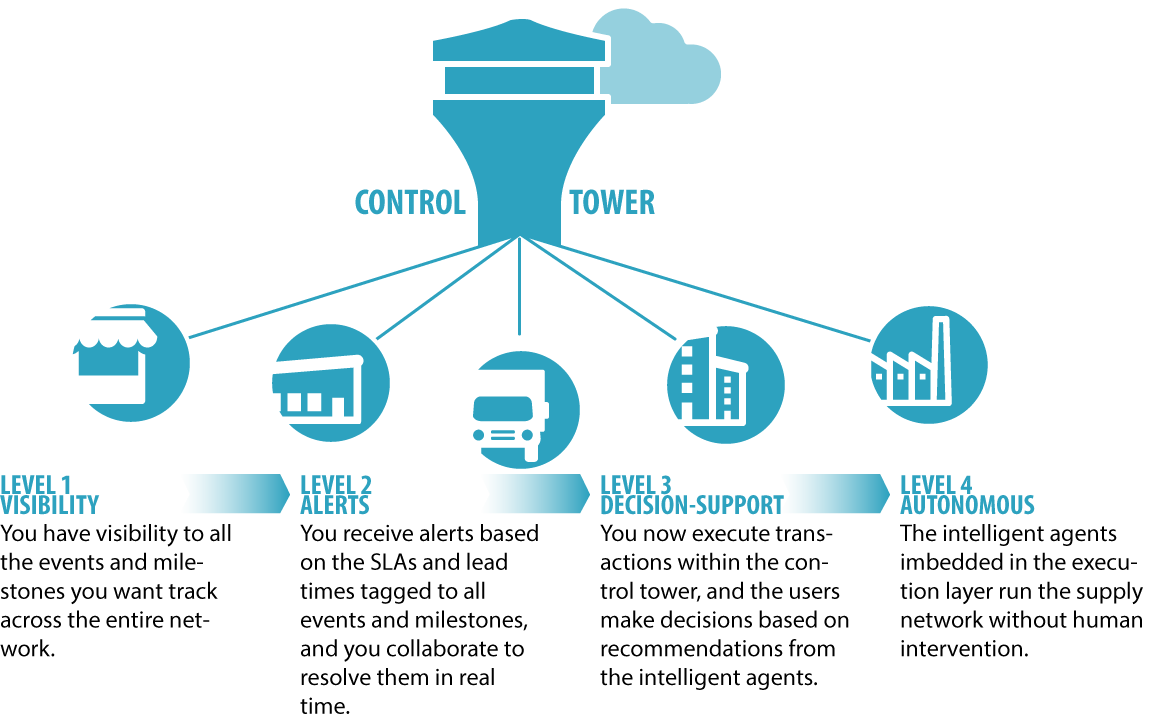
An ideal Supply Chain Control Tower (SCCT) is a cross-departmental, system-integrated “information hub” that provides end-to-end visibility.

There are two key elements to build/implement an ideal SCCT.

1. Real-time Visualization Catering to Different Personas.

BI | Think with Data – :: Cerebra ::

Executive Insights: An ideal supply chain control tower will provide a bird’s eye view of the overall supply chain health. It will enable the leaders to collect and distribute information, identify risks, and respond strategically.

Execution Insights: SCCT’s state-of-the-art setup caters to the nuanced aspects of the supply chain health for multiple execution persona – analysts or managers at the DC level or fulfillment center to view the various KPIs. It provides them with information to monitor, measure, and manage different aspects of the supply chain, including transportation, inventory movement, and operational activities.

2. Use Case Approach for Autonomous Supply Chain

Global Supply Chain Control Tower Market 2020 Analysis and Market Expert Research Report – Blue Yonder Group, Inc., Viewlocity Technologies Pty Ltd., E2open, LLC, – KSU | The Sentinel Newspaper

The ideal supply chain control tower can guide leaders/managers to explore potential use cases. It will allow them to find the most critical challenges that profoundly impact the overall performance of the supply chain and use advanced analytics, such as machine learning, advanced forecasting, or advanced scenario planning. In this way, they can combine use cases with visualization and diagnostic capabilities and automate the supply chain as they mature.

Conclusion: Control Towers are Stepping Stones Towards Autonomous Supply Chain

The supply chain control tower provides complete visibility from high-level monitoring layers to execution details, so the executives can optimize, manage, plan and execute supply chain processes and operations faster and more accurately. The addition of anomaly detection, automated root cause analysis, and response capabilities will further simplify the transition towards a cognitive supply chain control tower.

Data Warehouse Benefits and Drawbacks

What Is the Benefit of Modern Data Warehousing?

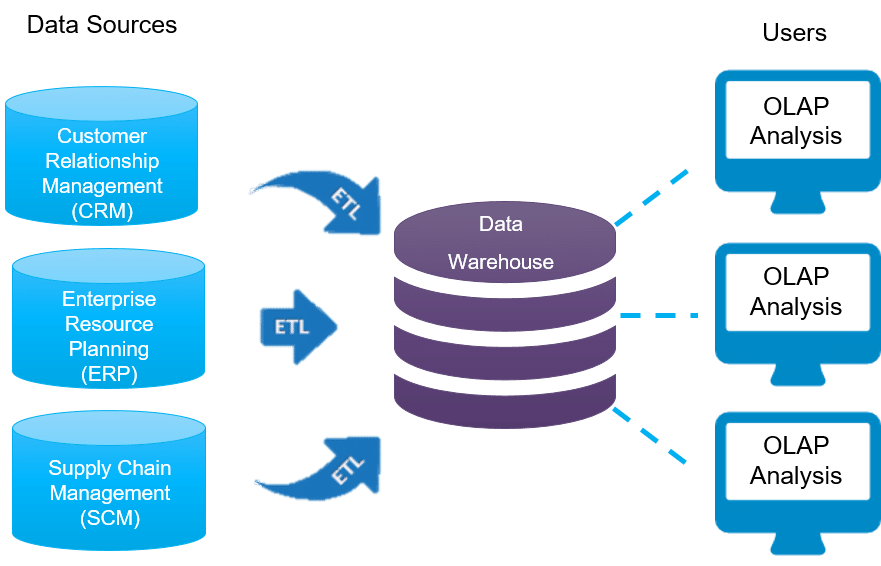
As businesses gather and store ever greater quantities of data, managing it becomes increasingly challenging. To get the maximum value from it, it needs to be easily accessed and compiled so that it can be analysed. However, when it is stored in separate silos across numerous departments, this is hard to achieve. The solution that many companies are opting for in order to overcome these issues is data warehousing. In this post, we’ll look at the pros and cons of setting up a data warehouse.

What is a data warehouse?

Data Warehouse Overview - Data Warehouse Tutorial | Intellipaat.com

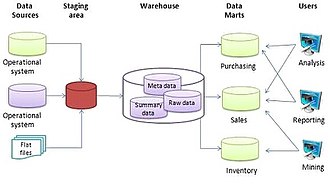
A data warehouse is a centralised storage space used by companies to securely house all their data. As such, it becomes a core resource from which the company can easily find and analyse the datasets it needs to generate timely reports and gain the meaningful insights needed to make important business decisions.

The pros of data warehousing

Pros and Cons of Snowflake Data Warehouse - Saras Analytics

The growing popularity of data warehousing is down to the benefits it provides business. Key, here, is that a unified data storage solution enhances decision making, enabling businesses to perform better in the marketplace and thus improve their bottom line. As a data warehouse also means data can be analysed faster, another advantage is that it puts the company in a better position to react to opportunities and threats that come their way.

With the entire array of the company’s data available to them, data managers can make more accurate market forecasts and do so quicker, helping them implement data-driven strategies swiftly and before their competitors. The accuracy of market forecasts is improved due to the warehouse’s ability to store huge amounts of historical data that can highlight patterns in market trends and shifting consumer behaviours over time.

Data warehousing can also help companies reduce expenditure by enabling them to make more cost-effective decisions, whether that’s in procurement, operations, logistics, communications or marketing. It can also massively improve the customer experience, with end to end customer journey mapping helping the company personalise product recommendations, issue timely and relevant communications, deliver better quality customer service and much more.

The cons of data warehousing

Data warehouse - Wikipedia

While the centralised storage of data brings many benefits, it does have some drawbacks that companies need to consider. For example, with such vast amounts of data in one place, finding and compiling the datasets needed for analyses can take time. However, not as long as would be needed if they were all kept in different silos.

Another potential issue is that when data is stored centrally, all the company’s data queries have to go through the warehouse. If the company’s system lacks the resources to deal with so many queries, this can slow down the speed at which data is processed. However, using a scalable cloud solution for data warehousing, where additional resources, charged on a pay per use basis, can be added as and when needed, eradicates this issue.

For many companies, the biggest obstacle for setting up a data warehouse is the cost. When undertaken in-house, there is often significant capital expenditure required for the purchase of hardware and software, together with the overheads of running the infrastructure. Additionally, there are ongoing staffing costs for experienced IT professionals. Again, the solution comes in the form of managed cloud services, like Infrastructure as a Service (IaaS), where the hardware and operating systems are provided without the need for capital expenditure and where software licencing can be significantly less expensive. What’s more, the service provider manages the infrastructure on your behalf, reducing staffing requirements. Even where specialised IT knowledge is required in-house, such as with integrating different systems, the 24/7 technical support from your provider will be there to offer expertise when needed.

Conclusion

Any company undergoing the process of digital transformation needs to consider the benefits of data warehousing. The centralised storage of all the company’s data is essential for companies that wish to integrate their existing business processes with today’s advanced digital technologies. Doing this means you can fully benefit from big data analytics, artificial intelligence and machine learning, and all the crucial insights they offer to drive the company forward.

Setting up a data warehouse in-house, however, presents several major challenges. There is significant capital expenditure required at the outset, together with on-going overheads. In addition, integrating a diverse set of company systems so that data can be centralised is not without its technical challenges. By opting for a cloud solution, however, cap-ex is removed, costs are lowered and many of the technical challenges are managed on your behalf.

Detection of Data Drift in Time Series Forecasting

Multiple Time Series Forecast & Demand Pattern Classification using R — Part 2 | by Gouthaman Tharmathasan | Towards Data Science

What is Data Drift?

Changes in the data distribution are monitored with Data Drift, one of the most common indicators when monitoring MLOps models. It is a metric that measures the change in distribution between two data sets. Before diving deeper into it, let us examine how ML Works defines drift for a time series use case and how the different drift components provide valuable insights and recommendations.

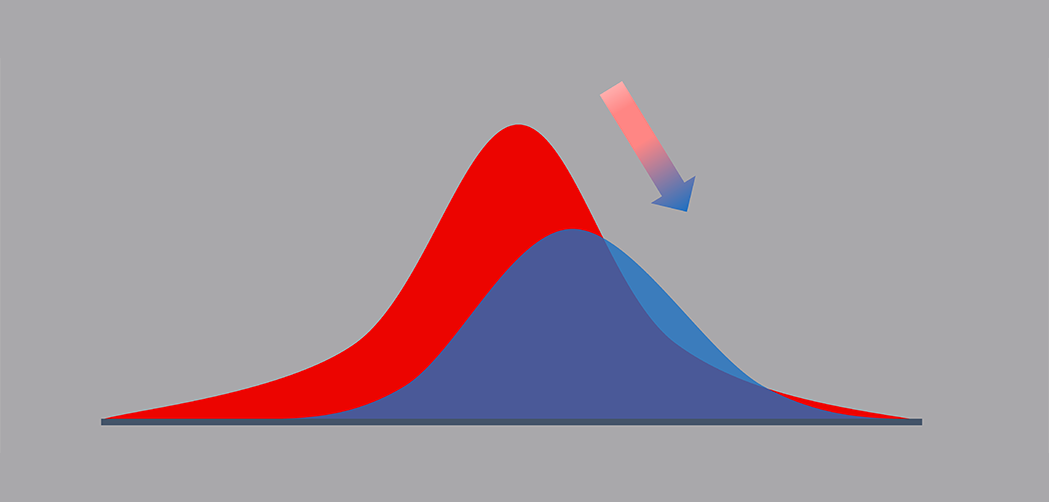
In Illustration 1 below, we can see that distributions of the light blue and dark blue samples (training and test data sets, respectively) are different for the same bin definitions of a feature in the model. This difference in the distribution is what drift quantifies as a percentage of shift.

Illustration 1: Distributions of the training (light blue bars) and the test data (dark blue bars).

Data Drift in Time Series Models

Let’s consider a Promotion Effectiveness Model as an example with four variables:

  • Total Promotion Spends
  • Promotion Duration
  • Product’s Base Price
  • Product’s Promoted Price

These variables drive product sales every month, and data drift is measured at the three major aspects of a time series model, i.e.,

  • Feature Drift
  • Target Drift
  • Lag Drift

Feature Drift 

In Feature Drift, each variable in the training data is compared with the new stream of data that the model uses to make the prediction. The importance of each feature’s variables and Feature Drift (ex: Promotion Duration) can give an idea of the data problems you need to address as a part of model degradation.

Note: Feature-level insights are applicable to all types of machine learning model.

Target Drift 

Target Drift plays an important role in further understanding data issues. It measures how predictions in the new data stream have a different distribution than the trained model’s target variable. Therefore, Target drift indicates how extreme the model predictions can be/are compared to the trained data.

Note: If Target Drift exists despite Feature-level Drift, one can assert that model is under-fitted, and the relationship between the Features(X) and Target(Y) is not robust to making predictions, or that the model is over-fitted to outliers, etc. (The reasons are not exhaustive to the assumptions made above).

Therefore, it is recommended to investigate the model training process and increase the quantity/quality of data entering the model (improve correlation, feature transformations, better stratification, etc.)

Lag Drift

In time series models, auto-correlation is likely to affect the final prediction of the model. Hence, to identify a data pattern change in the lag components, Lag Drift (A direct comparison of the training and test data frame of the model’s lag components) was introduced.

Note: If there is no Feature Drift or Target Drift, but there is Lag Drift, retraining the model with a better data sample is recommended for accurate sales prediction.

Some of the metrics elucidated above can help you set up the capability to monitor the health and degradation of production models and determine the data handling/modeling changes required to implement and sustain ML solutions and automation.

MLOps Principles

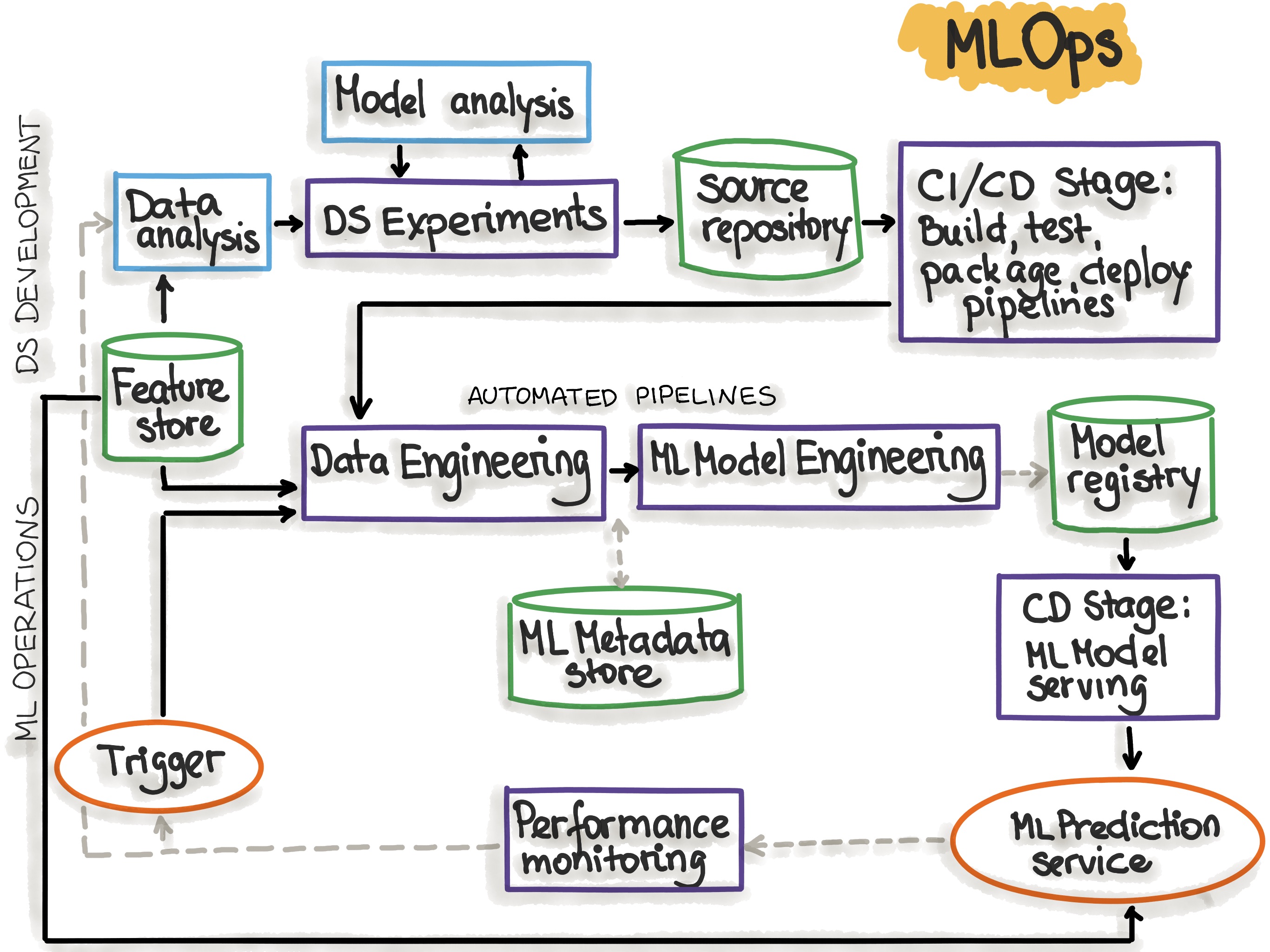
Illustration 2: Functional Flow of the First Step of Automating the ML Solution.

Based on our many years of consulting experience, we have built an enterprise-grade MLOps product called ML Works to address the problems mentioned above and enable ML solutions to take the first step in the MLOps journey.

With the rise of more and more MLOps platforms, the business world is moving towards an inevitable transformation. Today, big players like Google, Microsoft, and Amazon have begun to monetize this space.

As Anteelo’s next-gen industrialized MLOps, ML Works can reduce your Data Scientists’ efforts and lead your organization towards faster and frugal innovations.

8 Digital Transformation Trends to Watch

Digital transformation | Telecommunications Infrastructure Company

As businesses try to adjust to the new normal, many will be looking to technology to help them move forward. Digital transformation trends can give enterprises a competitive advantage but investing wisely means keeping abreast of innovations and up-to-date with trends and developments. To help, here are some of the main digital transformation trends keeping boardrooms excited.

Analytics

How to Utilize Google Analytics to Improve Your Restaurant's Website

Analytics has transformed the decision-making process, providing data and insights that help businesses identify problems, opportunities and solutions. The vast quantities of data available for analysis, including real-time data, means companies which don’t make use of it are at a serious disadvantage. It has applications in all areas of business: procurement, operations, logistics, marketing, communications, security, finance and HR; and with sophisticated analytics tools easily deployable in the cloud, it’s becoming much more widely used.

AI and machine Learning

An Introductory Guide To AI & Machine Learning - Analytics India Magazine

AI and machine learning trends are the ideal partners for data analytics and enable businesses to do much more with their data. They speed up analysis, automate large scale processing in the scalable cloud and remove the bottleneck caused by human analysts. They also learn and adapt from previous analyses while providing results in user-friendly, easily digested, graphical interfaces that non-IT staff can make sense of.

5G

While the consumer generally sees 5G as a way to improve smartphone c

What Is 5G Technology And How Must Businesses Prepare For It?onnections and speed up downloads, the deployment of 5G infrastructure will have a much wider impact that many businesses can benefit from. It will, for example, hasten the development of IoT infrastructures, such as smart cities, intelligent transport networks, smart vehicles and smart industry. At the same time, we’ll see a wider range of connected devices, making it easier for businesses to take advantage of the IoT and the valuable data it generates.

Wi-Fi 6

What's the Status of Wi-Fi 6?

The next generation of wi-fi, known as both Wi-Fi 6 and AX Wi-Fi, provides up to three times faster processing and wireless connection speeds. Even better, it enables networks to handle far more connected devices, which is helpful considering the proliferation in wi-fi enabled gadgets being used in the workplace and the increasing amounts of data they send and receive.

Blockchain

What the Future of Blockchain Means for Entrepreneurs

Although it’s often associated with cryptocurrencies, blockchain has many valuable uses in businesses, such as tracking the origin and movement of goods in the supply chain and providing financial audit trails. It has applications in healthcare, real-estate, media, energy and local government and can be used for a wide range of purposes.

The reason for its increased use lies in the number of service providers, including Amazon, Microsoft and IBM, who are developing subscription-based ‘blockchain-as-a-service’ platforms and thus making it easier for businesses to put it to good use.

Robotics and automation

How Similar are Automation and Robotics? - The Official 360logica Blog

There is a historical pattern of businesses shifting towards automation in response to a recession. Following the 2008 crash, for example, 25% of supermarket checkout assistants in the UK were replaced by automated self-service checkouts. The crisis following the 2020 pandemic is likely to see the pattern repeated, however, with more advanced robotic processes and AI interfaces available, more skilled workers could see the brunt of redundancies. Where roles aren’t completely replaced, workloads may be reduced, enabling existing staff to be upskilled.

Connected transport

Connected Vehicles | Metropolitan Transportation Commission

Although this is only happening on a small scale at the moment, automated and remote-controlled transport is already taking place. Drones are being used to ship medicines to remote Scottish islands, restaurants and supermarkets have been using automated robots, developed by a Cambridge company, to make local deliveries during the lockdown and the UK coastguard has just announced plans to use drones to assist with coastal searches.

Expect to see these technologies becoming more widely available and, thanks to 5G, being put to uses in more places. Many businesses can take advantage of these technologies, helping them deliver products and services quicker and without the need for a third-party delivery company.

Customer experience

6 Customer Experience Trends That Will Drive Growth for Your B2B SaaS Company, Tips, Guide | CommBox

According to a survey by Adobe, senior executives see customer experience as a bigger priority than investment in new products and services as it offers significantly more opportunities for growth. The key areas where development will take place are in omnichannel shopping, personalisation and frictionless payment, with technologies like data analytics and AI providing the insights needed to deploy these in the way that customers will appreciate.

By enhancing the customer experience, brands can develop both loyalty and trust. As a result, customers will engage more, share their needs and give feedback, enabling companies to develop their products and services in response.

Conclusion

Digital transformation not only affects all sectors; it also has an impact on all aspects of a company’s operations. Those that adopt and utilise the technologies mentioned here can reap the enormous benefits they offer. Being able to make use of these technologies, however, requires companies to make use of the cloud, as it is here where they are most easily and affordably accessible.

Android Architecture Components: Exploring

At Google I/O 2017, Google introduced new architecture components for Android. It is a new library which will help developers to maintain their activities or fragments lifecycle very easily.

This new library by Google provides some relief to the Android Developers by providing a complete solution to problems like memory leaks, data persistence during configuration changes and also helps in reducing some boilerplate code.

Exploring the new Android Architecture Components (Part 1) | Humble Bits

There are 4 Android Architecture Components :

  1. Lifecycle
  2. LiveData
  3. ViewModel
  4. Room

LiveData Clean Code using MVVM and Android Architecture Components | by Rohit Singh | AndroidPub | Medium

Lifecycle

Lifecycle class helps us in building lifecycle aware components. It is a class which holds all the information about the states of an activity or a fragment. It allows other objects to observe lifecycle states like a resume, pause etc.

There are 2 main methods in the Lifecycle class:

  1. addObserver() – Using this method, we can add a new instance of a “LifecyleObserver” class which will be notified whenever our “LifecycleOwner” changes state. For example: if an activity or a fragment is in RESUMED state then our “LifecycleObserver” will receive the ON_RESUME event.
  2. removeObserver() – This method is used for removing active “LifecycleObserver” from the observer’s list.

LifecycleObserver

With the help of this interface, we can create our Observer class which will observe the states of an activity or a fragment. We need to simply implement this “LifecycleObserver” interface.

LifecycleOwner

It is an interface with a single method called “getLifecycle()”. This method must be implemented by all the classes which are implementing this interface. This interface denotes that this component (an activity or a fragment) has a lifecycle.

Any class whose states we want to listen must implement the “LifecycleRegistryOwner” interface. And any class who wants to listen must implement the “LifecycleObserver” interface.

There are several events which we can listen with the help of the “LifecycleObserver” interface:

  • ON_CREATE – Will be called after onCreate() method of the “LifecycleOwner”.
  • ON_START – Will be called after onStart() method of the “LifecycleOwner”.
  • ON_RESUME -Will be called after onResume() method of the “LifecycleOwner”.
  • ON_PAUSE – Will be triggered upon the “LifecycleOwner” being paused (before onPause() method).
  • ON_STOP – Will be triggered upon the “LifecycleOwner” being stopped (before onStop() method).
  • ON_DESTROY – Will be triggered by the “LifecycleOwner” being destroyed (before onDestroy() method).

All these events are enough for managing the lifecycle of our views. With the help of these  “LifecycleObserver” and “LifecycleOwner” classes, there is no need to write methods like onResume(), onPause() etc in our activities or fragments. We can handle these methods in our observer class.

We can also get the current state of the “Lifecycle Owner” with the help of getCurrentState() method.

LiveData

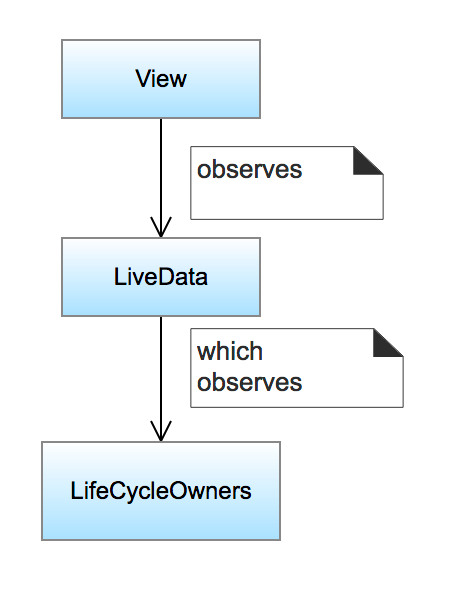
LiveData is a data holder class. It provides us the ability to hold a value and we can observe this value across lifecycle changes.

Yeah, you heard that right!

LiveData handles the lifecycle of app components automatically. We only need to observe this LiveData class in our components. That’s it and we are done.

There are some important methods of LiveData:-

  • onActive() – Called when there is an active observer. An observer is called active observer when its lifecycle state is either STARTED or RESUMED and the number of active observers changes from 0 to 1.
  • onInactive() – Called when there are no active observers. An observer is called inactive observer when its lifecycle state is neither STARTED nor RESUMED (like an activity in the back stack) and the number of active observers changes from 1 to 0.
  • setValue() – Used to dispatch the results to the active observers. This method must be called from the main thread.

In above method observe() we pass the Lifecycle Owner as an argument, this argument denotes that LocationHelperLiveData class should be bound to the Lifecycle of the MyActivity class. This bounding relationship of helper class with our Activity denotes that:-

  • Even if the value changes, the observer will not be called if the Lifecycle is not in an active state (STARTED or RESUMED).
  • The observer will be removed automatically if the Lifecycle is destroyed.

Whenever MyActivity is in either PAUSE or STOP state it will not receive location data. It will start receiving Location Data again once MyActivity is in either RESUME or START state.

There can be multiple Activities or Fragments which can observe LocationHelperLiveData instance and our LiveData class will manage their Lifecycle automatically.

There is no need to remove observer in onDestroy() method, it will be removed automatically once LifecycleOwner is destroyed.

How the Iot is Shaping modern Business in the 21st Century

Five ways the Internet of Things is transforming businesses today | Internet of Business

The world is getting smarter. Every day, devices and modern technologies that were once standalone are getting connected to the internet. From robots to running shoes, these smart devices contain sensors that allow them to be monitored and controlled remotely and to gather large quantities of data. Collectively known as the Internet of Things (IoT) these devices are transforming modern business. Here, we’ll take a look at how.

What is IoT?

How IoT is Transforming Business and the Best Ways of Keeping it Secure

The IoT is a system that comprises the smart devices deployed by companies, together with the infrastructure and applications needed to connect, monitor and control them and to gather and analyse the data they generate.

In most cases, IoT systems are automated so that processes can be done with little or no human intervention. This often requires the use of cloud-based technologies, such as real-time analytics, artificial intelligence and machine learning. By adopting such modern technologies, highly complex operational processes can work smoothly while employee involvement can be radically reduced.

Today, IoT systems are used everywhere. Domestically, they are used by consumers to manage their homes: controlling lighting, heating, security cameras, etc., via their phones and smart speakers. Businesses and other organisations use them for a much wider range of purposes: logistics management, server monitoring, remote automation, personalisation, energy management, remote workforce monitoring and much more.

Here are some of the main ways the IoT is having an impact.

Inventory management

IoT-driven Inventory Management: A Quick Guide

Inventory management is traditionally a time-consuming, labour-intensive process. The complexities of managing inventory mean data is rarely accurate or up-to-date and this often causes difficulties with procurement and order fulfilment.

Today, goods are labelled with RFID or Bluetooth tags and these are scanned automatically by IoT-connected scanners on entry to and exit from the warehouse and during transit. The scanners don’t just calculate stock levels, they also record the item’s location (making it easier to deploy warehouse robots, like Amazon) and the dates and times of movement.

Companies which use this modern technology always have accurate, real-time data about stock levels and can quickly find products in the warehouse. What’s more, the system can report issues with stock shortages, shelf-life, temperature control, travel delays and even flag potential theft from staff. On top of this, the company can be notified which stock items are in short supply and those which aren’t being sold, helping them make better decisions about procurement, product choice and pricing while ensuring that accurate fulfilment details are available.

Customer experience

Develop a Fruitful Customer Experience Plan – WebBasta – INSIGHTs

The customer experience is a critical element of the modern marketing strategy, with companies going all out to satisfy the ever-increasing expectations of the consumer. Those that succeed benefit from enhanced brand loyalty and significantly increased customer lifetime value.

IoT plays a key role in enhancing the customer experience as devices are used to gather customer information from every available touchpoint. Data from mobile apps, social media interactions, home devices, customer communications, website browsing and sales histories are unified to glean insights that provide personalised customer experiences which meet the needs of the user.

Productivity

27 Ways to Increase Employee Productivity in the Workplace

Sensors built into devices gather data that help companies drive up productivity in all areas. From production line processes to shipping delivery routes, operations and tasks can be completed quicker, more effectively and more cost-efficiently. Employee workloads are also reduced and the potential for automation is increased, enabling companies to reduce staffing levels or increase production.

Remote work and operations

Sudden Remote Work: The Ultimate Checklist to Maintain Operations on this COVID-19 Crisis - The Missing Report

IoT enables organisations to undertake remote working at levels previously inconceivable. An example which perhaps illustrates this best is the da Vinci robotic system, used by surgeons to carry out remote operations on patients. The surgeon views the patient in real-time while the connected robot holds the instruments and mimics their hand movements. Another advanced example is the real-time monitoring of aircraft engines during flight which enables specialised technicians to remotely deal with any issues that may arise.

On a less advanced level, IoT technology helps owners run their businesses or operations from anywhere in the world. During the lockdown, numerous companies have relied upon remotely connected devices to help employees work from home. Businesses that work on the go, such as plumbers, electricians, broadband installers, delivery drivers, etc., have been using IoT devices for a long time, helping them maintain schedules, track productivity, order and collect equipment and parts, obtain customer signatures and so forth.

Data-driven insights

How data-driven insights can transform your business

IoT technology enables far more data to be gathered. That data can be analysed using advanced analytics programs, together with AI and machine learning, to provide previously unobtainable insights into the business. These can be used to improve efficiency, productivity, marketing and communications strategies; to predict market movements and forecast supply and demand; and to monitor machine health and improve security. When data is gathered from devices used by customers, the insights can be used to develop better products, offer better services and better meet the customer’s needs and expectations.

Conclusion

With so many connected devices for businesses to deploy, and with the infrastructure needed to make use of the IoT readily available in the cloud, IoT adoption is becoming increasingly popular amongst the business community. Its potential to bring improvements across so many areas of business operations is making it a technology hard for business owners to ignore, regardless of the industry they work in.

Google’s Fuchsia OS, why?

Talk about innovation and you’ll see Google at its forefront. This time Google is working to replace its existing operating system called Android. Google is working on its next OS after Android and Chrome which is called Fuchsia. Fuchsia is an open-source, real-time operating system. Earlier the OS was introduced only with commands but now they have created a new crazy UI called Armadillo.
Google Fuchsia OS: What's the story so far?

Fuchsia is not a Linux based OS like Android and Chrome. Android is primarily designed for smartphones and touchscreen phones. Fuchsia has focused on voice control and AI. It is designed to better accommodate voice interactions across devices. It has extremely fast processors and uses non-trivial amounts of RAM.

There are mainly two reasons why Google is working on a new operating system-

  1. Unlike Android and Chrome OS, Fuchsia is not based on Linux—it uses a new, Google-developed microkernel called “Zircon.” With Fuchsia, Google would not only be dumping the Linux kernel, but also the GPL: the OS is licensed under a mix of BSD 3 clause, MIT, and Apache 2.0
  2. People love to write cross-platform frameworks for two reasons: First, they want to run their apps to run on both platforms without doubling the effort. And second, because Android programming is still so painful even after the Kotlin.

About Fuchsia

  1. Fuchsia is based on newly developed microkernel called Zircon. The microkernel is basically a stripped down version of a traditional kernel (the core of an operating system that controls a computer’s underlying hardware).
  2. Fuchsia, is partially written in Dart which is an open source programming language developed by Google itself. Dart compiles to JavaScript.
  3. The fuchsia interface is written in Flutter SDK which is cross-platform and is also developed by Google.
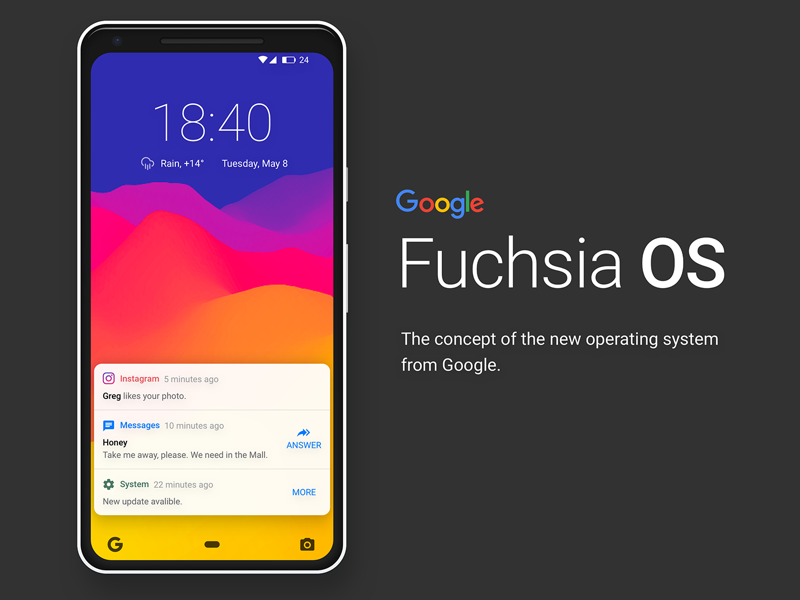
  4. Fuchsia has a new UI called Armadillo that has a different home screen containing a home button, a keyboard, and a window manager. It supports vertical scroll system where the user can adjust other icons like battery, profile picture, weather report and so on accordingly.
  5. A user can also adjust the apps which are shown in the cards on the basis of how frequently or recently he/she is using the app.
  6. Armadillo can run on iOS and Android platform or any other platform that flutter supports easily.
  7. Google hasn’t made any public, official comments on why Fuchsia exists or what it is for but as per their documentation it will overcome all the shortcomings of the previous operating systems and will provide the high performance which is not possible to implement in the existing operating system (Android).
  8. The Fuchsia interface is written in Flutter SDK which generates cross-platform code that runs on Android and iOS.

Armadillo- The Fuchsia System Interface

Is Fuchsia OS the next Android? - Dignited

  1. Earlier, Fuchsia was based on commands but later its interface is designed in the language called Armadillo by Google which is pretty interesting now.
  2. According to the picture of its UI- here is the description of how things will work in case of Fuchsia.

The center profile picture is a clickable area that will open the menu which is similar to Android Quick Settings. Battery and connectivity icon will be shown on the top bar. There is also a horizontal slider for brightness and volume and also icons for do not disturb, auto rotate and airplane mode.

The bottom ‘Google Now’ panel will bring up a keyboard which is not the Android keyboard but instead it’s a custom Fuchsia keyboard which has the dark new theme. Fuchsia keyboard functions are different from Android keyboard.

Summary

So Fuchsia is a brand new Google project which may be the answer to “How we will start writing Android again if we need to end the era of earlier stable OS”.

The biggest challenge to bring the brand new OS might not be developing the new OS but the risk in the transition idea from the world’s most popular Android Operating system to the new one. We can not say anything about the future of the Fuchsia. It can be successfully launched to the consumers by 2020 as quoted by some source or can be entirely trashed by Google before it sees the light of the day.
error: Content is protected !!